
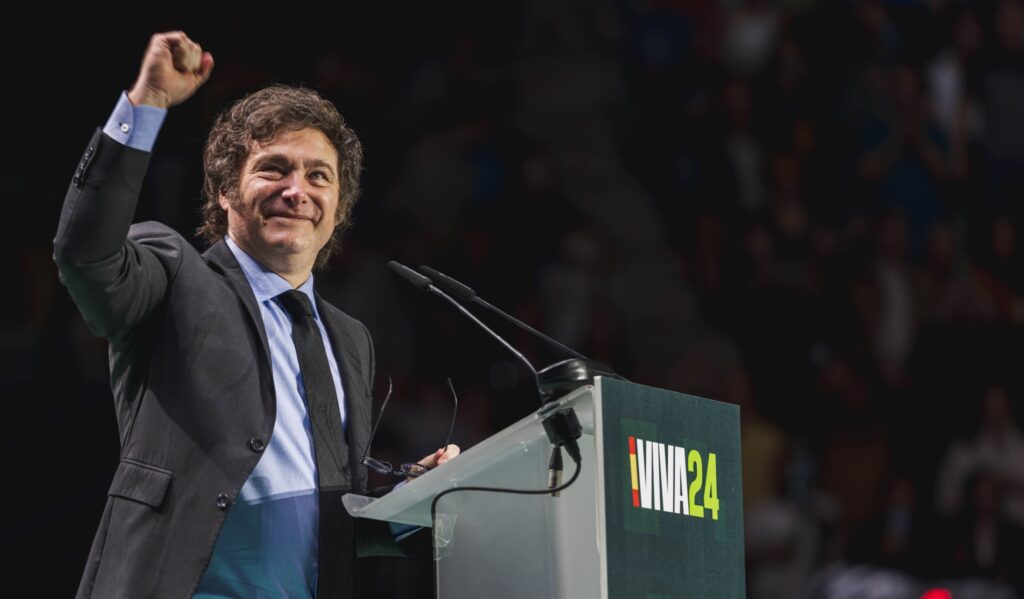
Javier Milei, President of Argentina, is driving pro-mining reforms and positioning Argentina as a key hub for Western supply chains
- Argentina’s mining exports hit record US$6.037 billion in 2025, up 29.2% yoy with gold the biggest contributor
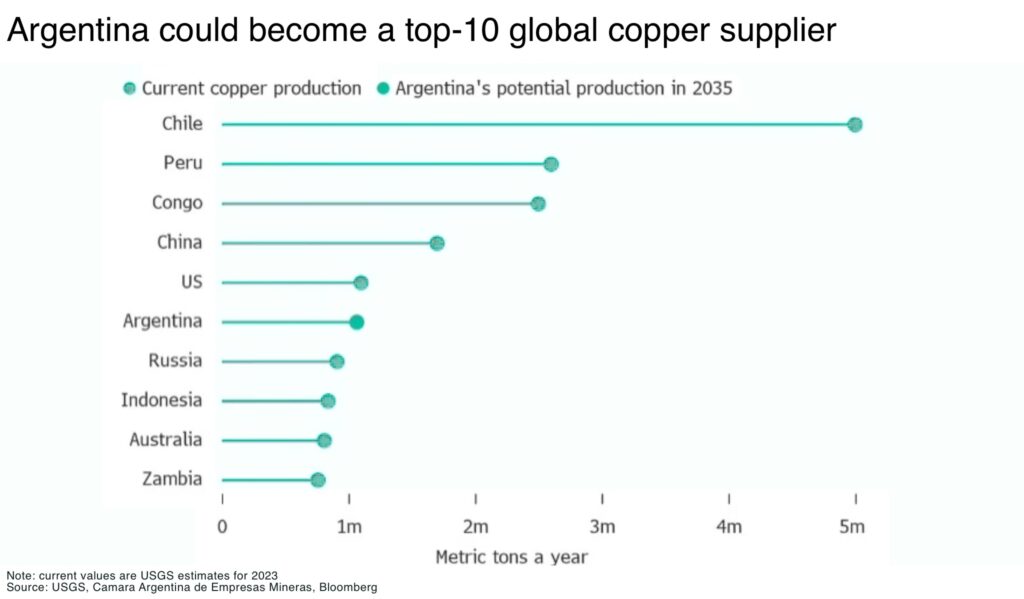
- potential to be 6th largest copper producer in world by 2035, from no copper production today
- the country is the world’s third-largest reserves and is the fourth-largest producer of lithium
- Argentina’s RIGI regime offers long-dated tax, customs and legal stability benefits for large projects
Argentina’s mining exports totaled a record US$6.037 billion in 2025, up 29.2% year-over-year, driven, in particular, by gold’s 65% price surge — its best performance in nearly half a century.
- Gold: US$4.078 billion (record, 67.5%)
- Lithium: US$905 million (record, 15%)
- Silver: US$870 million (14.4%)
- other minerals: US$184 million (3%)
Argentina has long held world-class mining potential, but historically underexploited its mining potential. This is now at an historic turning point, with a new regulatory framework driven by President Javier Milei against a stronger global conditions helping to unlock major investment as the US (and wider West) seek to secure mineral supply chain, especially with the conflict in the Middle East and Russia.
Not only is Argentina’s mining sector becoming a broader mining jurisdiction (after being heavily lithium-led since approx 2021), but this growth significantly outpaces that of most other established mining countries:
Global mining export and production performance (2025)
| Country | 2025 Performance |
| Argentina | +29.2% mining exports to US$6.037B record |
| USA | +5.6% value of mineral production to US$112B |
| Canada | +2.6% total exports in 2025 |
| Peru | +28% mining exports to US$61.849B record |
| Chile | +12.6% mining exports to US$63.25B record |
| Australia | -0.6% resource and energy export earnings forecast to A$383B in 2025–26 |
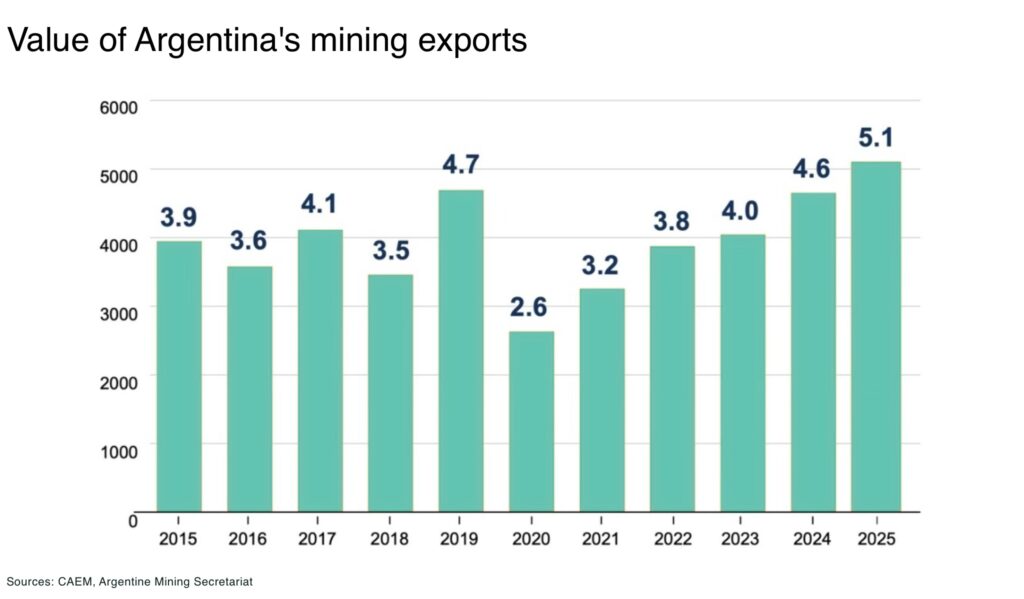
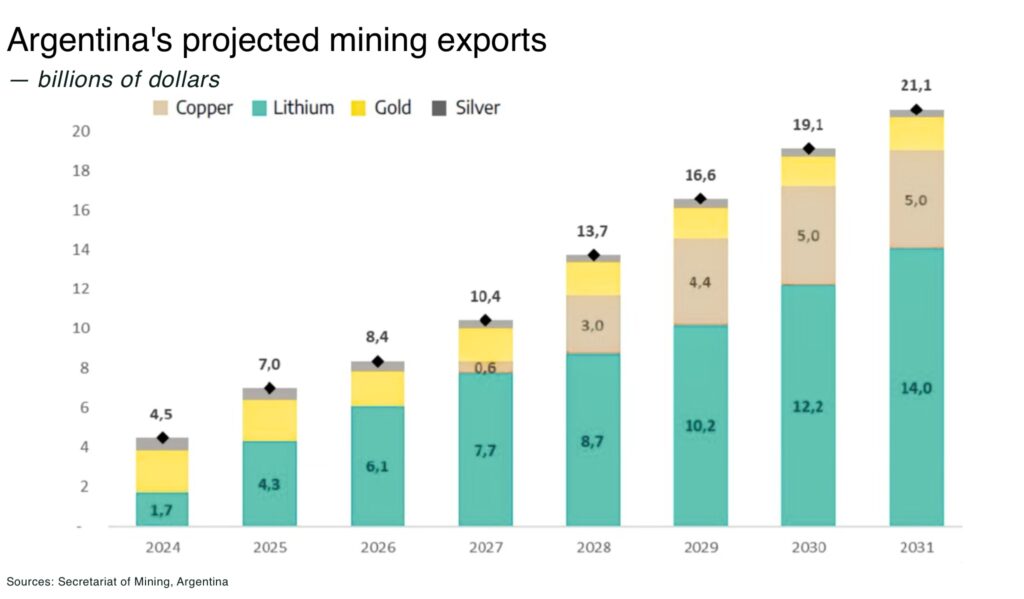
And, Argentina’s momentum is expected to continue with further major projects and policy reforms in the pipeline, including major copper, lithium and gold projects. Some estimates forecast Argentina’s total mining exports could reach US$100 billion, with the industry contributing between US$20-30 billion by the end of the next decade.
To highlight Argentina’s return as an important player in the global mining sector, in February 2026, the US and Argentina signed an agreement on critical minerals to strengthen and secure supply chains.
Argentina’s chainsaws and shovels
Argentina is arguably best know for its president, the chainsaw-wielding Javier Milei, who came to power two years ago promising to slash government spending and regulation — and has (so far) succeeded to taming inflation and achieved the country’s first surplus in 14 years — with projections the economy grew more than 5% in 2025.
Argentina is also rich in resources, in particular, lithium, copper, gold and uranium, all highly sought after as global powers work to secure supply.
Argentina’s major mineral resources and reserves (2024)
| Mineral | Resources | Reserves | Unit |
| Lithium | 197,9 | 18,6 | Million tonnes of LCE |
| Copper | 116,0 | 17,1 | Million tonnes |
| Gold | 138,4 | 33,6 | Million ounces |
| Silver | 3.839,5 | 492,7 | Million ounces |
| Uranium | 36.483 | Tonnes |
For the country’s mining industry, the most important change has been across the investment and regulation regulations.
In particular, the Milei government is using RIGI (the Incentive Regime for Large Investments) to attract large-scale capitall; it is officially described as offering “significant tax, customs and exchange benefits, while establishing a solid legal framework to guarantee legal certainty and facilitate the realization of long-term investment projects.” Since the launch of RIGI, mining projects representing an estimated US$33 billion in investment have been committed in the country.
In February 2026, Argentina’s Senate also approved a new bill would allow governors, many pro-mining, to overrule federal protections on glaciers and their surrounds, which could allow up to US$40billion in investment copper mines investment. The reform will now move to the lower house for a vote.
This matters, because Argentina’s mining problem was rarely geology, but, instead, was above-ground friction: currency controls, import bottlenecks, tax drag, and uncertainty over getting capital in and out. In the confidence game, Milei wants to rebuild trust with foreign capital.
Argentina, beyond lithium
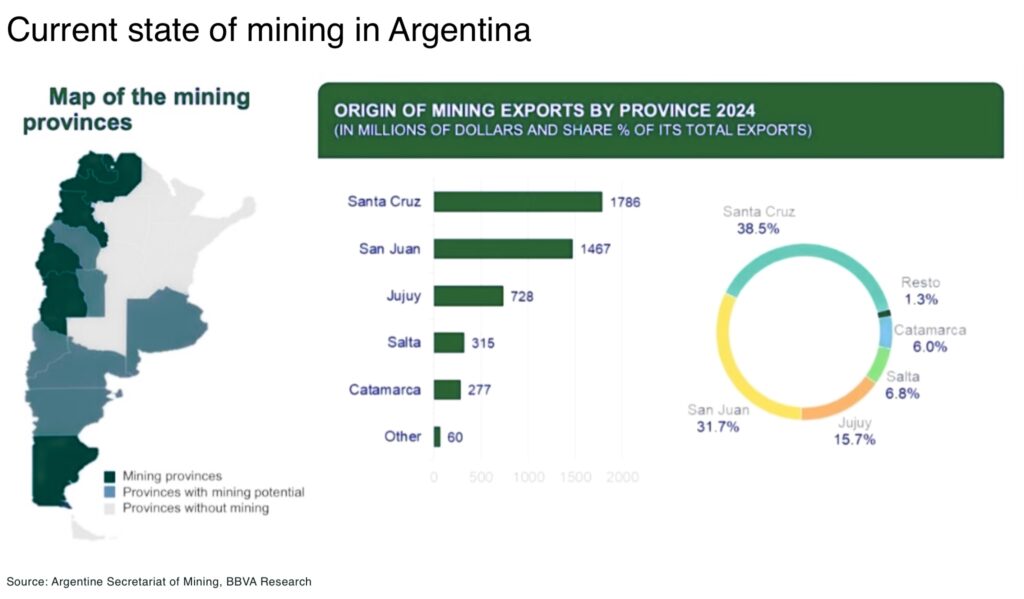
Since, approx 2021, Argentina has been framed primarily as a lithium exporter, as it positioned itself into the electric vehicle and electric battery supply chain scramble.
But that framework is increasingly too narrow.
Copper
Argentina has not produced copper since the closure of the La Alumbrera mine in 2018, but its copper deposits are concentrated in the northern province of San Juan, right nextdoor to Chile, the world’s top copper exporter.
Now, Argentina wants a slice of that pie.
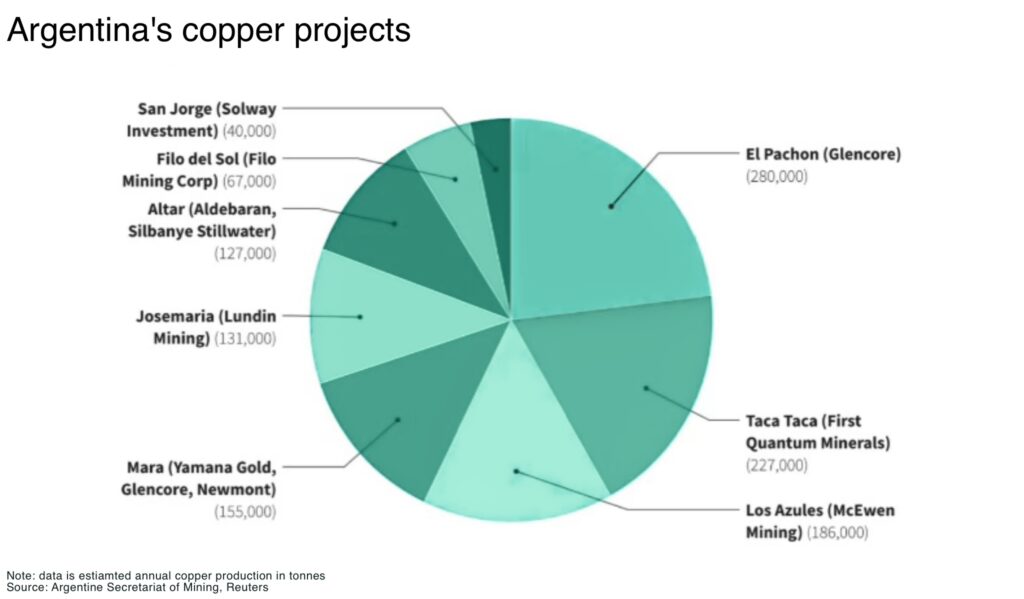
Today, Argentina’s mining portfolio is worth US$30B and contains 100-plus projects, more than half of which are copper-focused, according to the International Trade Administration (ITA). Argentina’s copper pipeline means the country has the potential to become one of the world’s most important copper producers. Estimates suggests that seven major projects (of the more than twenty in consideration) could produce 2 million tonnes of copper annually within ten years. This would bring the country’s total mining export value to US$15.4 billion by 2030, more than tripling 2024’s figure.
Projects include Los Azules, Taca Taca, El Pachón, as well as the recently announced Vicuña Project.
Lithium
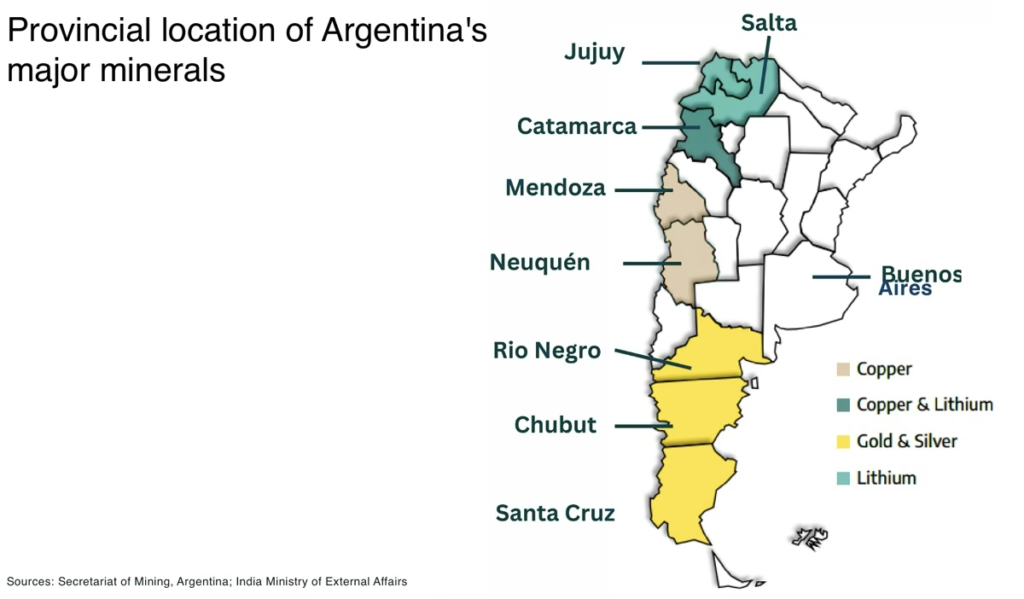
Argentina is home to the world’s third-largest reserves and is the fourth-largest producer of lithium. The country’s lithium reserves are primarily found in salt flats (salares) in the north-west provinces of Salta, Jujuy, and Catamarca — part of the “Lithium Triangle” (along with Chile and Bolivia), which concentrates more than half of the world’s brine reserves.
Currently, there are six lithium projects in production in Argentina, and more under construction, with major players include Lithium Americas, Lake Resources, Rio Tinto, and POSCO, among a variety of PRC companies.
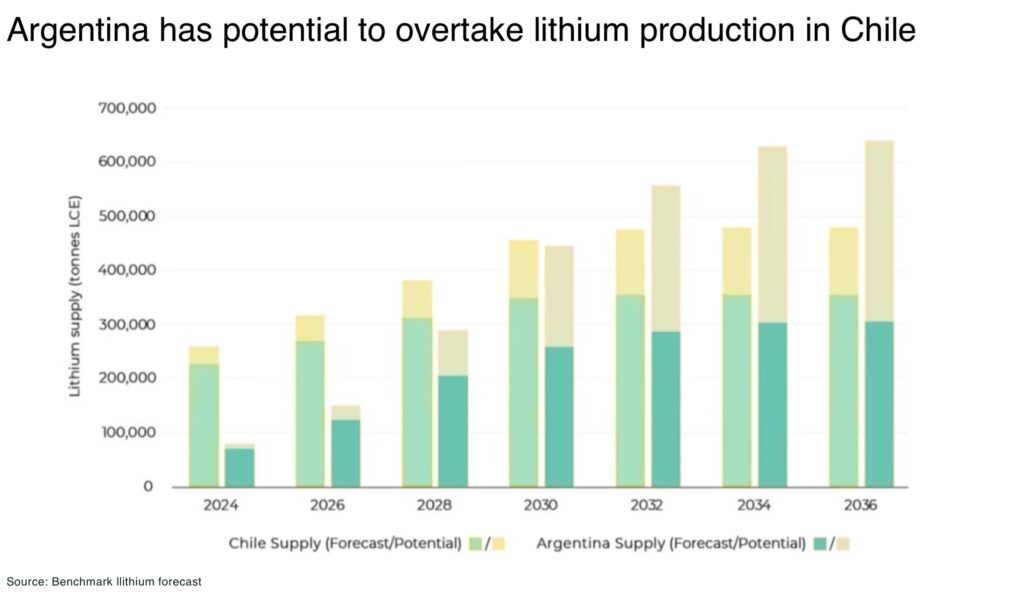
According to Benchmark’s Lithium Forecast, Argentina’s lithium production is set to increase 340% between 2024-2035, compared to the 56% growth forecast for Chile.
For example, in March 2026, Australia mining major, Rio Tinto, announced it had secured a US$1.175 billion financing package from four international lenders to support development of its Rincon lithium project, targeting annual production of about 60,000 tonnes of battery-grade lithium carbonate.
Gold and silver
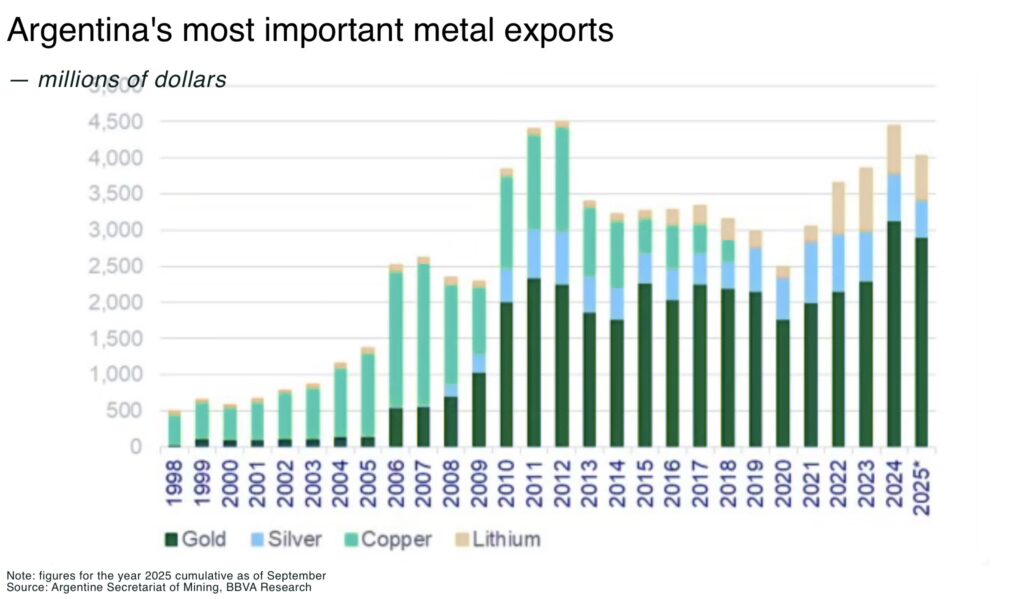
Gold remains Argentina’s biggest mining export, worth an estimated US$3.14 billion and representing 68% of total mining exports in 2024 (70% including silver exports) — and, in 2025, the country’s record mining exports were again led by gold.
The country ranked 21st as a gold producer globally in 2023, however, gold production itself has seen declines from its peak of 63,138 kg in 2010, hovering around 41,000 kg in 2023, due mostly to the natural maturation of the country’s major deposits.
With such an important role in the country’s cashflow, the country is eager to bring on more gold developments. For example, the RIGI tax break scheme committee approved a US$665 million gold and silver mining project in the western San Juan province in December 2025 (the tenth project to be approved under the scheme).
The broadening development pipeline for other metal mining projects in Argentina also helps gold mining in the country. Copper and lithium may be drawing the headlines and capex, but gold benefits from the same shift in investor attention, improved provincial capacity, as well as expansion of infrastructure (including roads, power, camps, contractors, etc).
Much of the international attention on Argentina is focused on the potential for copper and lithium expansion. But, the country’s gold mines are where Argentina already has operating credibility. For example:
- Barrick and Shandong’s Veladero mine in San Juan produced 504,000 ounces in 2024, and the partners are seeking a US$400 million RIGI-backed expansion expected to add 1.6 million ounces over the mine’s life
- in August 2025, Gualcamayo was pursuing a US$665 million redevelopment under RIGI, targeting 120,000 ounces per year from 2029 over a 17-year mine life
- in February 2026, Newmont announced they plan to invest US$800 million in Cerro Negro, one of Argentina’s flagship gold mines in Santa Cruz.
This is not the profile of a fading gold jurisdiction, but instead where old districts are being extended and re-rated as the local and global macro backdrop improves.
Astra Exploration: an early-stage play in Argentina’s gold rerating
Astra Exploration (TSX.V: ASTR | OTCQB: ATEPF) is drilling at La Manchuria, an at-surface high-grade gold-silver epithermal system in Santa Cruz, where Astra has an option to acquire a 90% interest. The project is located in the Deseado Massif— one of the most prolific epithermal gold-silver regions in the world that hosts world-class deposits including Newmont’s Cerro Negro and AngloGold Ashanti’s Cerro Vanguardia, both world-class mines.
If the established names show that Argentina already has gold mining credibility, Astra Exploration points to where the next leg of upside could come from: early-stage discovery.
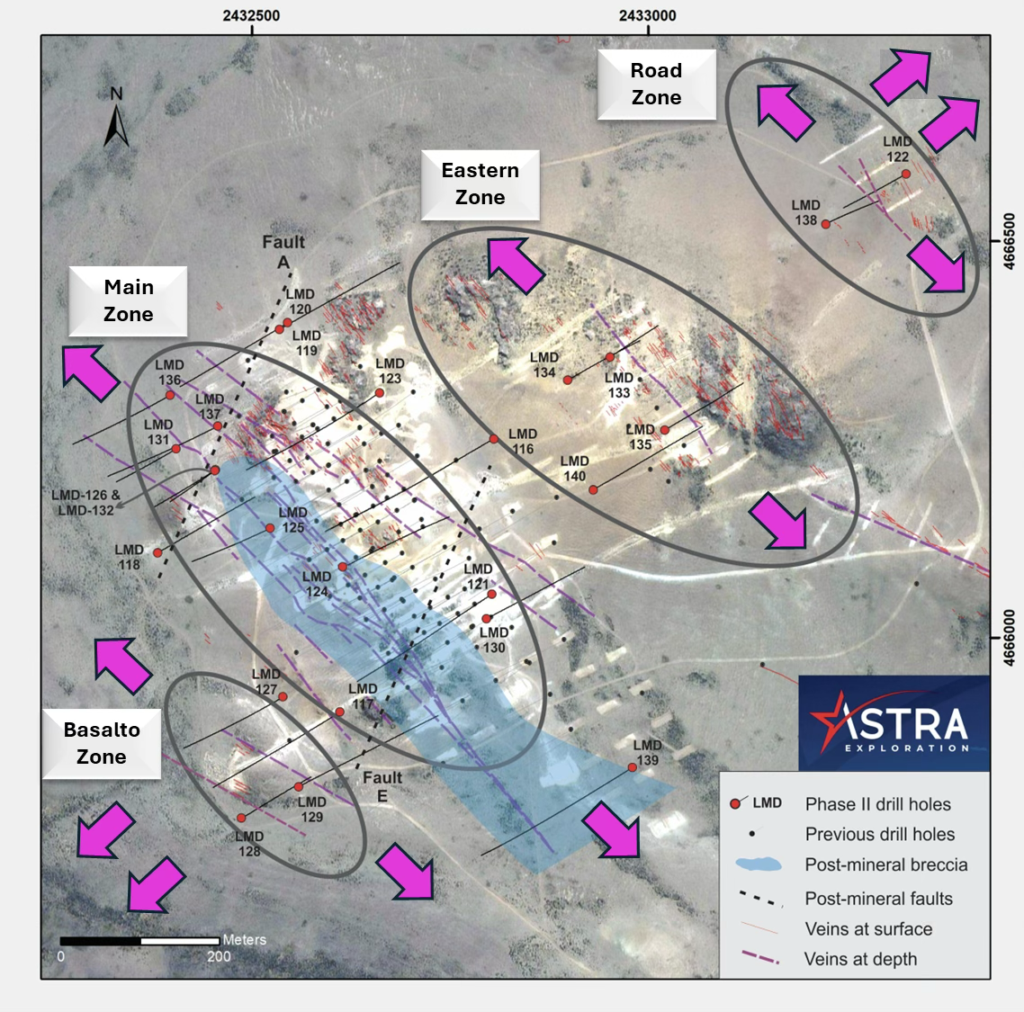
In its latest results, Astra reported multiple high-grade veins of key importance extended along strike and open in all directions, in particular, with 0.5 metres grading 2,371 g/t silver and 11.09 g/t gold from hole LMD-130. This is a possible extension of the Argentum Vein roughly 220 metres along strike to the southeast of the Phase I hole that returned 1.4 metres grading 35.3 g/t gold and 8,356 g/t silver. The same batch also extended the West Feeder in both directions, with intercepts including:
- 0.5 metres of 469.4 g/t silver and 6.61 g/t gold
- 0.6 metres of 255.3 g/t silver and 5.96 g/t gold
- 0.5 metres of 612 g/t silver and 1.48 g/t gold
This matters because Astra says these are key high-grade structures within the Main Zone that appear to be converging with depth, sharpening the feeder-zone thesis that underpins the Cerro Negro comparison.
The company remains fully funded for a minimum 5,000-metre follow-up program expected to start in April.
This matters because the market often rerates this type of story quickly once the geology, the tape and the country backdrop start lining up at the same time.
Astra describes La Manchuria as a “direct analogue” for Cerro Negro and says the target is a high-grade deposit exceeding 2 million ounces, while also explicitly cautioning that analogies are for geological context only and do not imply similar mineral content or economic value. That is the right way to frame it. The comparison is not that La Manchuria is Cerro Negro already. It is that Santa Cruz has produced this kind of discovery before, and Astra believes it is drilling into the right kind of system again.
AbraSilver showed how quickly Argentina’s market can wake up to a disciplined precious-metals story once the macro, politics and metals tape turn supportive. Astra may be far earlier-stage, but La Manchuria offers exposure to the same broader rerating dynamic: a high-grade Santa Cruz system, in a better Argentine market, with room to grow.
What are the risks?
There are, of course, still risks:
- Politics: Javier Milei has driven much of Argentina’s renewed mining momentum, improving both the regulatory backdrop and the broader economic story. But opposition remains entrenched, even if his landslide victory in the 2025 midterms showed how much appetite there is for change.
- Regulation: Environmental and permitting risk, especially in the Andes, remains a live issue. The glacier law reforms aimed at unlocking more copper investment may have cleared the Senate, but the backlash from environmental groups is a reminder that reform will not move uncontested
Conclusion
The opportunity in Argentina is the pivot as country risk falls significantly just as the metals cycle turns, exposing investors to a reformed jurisdiction with early-stage development potential — a dynamic that has been supercharged by escalating conflict in the Middle East and renewed anxiety over traditional energy and shipping routes.
Gold remains the country’s most important mining export, with capital returning to flagship mines and provinces with long mining histories getting reappraised. Just as copper and lithium pull in infrastructure and political attention, gold may end up as one of the biggest quiet beneficiaries of the entire shift.
That is why the Argentina mining opportunity matters now. And that is why, despite all the noise around copper and lithium, gold may still be the cleanest way to play it.