What are gallium and germanium?
Gallium and germanium are strategic minor metals used in semiconductors, communications, defence, aerospace and advanced optical systems.
Gallium (Ga), atomic number 31, is a soft, silvery metal with a melting point of approximately 29.8°C—low enough to melt in a person’s hand. It is mainly recovered as a by-product of processing bauxite for aluminium, with smaller quantities obtained from zinc-bearing materials.
Germanium (Ge), atomic number 32, is a hard, brittle, greyish-white metalloid with semiconductor and infrared-transmission properties. It is primarily recovered during zinc processing and from selected coal-related materials.
Neither element is generally mined on its own. Their low concentrations and status as by-products make supply dependent on larger aluminium, zinc and coal-processing industries.
Gallium takes its name from Gallia, the Latin name for France. Germanium was named after Germany following its discovery in the nineteenth century.
Today, both are classified as critical minerals in several major economies because they support strategically important technologies and have highly concentrated supply chains.
Why gallium and germanium matter
Gallium and germanium are grouped together because both are used in advanced technologies and face similar supply-security concerns. They are not interchangeable, however, and their largest applications are different.
Gallium is particularly important in compound semiconductors, radio-frequency communications, LEDs and power electronics.
Germanium is primarily associated with fibre-optic communications, infrared optics, specialised semiconductors and high-efficiency solar cells.
In both markets, small quantities of material can support products with significant economic or strategic value.
Gallium semiconductors and electronics
Most electronic applications do not use gallium as a pure metal. Instead, it is combined with other elements to produce compound semiconductor materials.
The most important include gallium arsenide, gallium nitride and gallium phosphide.
Gallium arsenide
Gallium arsenide, or GaAs, can process high-frequency signals efficiently and operate in applications where conventional silicon may not deliver the required performance.
It is used in:
- smartphone radio-frequency components
- satellite communications
- radar systems
- wireless infrastructure
- laser diodes
- photodetectors
- specialised integrated circuits
- high-efficiency solar cells
GaAs is more expensive to manufacture than silicon and is generally reserved for applications where speed, frequency, efficiency or resistance to radiation justifies the additional cost.
Gallium nitride
Gallium nitride, or GaN, can operate at high voltages, frequencies and temperatures. It enables smaller and more efficient power-conversion systems than conventional silicon in selected applications.
GaN is used in:
- fast chargers and power adapters
- data-centre power supplies
- telecommunications equipment
- electric-vehicle power electronics
- radar
- satellite systems
- LEDs and laser devices
- industrial power systems
The growth of AI computing, data centres and electrification could support GaN demand because electricity must be converted and controlled efficiently throughout these systems.
GaN competes with silicon and silicon carbide. The preferred material depends on voltage, power, cost, reliability and system design.
LEDs and optoelectronics
Gallium compounds are widely used in light-emitting diodes, laser diodes, photodetectors and other devices that generate or detect light.
These components are found in lighting, displays, communications, sensing equipment, industrial systems and consumer electronics.
The amount of gallium in an individual component can be small. However, the scale of electronics manufacturing and the importance of these components give gallium strategic significance.
Germanium in fibre-optic communications
Germanium compounds are used in the glass core of some optical fibres, where they help control how light travels through the cable.
Fibre-optic networks carry data across:
- telecommunications systems
- broadband networks
- data centres
- subsea cables
- industrial networks
- defence communications
Expansion of cloud computing, AI infrastructure and high-speed communications can therefore influence germanium demand.
Germanium is only one input into the fibre-optic value chain. Demand also depends on network investment, fibre design, manufacturing efficiency and the amount of material recovered during production.
Germanium in infrared optics
Germanium transmits parts of the infrared spectrum that ordinary glass does not. This makes it useful in lenses and windows for thermal-imaging systems.
Applications include:
- night-vision equipment
- surveillance systems
- missile guidance
- border and infrastructure security
- industrial inspection
- firefighting equipment
- autonomous systems
- medical and scientific instruments
Germanium’s combination of infrared transparency, durability and optical performance can make substitution difficult in demanding systems.
Alternative materials and sensor technologies are available, but they may involve trade-offs in cost, operating range, image quality or system design.
Semiconductors and advanced computing
Germanium played an important role in the development of the first transistors before silicon became the dominant semiconductor material.
It remains relevant in specialised electronics. Silicon-germanium, or SiGe, combines the established manufacturing base of silicon with properties that can improve speed and high-frequency performance.
SiGe technologies are used in:
- communications chips
- radar
- high-frequency circuits
- automotive electronics
- sensors
- selected computing and photonics applications
Germanium is also being studied for next-generation transistors, silicon photonics and other advanced semiconductor architectures.
Solar cells and space systems
Gallium and germanium are used in some of the world’s highest-efficiency photovoltaic cells.
Multi-junction solar cells combine several semiconductor layers, often including gallium-based materials grown on a germanium substrate. Each layer captures a different portion of the light spectrum, improving overall efficiency.
These cells are significantly more expensive than conventional silicon solar panels. Their use is therefore concentrated in applications where efficiency, weight and reliability matter more than cost, including:
- satellites
- spacecraft
- defence systems
- high-altitude aircraft
- concentrated photovoltaic systems
Gallium is also used in copper indium gallium diselenide, or CIGS, thin-film solar cells. CIGS competes with crystalline silicon and other thin-film technologies, so demand depends on its commercial adoption.
Defence and aerospace
Gallium and germanium support radar, communications, sensing, guidance and satellite systems.
Gallium-based semiconductors can handle the high frequencies and power levels required by advanced radar and secure communications. Germanium optics are used in thermal imaging, night vision and targeting systems.
Both materials can also be found in satellite communications and high-efficiency space solar cells.
For defence and aerospace users, the issue is not simply the amount consumed. It is whether material of the correct purity and specification is available when needed.
Other industrial applications
Gallium and germanium have additional specialised uses.
Gallium compounds are used in:
- permanent-magnet formulations
- temperature measurement
- medical and scientific research
- specialised alloys
- photonic devices
Germanium is used in:
- polymerisation catalysts
- phosphors
- radiation detectors
- specialist glass
- metallurgy
- medical and scientific applications
Demand from these sectors is smaller than demand from semiconductors, optics and communications, but can still be important in such limited-volume markets.
Why supply is strategically sensitive
Gallium and germanium supply is concentrated geographically and linked to the production of other commodities.
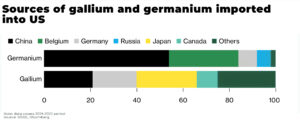
China is the dominant producer and processor of primary gallium and an important supplier of germanium. Other countries participate in refining, recycling and the production of high-purity materials, wafers and components, but alternative capacity remains limited.
Supply-chain exposure extends beyond raw metal. Semiconductor and optical applications require:
- high-purity refining
- specialised chemical conversion
- crystal and substrate production
- wafer fabrication
- component manufacturing
- customer qualification
A country may therefore produce or refine gallium or germanium without controlling the complete downstream supply chain.
By-product production
Gallium and germanium are usually recovered only when aluminium, zinc or other processors have the necessary extraction equipment and a commercial reason to operate it.
This creates an unusual supply dynamic. A higher gallium or germanium price may not lead directly to greater mining because the host operation is primarily designed to produce another commodity.
Additional supply can require:
- changes to an existing refinery
- recovery from residues or waste streams
- new separation and purification equipment
- long-term customer agreements
- sufficient prices to justify relatively small production volumes
A large theoretical resource does not automatically translate into commercially available metal.
Export controls and geopolitics
Gallium and germanium have become prominent examples of how trade policy can affect critical-mineral supply chains.
China introduced licensing requirements for exports of specified gallium- and germanium-related products in 2023 and has subsequently adjusted restrictions affecting strategic materials and destinations.
The rules and their implementation can change, making them unsuitable for fixed claims on an evergreen page. The durable point is that export controls can affect availability, prices, inventories and procurement decisions in markets with few alternative suppliers.
Governments and manufacturers have responded by exploring domestic recovery, allied-country supply, recycling, stockpiling and long-term purchasing agreements.
Recycling and secondary supply
Gallium and germanium can be recovered from some manufacturing scrap and end-of-life products.
Gallium recycling is concentrated largely around semiconductor manufacturing, where production scrap can be collected and processed. Recovering the small quantities dispersed across finished consumer products is more difficult.
Germanium can be recovered from fibre-optic manufacturing scrap, infrared optics, catalysts and selected electronic materials. Some optical components can also be refurbished and reused.
Recycling is strategically useful, but collection, separation and economics limit how much secondary material can return to the market.
Substitution and material efficiency
Alternative materials exist for many gallium and germanium applications, but substitution often involves performance or cost trade-offs.
Silicon, silicon carbide and indium phosphide can replace gallium-based semiconductors in selected devices. The best option depends on frequency, voltage, efficiency, heat management and manufacturing cost.
Alternative glasses and optical materials can replace germanium in some infrared or fibre-optic applications. Other detector technologies may also reduce the need for germanium lenses.
Manufacturers can respond to tight supply by redesigning products, reducing material intensity or improving production yields. In defence, space and other high-performance systems, however, technical requirements may restrict these options.
What drives gallium and germanium demand?
The main demand drivers include:
- Semiconductors: gallium and germanium support high-frequency, power and specialist integrated circuits
- Telecommunications: GaAs and GaN are used in wireless systems, while germanium supports fibre-optic networks
- AI and data centres: advanced communications and power-conversion systems can use gallium-based devices, while fibre networks use germanium
- Defence: both metals are used in radar, communications, guidance and sensing technologies
- Aerospace: satellites and spacecraft use compound semiconductors, infrared systems and high-efficiency solar cells
- Power electronics: GaN supports compact and efficient power conversion
- Infrared optics: germanium is used in thermal imaging and night-vision equipment
- Solar energy: gallium and germanium are used in specialised high-efficiency photovoltaic technologies
What to watch in the gallium and germanium markets
Gallium and germanium sit at the intersection of semiconductor policy, industrial strategy and national security.
Key trends to watch include:
- Export controls: licensing rules and trade restrictions can quickly alter market availability
- Semiconductor investment: new capacity for GaAs, GaN, SiGe and photonic devices can influence demand
- AI infrastructure: data-centre power electronics and optical networks may support consumption
- Defence procurement: radar, infrared and satellite systems require high-performance materials
- Alternative production: recovery from bauxite, zinc residues, coal-related materials and industrial waste could diversify supply
- High-purity processing: raw material alone is insufficient without refining and component-manufacturing capacity
- Recycling: improved recovery from manufacturing scrap can strengthen secondary supply
- Substitution: silicon, silicon carbide and alternative optical materials may limit demand in some applications
- Strategic stockpiling: governments and manufacturers may hold inventories to reduce exposure to disruptions
- Prices and project economics: small markets can experience significant volatility, while low prices can discourage alternative production
The strategic takeaway
Gallium and germanium are critical-minerals stories because small amounts support high-value technologies.
Their importance does not come from the volume consumed. It comes from their role in semiconductors, communications, infrared optics, defence and aerospace—and from the difficulty of replacing them without compromising performance in certain applications.
For investors, manufacturers and policymakers, the central question is whether production, high-purity refining and downstream manufacturing can diversify faster than demand from strategic technologies grows.
———————–
What is gallium used for?
Gallium is used primarily in compound semiconductors, including gallium arsenide and gallium nitride. Applications include smartphones, radar, satellites, LEDs, laser diodes, power electronics and high-efficiency solar cells.
What is germanium used for?
Germanium is used in fibre-optic communications, infrared lenses, night-vision systems, silicon-germanium semiconductors, radiation detectors and specialised solar cells.
Why are gallium and germanium considered critical minerals?
They are considered critical because they support semiconductors, communications, defence and advanced energy technologies, while their production and processing are concentrated and difficult to expand quickly.
Are gallium and germanium rare-earth elements?
No. Gallium and germanium are critical minerals, but they are not part of the rare-earth group of elements.
Can gallium and germanium be recycled?
Yes. Both can be recovered from certain manufacturing scraps and end-of-life products. Recycling is most practical where material is concentrated, such as semiconductor scrap, fibre-optic waste, catalysts and infrared optical components.
What affects gallium and germanium prices?
Prices are influenced by Chinese production and export policy, semiconductor demand, defence procurement, fibre-optic and infrared demand, by-product recovery, inventories, recycling and the availability of high-purity processing capacity