



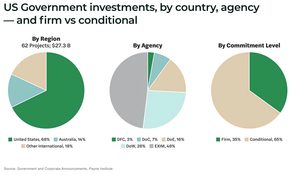
America’s $27 billion push to break China’s minerals grip
The US has committed or conditionally committed at least US$27.3 billion to 62 critical minerals projects since the start of 2025, according to the Payne
Tungsten is a strategically important critical mineral essential for semiconductors, aerospace systems, defence applications — including armour-piercing equipment and high-performance alloys.
China produces more than 80% of mined tungsten and tightened export controls in 2025, intensifying global supply concerns. With limited new mines, governments are racing to secure diversified tungsten supply chains.
Tungsten is a dense, hard and heat-resistant metal, chemical symbol W and atomic number 74.
It has the highest melting point of any pure metal, at approximately 3,422°C, and one of the highest densities. These properties make tungsten valuable in cutting tools, mining equipment, aerospace components, defence systems, electronics and other demanding applications.
The name “tungsten” comes from the Swedish words tung sten, meaning “heavy stone”. Its chemical symbol W comes from wolfram, an older name associated with the mineral wolframite.
Tungsten does not occur naturally as a pure metal. It is extracted mainly from the minerals scheelite and wolframite, then processed into chemicals, metal powder, tungsten carbide and specialised alloys.
Tungsten retains useful properties under conditions that would wear down, deform or melt many other materials.
It is valued for:
These characteristics make tungsten strategically important to manufacturing, mining, construction, defence, aerospace and electronics.
Its largest application is not pure tungsten metal. Most tungsten is used in tungsten carbide and cemented-carbide tools.
Tungsten carbide is a compound made from tungsten and carbon. It is extremely hard and resistant to abrasion.
Fine tungsten-carbide particles are commonly combined with a metallic binder, often cobalt, to produce a material known as cemented carbide or hardmetal.
Cemented carbides are used in:
The carbide provides hardness and wear resistance, while the binder adds toughness and helps prevent brittle failure.
Different combinations of particle size, binder content and additional carbides allow manufacturers to tailor a tool for a particular material or operating environment.
Tungsten-carbide tools can cut, shape and drill metals at speeds and temperatures that would quickly degrade many conventional steel tools.
Applications include manufacturing:
This gives tungsten an indirect role across much of the industrial economy. Even when the finished product contains no tungsten, tungsten tools may have been used to manufacture it.
Demand therefore depends on factory output, capital investment, construction and resource extraction.
Mining and construction equipment must operate against hard, abrasive rock.
Tungsten-carbide inserts are used in:
The inserts take most of the wear and can often be replaced without discarding the complete steel tool.
Tungsten demand from these sectors is influenced by mining activity, infrastructure spending and the intensity of drilling and excavation.
Tungsten’s density, hardness and heat resistance make it important in defence applications.
It is used in:
Tungsten-heavy alloys can provide high density without using lead or depleted uranium in selected applications.
The metal’s strategic importance comes not only from the volume consumed but from the difficulty of matching its performance in safety- and mission-critical systems.
Defence applications require reliable supplies of qualified powders, alloys and finished parts—not simply tungsten concentrate.
Tungsten and tungsten-containing alloys can perform at temperatures that exceed the limits of many conventional metals.
Applications include:
Pure tungsten can be brittle under some conditions, which limits its use as a conventional structural metal. Manufacturers use alloys, composites and carefully controlled production methods to improve performance.
Tungsten is also added in small quantities to selected nickel-based superalloys, where it can help improve strength at high temperatures.
Tungsten is used in electronics because it tolerates heat, conducts electricity and remains dimensionally stable.
Applications include:
In semiconductor manufacturing, tungsten can form conductive connections and plugs between different parts of an integrated circuit.
The quantities used per chip are small, but semiconductor purity requirements are extremely strict. This creates demand for high-purity tungsten chemicals and deposition materials rather than ordinary metal powder.
Tungsten was historically best known as the filament material in incandescent light bulbs.
Its high melting point allows a thin wire to glow at extremely high temperatures without immediately melting.
LED lighting has reduced this market, but tungsten remains useful in:
Tungsten electrodes are also used in gas tungsten arc welding, commonly known as TIG welding. The electrode creates and maintains an electric arc while resisting the heat of the welding process.
Electrode formulations vary and may include oxides of lanthanum, cerium, zirconium or other elements.
Tungsten is added to selected tool steels to help them retain hardness at elevated temperatures.
High-speed steels are used in:
Tungsten-containing high-speed steel competes with molybdenum-based steels and cemented-carbide tools.
The preferred material depends on cost, toughness, cutting speed and the type of work being performed.
Tungsten’s density is similar to that of gold and substantially greater than steel or lead.
Tungsten-heavy alloys are used in:
Small tungsten components can provide substantial mass in limited space.
This is valuable where engineers need weight without increasing component size.
Tungsten is used in medical imaging and radiation management.
Applications include:
Tungsten’s high density helps absorb X-rays and gamma radiation. It can replace lead in selected products where durability, formability or environmental considerations justify the higher cost.
Tungsten compounds and alloys used in medical systems must meet application-specific safety and purity requirements.
Tungsten compounds have several chemical and industrial uses.
Applications include:
Tungsten oxides can change colour when ions or electrical charge enter their structure. This property supports electrochromic “smart glass” that adjusts light transmission.
Tungsten disulphide can act as a solid lubricant under high loads and temperatures.
Tungsten is not a major bulk input into mainstream batteries, solar panels or wind turbines. Its energy-transition role is more specialised.
It is used in:
Tungsten is a leading candidate for plasma-facing components in some nuclear-fusion designs because of its melting point, thermal properties and resistance to erosion.
Commercial fusion remains an emerging application, so its eventual impact on tungsten demand is uncertain.
The two principal tungsten minerals are scheelite and wolframite.
Scheelite is calcium tungstate and is commonly found in:
Scheelite may fluoresce under ultraviolet light, which can help geologists and miners identify it.
Wolframite is an iron-manganese tungstate.
It occurs in:
Wolframite is a mineral series that includes iron-rich ferberite and manganese-rich hübnerite.
Tin and tungsten mineralisation can occur within the same geological systems, although each project has its own mineralogy and processing requirements.
Most tungsten is produced from hard-rock mines using open-pit or underground methods.
After mining, ore is crushed and ground before the tungsten minerals are concentrated.
Processing methods can include:
Wolframite’s high density and magnetic properties can support gravity and magnetic separation.
Scheelite may require flotation because its physical properties and association with other minerals differ.
Ore grades can be low, making recovery, energy consumption and waste management central to project economics.
The tungsten supply chain includes several chemical and metallurgical stages.
A simplified route includes:
Each stage requires different technology and customer qualifications.
A country may mine tungsten while remaining dependent on another country for APT, powder, carbide or finished tools.
Ammonium paratungstate, usually abbreviated to APT, is a purified intermediate used throughout the tungsten industry.
APT can be converted into:
APT prices are often used as an important benchmark for the tungsten market.
However, concentrate, APT, powder, carbide and scrap all have different specifications and prices. There is no single universal tungsten price.
China dominates global tungsten mining, processing and consumption.
Other producing countries include, at varying scales:
Additional resources and development projects exist across North America, Europe, Australia, Africa and Central Asia.
Supply diversification remains difficult because a new mine also needs access to chemical processing, powder production and qualified downstream customers.
Tungsten has a relatively small market and a highly concentrated supply chain.
China holds a leading position in:
China also applies controls to selected tungsten-related exports. The scope and administration of these measures can change, making fixed policy descriptions unsuitable for an evergreen page.
The lasting issue is that trade restrictions or production disruptions can affect industries that depend on small quantities of specialised tungsten material.
Other supply risks include:
Tungsten is one of the four minerals commonly grouped as 3TG: tin, tantalum, tungsten and gold.
The designation comes from concerns that mining and trade in conflict-affected or high-risk areas may finance armed groups or contribute to human-rights abuses.
Tungsten supply chains can face risks involving:
Responsible sourcing does not mean that all tungsten from a particular region is conflict-linked. It requires companies to identify and manage risks through traceability, supplier engagement, smelter reviews and independent assurance.
The OECD provides a risk-based due-diligence framework for companies sourcing minerals from conflict-affected and high-risk areas.
Tungsten mining and processing can create environmental impacts through:
Tungsten deposits can contain arsenic, sulphides or other minerals that require careful waste and water management.
Chemical conversion into APT and tungsten powders creates additional waste streams that must be treated.
Environmental performance depends on deposit type, processing technology, regulation and operating standards.
Recycling is an important source of tungsten supply.
The highest-value scrap includes:
Two broad recycling routes are used.
Direct processes recover tungsten carbide while preserving much of its existing chemical form.
This can reduce the number of conversion stages required before the material returns to tool production.
Chemical processes dissolve tungsten-bearing scrap and recover it as APT or another purified intermediate.
This route can handle a wider range of scrap and remove contaminants but requires additional chemical processing.
Collection is the main challenge. Small cutting inserts and worn tools may be dispersed across thousands of workshops, mines and construction sites.
Possible tungsten substitutes include:
No substitute matches every tungsten property.
A material that can replace tungsten in a cutting tool may not work as a radiation shield or high-temperature electrical contact.
Manufacturers can reduce tungsten use through:
Substitution is most difficult where hardness, density and extreme-temperature performance are required together.
Tungsten is not traded on a major exchange in the same way as copper or nickel.
Prices are commonly assessed through physical-market transactions for products such as:
Concentrate and APT prices may be quoted in metric-ton units, or mtu. A metric-ton unit represents ten kilograms of tungsten trioxide content.
Prices vary by purity, location, contract terms and product form.
The principal sources of tungsten demand include:
Tungsten prices are influenced by:
Because the market is small, changes in policy, inventories or a major supply source can produce significant price movements.
Tungsten sits at the intersection of manufacturing, defence and supply-chain security.
Key trends to watch include:
Tungsten is a small-volume metal with an outsized role in industrial capability.
Its primary importance comes from tungsten carbide—the material that allows manufacturers, miners and construction companies to cut and drill other hard materials. Defence, aerospace, electronics and medical applications add further strategic value.
For investors, manufacturers and policymakers, the central question is not simply whether tungsten resources exist. It is whether concentrate can be converted into APT, powder, carbide and qualified components through a secure and responsibly managed supply chain.
———————–
Tungsten is used in cutting tools, drill bits, mining equipment, defence systems, aerospace components, high-speed steel, electronics, welding electrodes, radiation shielding and high-temperature industrial equipment.
Tungsten and carbon form a strong crystalline compound that resists scratching and wear. Combining tungsten-carbide particles with a metal binder creates a material that balances hardness with toughness.
Pure tungsten melts at approximately 3,422°C, the highest melting point of any pure metal.
Scheelite and wolframite are the principal commercial tungsten minerals.
No. Tungsten is a transition metal and a critical mineral, but it is not part of the rare-earth group.
Tungsten is one of the 3TG minerals covered by prominent conflict-mineral due-diligence frameworks. This does not mean all tungsten is conflict-linked; companies assess risk according to mine origin, transit routes and supply-chain conditions.
Yes. Tungsten can be recovered from carbide tools, manufacturing scrap, heavy alloys and high-speed steel. Recycling is an important source of supply because used carbide retains substantial value.
China has large resources and an integrated industry spanning mining, APT production, powders, carbide and finished tools. This downstream capacity reinforces its position beyond mine production alone.
—
Reference sources for annual review: USGS tungsten statistics, USGS Mineral Commodity Summary, IEA critical-minerals outlook and the OECD responsible-minerals guidance.
The US has committed or conditionally committed at least US$27.3 billion to 62 critical minerals projects since the start of 2025, according to the Payne

Tungsten prices increased 310% between January-July 2026 — one of the sharpest commodity rallies of the year — as Chinese export controls and rising military
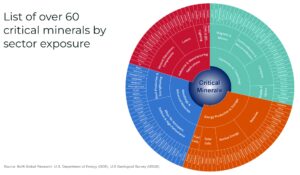
Bank of America has launched an 18-month, US$250 billion Critical Infrastructure Finance Initiative covering the physical systems behind America’s AI, energy and industrial buildout — with

President Donald Trump has announced more than US$2 billion in government support for critical mineral and mining-related projects, alongside more than US$180 million for the
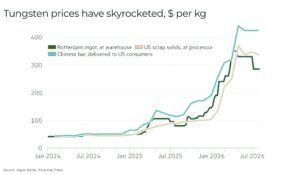
The US will block most exports of tungsten waste and lithium-ion battery “black mass” for one year — from August 27, US companies selling covered
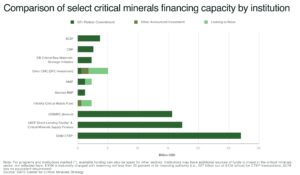
The West needs about US$500 billion in new mining investment by 2040 to meet mineral demand under current policy settings — but the public institutions
Investment intelligence and in-depth reports on critical minerals, mining, energy and geopolitics — from capital-markets professionals with boardroom and institutional experience.