
- the US is the world’s largest helium producer
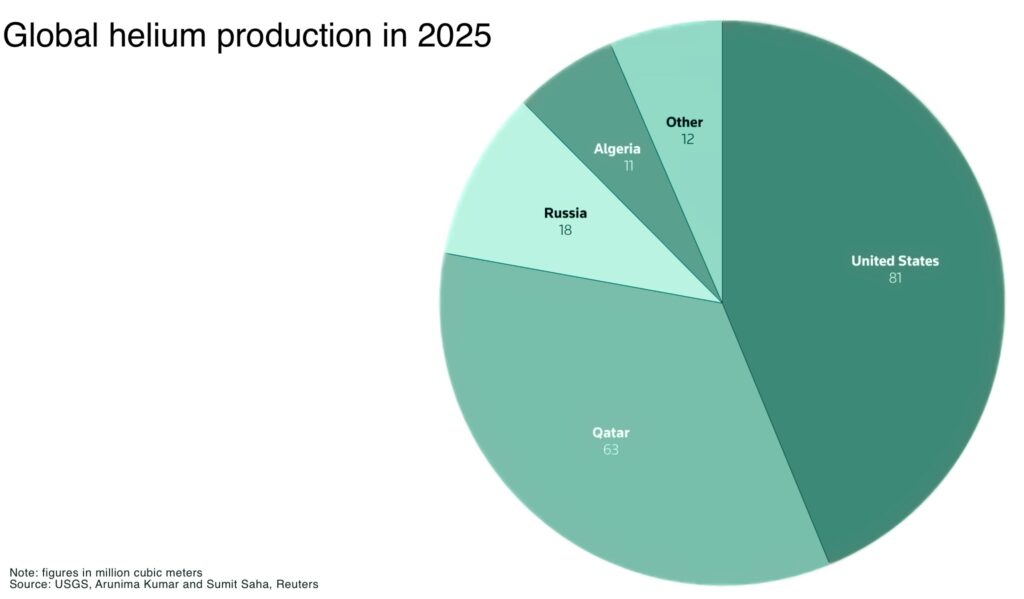
- attacked Qatari facilities accounted for roughly one-third of global helium supply, producing approx 63 million cubic meters in 2025 out of roughly 190 million globally
- helium spot prices estimated to have increased 50%, with sustained-disruption scenarios potentially pushing prices back above $2,000 per thousand cubic feet
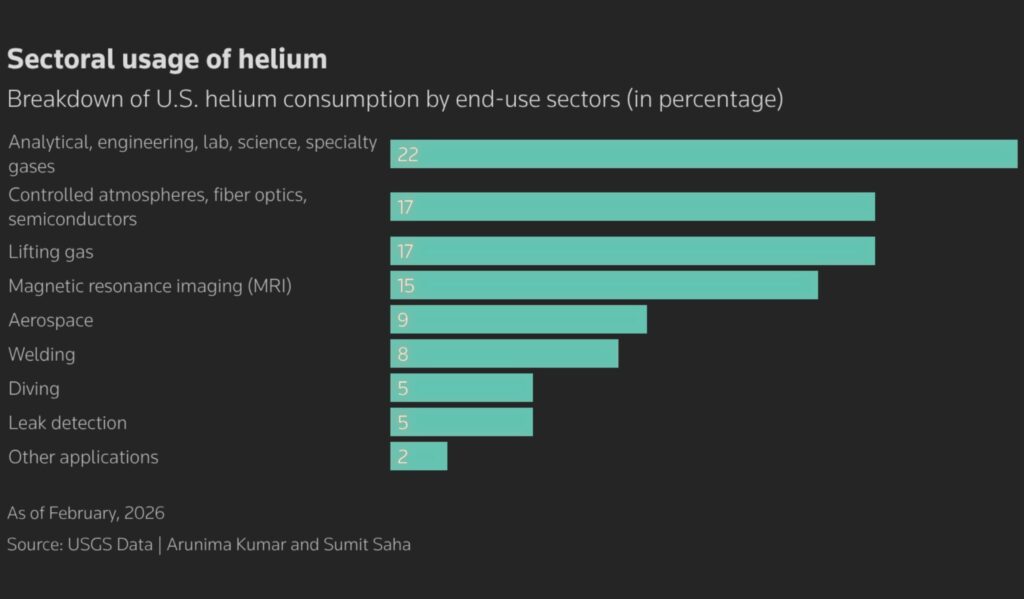
- helium is critical to semiconductors, fiber optics, welding, MRI, aerospace and leak detection, analytical and specialty gases, lifting gas, and there is no substitute for helium in deep cryogenic applications
If we say helium, you say “balloons” — yet party balloons make up less than 10% of helium’s use across semiconductors, rocket launches, aerospace, and medical equipment.
The scale and importance of the global helium market is often overlooked.
But, now, the conflict in the Middle East has disrupted up to a third of global helium supply after attacks on Qatar’s gas processing facilities, putting helium at the top of global headlines.
In a market as small, opaque and logistics-sensitive as helium, this is not “noise” — helium spot prices have doubled since the Middle East crisis began — but a supply shock that threatens advanced tech supply chains.
Fitch ratings warns spot helium prices could spike by 50%–200% in severe shortage scenarios, while contract prices are typically more stable but could still rise 20%–40% on renegotiation.
And, in this crisis, there’s only one clear winner.
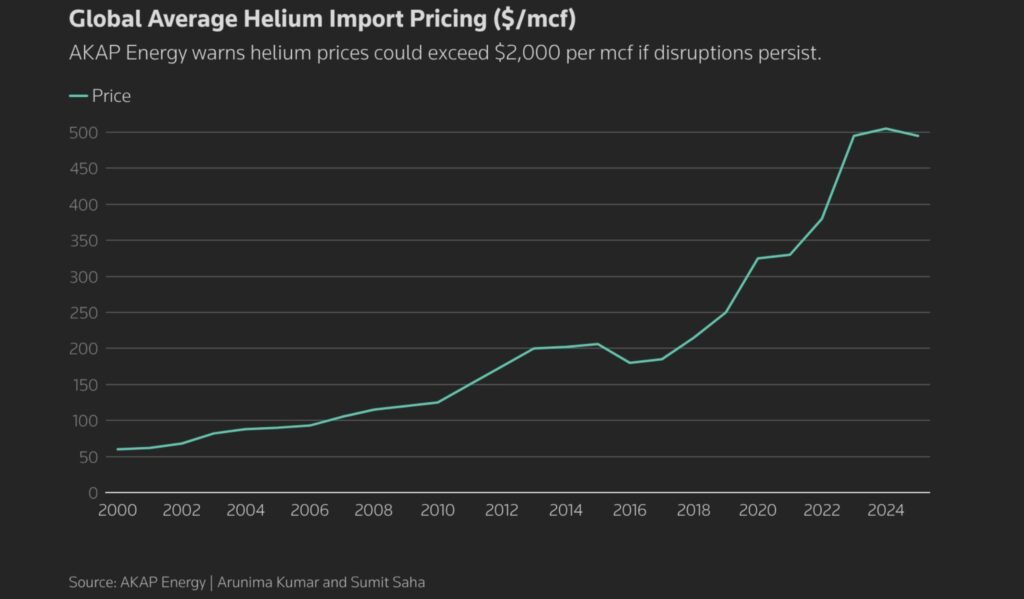
Helium is not publicly traded, with agreements negotiated privately between buyers and sellers, so pricing is often difficult to establish. But it is clear, this crisis hits the sector just as demand was already rising due to semiconductors, data centers and advanced manufacturing growth. Annual global demand was projected to increase from 6.0Bcf to 8.5Bcf by 2030, with a current global import growth of 10% year on year.
In other words, the world was already heading into a tighter helium market.
And this is not due to a one-off supply chain problem: this would arguably be the fifth helium supply shortage since 2006.
Why is helium important?
Helium gas is the second most abundant element in the universe, after hydrogen, but considered the only non-renewable element on earth, it’s so light that it can easily escape the Earth’s gravitational pull, and then disappears from the planet.
Naturally occurring helium on Earth takes thousands of years to produce, as elements, such as uranium and thorium, decay deep in the Earth. The helium rises up and is then trapped in pockets of natural gas, which is drilled and processed.
Most popularly known for filling party balloons, helium is essential across significant growth industries, particularly as it’s use as a super coolant, including:
- medical, eg to cool the superconducting magnets in MRI scanners (there is no substitute for helium in cryogenic uses requiring temperatures below minus 429°F, which is why it remains essential in MRI and other superconducting applications)
- military equipment, eg air-to-air missile guidance systems
- high-tech manufacturing, eg fibre optic cables
- space rockets, eg liquid fuel rockets to separate hot gases and ultra-cold liquid fuel during lift-off; for example, NASA is one of the biggest consumers of helium in the world, buying 1.4 million liters of liquid helium and 87.7 million standard cubic feet of gaseous helium in 2022
- semiconductors and scientific research, eg as a “superfluid” in quantum computing

Helium supply chains
The helium market had only just started to recover from a series of problems after the disruption of Covid lockdowns, including a 6-month long, unscheduled outage at BLM’s Crude Helium Enrichment Unit last year; a fire at a natural gas processing plant in Kansas; maintenance of two of Qatar’s three helium plants; fires at Russian facilities; and, in 2023, ExxonMobil’s LaBarge facility in Wyoming, which provides 20% of the world’s supply, reportedly closed for 29 days for maintenance. And, in Russia, the huge new planned increase of helium production at the Amur Gas Processing Plant, run by Russia’s state-owned energy company, has been hit by delays and shutdowns.
This may seem like bad luck, but helium is an industry beset by problems with unsettling consistency. Every year seems to bring some new challenge, so much so that the market had been in supply deficit for 8 years — nearly half — between 2006-2022.
The main reason for volatility in helium prices is the vulnerability of the supply chain: the US and Qatar produce over 85% of the world’s supply.
The main challenge is transporting it, as it is difficult to store and starts to evaporate during transport, so it needs to be moved quickly.
Helium mostly trades through contracts rather than a transparent exchange, so price signals are slower and inventories are key. But the reserve backdrop is also weaker than it was after America sold its Federal Helium System assets in 2024, which meant the market has less official cushioning and more dependence on private operators, storage and logistics discipline.
The US removed helium from its critical mineral list in 2021, but concerns over concentration of supply has meant helium is listed as a critical mineral in Canada and Australia, and the EU is proposing adding it.
China imports approx 85% of its helium (split between Russia and Qatar), and is now reportedly facing significant shortages, impacting their high-tech sectors. They have announced plans to add 250 million standard cubic feet (mmscf) a year of domestic helium capacity from May 2026 but this will take time to bring online.
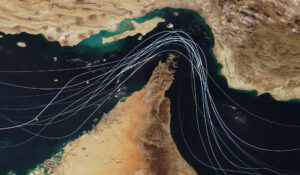
How the Strait of Hormuz hit helium
In Qatar, helium is produced at the Ras Laffan facility, the world’s largest liquefied natural gas plant — which halted production of LNG and “associated products” on March 2, including a fall in helium production of at least 14% — because of Iran’s drone attacks forcing it to declare force majeure.
Qatar produced about 63 million cubic meters of helium in 2025, close to one-third of global supply, so any prolonged disruption would remove roughly 5.2 million cubic meters of helium per month from the market.
The other problem is that helium is notoriously difficult to store, with the specialized containers used to store helium for 35-48 days. But, much longer and they start warming up, letting the helium transform into gas that escapes through pressure release valves. An estimated 200 of these containers are stuck in the Middle East.
Airgas, a US distributor of packaged gases, has declared force majeure on helium shipments after Qatar suspended production and, Air Liquide, French industrial gas major, warns helium shortages will arise as they work to reallocate helium supplies from other regions.
Semiconductor industry at risk
Helium is essential to semiconductor production — including cooling, leak detection and precision manufacturing processes — and so, in turn, advanced tech, AI and data centers, and the vast investment that has been pumped into the tech companies stock prices (the MAG7) in the US.
And the industry is already warning tightening supply is impacting tech supply chains.
In South Korea, home to some of the world’s largest chipmakers, reports suggest the industry has enough helium inventory to last until at least June, supported by US exports as well. But, these companies are paying a premium that will only be exacerbated the longer the conflict continues.
And this demand will be in competition with other priorities, including medical MRI systems, military equipment, rockets and more.
Lift off for US helium market
The US is now the world’s largest helium producer and one of the few countries with both major resource depth and expanding production:
- the US has an estiaated 8.5 billion cubic meters of recoverable helium in geologic reservoirs, compared with 31.3 billion cubic meters for the rest of the world
- in 2025, the US sold or used an estimated 81 million cubic meters of helium worth about US$970 million
- the country has nine crude helium plants, 11 gaseous helium plants, five Grade-A helium plants, and four additional purification plants upgrading crude helium from other sources; with six new helium operations starting production in 2025, with three in New Mexico and one each in Colorado, Kansas, and Montana. A new helium storage cavern in Beaumont, Texas also came online in 2025, adding more flexibility to the domestic market
In comparison, helium production outside of the US remains highly concentrated and under threat of disruption (whether the Middle East or war in Ukraine).
China has been working to decrease its helium imports from the USA (down to just 5% in 2024), but this dynamic has now shifted dramatically.
There are new facilities opening up in Canada and South Africa, but — especially with its massive natural gas industry — the trajectory favours US hegemony of global helium supply chains.
For example, Morgan Bazilian, director of the Payne Institute for Public Policy at the Colorado School of Mines, has called on Washington to treat helium as a “strategic industrial gas”:
“That reality has immediate American economic implications for the material foundations of the artificial intelligence boom,” they said, adding that the crisis “stings even deeper into the US and allied defence industrial base than most policymakers appreciate.”
Currently, only the US has the scale and capability to accomplish such targets.
Conclusion
While policymakers in Washington worry about the security of critical mineral supply chains (such as copper or nickel or rare earths), the US helium industry faces a different dynamic: its primary competitor has effectively been removed from the market — and prices are rising.