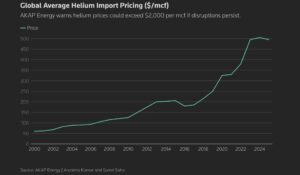

Helium is a strategically important resource, essential to semiconductor manufacturing, medical imaging, aerospace, defence and advanced scientific research.
With helium supply concentrated among a small number of producers at risk of geopolitical disruption (especially Russia and Qatar), governments and industry are seeking more secure sources amid concerns over helium shortages, supply-chain disruption.
Helium is a colourless, odourless and non-flammable gas valued for its chemical stability, low density and exceptional cooling properties.
It is the second-lightest element and has the lowest boiling point of any element. Helium remains liquid at temperatures close to absolute zero, making it essential for cooling superconducting magnets and other equipment that must operate at extremely low temperatures.
The name comes from helios, the Greek word for the Sun, where helium was first detected through analysis of sunlight.
Today, helium is used in semiconductor manufacturing, magnetic resonance imaging, aerospace, defence, scientific research, fibre optics, welding and leak detection. These specialised applications have made secure helium supply increasingly important to advanced industrial and technology supply chains.
Helium combines properties that are difficult to reproduce with another gas.
It can:
These properties make helium far more than a lifting gas. It is a critical input for healthcare, electronics, aerospace and advanced scientific infrastructure.
High-purity helium is used throughout parts of the semiconductor manufacturing process.
It can help:
Semiconductor plants require gases that meet strict purity and consistency standards. Even small amounts of contamination can affect production yields or damage sensitive equipment.
Helium supply disruptions can therefore create problems beyond the volume of gas involved. Manufacturers may have limited ability to replace helium quickly without changing equipment, processes or quality controls.
Liquid helium is used to cool the superconducting magnets inside many magnetic resonance imaging scanners.
These magnets must operate at temperatures close to absolute zero. At such temperatures, specialised materials can conduct electricity with almost no resistance, allowing MRI systems to generate the powerful magnetic fields required to produce detailed medical images.
NIST records helium’s normal boiling point at approximately 4.2 kelvin, equivalent to about −269°C.
Newer MRI systems may use less helium or incorporate sealed cooling systems that reduce losses. However, helium remains important across the installed base of medical-imaging equipment, particularly during maintenance, repairs and magnet servicing.
Helium is used in aerospace and defence because it is light, inert and non-flammable.
Applications include:
pressurising rocket fuel tanks
Helium can remain gaseous under conditions where some other gases may liquefy or react with surrounding materials. This makes it useful in systems where reliability and chemical stability are essential.
Helium supports a wide range of research and industrial processes.
It is used in:
particle accelerators
Many of these applications consume relatively modest quantities compared with bulk industrial gases, but they can require extremely high purity and have few practical substitutes.
Most helium on Earth is produced through the natural radioactive decay of uranium, thorium and other elements within rocks.
Over geological time, helium can migrate through the surrounding rock and accumulate in underground gas reservoirs. Commercial concentrations are most commonly found alongside natural gas, particularly where suitable source rocks, seals and trapping structures have preserved the gas.
Helium is considered a non-renewable resource on human timescales. Once released into the atmosphere, it can eventually escape into space because its atoms are extremely light.
Almost all commercial helium is recovered from natural-gas production.
A typical helium supply chain can include:
A gas field can contain helium without being commercially viable. Project economics depend on helium concentration, reservoir size, gas composition, processing requirements, infrastructure, energy costs and access to customers.
Helium has traditionally been recovered as a by-product of natural-gas production.
This creates a structural supply challenge: decisions about helium output may depend on the economics of the larger natural-gas project rather than helium demand alone. A gas field may close, reduce production or vent low-value gases even when helium markets remain tight.
Some projects are designed specifically around helium-rich reservoirs. These primary helium developments can offer more direct exposure to helium demand, although they still face geological, processing, financing and infrastructure risks.
The commercial value of a project depends on recoverable helium rather than concentration alone. Flow rates, reservoir pressure, contaminants and the cost of purification can all affect viability.
Helium is supplied in gaseous or liquid form depending on the application.
Compressed gaseous helium is commonly used for:
It can be transported in cylinders, tube trailers or other high-pressure containers.
Liquid helium is primarily used where extremely low temperatures are required, including MRI systems, scientific research and superconducting equipment.
Producing and transporting liquid helium requires specialised infrastructure. Heat entering a container causes some of the liquid to evaporate, known as boil-off, making storage time, insulation and logistics important parts of the supply chain.
Helium production and processing are concentrated in a limited number of countries and facilities. Supply can be affected by plant maintenance, pipeline disruptions, geopolitical events, shipping constraints and changes in natural-gas production.
The challenge is not simply finding helium underground. A secure helium supply chain also requires:
Because helium is often produced as a by-product, supply may respond slowly to higher prices or stronger demand. New projects can also require substantial investment before commercially saleable helium is produced.
Helium can be captured, purified and reused in some applications.
Recovery systems are particularly valuable in hospitals, laboratories, semiconductor plants and research facilities where helium consumption is high or supply continuity is essential.
Recycling may involve:
Closed-loop systems can reduce exposure to supply interruptions and lower long-term consumption. However, installation costs, facility size and purity requirements determine whether recovery is practical.
Substitutes exist for some helium applications, but performance varies.
Argon can replace helium in certain welding and inert-atmosphere processes. Hydrogen or nitrogen may be suitable for some leak-detection, cooling or industrial applications. Modern MRI designs can also reduce the amount of helium required.
However, there is no universal replacement. USGS notes that no substitute can provide the same performance where cryogenic temperatures below approximately −254°C are required.
Substitution therefore depends on the equipment, required temperature, safety conditions, purity standards and cost of redesigning the process.
Helium itself is non-toxic and does not contribute directly to climate change. Its environmental footprint is mainly associated with the way it is extracted, processed and transported.
Potential considerations include:
Primary helium projects associated with nitrogen-rich rather than hydrocarbon-rich gas may have a different emissions profile from conventional natural-gas projects. However, each project must be assessed according to its reservoir composition, power source and processing design.
Recovery and recycling can reduce waste, but these systems also require equipment and energy.
Helium’s investment case is built around the gap between its small market size and its importance to high-value industries.
Healthcare systems, semiconductor manufacturers, aerospace companies and research facilities may use relatively limited volumes, but supply interruptions can have significant operational consequences.
For investors, the main factors to assess include:
helium concentration and recoverable resource
A large helium resource does not automatically make a strong commercial project. Processing complexity, infrastructure requirements and the ability to deliver qualified product reliably can be more important than headline resource size.
Investment intelligence and in-depth reports on critical minerals, mining, energy and geopolitics — from capital-markets professionals with boardroom and institutional experience.