

- price volatility: lithium carbonate prices increased 130% in late 2025
- tightening supply: global lithium consumption forecast to jump 13–17% in 2026, driven by EVs, heavy electric trucks, and grid battery storage
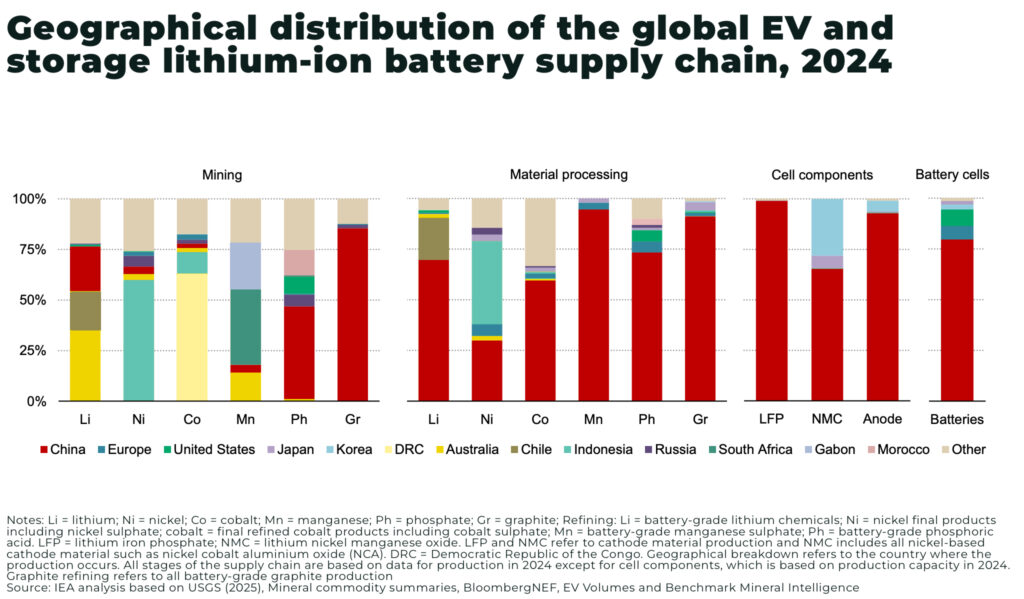
- geopolitics: China processes over 75% of the world’s lithium into battery chemicals, but US opened its first lithium refinery in Texas in 2026 and is stockpiling critical minerals to secure supply chains
Lithium prices have staged a remarkable comeback in early 2026, surging over 100% from their 2025 lows to more than US$16,000 per tonne in January 2026.
Price volatility reflects mounting concerns over tightening lithium supply after years of a “glut”, just as demand is accelerating:
- Morgan Stanley forecasts a deficit of 80,000 metric tons of lithium carbonate equivalent (LCE) in 2026
- UBS estimates a deficit of 22,000 tons, compared with an expected surplus of 61,000 tons in 2025.
- analysts who spoke to Reuters project global lithium demand will increase by 17% to 30% in 2026; three other Chinese analysts expect a narrower lithium market surplus in 2026
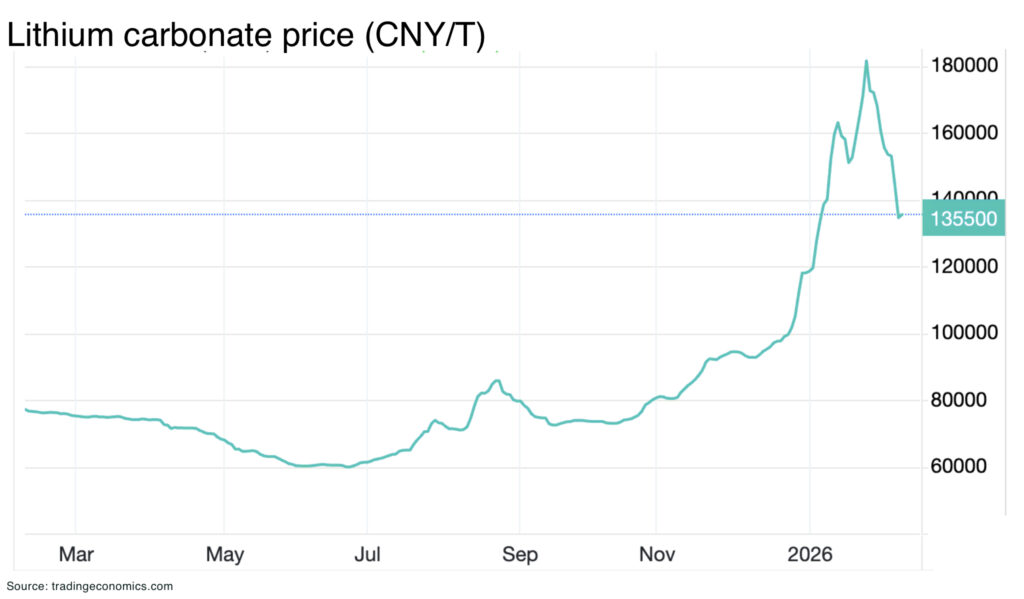
Analysts forecast a price range of US$11,432-$28,580 per ton in 2026 — but might prices overshoot and hit US$30,000, a level not seen since early 2023?
What’s driving soaring lithium demand?
The fundamental growth story for lithium remains intact: electric batteries.
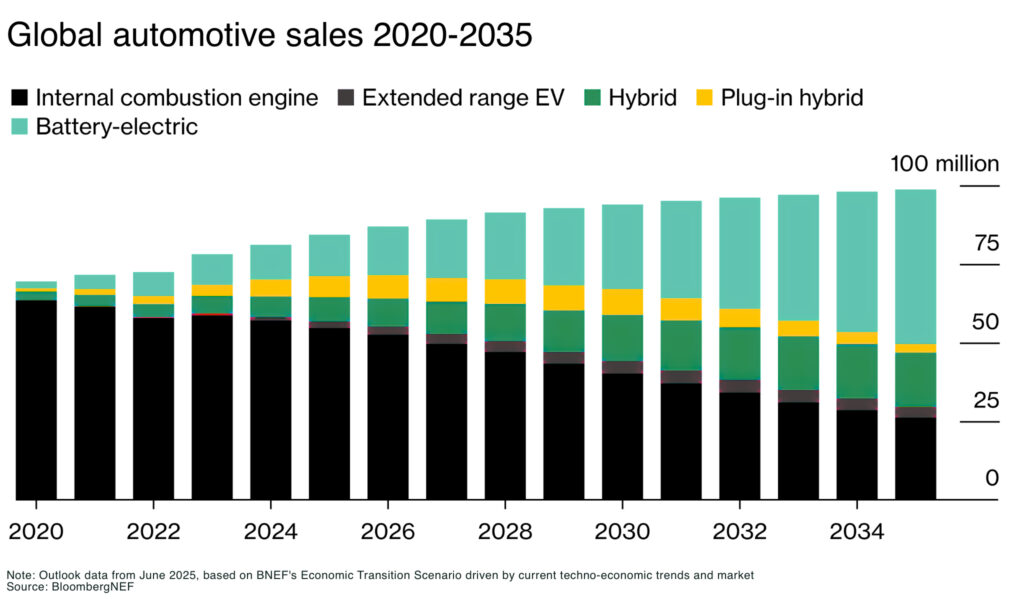
Despite a shift in narrative and slowing momentum in electric vehicles, including electric trucks that carry a much larger battery) in some key markets, sales continue to rise, reaching more than 22 million units sold in 2025. And that growth is forecast to continue into the next decade.
But, in 2025, it’s electric batteries for stationary energy storage that has proved the game changer.
Grid-scale storage systems, built with lithium-iron phosphate batteries, are now lithium’s fastest-growing demand sector.
Analysts across the spectrum expect lithium demand for energy storage to increase in 2026:
- 90% year-over-year to 380,000 mt in 2025, according to an estimate by Albemarle, the world’s largest lithium producer. And it’s North America that is the fastest-growing region for stationary storage, up almost 150% in 2025
- 45.6% to 312,934 mt in 2030 from a 2025 estimate, S&P Global Energy CERA analysts project
- 55% in 2026, following a jump of 71% in 2025, according to a Reuters and UBS data
Utilities worldwide are still installing big battery farms to buffer the intermittent energy supply from solar and wind power, but it’s the new data center data construction boom — across both the US and China — that ignited a surge in battery storage deployments in late 2025.
Importantly, the common LFP battery chemistry in storage uses 30–50% more lithium per kWh than higher-density EV batteries, due to its lower energy density.
“We expect lithium demand for stationary storage applications to increase more than 2.5 times by 2030” — Kent Masters, CEO of Albemarle, said on a Nov 6 2026 earnings call
“We expect battery energy storage systems will see mid-double-digit growth in 2026 and continue to be the fastest growing lithium demand source” — Seth Goldstein, a senior equity analyst at Morningstar, told Platts, part of S&P Global Energy
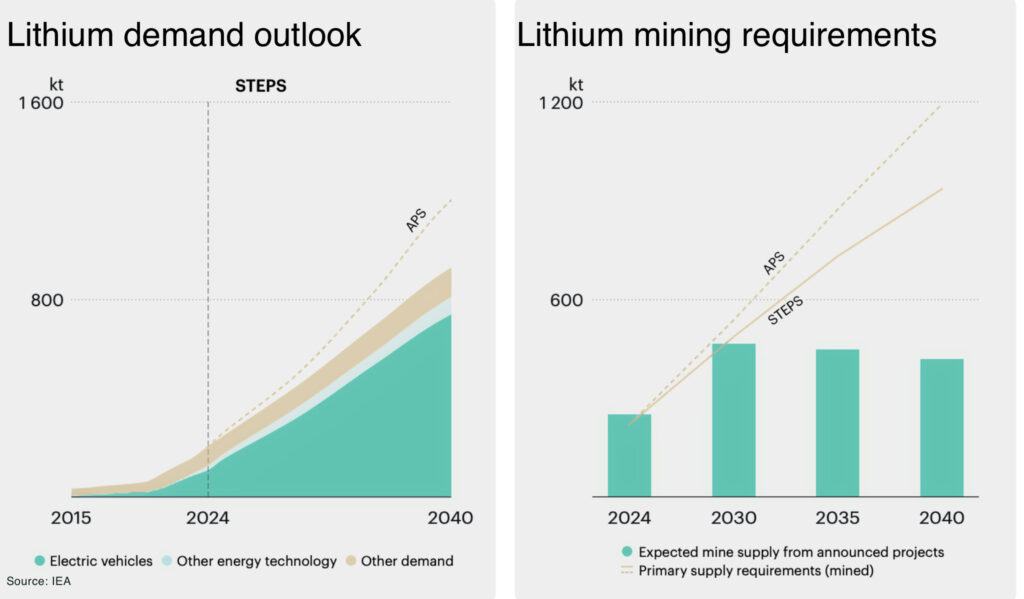
In total, an estimated 55 additional average-sized lithium mines are estiamted to be required to meet demand in 2035.
Can lithium supply keep up with demand?
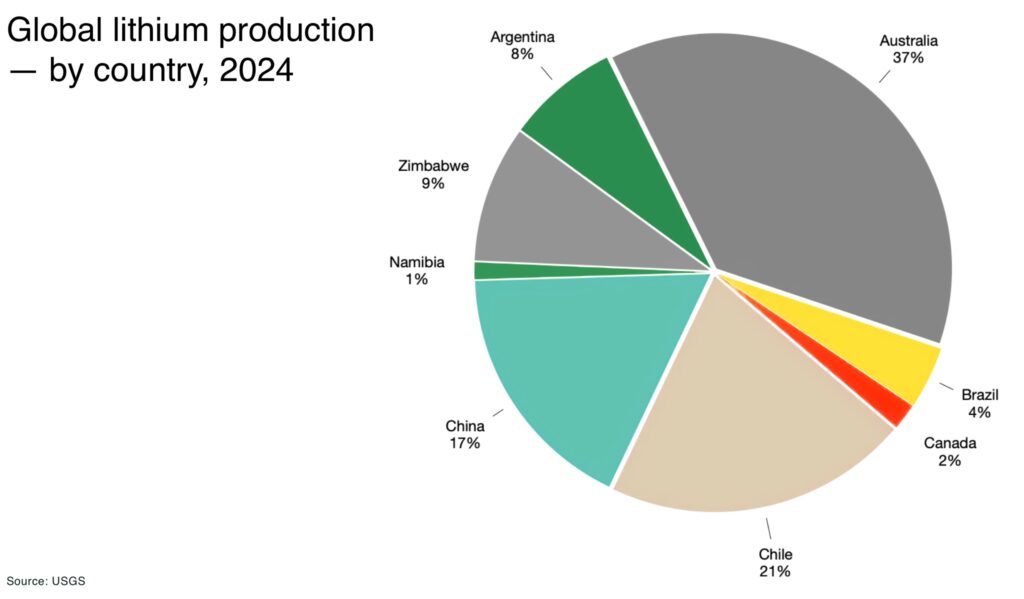
Worldwide lithium production in 2024 increased by 18% to approximately 240,000 tons from 204,000 tons in 2023 in response to strong demand from the lithium-ion battery market and high lithium prices from 2021-2023.
- Australia is the world’s top lithium producer, with approx 88,000 tons Li in 2024 (about 37% of global output) from hard-rock spodumene mines
- Chile produced 49,000 tons (20% share) from its vast brine deposits in the Atacama salt flats
- China mined 41,000 tons (17%) from both hard-rock and brines
- Argentina, Brazil, and Zimbabwe are also notable producers, each with approx 10,000–20,000 ton range
In contrast, the United States is currently only a small producer, with less than 5,000 tons of lithium per year (under 2% of world output) from a single brine operation in Nevada.
But production overshot and prices slumped in the ensuing “glut.”
- Chinese lithium-mica shutdowns: for example, high-cost lepidolite (mica) mines in Jiangxi were progressively idled from late 2023 through 2024 as lithium carbonate prices collapsed below marginal cost
- Australian hard-rock mines mothballed: for example, Arcadium Lithium placed the Mt Cattlin spodumene mine into care and maintenance in 2024, removing export-grade concentrate from the seaborne market
- processing plant shutdowns and output curtailments: for example,Pilbara Minerals (one of the world’s largest spodumene suppliers) placed part of its processing capacity into care and maintenance during 2023–2024
- ramp-ups slowed and expansions deferred: for example, Liontown Resources slowed production ramp-up plans at Kathleen Valley across 2023–2024
- capex cuts and workforce reductions at tier-one producers: for example, SQM reduced capital spending and cut staff in 2024 as lithium prices remained depressed
Between 2022 and 2024, the lithium market didn’t just slow, it forcibly removed supply. High-cost Chinese material exited first, then Australian hard-rock followed, and finally even tier-one producers hit the brakes.
As the old saying goes, low prices are the cure for low prices. And this time is no different. Years of underinvestment and project hurdles now pose significant challenges to ramp up lithium supply to meet the increased demand.
And tightening supply compounds another problem: the concentration of lithium processing in China (as well as manufacturing of battery cell components), which stands at approx 67% of global supply.
This, as we have covered across so many other critical minerals, is ringing alarm bells across America and the rest of the West, especially after China enforced export restrictions on rare earths in 2025.
What this means for lithium supply
Despite the low prices, the industry has not stood still, with major investments including:
- Rio Tinto completed a US$6.7 billion acquisition of Arcadium Lithium (maker of lithium products and assets in Australia, Argentina, Canada, US) in 2025, aiming to increase the capacity of its Tier 1 assets to over 200 thousand tonnes per year of lithium carbonate equivalent by 2028
- Vulcan Energy Resources secured a US$2.6 billion financing package in 2025 to develop the Lionheart lithium and renewable energy project in Germany
- General Motors invested US$650million into the Thacker Pass project (Lithium Americas) in 2023, followed by another US$625 million in 2024
- there are also new investments across Africa, in particular, Chinese investments in Zimbabwe and Namibia
New projects are coming, the problem is that it’s not fast enough in the near-term: on average, a new lithium mine takes approx 16.7 years to build; restarts of mothballed Australian mines are possible if prices stay high, but operators are cautious and, even then, restarting a mine can take 12+ months of contractor mobilization and regulatory approvals.
What this means for lithium onshoring in America
In response, the Trump administration has issued numerous executive orders focusing on boosting domestic critical mineral production, including invoking the Defense Production Act and explicitly linking it to national security and economic competitiveness, and directing federal agencies to accelerate domestic mining and processing through streamlined permitting and investment.
In October 2025, the US government took an approx 10% share in Lithium Americas, the developer of the Thacker Pass lithium mine in Nevada, a project poised to be one of the largest lithium sources in North America once operational.
And, in 2026, Tesla’s new lithium refinery in Texas is now operational, with Elon Musk boasting it is the “largest” in America.
So the pieces of the puzzle to secure US domestic lithium supply are being put in place. But none of them arrive in time to relieve the current squeeze and, in the near term, these moves are more likely to exacerbate tightness than ease it.
Sponsored Spotlight: a tightening supply backdrop puts US-based lithium optionality in focus
As the US moves to onshore lithium supply for economic and national security reasons, domestic hard-rock lithium projects are attracting renewed attention, particularly those outside the congested permitting bottlenecks of federal land and long-dated development timelines.
Lion Rock Resources (TSXV:ROAR | OTCQB: LRRIF)is advancing the Volney lithium-gold-tin project in South Dakota’s Black Hills, an historic mining district. What makes this one stand out is the combination of concentrate-grade lithium and the potential for rapid development all the way to production.
Unlike many US lithium plays focused on brines or clay, Lion Rock’s lithium exposure is spodumene-bearing LCT pegmatites, the same style of hard-rock lithium that underpins supply from Australia and parts of Canada. Historic work at Volney returned lithium grades up to 5.4% Li₂O, with bulk sampling averaging approx 2.5% Li₂O, placing it firmly in concentrate-grade territory.
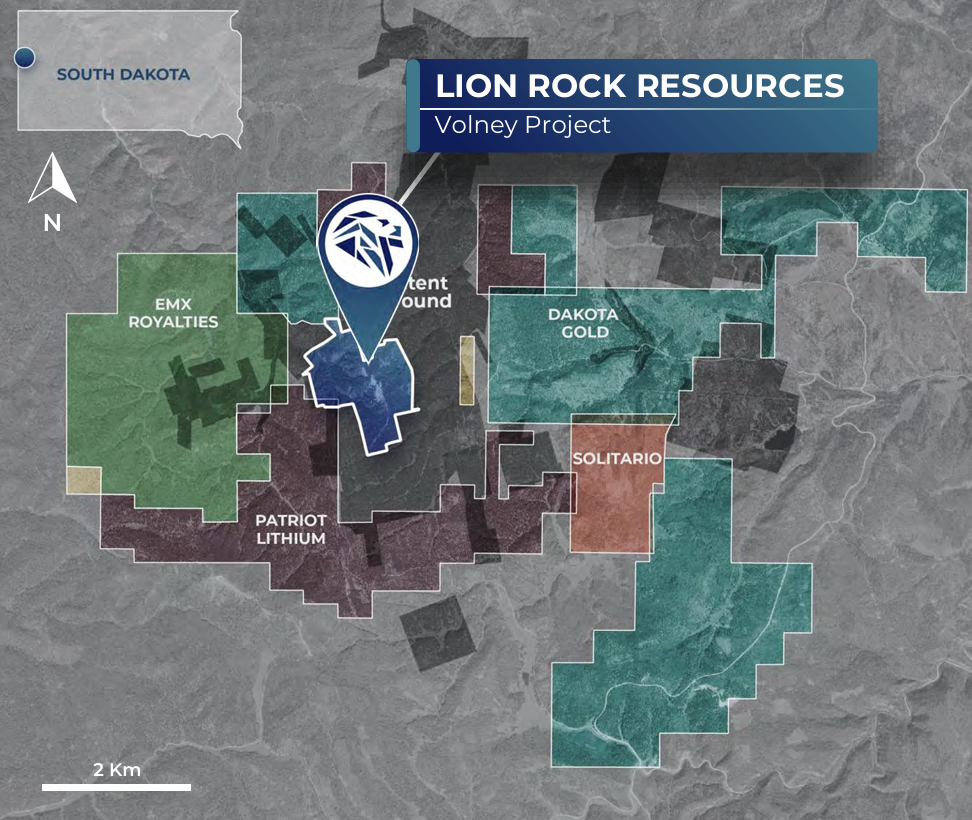
The project has seen limited modern drilling, most historic holes were shallow (<50m), leaving significant expansion potential at depth and along strike across a district-scale pegmatite system. In late 2025, Lion Rock completed its first modern drill program, intersecting spodumene-bearing pegmatites, with assays pending.
If the assays confirm the presence of a large, high-grade lithium system then Lion Rock will quickly find itself on a lot of investor radars. However, it’s the project’s existing infrastructure, private land tenure (accelerated permitting), and direct access to power, road, and rail, that will almost certainly attract the attention of some big players.
Lion Rock has significant funding already in place following a C$5.3m financing in Q3 2025, positioning it to move quickly through follow-up drilling and definition work as results flow.
In a market where new lithium supply takes a decade or more to deliver, early-stage US hard-rock discoveries represent asymmetric exposure to higher prices, particularly if lithium overshoots toward the upper end of the $20,000–$30,000 range being discussed for 2026.
Conclusion
So, how high can lithium prices go?
Mainstream forecasts suggest 2026 prices in a range of US$15,000-$28,000 per tonne, but there is also a more optimistic scenario, that includes:
- historical precedents with lithium’s price volatility
- lithium is also being pulled into the broader debasement trade. As investors position for structurally higher deficits, industrial policy spending, and looser fiscal discipline, hard assets tied to electrification and national security are increasingly treated as stores of strategic value, not just cyclical commodities — amplifying price moves when markets tighten
- political risk (protests or geopolitical fallout) in any of the major producers or suppliers, including South America or Africa
- (and factoring in no “hard landing” for the economy)
All of these factors could help push the lithium price toward $30,000 or higher.