
Sponsored Post: Empire Metals is developing the Pitfield Project, a unique, district-scale high-grade titanium deposit in Western Australia.
With surging investment across aerospace and defence, secure titanium supply chains are increasingly treated as a critical national security risk. Western buyers need qualified, high-purity material, but the pool of reliable supply is tightening.
Against this backdrop, Empire Metals’ (LON: EEE OTCQX: EPMLF) Pitfield titanium project in Western Australia, a high-grade TiO₂ discovery of unprecedented scale, is poised to materially shift the market and become a strategic source of Western titanium feedstock.
With a Mineral Resource Estimate (MRE) reporting 2.2 billion tonnes at 5.1% TiO₂ (113 Mt contained TiO₂), Empire Metals’ Pitfield titanium project in Western Australia ranks as one of the largest, high-grade titanium discoveries in the world.
The strategic significance of this project is rooted within its mineralization. As an exceptionally large and high-grade deposit, it has the potential to produce high-value TiO2 pigments as well as feedstock suitable for titanium sponge metal, already indicated by the TiO₂ grade of 99.25% product achieved in laboratory beneficiation with negligible impurities.
Combining high-purity ore, immense scale and mineralization that will benefit from low-energy processing advantages, this giant deposit is strategically positioned to supply the titanium market, valued at US$20 billion in 2025, with a projected CAGR of 3.4% from 2023-2030, just as it faces supply constraints amid ongoing geopolitical realignment.
The strategic significance of titanium:
- classified as a critical mineral by the US, EU, UK, Canada, South Korea, Australia and Japan
- titanium’s strong, lightweight, corrosion resistant properties are essential for aerospace, defense, medicine, industry and automotive industries
- no cost-effective alternative for its use in pigments and coatings for “whiteness and brightness”
Pitfield’s scale has been realised at significant speed. Empire Metals identified the potential of the Pitfield titanium project in 2023, with early drilling confirming a large, laterally continuous mineralised system. The company then moved quickly from discovery to resource definition.
Total drilling at Pitfield has now surpassed 67,846m across 1,104 holes, providing a robust foundation for geological modelling, resource definition and initial economic evaluation work. The discovery is anchored by two broad, near-surface zones, the Thomas and Cosgrove prospects, each spanning over 7 km in strike with thick, high-grade titanium beds. Notably, these prospects on which the MRE is focused, represent less than 20% of the 40×8 km anomaly, highlighting the potential for a multi-generational titanium resource. In other words, the delineated resource outlines the initial scale of what could be a much larger titanium system.
The JORC-compliant 2025 Mineral Resource Estimate stands at 2.2 Bt @ 5.1% TiO₂ (113 Mt contained TiO₂) including 697 Mt indicated @ 5.3%, marking Pitfield as one of the highest-grade and largest titanium mineral resources ever reported. The recently completed drilling campaign (announced 5 May 2026) delivered 712 holes for 34,844m, the largest by far to date and was designed to increase the resource confidence level at the Thomas prospect, increase the size of the Cosgrove resource and to drill exploration holes to delineate the edge of the giant mineralisation footprint at Pitfield.
Location and infrastructure
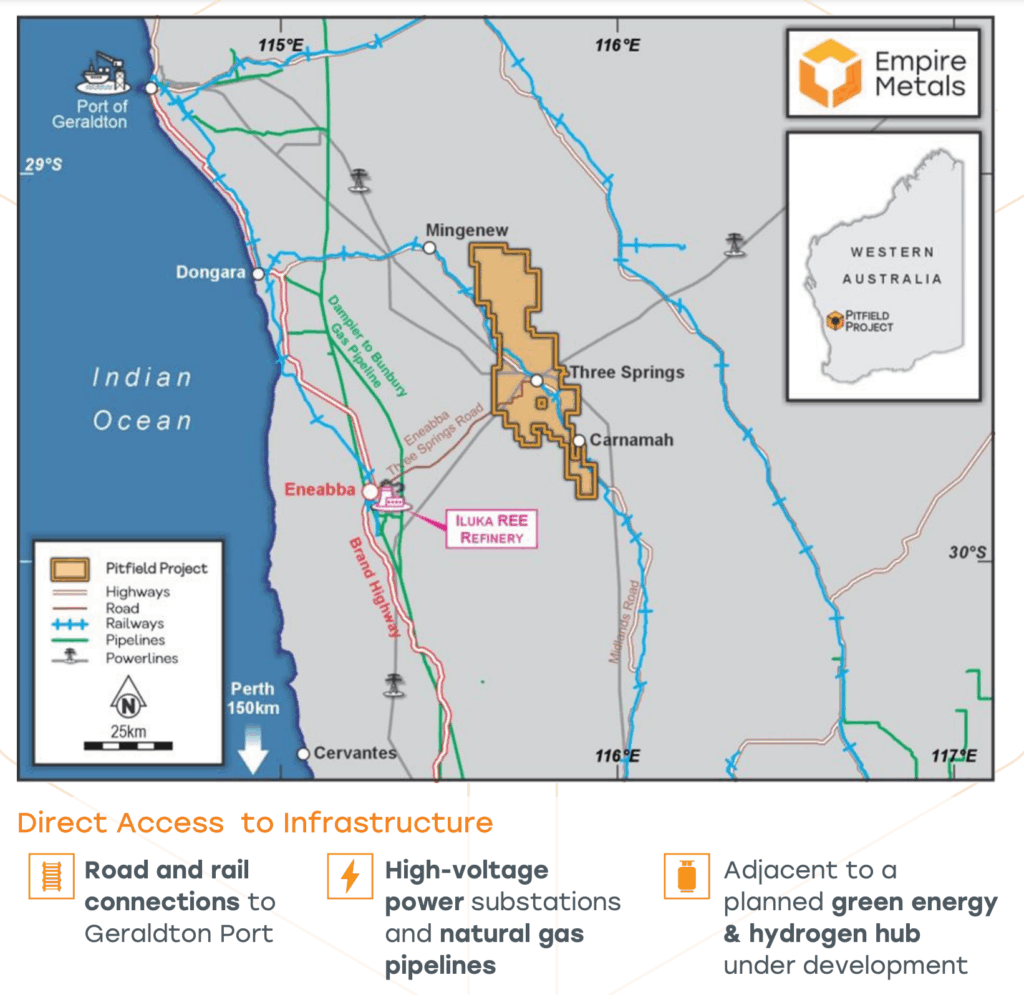
The project’s location and infrastructure are integral to the Pitfield thesis. The project sits 313km north of Perth in Western Australia’s mid-West mining region, providing ready access to a deep pool of mining talent, technical services and laboratory infrastructure.
As a tier-1 mining jurisdiction, Western Australia also offers transparent, well-defined permitting frameworks. In addition it boasts a policy environment increasingly supportive of critical minerals development including the Australia’s Critical Minerals Strategy 2023–2030 and Western Australia’s Battery and Critical Minerals Strategy 2024–2030.
Mining projects within the region continue to be supported by strong government initiatives, including the A$4 billion Critical Minerals Development Fund and the new US-Australia Critical Minerals partnership.
Empire has already secured the necessary exploration licenses and is advancing environmental studies.
Pitfield is located only 160 km from the major Geraldton deep-water port, linked by existing roads and rail, offering direct shipping routes to key markets in Asia, Europe, and North America. Access to grid power and water in an established mining belt further de-risks future operations.
Taken together, Pitfield is not just a large titanium discovery in a favourable location. It sits within a jurisdiction that has the infrastructure, policy support, and execution track record to develop projects of this scale, a combination that materially de-risks the pathway from resource to production.
Empire is also excitingly currently pursuing an Australian dual listing, which is on track for H2 2026, with Canaccord Genuity (Australia) to act as lead adviser.
Geological advantages
Pitfield’s titanium mineralization is zoned, with high-purity anatase and rutile (>90% TiO₂) concentrated in the near-surface weathered cap, while titanite is the dominant titanium-bearing mineral in the underlying fresh ore. These high-value heavy minerals are distributed in an in-situ weathered cap averaging 40–60m depth from surface, and, importantly for mining, the orebody has no significant overburden or interburden with a host rock of friable saprolite or weathered sandstone. This means no drilling or blasting is required: the material can be scraped and scooped easily, translating to lower mining costs and a reduced environmental footprint.
The MRE contains an in-situ weathered zone of 1.3 Bt @ 5.2% TiO₂ containing 66Mt TiO₂, within this soft, weathered zone alone, forming a high-grade cap rich in rutile/anatase. Diamond drilling results show a high-grade central core at the Thomas prospect with drill assays of over 6% TiO₂ along a continuous 5 km strike, pointing to additional zones of exceptional grade that could be targeted for early production.
Pitfield Key Metrics (Western Australia):
- Resource size: 2.2 billion tonnes @ 5.1% TiO₂ (113 Mt contained TiO₂) – among the largest titanium projects globally
- Ore quality: Titanium minerals are predominantly rutile/anatase (>90% TiO₂) with negligible contaminants. Processing tests have produced a 99.25% TiO₂ anatase pigment product free of deleterious impurities
- Shallow mining: Soft, weathered ore to ~40 m depth; no overburden, no blasting needed, enabling low-cost, large-scale open-pit mining
- Scale and upside: Mineralization extends over 40 × 8 km, open at depth, with only 20% of the system explored, hinting at multi-generational mine life potential
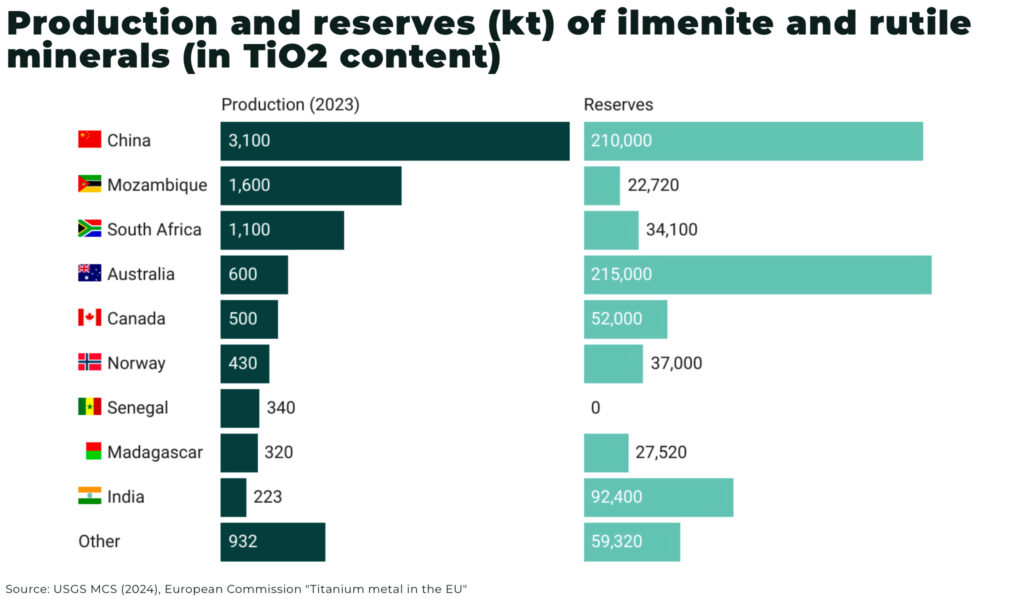
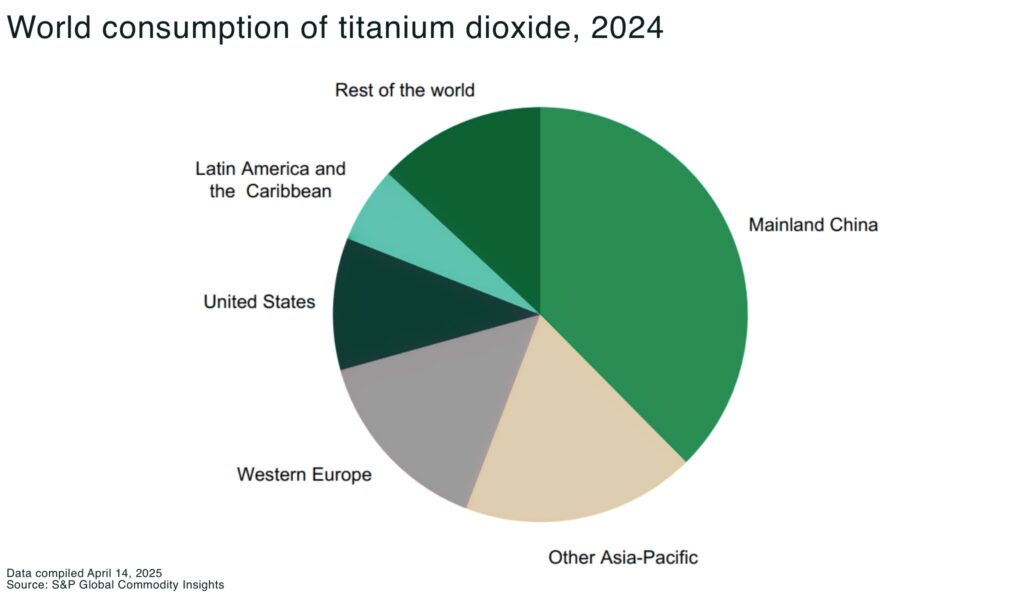
Globally, the titanium market (encompassing titanium dioxide pigments and metal) was valued around $20 billion in 2025 and is projected to grow 3.4% CAGR through 2030 amid rising demand.
Global TiO₂ capacity is concentrated in a relatively small number of suppliers: seven major producers account for 53% of capacity outside China, mainland China’s fragmented producer base accounts for 41%, and the remaining 6% is spread across about 15 smaller producers elsewhere.
Approx 90% of global titanium demand is for titanium dioxide (TiO₂) and 7% is for titanium metal, which, while smaller in tonnage, is critical for high-performance applications including aerospace, defence, medicine, industry and automotive industries. The market is further constrained by specification, with much of the material available globally not meeting the purity and performance requirements demanded by major aerospace and defence end users, further limiting the pool of suitable supply.
These trends underscore why Empire Metals’ Pitfield project is garnering attention. It sits at the nexus of geology and strategy: a massive, high-grade resource in a stable, Western jurisdiction, capable of yielding the kind of premium titanium product that advanced industries need.
Conclusion
In the new era of critical minerals, geology and geopolitics are increasingly intertwined. Pitfield’s giant high-purity titanium resource, being developed with modern, low-cost techniques, is strategically positioned to emerge as a flagship Western source of critical titanium feedstock for both titanium dioxide and titanium sponge metal markets.
At a time when geopolitical shifts are reshaping global markets and supply chains are highly concentrated, projects capable of delivering secure, high-quality titanium are not just attractive, but essential.