
- mining under siege: coordinated disinformation campaigns now target mines worldwide; nearly 40% of monitored mines faced disruptive attacks, derailing operations and stock prices
- geopolitical game-changer: hybrid tactics – from Wagner-backed propaganda in Africa to troll farms in Eastern Europe – undermine Western miners and prop up allied regimes
- real-world impacts: viral fake news has shut down billion-dollar mining projects
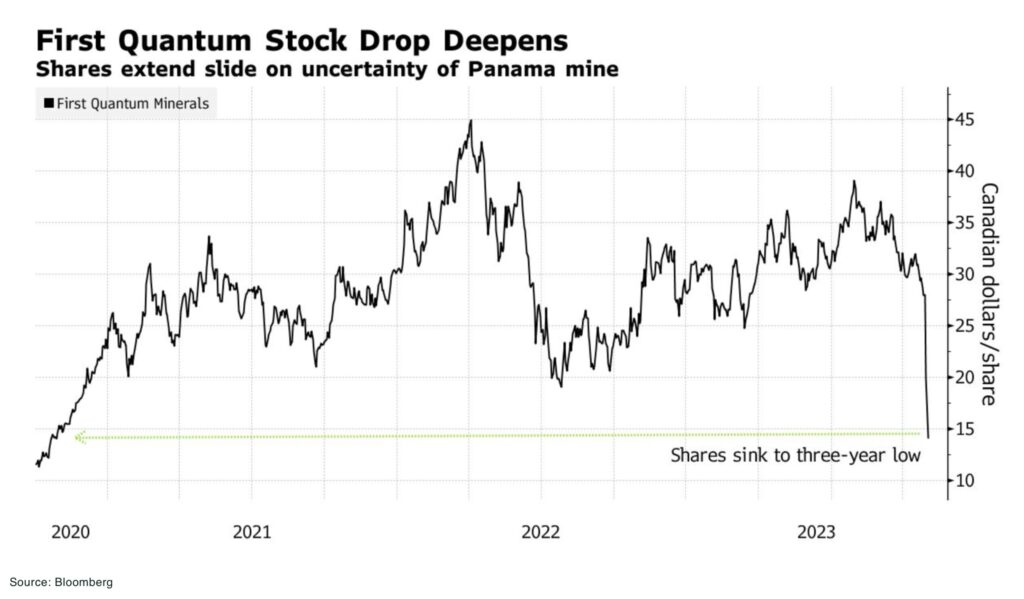
On a rainy Monday morning, mining investors in London watched in disbelief as shares of First Quantum Minerals plummeted. Overnight, Panama’s Supreme Court (on November 27–28, 2023) had struck down the company’s contract for the Cobre Panama copper mine. The mine had became the focus of an intense disinformation war, helping to fuel protests and blockades against the project, with false claims that the mine brought no benefit to Panama and that the land was given away to Canada went viral, whipping up public anger.
The ensuing blockades and political crisis didn’t just halt a US$10 billion project; they wiped out approx 50% of First Quantum’s market value (over US$6 billion) virtually overnight.
This dramatic episode, far from isolated, underscored a new reality that many mining companies are all to well area of — but unprepared for: disinformation has become a strategic weapon in the mining sector — with AI and geopolitics accelerating these trends.
What is the scale of the disinformation war targeting the mining industry?
According to a new report by Refute — a London-based AI tech startup to help organizations detect, analyze, and counter sophisticated disinformation and narrative attacks — 40% of mines that Refute monitored faced highly disruptive disinformation attacks from approx 1,135 bots pushing false narratives that are increasing in complexity and severity.
The increase in disinformation targeting Western interests coincides with China and Russia’s strategic expansion across Latin America and Africa, whether it’s China’s state-backed investment in Latin America or Russia’s approach in Africa of hybrid warfare tactics and coordinated disinformation through groups like Wagner — but, it’s not just major powers but local governments, activists and opportunists.
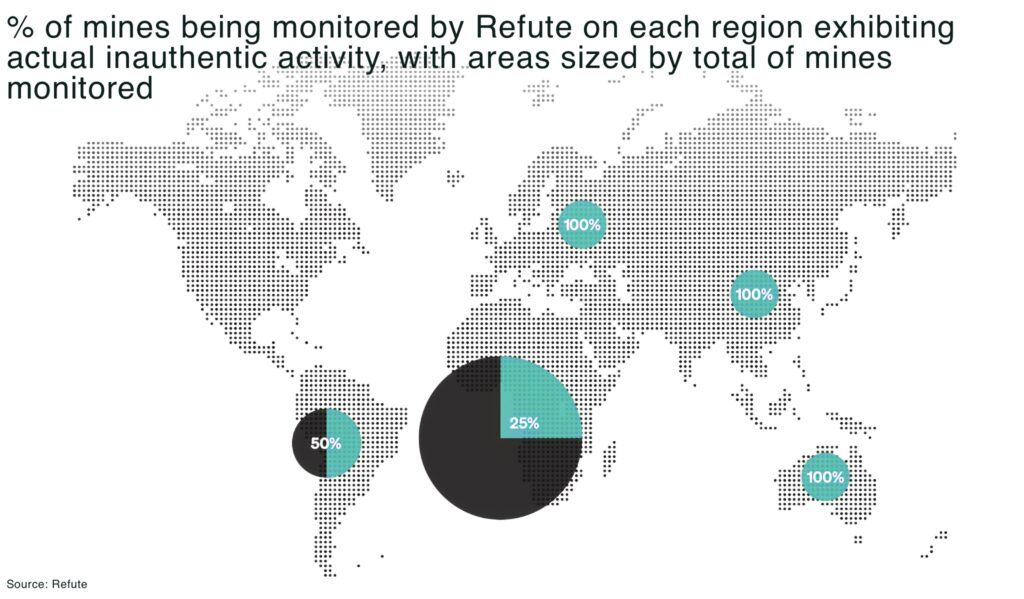
- Eastern Europe: campaigns are led by environmental activists and geopolitical actors, that reflect foreign interests in countries like Serbia. Inauthentic narratives both for and against Rio Tinto’s Jadar mine have also been found, and are linked to the ongoing protests in Serbia
- Africa: the continent’s mineral wealth and great power rivalries make it especially vulnerable, with the main threat activity comes from inauthentic accounts, and reflects the position of local governments
- Latin America: the region has become a hotbed of mining disinformation given its rich copper, lithium, and gold reserves, with campaigns in the region can often be traced back to local governments and environmental activists
- Asia: with a particular focus on Indonesia, the Philippines, and Myanmar, main threat actors in the region include terrorist organisations, foreign influence actors, and local governments
- Australia: negative narratives around DEI policies and indigenous peoples provide a basis for further disinformation and influence campaigns
The main influencers in the local disinformation wars include:
- foreign influence actors
- local governments
- activists
- terrorists or insurgent groups
And, the main themes and narratives targeted in the disinformation war exploit local grievances to incite opposition to Western developments, often focusing on the local environment (including tailings dams), indigenous community, as well as DEI and employee safety.
“Disinformation poses a significant and growing threat to mining organisations, with the potential to disrupt operations, physically harm executives, damage reputations, and even impact financial valuations. With little to no disinformation regulation, threat actors can mount campaigns that infiltrate employee safety and send share prices tumbling before organisations have the chance to detect and respond to the attack”
— Mining under Threat report, Refute
For example, a proposed lithium mine or copper pit can swiftly be recast online as a dire ecological threat or neocolonial theft of national wealth, regardless of facts, and such narratives can swiftly gain traction, forcing governments to backtrack on permits and sending company executives scrambling.
Why is the mining industry a target for disinformation?
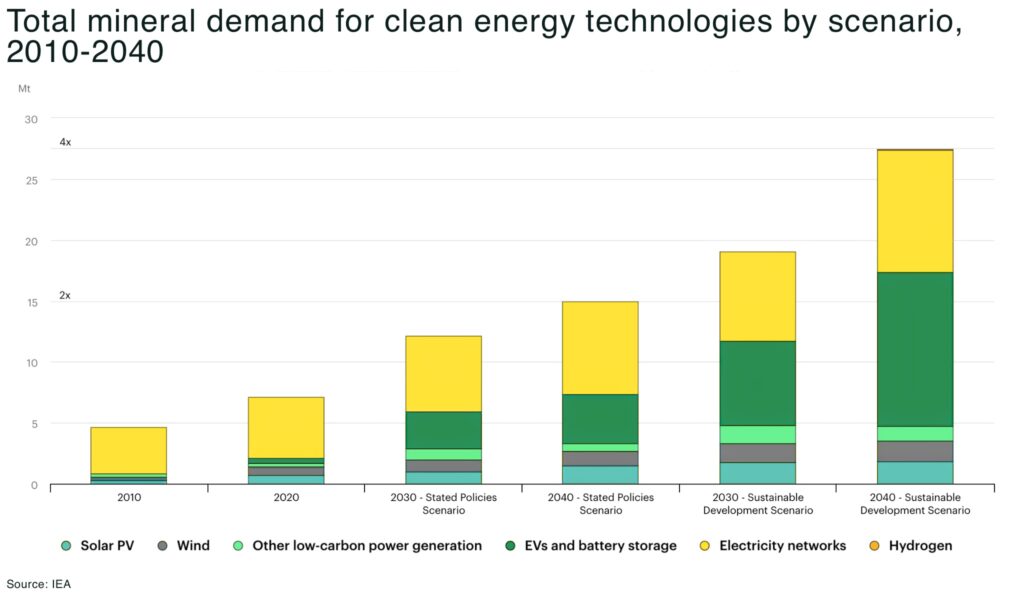
The International Energy Agency projects that mineral demand for clean technologies could triple by 2030 and quadruple by 2040. However, secure supply of these critical minerals is increasingly precarious as China restricts exports, including rare earths, gallium, germanium, tungsten, and antimony, in retaliation for US tariffs as it works to reshore/friendshore supply.
Demand is driven by the minerals-intensive energy transition, the staggering roll out of data centers for AI, as well as military needs for advanced weaponry — all just as supply is tightening across a range of metals.
How do disinformation campaigns work? (bots, AI and viral falsehoods)
Disinformation campaigns often follow a playbook. It typically starts with a sensational narrative seeded online: perhaps a rumor of toxic waste spill, a doctored photo of environmental damage, or a conspiratorial tweet claiming a mining CEO bribed officials. From there, bot networks and troll accounts amplify the message at scale.
Refute documented approx 1,135 bots pushing anti-mining narratives across social platforms and forums. On apps like TikTok and X (Twitter), these fake accounts can account for the vast majority of engagement. For example, up to 83% of viral posts on mining DEI and employee safety come from accounts exhibiting inauthentic behavior.
Modern disinformation goes beyond troll farms manipulating algorithms in St. Petersburg or Beijing, with the next wave including AI-generated content using deepfakes at scale.
Crucially, these influence operations can be multilingual and multi-platform. A false story might start on Facebook in Spanish targeting a local town, then be picked up by Russian state media in English, and later translated into Chinese – each time tailored to the audience with a particular spin.
Mining companies have limited internal disinformation threat-related skills, as well as lacking capacity for a co-ordinated response. By the time mining companies recognize and respond to disinformation campaigns, the narrative has already morphed and traveled further. And an official response can sometimes make the problem worse. This creates a perpetual game of whack-a-mole, where mining firms find themselves perpetually reactive, struggling to reclaim control of the conversation.
Other examples of disinformation against the mining sector
Rio Tinto – Jadar Lithium project (Serbia, 2024)
- Impact: Europe’s largest planned lithium mine faced massive protests and project suspension
- Disinformation tactics: CEO Jakob Stausholm claimed the project was targeted by a “carefully designed and well-organized” disinformation campaign; both pro- and anti-mining inauthentic narratives detected, linked to ongoing protests; “Russian disinformation experts considers it to be highly likely that the Kremlin has played a role in spreading this disinformation”, according to the US State Department
- Claims: the disinformation campaign propagated claims of secret uranium mining, local water poisoning, acid rain over Belgrade
- Complexity: Multiple actors involved, including environmental activists, geopolitical actors, and competing foreign interests
- Outcome: Project paused, staff intimidated, 30,000-person protests in August 2024
The Montepuez Ruby Mine incident, Mozambique (2024)
- Impact: in October 2024, a false social media post initiated by illegal ruby smugglers, claimed the mine would allow free public mining for 24 hours. This digital deception quickly escalated into a real crisis when 500 people stormed the mine, engaging in violent clashes resulting in multiple casualties and a three-month operational shutdown, costing millions in lost revenue
Wagner Group operations (Central African Republic, 2023)
- Impact: After nine Chinese nationals were killed at a gold mine in March 2023, disinformation video circulated falsely claimed France secretly ordered the attack to discredit Wagner mercenary group
- Broader context: Wagner has exported disinformation campaigns to every African country where it operates, with Russia extracting an estimated US$2.5 billion in gold from Africa since 2022
Investment risk and cost of fake news
For mining investors and companies, the implications are stark: disinformation is no longer just a PR nuisance, but is a material risk to operations, assets and market capitalizations.
And, for governments, particularly across the West, delayed or cancelled projects due to protests or political influencers, can threaten long-term supply chains and national security.
Refute warns there are also other potential knock-on effects, including possible insurance premiums for doing business in “disinformation-prone” jurisdictions; investors reluctant to finance possible controversial projects; as well as corporate reputational damage.
The West wakes up to the disinformation threat
Western governments and industry leaders are now pivoting to take on the threat by opening up a new front in the disinformation front:
- major firms often monitor social media for hostile narrative
- some mining companies are hiring specialists (eg ex-military or intelligence analysts) to identify bot networks, fake accounts, and a mounting online crisis
- proactive community engagement, to take the initiative in the information space
- pursue legal takedowns, and flagging content as defamatory or dangerous
High-level officials in the US and EU who we’ve spoken to (off-the-record) say they are aware of the threat and it is being taken seriously — especially now with the latest efforts by the Trump administration to secure critical mineral supply.
Yet, the truth is that most firms remain ill-prepared.
Geopolitical escalation: The Iran War and its impact on the mining disinformation ecosystem
And the Middle East conflict will only sharpen the problem of disinformation across the mining sector.
As resources like diesel and sulphuric acid grow scarcer, driving increased competition among urgent priorities increase (eg helium for semconductors or MRI machines?), so governments are imposing national security measures — hoarding, export restrictions, and strategic reserves. Mining projects are no longer viewed as purely commercial ventures; they’ve become strategic national assets.
And the tighter the supply, the more urgent the priorities, the greater the involvement of governments — the more politicized mining and critical minerals become — a shift that makes them more vulnerable to activist campaigns, foreign state interference, political exploitation, and coordinated online attacks.
And, as the crisis pushes supply chains to source supply from riskier jurisdictions in the short term — jurisdictions already destabilized by the ongoing disruption from the Strait of Hormuz closure — Western mining companies face a compounding challenge: they must establish operations in regions increasingly vulnerable to state-sponsored disinformation campaigns and local political instability, creating simultaneous threats to both operational security and investment viability.
“Since the outbreak of the Iran war, we’ve been continuously monitoring mining operations, and looking at disinformation trends by country and commodity over time.
While we haven’t tracked an immediate impact on disinformation campaigns against mining companies, we expect to see secondary knock-on effects in the mining sector to reflect the shift towards energy security and renewable energy sources.
This could lead to a scramble to secure control over critical mineral supply chain, creating a domino effect from the conflict in the Middle East into riskier jurisdictions such as Africa. On the whole, disinformation will undoubtedly be deployed as a weapon in the battle over commodities and battery metal supply”
— says Tom Garnett, CEO, Refute
Conclusion
Just as mines invest in fences and keypasses, they also need to invest in monitoring and safe-guarding the digital information zone around their operations. They should have started more than a decade ago, but it’s not too late — and now the weight of national governments is coming in to support.
In the short-term it would be easy to throw disinformation at disinformation — but, in the long-term, this would be a disaster for trust and community cohesion. The old adage that “sunlight is the best disinfectant” holds true here in winning hearts and minds.