

- the global sulphuric acid shortage has a new flashpoint: Cameco suspended mining at Cigar Lake on July 1 after a mechanical failure at the acid plant shut Orano’s McClean Lake mill
- the suspension comes six days after Lotus Resources paused Kayelekera in Malawi because contracted and prepaid third-party acid deliveries were delayed or not fulfilled
- Benchmark Minerals warns sulphuric acid prices more than doubled between the start of the Iran war and mid-April
On July 1, Cameco suspended mining at Cigar Lake, the world’s highest-grade uranium mine, after operational problems shut the sulphuric acid plant at Orano’s McClean Lake mill.
A broken acid plant in northern Saskatchewan would normally be a maintenance problem. In the middle of a global sulphuric acid shortage, due to the it leads to conflict and closure of the Strait of Hormuz, it becomes a uranium market event.
The mechanical failure at Cigar Lake is local. Cameco has not linked it to the Middle East or the Strait of Hormuz. The wider risk is that the spot market ,which should provide replacement acid is already under severe pressure.
Cameco’s shutdown is a warning that the mining industry has lost its sulphuric acid buffer.
Cigar Lake turns a reagent shortage into lost production
Cameco expects McClean Lake to restart in approximately two weeks (but it could, of course, take longer). Orano is repairing the plant and looking for alternative acid while it waits for replacement parts. The company says there is no expected impact on Cigar Lake’s 2026 guidance, but longer repairs or difficulty sourcing replacement acid could change that outlook.
Cigar Lake was expected to produce 17.5–18 million pounds of U3O8 in 2026, including 9.5–10 million pounds attributable to Cameco. The mine packaged 4.9 million pounds in the first quarter.
We warned in March that sulphuric acid had become a single point of failure across critical-mineral processing. Cigar Lake shows that risk has reached even the highest-quality assets in the safest mining jurisdictions.
The Strait of Hormuz squeezes replacement sulphuric acid supply
Sulphuric acid is difficult and expensive to move: it is bulky, corrosive and often produced close to where it is consumed. Its main feedstock, sulphur, is easier to ship, but almost 50% of global seaborne sulphur exports normally come from the Middle East, which accounted for around 24% of global sulphur production at 83.87 million metric tons last year.
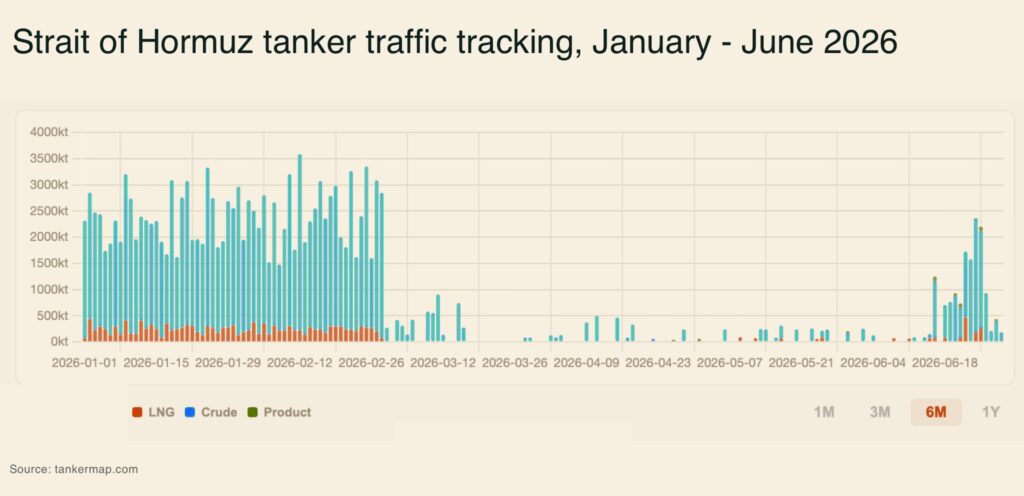
Shipping through Hormuz collapsed after conflict escalated at the end of February. UN Trade and Development recorded daily ship transits falling from 103 to single digits within weeks. And, despite the signing of an MoU, AIS data show tanker traffic shows a 7-day average of 6.7 vessels per day, compared with a rate of approx 125 a day before February 2026.
China tightened sulphuric acid exports
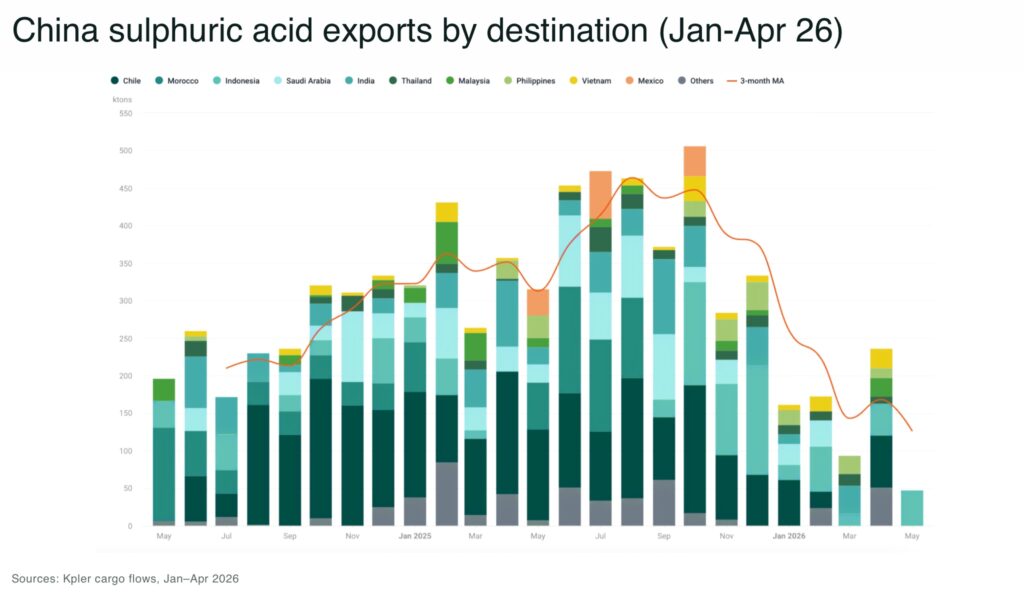
China exported about 4.6 million metric tonnes of sulphuric acid in 2025, making it the world’s largest exporter, but then tightened export restrictions in April 2026.
Prices reacted first. Platts assessed sulphuric acid delivered to the US Gulf at US$400 per metric tonne on May 6, up from US$155 before the war. Benchmark later put spot acid above US$380 per tonne in Indonesia and US$440 per tonne in Chile.
Why sulphuric acid important for mining and refining
Sulphuric acid is one of industry’s basic working chemicals. In mining it is used mainly in leaching, where ore is treated with acid so metals can be dissolved, separated and recovered. It is central to hydrometallurgy, especially for acid-intensive routes such as HPAL nickel, oxide copper leaching, and parts of the uranium, rare earths and titanium sulphate-route processing chains.
Without acid, a large share of low-grade or chemically difficult ore cannot be processed economically at scale. The metals particularly exposed include:
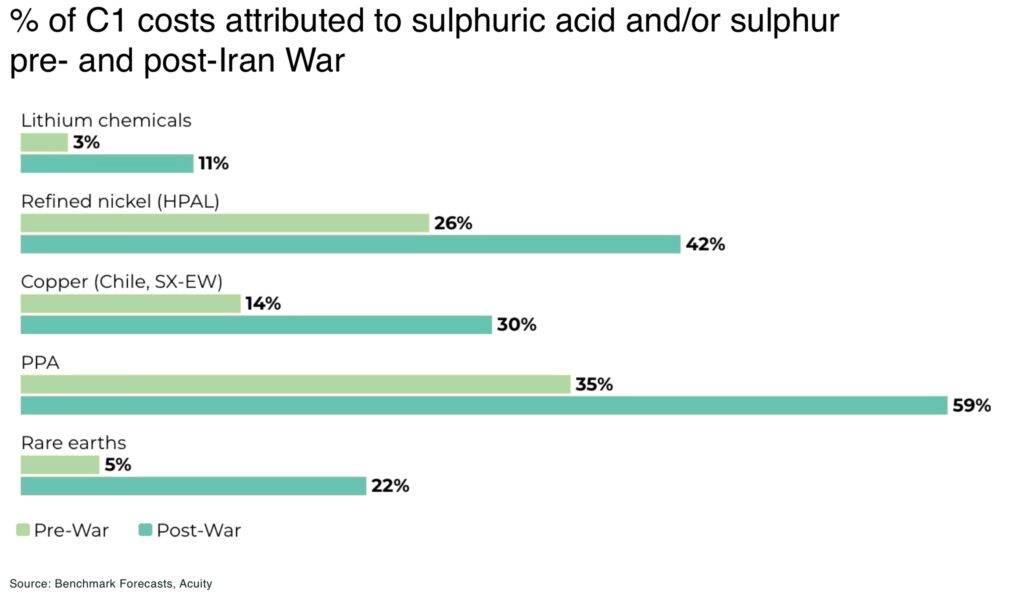
According to Benchmark Minerals the sulphuric acid crunch is now feeding directly into critical minerals production costs, with sulphur and acid accounting for an average 33% of C1 costs across key supply chains — rising to 42% for HPAL nickel and 30% for Chilean SX-EW copper.
Between the start of the conflict in the Middle East at the end of February and mid-April, sulphuric acid prices surged by more than double and sulphur prices rose by 50% (albeit with regional variations).
The mining industry is exposed to shortages, not price
But it’s the supply shortage — not the prices — that are now starting to impact the mining industry.
Lotus Resources paused Kayelekera on June 25 after multiple third-party acid deliveries were delayed or not fulfilled. Its own acid plant was not ready to fill the gap after refractory bricks failed during commissioning.
And now, Cameco has suspended mining at Cigar Lake, the world’s highest-grade uranium mine, after operational problems shut the sulphuric acid plant at Orano’s McClean Lake mill.
The sequence matters: first higher prices, then missed deliveries, then production stops.
| Sector | Why acid matters | Signal for investors |
|---|---|---|
| Uranium | Acid is used in conventional milling and in-situ recovery. Cameco and Lotus have now paused production, while Kazatomprom’s 2026 guidance remains subject to sulphuric acid availability. | Watch physical reagent supply, not only uranium spot prices. |
| Lithium | Benchmark estimates acid has risen from 3% to 11% of hard-rock lithium chemical C1 costs, overtaking energy as the largest individual component. | High-cost converters and import-dependent plants lose margin first. |
| Nickel | Sulphur now represents 42% of HPAL nickel costs, up from 26% before the conflict; Indonesia sourced 76% of its sulphur imports from the Middle East in 2025. | Captive sulphur burners and longer inventories gain an operating advantage. |
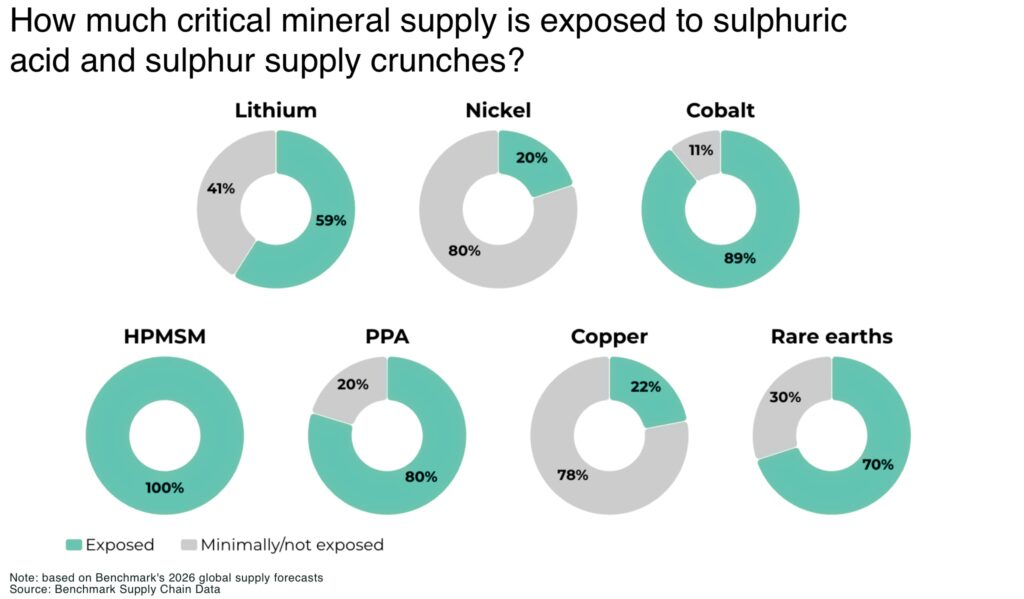
| Cobalt | Laterite ores are processed using hydrometallurgy, with HPAL using sulphuric acid to leach both nickel and cobalt. Benchmark estimates that more than half of expected 2026 cobalt production is exposed to sulphur or sulphuric acid disruption. | Cobalt supply can tighten as a secondary effect of curtailments at nickel and copper-cobalt operations. |
| Rare earths | Bastnäsite and monazite concentrates require chemical cracking to release the rare earths; the US Department of Energy identifies high-temperature cracking with sulphuric acid as a key processing route. Benchmark estimates that more than half of expected 2026 rare-earth production is exposed to sulphur or sulphuric acid disruption. | Acid-bake refiners face higher reagent costs and outage risk; alternative flowsheets and secure captive supply gain value. |
| Copper | Acid-intensive SX-EW operations account for 22% of mined output, while S&P Global models a 5.1% increase in global copper mining costs under its updated assumptions. | Leach operations are exposed; smelters can benefit because acid is a saleable byproduct. |
Benchmark estimates that more than half of expected 2026 lithium, cobalt, rare-earth and purified phosphoric acid production is exposed to sulphur or sulphuric acid disruption; high-purity manganese sulphate supply is 100% exposed.
Conclusion
If there was a single point of failure for the metals and mining industry, it would be sulphuric acid. If the acid is not in the tank, then the ore will stay in the ground — and prices will hit the sky.
Q&A
Why did Cameco suspend Cigar Lake?
Cameco stopped mining because the sulphuric acid plant at Orano’s McClean Lake mill shut for repairs. With limited ore storage at Cigar Lake, mining cannot continue for long while the mill is unable to process ore.
How long will the Cigar Lake shutdown last?
Cameco expects the McClean Lake mill to restart in approximately two weeks from July 1, or around mid-July. It warned that longer repairs or difficulty finding alternative acid could affect Cigar Lake’s 2026 production outlook.
Why is there a global sulphuric acid shortage?
Middle East disruption has constrained sulphur, the main feedstock for sulphuric acid, while Chinese export restrictions removed another major source of traded acid. The Middle East normally supplies nearly half of global seaborne sulphur exports.
Which commodities are most exposed to sulphuric acid?
Uranium, copper, nickel, lithium, cobalt, rare earths, manganese and phosphate all use acid-intensive processing routes. Benchmark estimates more than half of 2026 lithium, cobalt, rare-earth and purified phosphoric acid production is exposed to sulphur or sulphuric acid disruption.
Will Cameco buy uranium on the spot market?
Cameco has not announced Cigar Lake-related spot purchases. It can use inventory, product loans and market purchases to manage deliveries; in the first quarter it bought 0.2 million pounds and borrowed 750,000 pounds.