
Ben Elvidge serves as both the lead for metals.io and Head of Alternative Assets at Trilitech, a London-based R&D hub for the Tezos blockchain. He currently leads the launch of real-world asset (RWA) projects, most notably spearheading the world’s first tokenized physical uranium initiative, xU3O8, and its dedicated platform, uranium.io, as well as metals.io, a platform for investing in uranium, gold, and other critical metals.
Prior to joining Trilitech, Ben was the Chief Product Officer at Bridgeweave, an AI-powered fintech. Before that, he was an Executive Director at Morgan Stanley Investment Management. LinkedIn | X
Most people, when they think of metals from an investment perspective, think of gold and silver. But things have changed in recent years, in part due to a rapid acceleration in global industrialisation. China, India and others have emerged as manufacturing superpowers, while the U.S. has further established itself as a global technology leader, with AI driving unprecedented demand for critical minerals and the components manufactured from them. That’s a fact made evident to anyone who’s tried to buy a new laptop or memory card recently.
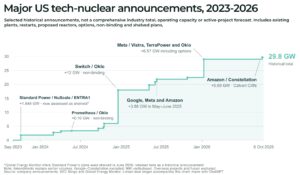
The growth of AI and the resulting boom in semiconductor manufacturing has also led to an energy crunch, straining a grid that’s already struggling to meet demand. Add to that a pressing need to reduce CO2 emissions, and it’s hard to ignore that change is already here. Combined, these factors have driven demand for a new breed of commodities: uranium and rare earth metals like hafnium and indium that are critically important for industry.
Somehow the investment potential of these commodities remained untapped for many years, largely due to systemic barriers that prohibited mainstream access. The London Metal Exchange was founded in 1877, and when it comes to how metals and commodities are traded today, not much has changed in the last 150 years. There’s still no digital market or transparent pricing. A lot of commodities are traded in over-the-counter (OTC) trades, at prices agreed on the spot.
The launch of uranium.io in December 2024 was the catalyst for change that the commodities sector needed. Unlike other assets with transparent real-time spot prices, uranium typically trades OTC through private contracts; fractionalization opened it up to investors who previously had no practical way in. The same barriers that made uranium inaccessible had already been removed for other real-world assets like art and real estate. It was only natural that commodities would be next.
We always started with the idea that uranium was a blueprint for what could be done. We proved with uranium.io that you can take a market that’s pretty archaic but crucial, and use on-chain infrastructure and blockchain rails to improve access to it. We removed a lot of the operational barriers and removed a lot of the capital barriers. When we launched uranium.io, we thought that would be the start of something bigger. And here we are.
Uranium was interesting not just from the fundamentals of how the market operates, but because it’s a technology-flavoured commodity. There’s a clear link between uranium and the nuclear energy sector, and nuclear is now linked to AI. That makes it potentially much more interesting than, say, a T-bill or a tokenized money market fund, which, for context, are currently the biggest growing sector after gold in real-world assets. Rare earth metals play into similar themes: previously inaccessible, but critical, not just from an investment thesis perspective, but for society as a whole.
For many of us working on tokenization, the goal is a single venue where investors can digitally access a wide range of assets that were previously off-limits to them. Being able to provide on-chain assets that are genuinely diversified gives people something that isn’t widely available. Rare earth metals are well diversified from equities, other digital assets, and fixed income, and they’re dominating the news cycle right now for good reason.
Metals.io is an attempt to modernize that infrastructure and bring it into the future with the best technology we’ve got – fast, robust, secure, low cost, and 24/7 globally accessible – so people can focus on getting the closest possible exposure to the asset rather than worrying about fees and slippage.
In terms of who this is for: crypto investors who want diversified assets alongside their existing holdings; traditional commodity investors who currently have to use uranium company stocks or ETFs to tap into the market but want direct spot exposure; and institutional investors and end consumers in heavy industry who need these metals and see genuine value in trading them on modern rails. We think the thesis holds for all four. There is still quite a way to reach mainstream, and for large traders and institutional users to get on board as a primary mechanism. However, we’ve solved some of the core problems, such as near-instantaneous settlement, an irrefutable record of ownership, and reduced counterparty risk, and continue to push towards a wide spectrum of products.
We’ve reached a point at which financial literacy is at an all time high. More and more people want and expect to diversify their investments, and tokenization is providing a means of providing access to exciting assets that were previously out of reach for most people. While previously there was an element of skepticism when talking about how blockchain technology could upend commodities trading, the tide has now turned. When asset managers like BlackRock are talking about tokenization you have to accept that tokenized commodities are having a moment. It’s going to be exciting to see where the sector can go from here.
Subscribe for Investment Insights. Stay Ahead.
Investment market and industry insights delivered to you in real-time.