

Mitchell Smith is a seasoned finance professional with over 15 years of entrepreneurship, executive leadership, and capital markets experience. In addition to his command in accessing capital markets he has extensive hands-on experience as a key stakeholder, management, and board member for private and public resource companies. Mitchell’s considerable board and executive leadership experience together with his extensive sectoral expertise in battery and energy technology has positioned him as a recognized global voice on critical mineral supply chain security. Mitchell is currently a Partner, Metals & Mining at Moneta Securities, a Vancouver-based boutique investment bank. He is a Director of the Battery Metals Association of Canada, a not-for-profit organization supporting Canada’s role in the rapidly expanding battery supply chain. He also serves as founder, director, and board member across several private and public companies in Canada and the UK, including being a non-executive independent director of AE Fuels.
For years, investors focused almost exclusively on lithium, copper, cobalt nickel, and rare earths as the world transitioned toward electrification and advanced manufacturing. But beneath the surface, another mineral, one largely unknown outside industrial circles, has quietly become one of the most strategically important commodities in the global supply chain.
That mineral is fluorspar.
And with North America facing a severe shortage of domestic production, companies positioned to help rebuild supply are beginning to attract growing attention from both investors and policymakers alike.
Among the newest entrants into the space is AE Fuels Corporation, a Canadian-listed critical minerals company assembling what could become a significant district-scale fluorspar position in New Mexico through its Fluorite Ridge Project.
At a time when the United States is urgently attempting to secure domestic critical mineral supply chains, AE Fuels may be entering the market at exactly the right moment.
Why Fluorspar has suddenly become a strategic mineral
Despite receiving far less public attention than lithium or rare earth elements, fluorspar is indispensable to the modern economy.
Fluorspar is the primary source of fluorine and the essential feedstock used to produce hydrofluoric acid (HF), one of the most important industrial chemicals in the world. Without fluorspar, industries central to modern technology and national security would struggle to function.
Fluorspar is used in:
- semiconductor manufacturing
- lithium-ion battery production
- electric vehicle supply chains
- uranium enrichment and nuclear technologies
- aluminum and steel manufacturing
- refrigerants and advanced chemicals
- solar panels and renewable energy infrastructure
- defense and aerospace applications
In particular, hydrofluoric acid is critical in semiconductor etching, a foundational process for producing advanced computer chips.
As artificial intelligence, electrification, defense spending, and domestic manufacturing continue accelerating globally, the importance of securing reliable fluorspar supply is becoming increasingly difficult to ignore.
The problem: North America barely produces fluorspar
The strategic importance of fluorspar stands in stark contrast to the reality of global supply.
The United States currently imports the overwhelming majority of its fluorspar requirements, with much of the global market dominated by China, Mexico, Mongolia, and South Africa. China alone has historically controlled a significant share of global production and downstream processing capacity.
That dependence has created growing concern among US policymakers and industrial consumers.
Perhaps most alarming is the fact that the United States currently has virtually no meaningful primary domestic fluorspar mining industry operating at scale.
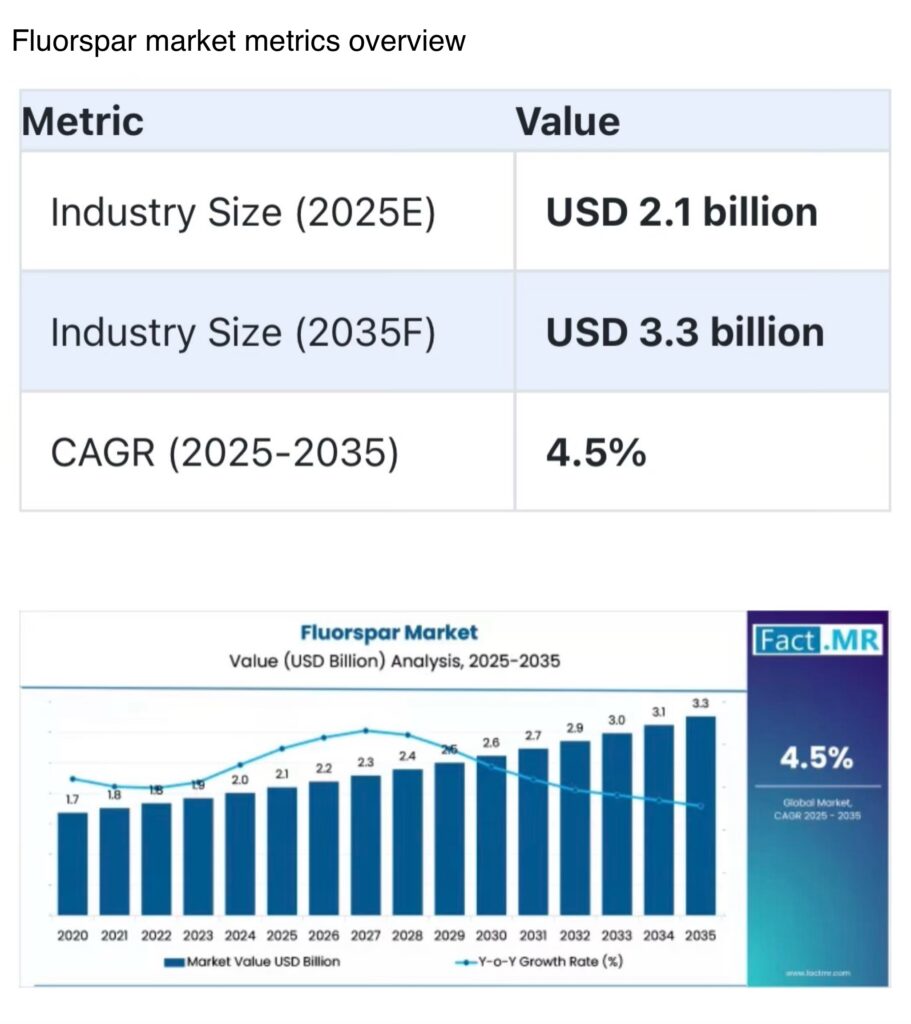
Historically, the US once produced significant amounts of fluorspar, particularly from Illinois and Kentucky. However, decades of underinvestment, lower-cost foreign competition, and shifting industrial priorities led to the collapse of domestic production capacity.
Today, North America has only a handful of advanced fluorspar development projects, and very few publicly traded companies offer meaningful exposure to the commodity.
That scarcity matters.
As governments increasingly prioritize supply chain resilience and domestic critical mineral production, the companies capable of developing US-aligned fluorspar supply could occupy an increasingly strategic position in the market.
The supply chain vulnerability is growing
The geopolitical environment is further intensifying the urgency.
Over the past several years, Western governments have become acutely aware of their dependence on foreign-controlled mineral supply chains. Export restrictions, geopolitical tensions, and rising resource nationalism have highlighted vulnerabilities across numerous critical materials.
Fluorspar sits directly in the middle of that issue.
Without reliable fluorspar supply:
- semiconductor manufacturing expansion becomes more difficult;
- advanced battery production faces bottlenecks; and
- domestic chemical manufacturing remains exposed to foreign dependency
This is precisely why investors are beginning to revisit overlooked critical minerals capable of supporting North American industrial independence.
The opportunity is no longer simply about commodity prices, it is increasingly about strategic scarcity.
Enter AE Fuels: a new fluorspar player with district-scale ambitions
Against this backdrop, AE Fuels Corporation, listed on the TSX Venture Exchange under AEF and OTCQB under NRGFF, is emerging as a company attempting to establish itself within one of the most supply-constrained critical mineral markets in North America.
The company recently announced a major expansion of its wholly owned Fluorite Ridge Project in Luna County, New Mexico, increasing its footprint to approximately 1,673 acres across a seven-kilometre mineralized trend.
The project area itself carries considerable historical significance.
Mining activity at Fluorite Ridge dates back to the early 1900s, with notable production occurring during World War II when the US urgently required domestic industrial mineral supply. Historical reports from the district referenced exceptionally high-grade fluorspar mineralization, with some production reportedly reaching grades exceeding 90% CaF₂.
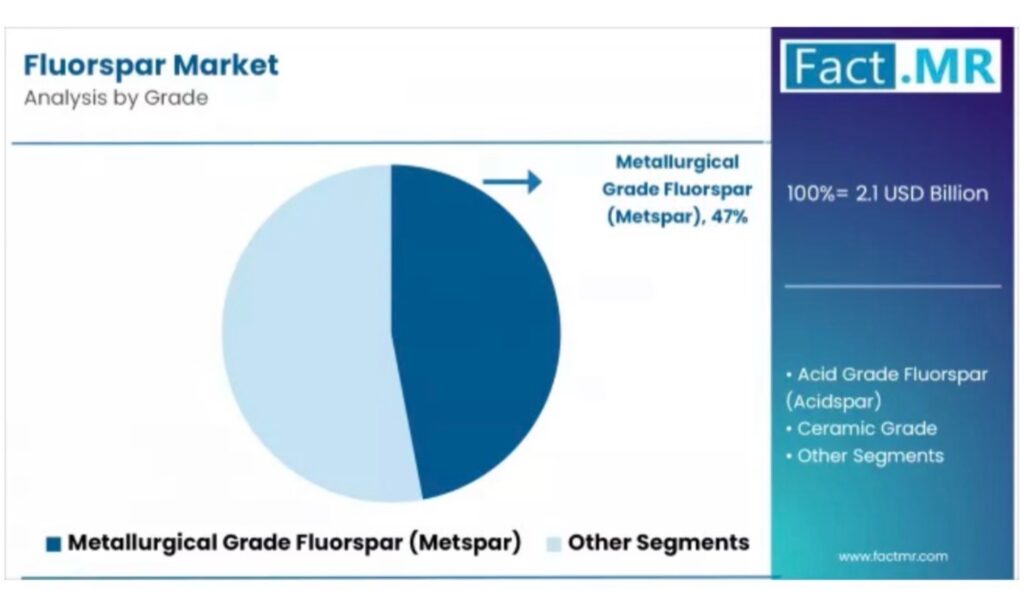
Importantly, historical mining appears to have focused primarily on selective high-grade extraction rather than systematic district-scale exploration.
That distinction may prove critical.
According to AE Fuels, large portions of the district have never been subjected to modern exploration techniques, leaving the possibility for broader mineralized systems beyond the historically mined veins.
Why Fluorite Ridge could matter
AE Fuels is not simply marketing a historical mining story.
The company has already completed:
- extensive geological mapping;
- soil geochemistry programs;
- channel sampling; and
- early metallurgical characterization studies
Initial exploration work reportedly identified strong fluorine anomalies and geological features that may suggest the presence of larger-scale mineralized systems, including jasperoid and breccia-hosted mineralization.
If future drilling validates the existence of broader bulk-tonnage mineralization, Fluorite Ridge could evolve beyond a small historical fluorspar occurrence into a potentially strategic North American critical minerals asset.
That possibility is what makes the project increasingly interesting from an investment perspective.
Why AE Fuels may represent a unique investment opportunity
For investors seeking exposure to critical minerals, fluorspar remains one of the least crowded sectors in the market.
There are currently very few publicly traded North American companies offering meaningful fluorspar exposure, particularly in the United States.
That scarcity alone creates a potentially compelling dynamic:
- limited public market competition;
- growing strategic importance;
- rising government focus; and
- increasing industrial demand
AE Fuels also benefits from timing.
The company is advancing its project during a period when:
- governments are aggressively supporting domestic supply chains;
- semiconductor manufacturing is expanding across North America; and
- industrial policy is increasingly favouring US-aligned mineral production
Should fluorspar continue gaining recognition as a strategic bottleneck commodity, companies with advanced North American projects could experience significant re-rating potential.
As with any junior exploration company, AE Fuels still faces substantial risks related to exploration success, financing, permitting, and project development. However, the broader macro environment surrounding fluorspar has arguably never been more favourable.
The bigger investment thesis
The global critical minerals race is entering a new phase.
The market is no longer focused solely on headline commodities like lithium and copper. Increasingly, attention is shifting toward the overlooked materials essential to semiconductors, defense systems, AI infrastructure, chemical manufacturing, and energy security. Materials once considered niche industrial minerals are rapidly becoming strategically important as nations compete for technological and manufacturing independence.
Fluorspar sits at the center of that transformation.
And in a market with extremely limited North American production capacity, companies capable of establishing domestic supply may become increasingly valuable strategic assets.
With a district-scale footprint, historical high-grade production, exposure to US industrial policy tailwinds, and growing recognition of fluorspar’s importance to advanced manufacturing, AE Fuels may be emerging as one of the more intriguing speculative stories in the North American critical minerals space.
For investors looking beyond crowded battery metal trades, the “new fluorspar player in town” could be worth watching closely.