
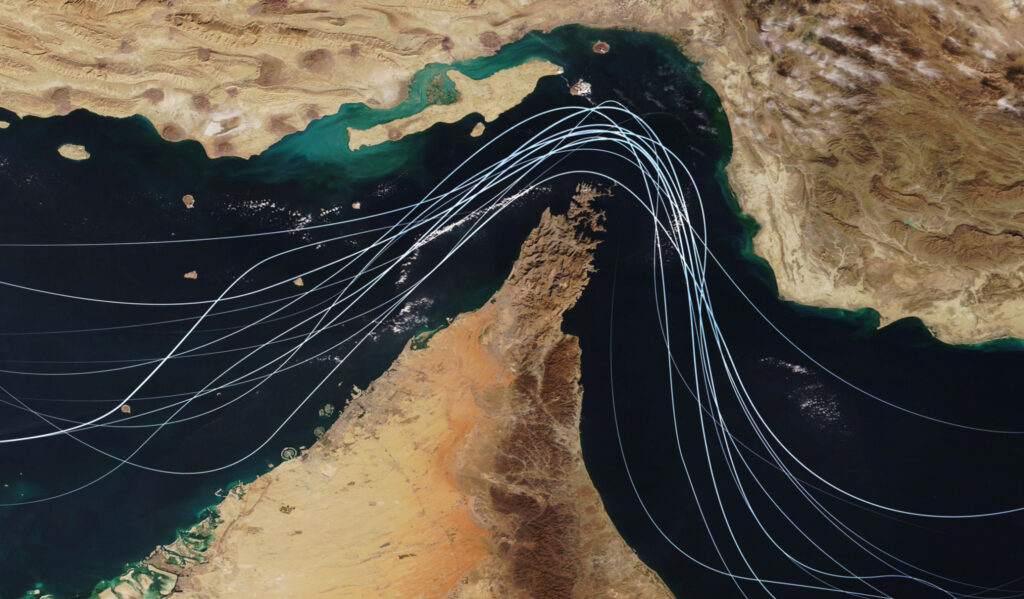
- The Strait of Hormuz normally carries close to 20 million barrels a day of crude and oil products. The IEA says flows have fallen from around that level to a trickle, creating the largest oil supply disruption in market history.
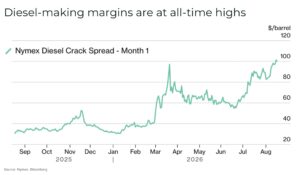
- Singapore gasoil prices jumped 57% since February 28, while jet fuel surged 114%, showing refined fuels are tightening faster than oil itself.
- Diesel is the mining industry’s pressure point. Up to 40% of Australia’s diesel is consumed by mining, while Deloitte says the sector runs more than 50,000 large diesel-powered trucks
Oil exports through the Strait of Hormuz have cut oil exports from approx 20 mb/d before the war to a “trickle“, driving diesel and petrol prices higher. This is a major problem for the mining industry.
Oil prices may be hovering below $100 — after the Trump administration suggested they would use the futures market to drive prices down — but that does not mean oil is getting through. To put in context: approx 20-34% of global crude oil trade, passed through the Strait.
“The war in the Middle East is creating the largest supply disruption in the history of the global oil market” — IEA, Oil Market Report, March 2026
For the mining industry diesel does not just run haul trucks. It runs pit fleets, generators, rail, marine logistics, contract mining equipment, and much of the heavy supply chain that gets ore out of the ground and into a mill, a port, or a smelter. Let alone the ships and trains to transport of ships, trains and trucks to transport the commodities.
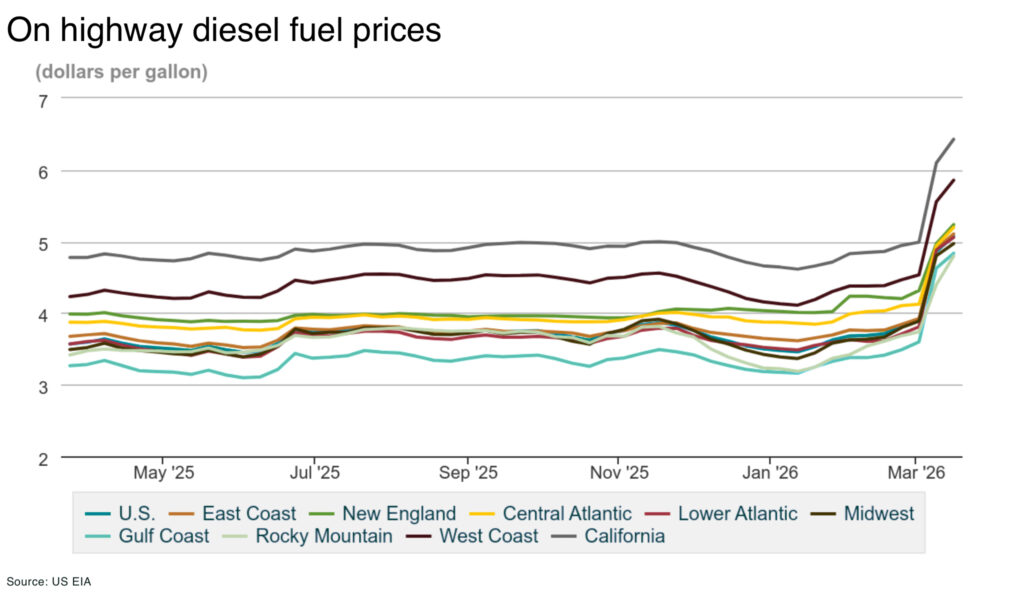
Diesel prices have soared. In the US averaging $5 a gallon; in Australia, rising approx 48.8% to AUD $2.456. in the last month; in Singapore, surging 255%, from S$0.90 to S$2.30 a litre; etc.
To put the diesel price rise in context for the mining industry:
- the mining industry employs more than 50,000 large mining trucks, mostly diesel-powered and consuming about 900,000 liters of diesel annually
- in Australia, the mining sector uses approx 9.6 billion litres of diesel per year, roughly 10% of the country’s total energy consumption
- in Canada, in the last survey of nine major open-pit mines (done in 2005), diesel was the most heavily used fuel at 235 million litres
Heavy off-road vehicles, including construction equipment, mining machinery, and agricultural vehicles, consume 20% of global diesel.
“Diesel is the most exposed product to this conflict structurally,” Shohruh Zukhritdinov, founder of Dubai-based Nitrol Trading, told Reuters. “Diesel underpins freight, agriculture, mining and industrial activity, making it the most macro-sensitive barrel in the system.”
The diesel supply loss associated with the Strait of Hormuz disruptions is estimated to be 3-4 million barrels per day, or roughly 5%-12% of total global consumption. This has meant diesel prices have increased faster since the start of the Middle East war compared to oil and gasoline.
To return to the Australian example: up to 40% of Australia’s diesel is consumed by mining — but what happens if shortages force the government to prioritise diesel for food production and distribution?
What does that mean for the mining industry?
Mining has seen diesel shocks before, and the pattern is usually the same: first comes margin compression, and then operators start cutting fuel intensity wherever they can.
The immediate response is usually defensive rather than transformational: mines build on-site inventories, lock in supply contracts, ration non-essential use, and push harder on dispatch, idling, haul-route efficiency, and maintenance to squeeze more tonnes out of each litre.
During the 2022 diesel squeeze, high prices and shortages accelerated operational fuel-saving measures across the resources sector, as miners tried to protect margins from a transport-fuel shock that was feeding straight into site costs.
Many countries and miners have diesel stockpiles (usually for emergencies such as flooding) but every site is different. In Australia, AngloGold Ashanti told ABC that it is “business as usual” — with Australia itself holding domestic reserves for an estimated 34 days of diesel domestic reserves — but for how long?
Some mining companies, similar to airlines, also hedge their diesel costs.
However, in a real diesel squeeze, once inventories start running low, the response becomes operational.
Mining companies guidance is to cut discretionary fuel burn first: less non-essential movement, tighter dispatch, fewer wasted haul cycles, stricter idling controls, and a sharper focus on keeping only the most productive equipment running. Fuel-management specialists that work with large mines describe exactly this pattern: tighter forecasting, tighter ordering cycles, and more aggressive monitoring of site-by-site fuel use when supply becomes uncertain.
If the shortage worsens, mines start prioritizing what gets fuel and what does not. That can mean keeping ore movement going while delaying waste stripping, contractor activity, exploration support, or other work that is important but not immediately production-critical.
Basically, mines start shutting down.
How long until mines start shutting down?
We ran some numbers with ChatGPT.
There is no single universal shutdown clock for mines, instead the answer is a range:
- best-positioned mines: can usually keep running for 4–8 weeks
- typical remote diesel-heavy mines: begin facing real curtailment risk in 2–6 weeks
- weakest or least-protected operations: can run into trouble in days to 2 weeks
A potential shutdown timeline:
0–7 days: price shock, not mine shutdowns
In the first week, most mines do not shut. They pay more, scramble for deliveries, and protect on-site stocks. National oil reserve releases also start to cushion the first hit; eg the IEA has already approved a 400 million barrel emergency release, and Australia has also moved to release fuel from emergency reserves as well. These moves help prevent an immediate system-wide seizure, even if it does not solve local delivery bottlenecks.
1–3 weeks: weakest sites start to wobble
The first real problems tend to appear after a few weeks, especially at remote operations, mines dependent on trucked-in fuel, and sites with thin working inventories. The lower end of the timeline can be days to a couple of weeks where logistics are fragile.
2–6 weeks: curtailment risk becomes serious
This is the danger zone for the average diesel-heavy remote mine. By this point:
- hedging may offset some price pain, but it does not create physical fuel
- stockpiles have been drawn down
- governments may still have reserves, but distribution into the mining markets will slow as other sectors are prioritised
6–12 weeks: broader mine slowdowns and selective shutdowns
If Hormuz stayed effectively shut for this long, the problem of diesel supply likely stops being just “high prices” and becomes allocation and physical scarcity. By then, mines that are not top priority customers, are far from fuel hubs, or have high strip ratios and weak margins would be under real pressure to:
- defer waste stripping
- cut contractor activity
- slow haulage
- suspend lower-priority pits or satellite operations
- in some cases place care-and-maintenance decisions on the table
This is the stage where national reserves may still be supporting the economy, but not every mine gets all the diesel it wants.
Reuters’ reporting that retail diesel could roughly double if the closure persists is important here: even before a mine fully runs out, the economics can break first. A mine can remain physically operable but become uneconomic to run at full rates.
Which miners are best positioned?
The winners are not necessarily the biggest miners. They are the miners with the lowest fuel intensity and the most energy flexibility — a process some miners have been pushing as part of the energy transition to cleaner energy sources.
Rio Tinto, for example, has already been working to transition its fleet away from fossil fuel diesel, with its Boron mine in California as the first open-pit mine to fully transition heavy machinery to renewable diesel in 2023, and Rio said the later transition at Kennecott means renewable diesel now replaces 11% of its global fossil diesel consumption.
But most of these energy transition deadlines were for 2030-2050, instead diesel use largely increased in the last decade.
Instead, we recommend to look at geographies: which countries have the largest shock absorbers to the diesel price rise, for example:
- countries with secure supply of diesel (eg the USA – not necessarily Asia which is highly exposed to Middle East fuel)
- and, countries with large strategic oil and diesel reserves (eg China)
How much do mining costs rise when oil rises?
The relationship is not linear, but it is real and historically visible.
Estimates from S&P Global and BMO, using Wood Mackenzie data, suggest mining costs rise:
- about 4.2% for iron ore
- 3.5% for copper
- roughly 2% for gold
- Iron ore: about +4.2% mining cost for every +10% oil
- Copper: about +3.5% for every +10% oil (Project Blue forecasts a $50/b rise in oil prices typically lifts copper mining costs by 5%–10% overall)
- Gold: about +2% for every +10% oil
- Copper energy cost share in 2025: 22.7% of total cash costs
- Gold fuel cost inflation: $44/oz in 2022, rising to $91/oz in 2024
On that basis, if crude averages around US$100 a barrel — about 47% above the 2025 average — mining costs could rise roughly 20% for iron ore, 16% for copper, and 9% for gold.
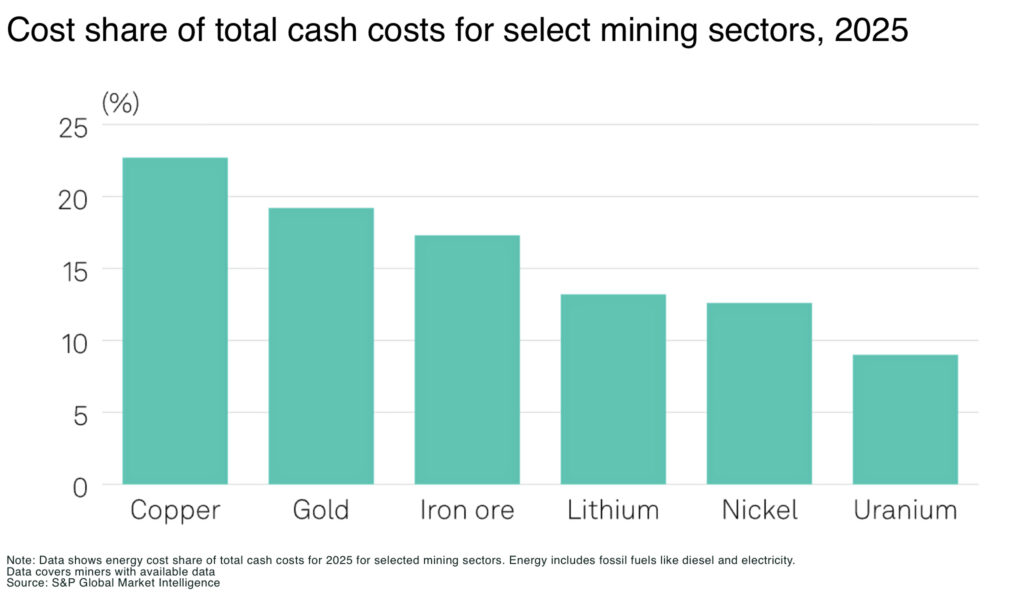
The key point is that mining’s exposure to oil prices is commodity-specific:
- iron ore tends to be hit hardest because of its bulk mining and transport intensity
- copper is close behind because large open pits, truck haulage and energy-intensive processing leave a lot of surface area exposed
- gold is more mixed: some underground and grid-connected assets are less vulnerable, but large open-pit gold mines still see fuel hit margins quickly
Why does this matter beyond fuel?
Because this is starting to look like a broad industrial inflation shock, not a narrow oil move, the crisis in the Strait of Hormuz raises the risk that energy-intensive parts of the mining chain get squeezed from both sides: diesel for mobile equipment and transport, and gas or power for processing, refining, and downstream manufacturing.
A long disruption would not just hit mine-site costs. It would hit smelters, refineries, alumina, chemicals, and fertilizer-linked inputs across the industrial system.
Conclusion
A diesel shock does not hit every mine equally, but it does hit the weakest cost structures first. And, the longer the Strait is closed, the higher the costs and tighter the margins on global diesel supply.
Mines with grid power, hybrid systems, or electrified fleets are more insulated; so too are operations in countries with large strategic fuel reserves or stronger domestic supply buffers, while remote diesel-heavy operations remain the most exposed.
But this is not “just” a diesel crisis, but a polycrisis — see our last newsletter on the crisis in suplhuric acid supply to miners.
If Hormuz reopens quickly, this becomes a violent but temporary cost spike. If it does not, mining cost curves will move higher and both operations and mineral supply will come under significant pressure.
What does this mean for the price of minerals? Volatility first. Then, if miners start to shutdown, acute tightening.