
- India and Australia have finalised the administrative arrangements for Australian uranium exports to India for exclusively peaceful purposes under IAEA safeguards
- the arrangement sits under the 2015 Australia-India Nuclear Cooperation Agreement and is designed to help India increase non-fossil fuel power capacity
- the uranium announcement came alongside a wider Australia-India defence and security declaration, including consultation on Indo-Pacific defence developments
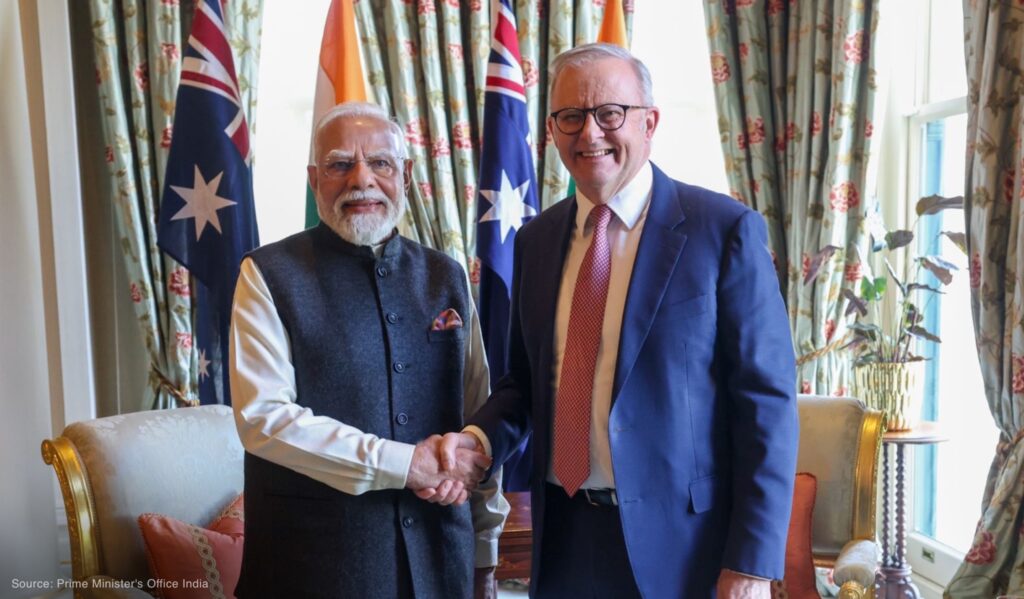
- Prime Minister Narendra Modi said the nuclear agreement would “pave the way for uranium supplies from Australia to India”
Australia and India have agreed to enable long-term Australian uranium exports to India during Modi’s July 9 summit with Prime Minister Narendra Modi, finalising arrangements under the 2015 nuclear cooperation agreement for peaceful use under IAEA safeguards.
No volumes or delivery dates have been disclosed.
The deal gives Australia an additional market for its resources sector and gives India a trusted uranium supplier for its non-fossil power buildout, while tying energy security to a wider package on defence, critical minerals and Indo-Pacific supply chains.
Modi framed the agreement as a clean-energy move that would “pave the way for uranium supplies from Australia to India” and give India’s clean-energy objectives “fresh momentum.”
The significance of the deal is Australia’s positioning itself in the uranium market and as part of India’s long-term energy security mix (as well as working to diversify from China)
India is trying to turn nuclear from a small power source into a strategic energy pillar: the country has 7.9 GW of operable nuclear capacity and 6.0 GW under construction, but has set a target to reach at least 100 GW by 2047. That buildout depends on new reactors, small modular reactor development, private-sector participation, foreign technology and secure uranium supply.
And for Australia the deal’s importance lies in the contry’s complicated relationship with uranium, with states, such as Victoria and New South Wales, banning or heavily restricting uranium mining. And national legislation means uranium from Australia may only be exported for peaceful non-explosive purposes.
The uranium agreement was not announced in isolation.
In the same summit statement, the leaders linked energy cooperation with critical minerals, resilient supply chains and economic security. They also agreed to deepen defence cooperation, maritime security, cyber, critical technologies and supply-chain resilience.
That is the real significance. Uranium is becoming part of a wider trusted-supplier architecture.
Australia and India said they share a vision for a free, open and prosperous Indo-Pacific. Their defence declaration commits the two countries to consult on defence-related developments in the Indo-Pacific that affect shared interests, increase defence exercise complexity and expand interoperability.
Energy, in other words, is no longer separate from security.
Q&A
What is the India Australia uranium deal?
The India Australia uranium deal is an administrative arrangement enabling Australian uranium exports to India for exclusively peaceful purposes under IAEA safeguards.
Why is the uranium deal significant?
It links uranium supply, energy security and non-fossil fuel power capacity, while strengthening the Australia-India strategic partnership.
Did Australia and India announce uranium shipment volumes?
No. The official summit statements confirmed the arrangement enabling long-term uranium exports, but did not disclose shipment volumes, pricing or delivery dates.
How does the uranium deal connect to Indo-Pacific security?
The uranium announcement came alongside a defence and security declaration covering Indo-Pacific consultation, defence exercises, interoperability and maritime cooperation.