






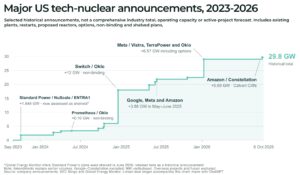
Google nears $1 billion nuclear deal as Big Tech locks in America’s reactor fleet
Google is nearing an agreement to purchase nuclear electricity from Constellation Energy for US$1 billion or more over several years, according to Bloomberg, in a
Uranium is the fuel for the global nuclear energy renaissance to power energy security, lower emissions and reliable electricity for AI data centres.
Supply remains highly concentrated, with Kazakhstan, Canada and Namibia producing roughly three-quarters of mined uranium. Underinvestment in new mines and dependence on enrichment capacity means secure nuclear fuel supply chains are increasingly important.
Uranium is a dense, naturally radioactive metal, chemical symbol U and atomic number 92. It is the principal fuel used in nuclear fission reactors.
In a reactor, uranium atoms split through a process called nuclear fission. This releases heat, which is used to produce steam and generate electricity. A relatively small amount of uranium can release a large amount of energy compared with fossil fuels.
Uranium occurs naturally in rocks, soil and water. It does not enter a reactor directly after mining: it must pass through a specialised supply chain that can include milling, conversion, enrichment and fuel fabrication.
Today, uranium supports nuclear electricity generation, research reactors, naval propulsion and the production of medical and industrial radioisotopes. Its strategic importance comes from both the metal itself and the limited global capacity available to process it into reactor fuel.
Uranium is the primary raw material for commercial nuclear fission.
Nuclear power plants can generate electricity continuously for long periods and produce very low direct carbon emissions during operation. They can also support power-system stability alongside renewable and other generation sources.
Uranium is important to:
The complete uranium market extends far beyond mining. Conversion, enrichment and fuel-fabrication capacity can be as important to supply security as access to uranium ore.
Natural uranium is made up primarily of three isotopes:
Uranium-238 represents more than 99% of natural uranium by mass. Uranium-235 accounts for approximately 0.7%, while uranium-234 is present in a much smaller amount.
Uranium-235 is fissile, meaning it can sustain a nuclear chain reaction after absorbing a neutron.
Uranium-238 is not fissile with slow neutrons, but it is fertile: inside a reactor it can absorb a neutron and eventually form plutonium-239, which can contribute to energy production.
Different reactor types require different uranium isotope concentrations and fuel designs.
When a uranium-235 nucleus absorbs a neutron, it can split into smaller atoms and release:
Those neutrons can split other uranium nuclei, creating a controlled chain reaction.
The reactor uses this heat to warm water or another coolant. The resulting steam or heat transfer system drives a turbine connected to an electrical generator.
Control rods, coolant systems and other engineered features regulate the reaction and remove heat safely.
The uranium itself does not burn in the same way as coal or natural gas. Energy comes from changes within the atomic nucleus.
Commercial nuclear reactors are the largest source of uranium demand.
Most operating reactors use uranium dioxide fuel formed into ceramic pellets. These pellets are stacked inside metal tubes to create fuel rods, which are assembled into larger fuel bundles.
The fuel remains in the reactor for an extended period. During operation, some uranium atoms undergo fission while other radioactive materials form within the fuel.
Nuclear operators do not purchase uranium only when a reactor is about to be refuelled. Utilities commonly plan procurement years ahead through inventories and long-term contracts covering different stages of the fuel cycle.
The nuclear fuel cycle describes the processes that turn uranium ore into reactor fuel and manage that fuel after use.
The front end generally includes:
The back end includes:
Each stage requires different technology, regulation, infrastructure and expertise.
Uranium is mined using three principal methods:
The appropriate method depends on deposit depth, grade, geology, groundwater conditions and economic factors.
Open-pit mining is used where uranium ore is relatively close to the surface.
Rock and soil are removed to expose the deposit. Ore is then drilled, blasted, loaded and transported to a processing plant.
Open pits can achieve high production rates but create substantial volumes of waste rock and require significant land disturbance.
Underground mining is used for deeper deposits and some high-grade orebodies.
Workers access the ore through shafts, declines and tunnels. Underground methods can reduce surface disturbance compared with a large open pit but involve complex ventilation, ground control and radiation-protection requirements.
Some of the world’s highest-grade uranium deposits require specialised underground or remote mining methods because direct worker exposure must be carefully controlled.
In-situ recovery, or ISR, extracts uranium without bringing conventional ore to the surface.
Wells inject a solution into a permeable uranium-bearing rock formation. The solution dissolves the uranium, which is pumped to the surface through recovery wells and processed.
ISR can avoid an open pit, underground mine and large conventional tailings facility. However, it requires suitable geology and careful groundwater management.
Operators must monitor fluid movement, prevent unintended migration and restore the affected aquifer according to regulatory requirements.
Uranium occurs in many geological settings.
Important deposit types include:
Sandstone deposits are often suitable for in-situ recovery when the ore occurs within permeable, groundwater-bearing formations.
Unconformity-related deposits can contain exceptionally high uranium grades. These deposits are particularly important in parts of Canada.
Deposit grade, mineralogy, depth, access and regulatory conditions determine whether a resource can become an operating mine.
Conventionally mined uranium ore is crushed and ground before chemical processing separates uranium from the surrounding material.
A uranium mill generally:
The resulting product is commonly called yellowcake, although its colour can vary.
Modern yellowcake is usually dominated by triuranium octoxide, written as U₃O₈. It is sealed in drums and transported to a conversion facility.
Yellowcake is not enriched uranium and cannot be loaded directly into most commercial reactors.
Conversion changes uranium concentrate into the chemical form required for enrichment or fuel fabrication.
For most light-water reactor fuel, uranium concentrate is converted into uranium hexafluoride, or UF₆.
UF₆ is useful because it becomes a gas at a relatively modest temperature, allowing uranium isotopes to be separated during enrichment.
Reactors that use natural uranium may follow a different conversion and fabrication route without requiring enrichment.
Conversion capacity is concentrated among a relatively small number of facilities. A country can have ample uranium concentrate while still facing fuel-supply risk if it lacks access to conversion services.
Enrichment increases the proportion of uranium-235 relative to uranium-238.
Most commercial light-water reactors use low-enriched uranium. Natural uranium contains only about 0.7% uranium-235, while conventional light-water reactor fuel typically requires a higher concentration.
Modern commercial enrichment is generally performed with gas centrifuges.
Centrifuges spin uranium hexafluoride gas at high speed. The small mass difference between uranium-235 and uranium-238 allows the isotopes to be separated gradually through many connected stages.
Enrichment output is often measured in separative work units, or SWU. The cost of enrichment therefore has its own market, separate from the price of mined uranium.
These terms describe different isotope compositions.
Natural uranium has approximately the same isotope composition as uranium found in nature.
Some reactor designs, including certain heavy-water reactors, can use natural uranium fuel.
Enriched uranium contains a higher proportion of uranium-235 than natural uranium.
Commercial reactor fuel is generally low-enriched. Some advanced and research reactors require different enrichment levels.
Highly enriched uranium is subject to particularly strict safeguards and security controls because of its potential military applications.
Depleted uranium is the material remaining after part of the uranium-235 has been removed during enrichment.
It consists mostly of uranium-238 and is less radioactive per unit mass than natural uranium.
Depleted uranium is used in selected:
Large quantities are also stored for possible future use, re-enrichment or disposal.
After enrichment, uranium hexafluoride is converted into a solid uranium compound, commonly uranium dioxide.
The powder is pressed and heated into hard ceramic pellets. These pellets are loaded into corrosion-resistant metal tubes, usually made from zirconium alloys, to form fuel rods.
Fuel rods are assembled into precisely engineered bundles designed for a particular reactor.
Fuel fabrication requires:
Fuel assemblies are not interchangeable across all reactor types.
Small modular reactors, or SMRs, are designed to be manufactured in smaller units than conventional large reactors.
Some SMR designs use established low-enriched uranium fuel. Others may require higher-assay low-enriched uranium, often abbreviated to HALEU.
HALEU contains more uranium-235 than standard light-water reactor fuel but remains below the threshold for highly enriched uranium.
Potential advantages in some advanced designs include:
However, not every SMR requires HALEU, and reactor designs remain at different stages of licensing and commercial development.
The availability of specialised enrichment and fuel-fabrication capacity may determine how quickly some designs can be deployed.
Some submarines, aircraft carriers and icebreakers use nuclear reactors for propulsion.
Nuclear propulsion can provide long operating endurance without frequent refuelling. Fuel specifications vary by country and reactor design and are generally subject to strict security controls.
Naval demand is part of the strategic uranium and enrichment landscape, but detailed information is often classified or not publicly reported.
Research reactors use uranium fuel to support:
Uranium is not itself the medical isotope used in most treatments or diagnostic procedures. Instead, reactors use uranium fuel—or, in some cases, uranium targets—to create other radioactive isotopes.
These isotopes support:
Research-reactor fuel and target designs are governed by safeguards, security and non-proliferation requirements.
Uranium mine production is concentrated in a relatively small number of countries.
Major producing countries include:
Additional production comes from countries in Africa, Asia, Europe and North America.
Kazakhstan is the leading mine producer and relies heavily on in-situ recovery.
Canada produces uranium from high-grade deposits, while Namibia operates large conventional mines. Australia holds extensive uranium resources, although production comes from a limited number of operations.
Mine rankings and volumes change over time. The durable strategic issue is the concentration of output among a small number of countries and individual operations.
Mine production is only one part of nuclear-fuel security.
Conversion and enrichment capacity is also concentrated among a limited number of countries and companies.
Russia retains an important position in global uranium conversion, enrichment and fuel services. Other capacity exists in Europe, North America and China.
This concentration creates exposure to:
Replacing one mine supplier may be easier than replacing a qualified conversion, enrichment or fuel-fabrication provider.
Utilities and governments therefore assess the complete fuel cycle rather than mine supply alone.
Newly mined uranium is called primary supply.
Secondary supply can include:
Secondary material has historically played an important role in meeting reactor requirements.
The amount available can change as inventories are drawn down, strategic policies shift or reprocessing and re-enrichment economics change.
A uranium resource is a concentration of uranium with varying levels of geological knowledge and economic potential.
A reserve is the economically mineable part of a resource under stated technical, regulatory and financial assumptions.
Resource estimates can change when:
The existence of large uranium resources does not guarantee that mines can be developed when required.
Projects need permitting, financing, infrastructure, community support and suitable market conditions.
Uranium mines can take many years to develop.
The process may include:
Nuclear utilities also require confidence that a producer can meet quality, transport and regulatory standards.
Long development timelines can create periods when uranium resources are abundant but near-term production capacity is constrained.
Uranium mining and processing can create environmental impacts that require long-term management.
Potential issues include:
Uranium tailings can retain radioactive elements such as radium and may generate radon gas. They require engineered containment, water management and long-term monitoring.
ISR avoids conventional mine waste but introduces processing fluids into an underground formation. Groundwater protection, fluid control and aquifer restoration are therefore central to regulation.
Environmental performance depends on deposit type, mining method, operational standards and the effectiveness of closure planning.
Some uranium resources occur on or near lands important to Indigenous peoples and local communities.
Historical uranium mining has left environmental and health legacies in several regions. Modern project development therefore faces significant expectations around:
Community relationships can influence whether a technically attractive resource becomes an operating mine.
Natural uranium is weakly radioactive, but it is also a toxic heavy metal.
The principal risks depend on the material, chemical form and exposure route.
External exposure to natural uranium is generally less significant than exposure to highly radioactive materials created inside a reactor. Ingestion or inhalation can create chemical and radiological risks.
Uranium mines, mills, fuel-cycle facilities and reactors operate under specialised radiation-protection, safeguards and security rules.
The radioactivity of uranium ore, reactor fuel and spent nuclear fuel should not be treated as equivalent. Their compositions, radiation levels and handling requirements differ substantially.
After use in a reactor, fuel contains:
Spent fuel is highly radioactive and generates heat.
When removed from a reactor, it is initially stored under water. The water cools the fuel and provides radiation shielding.
After sufficient cooling, fuel may be moved into dry storage systems made from steel and concrete.
Long-term options include:
Policies differ by country.
Reprocessing separates usable uranium and plutonium from fission products and other waste in spent fuel.
Recovered material can be fabricated into new fuel, including mixed-oxide fuel known as MOX.
Potential benefits include:
Reprocessing does not eliminate radioactive waste. It creates separate waste streams that still require treatment, storage and disposal.
The economics, safeguards and public policy surrounding reprocessing vary significantly between countries.
There is no single price for nuclear fuel.
Separate markets exist for:
Uranium concentrate is commonly traded through long-term contracts between producers, traders and utilities. A smaller spot market provides shorter-term transactions and price signals.
Long-term contract terms may include:
The spot price does not necessarily represent the price paid for most material delivered to reactors.
Uranium prices are influenced by:
The price of uranium concentrate is only one part of the cost of finished nuclear fuel.
Because fuel costs are a smaller share of nuclear electricity costs than fuel costs are for many fossil-fuel plants, utilities may prioritise reliability and diversification rather than purchasing only the cheapest uranium.
The principal sources of uranium demand include:
Demand depends on reactor numbers, capacity, operating performance, fuel design and inventory policy.
Uranium sits at the intersection of electricity policy, national security and geopolitics.
Key trends to watch include:
Uranium is not simply a mined commodity. It is the starting point of a highly regulated, technically specialised fuel cycle.
Mine supply matters, but so do conversion, enrichment, fuel fabrication, transport, inventories and spent-fuel management. A disruption at any one of these stages can affect nuclear-fuel security.
For investors, utilities and policymakers, the central question is whether the complete fuel cycle can expand and diversify quickly enough to support existing reactors, new nuclear capacity and emerging reactor designs.
———————–
Uranium is used primarily as fuel for nuclear reactors that generate electricity. It also supports research reactors, naval propulsion and the production of medical and industrial isotopes.
No. Uranium is a finite mineral resource. Nuclear energy is generally classified as low-carbon rather than renewable.
Yellowcake is a concentrated uranium product made after mining and milling. It is commonly dominated by U₃O₈ and must undergo further processing before becoming reactor fuel.
No. Some reactor designs can use natural uranium. Most commercial light-water reactors require uranium with a higher concentration of uranium-235.
Enrichment increases the proportion of uranium-235 relative to uranium-238. It is a separate industrial service from uranium mining and conversion.
Depleted uranium is material left after part of the uranium-235 has been removed during enrichment. It consists mostly of uranium-238 and is used in selected shielding, counterweight and defence applications.
Used fuel is cooled and stored. Depending on national policy, it may later enter dry storage, be reprocessed to recover usable material or be prepared for disposal in a geological repository.
Uranium mining involves radiological, chemical and conventional mining risks. Modern operations use ventilation, exposure monitoring, water management, engineered waste facilities and regulatory oversight to control them. Performance varies by operation and jurisdiction.
Uranium is treated as a strategic or critical energy resource in many jurisdictions, although some official critical-mineral lists exclude fuel minerals and regulate uranium separately.
—
Reference sources for annual review: IAEA nuclear-fuel-cycle overview, USGS uranium supply-chain analysis, NEA–IAEA Uranium Red Book, USGS uranium mining and remediation research and the IAEA fuel-cycle waste overview.
Google is nearing an agreement to purchase nuclear electricity from Constellation Energy for US$1 billion or more over several years, according to Bloomberg, in a

Russia supplied 26% of the enrichment services purchased by US nuclear operators in 2025, up from approx 20% a year earlier — but under existing

The US has committed or conditionally committed at least US$27.3 billion to 62 critical minerals projects since the start of 2025, according to the Payne
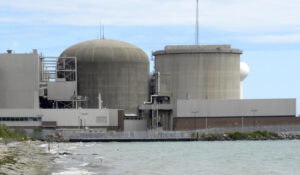
Ontario has started work on the US$19.1 billion refurbishment of four CANDU reactors at the Pickering Nuclear Generating Station — to return up to 2,200
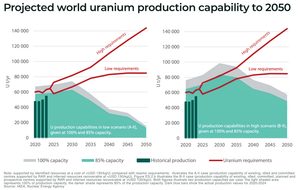
Annual uranium mine supply could fall approx 46,000 tonnes below reactor requirements by 2040 under a high-demand scenario, equivalent to 41% of projected needs, The
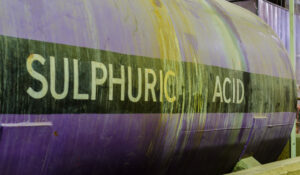
Russia has announced a temporary ban sulphuric acid exports until December 31, putting Kazakhstan’s uranium supply chain under renewed scrutiny after Russia provided 93.6% of
Investment intelligence and in-depth reports on critical minerals, mining, energy and geopolitics — from capital-markets professionals with boardroom and institutional experience.