
- tungsten prices surge to record levels, with Rotterdam APT trading at US$3,185/MTU, up 350% year-to-date and nearly 900% over 12 months
- China controls roughly 80% of global mine supply and dominates the downstream APT, powder and carbide chain
- tungsten demand forecast to rise from 143kt in 2025 to 210kt by 2035, a 47% increase, driven by defense, aerospace, semiconductors and industrial carbide demand
- US has no domestic tungsten mine production and faces a defense procurement deadline from January 1, 2027, when Chinese, Russian, Iranian and North Korean tungsten set to be barred from key military applications
The price of tungsten has gone vertical with gains over the past year outpacing those gold and oil. The Rotterdam ammonium paratungstate (the benchmark intermediate product for tungsten) trades at US$3,185 per metric tonne unit, up 350% this year and about 900% over the past 12 months (as per April 2026).
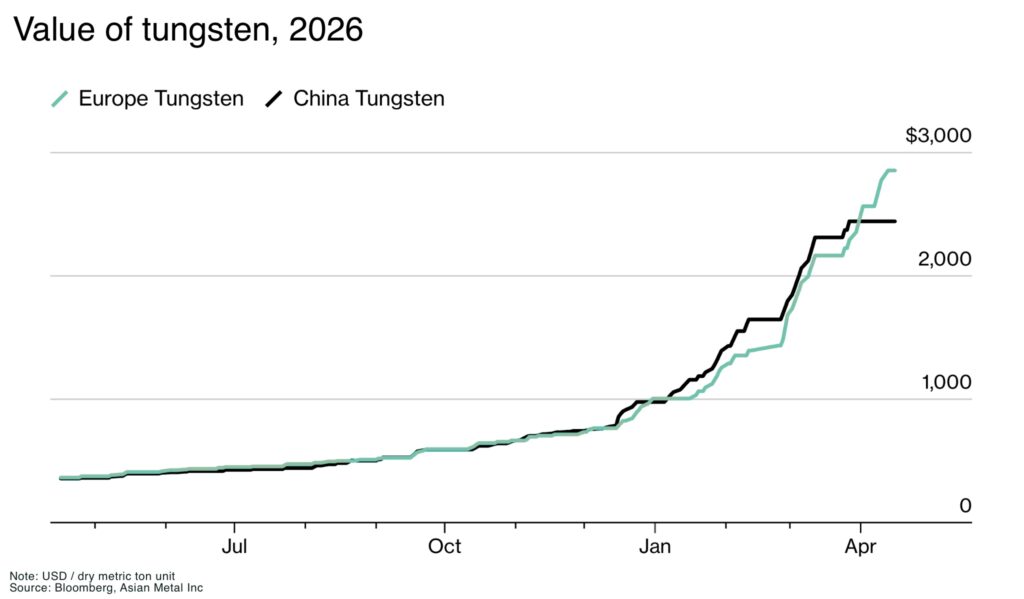
The price spike reflects a supply squeeze as demand for tungsten across the West ramps up — just as China, which controls about 80% of global mine production and 80% of downstream processed tungsten products, tightens exports.
The value of the global tungsten market is estimated at approx US$18 billion in 2026, but this is no longer a niche pricing move in an obscure industrial metal. It is a supply-chain stress test of a metal now at the center of global geopolitics and national security.
What is tungsten
Tungsten is known as one of the strongest-known naturally-occurring materials and is critical across modern technology, from smart phones to hypersonic missiles.
It is listed as a critical mineral in the US, EU, China, UK, Australia, Japan and others, for good reason:
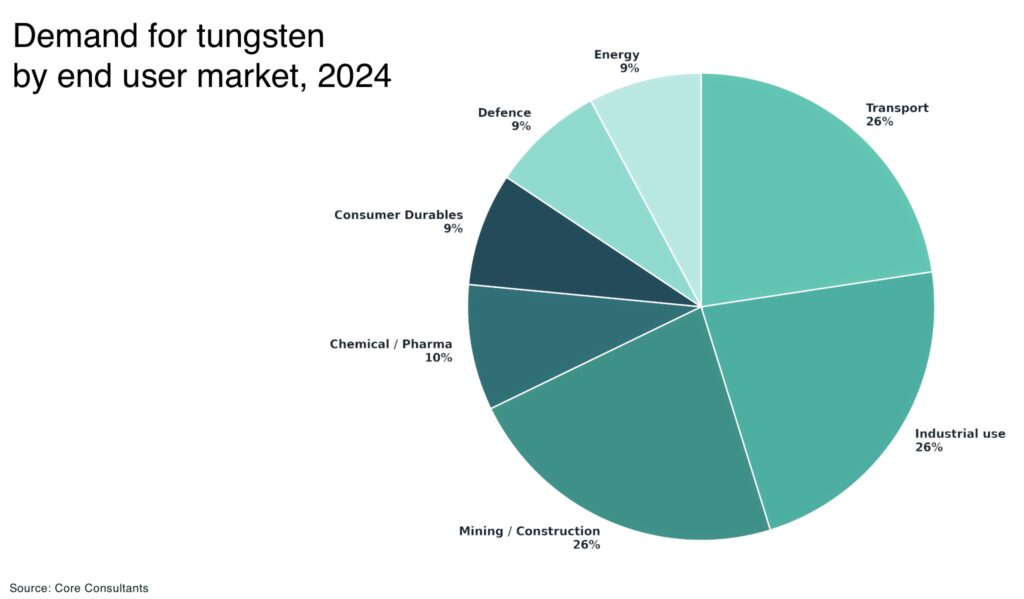
- military: with the highest melting-point of any metal and almost as hard as diamond, tungsten is essential across a range of military applications, including armour-piercing munitions, tank armour, and missiles
- technology: tungsten is crucial in the efficiency and durability of solar panels, semiconductors, robotics, and potentially even for the walls of nuclear fusion reactors due to its capacity to withstand extreme heat and radiation
- electric vehicles: electric vehicles require approx 2kg of tungsten for gearing systems, battery anodes and cathodes, as well as about 2,000 wiring looms in the vehicle’s semiconductors
- tungsten is also used in mining equipment, energy production, construction, and aerospace
Why are tungsten prices rising so sharply?
The price rally in tungsten is being driven by a vicious cycle of US tariffs, Chinese export controls, strategic defense stockpiling, and limited new mine supply.
China’s export controls (and imports)
China imposed export licensing on tungsten and related compounds in February 2025, after US tariffs on Chinese imports.
According to the latest report from Canaccord Genuity, exports of key processed tungsten products (ammonium paratungstate, tungsten oxide and tungsten carbide) halted entirely in March 2025, before APT resumed in April at minimal volumes of roughly 8 tonnes. The export volume of tungsten APT reportedly fell almost 70% from 782 tonnes in 2024 to 243 tonnes in the first 11 months of 2025, and still down 27.6% year on year in January–February 2026.
The pressure tightened again in December 2025, when China confirmed that only 15 companies would be authorized to export tungsten in 2026–27, giving Beijing direct control over volume, timing and destination of tungsten flows.
The moves come as, Project Blue estimates, China’s mined production fell 10% year-on-year to 61,000 tons in 2025, due to ageing mines (some over 30 years old), lower ore grades, and increased production costs with environmental clampdowns on smaller miners.
US tariffs
The US has 7 companies with capacity to process tungsten but, since 2015, the US has no domestic tungsten mine production. As with so many other critical minerals, Washington is now pulling numerous financial and policy levers (from the Defense Production Act, EXIM financing, stockpiling and allied supply-chain funding) to accelerate non-China projects.
At the end of 2024, the US, under section 301(b) of the Trade Act of 1974, increased tariffs to 50% on several tungsten products from China. And, from January 1, 2027, a new law will restrict the US from procuring tungsten from China, Russia, Iran and North Korea for defense applications. To be clear, as of May 2026, that is 8 months away (and counting), while mines can take years, if not decades to build.
The policy direction is clear: tungsten is being treated as critical to national security.
This not only changes the timing dynamic behind new mine development, but also market dunamics as, for decades, low-cost Chinese supply pushed out Western projects from the market. Now, policy suggests buyers are less price-sensitive with a premium put on secure supply.
So, as Fastmarkets reports, US support is being directed across Kazakhstan, Australia, the UK, Rwanda, Canada and the US, including large financing packages designed to anchor non-China tungsten supply.
For example, America’s EXIM bank has committed about US$900 million and the US Development Finance Cooporation (DFC) is exploring up to US$700 million for both debt financing and project development funding for Cove Kaz Capital Group’s investment in the Severniy Katpar Tungsten Mine in Kazakhstan, one of the world’s largest untapped tungsten deposits, estimated to contain more than 10% of global reserves.
Limited tungsten mine pipeline
Tungsten supply is one of the most concentrated critical mineral markets in the world with global mine of tungsten production was about 85,000 tonnes in 2025. China produced 67,000 tonnes, or 79% of total supply.
However, the latest research by Canaccord suggests a limited pipeline of new projects with a market in deficit until 2030.
“Our research suggests a limited new project pipeline, and with our forecast 47% demand growth to 2035, we expect the tungsten market to remain in structural deficit” — Canaccord Genuity, The Emerging Tungsten Book
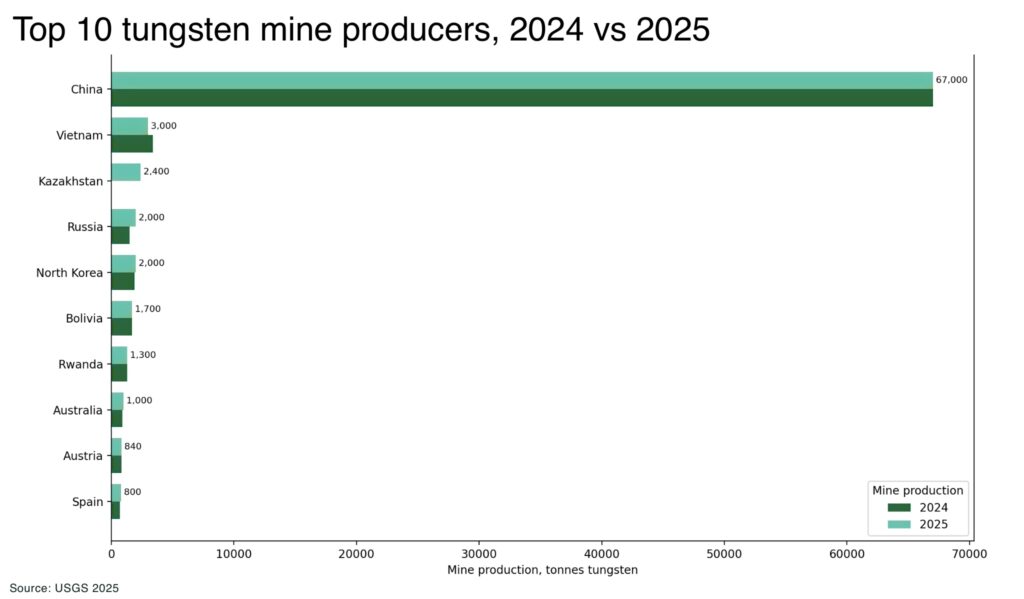
| Country | 2025 mine production | Share |
| China | 67,000t | 79% |
| Vietnam | 3,000t | 4% |
| Kazakhstan | 2,400t | 3% |
| Russia | 2,000t | 2% |
| North Korea | 2,000t | 2% |
| Bolivia | 1,700t | 2% |
| Rwanda | 1,300t | 2% |
| Australia | 1,000t | 1% |
Global tungsten reserves are also concentrated, estimated at more than 4.7Mt, with China holding about 2.5Mt, or 53%, while Australia holds about 570,000 tonnes, or 12%, despite producing only about 1% of global supply.
The same imbalance appears downstream. China controls approx 80–85% of tungsten mining and beneficiation, 70–85% of APT refining, 70–85% of powder metallurgy and 60–75% of fabrication and alloys, according to Canaccord.
This is why the tungsten market narrative now looks similar to rare earths, gallium, germanium and antimony: the mine and processing supply is concentrated in one increasingly insecure chokepoint.
From 2021-2024, US imports of tungsten ores, concentrates, and other forms were from:
- China, 26%
- Germany, 14%
- Bolivia, 8%
- Vietnam, 8%
- and other, 44%
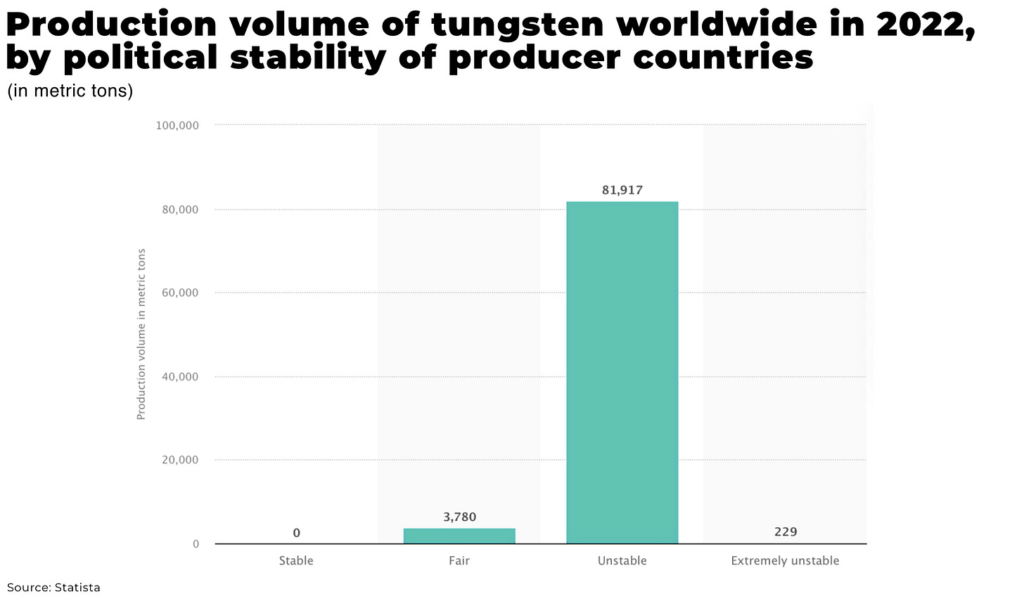
In total, countries classified as “politically unstable” and “extremely unstable” account for 96% of global supply.
Why is demand rising?
The tightening of supply is happening just as demand is increasing, not just in the rest of the world, but also in China which has switched from being a net exporter of tungsten, to being a net importer of tungsten: total imports of Chinese tungsten concentrate stood at around 5,195.7 tonnes over January-February 2026, surging 153.7% year on year.
Most importantly, tungsten is critical to national security and defense infrastructure in an increasinsly volatile world, from Ukraine to the Middle East:
- military demand, from helicopters to fighter jets, armour piercing ammunition to bullet-proof vehicles, is expected to increase 12% in 2026. And note, once fired, the metal cannot be recycled.
- semiconductors (where tungsten hexafluoride (WF₆) is used as a deposited thin film for contacts and interconnects) and AI data centre demand is expected to double by 2030
- electric batteries (where tungsten is used to improve the energy density of the battery) are seeing growth accelerate, eg 50% new battery-electric vehicle (BEV) registrations across the EU rose 48.9% in March 2026 compared to the same period last year, as the Iran War drives energy price volatility
- and then there’s mining itself, where tungsten is used across drilling, machines and mining across a range of metals and ores — just as prices rise almost across the board
“In my 12 years working across the commodity space and dealing with a lot of weird and wonderful metals, I have never seen a market as tight as tungsten is right now — aside from maybe lithium in 2021,” George Heppel, vice president of commodity research with BMO Capital Markets, told Bloomberg. “This isn’t like lithium, where there was a huge pipeline of projects that could come online.”
Is the tungsten market in long-term deficit?
The tungsten market is in severe and structural deficit. And new supply coming online is limited, with long mine development timelines (averaging 5-7 years), scarcity of high-grade deposits, and high upfront costs that are limiting supply, particularly in Europe.
Non-China production rose by 20% year-on-year to 19,000 tons in 2025, but this was largely down to the start of the China-controlled Boguty mine in Kazakhstan. US mining investment company Cove Capital signed a deal in November 2025 to lead development of another large tungsten deposit in Kazakhstan, backed by $900 million from the US Export-Import Bank. The challenge is that Kazakhstan is a country caught a “Great Game” for resources between China, Russia, Europe and America.
In Vietnam, the second-largest tungsten producer outside China, the Nui Phao mine operated by Masan Resources contributes significantly to global supply. However, the mine has reportedly seen production decline by 15% year-on-year in 2024, due to lower grades and throughput.
Australia, has world’s second-largest tungsten resources, but only one active tungsten mine at Mt Carbine mine, currently exploring US government funding opportunities.
Russia holds substantial tungsten reserves and is a significant producer. However, sanctions by the UK and EU, imposed in response to the invasion of Ukraine, are complicating trade and investment.
Aiming to fill the domestic production gap, American Tungsten started construction and building work for the mine plan at its Ima project in Idaho. Between 1945 and 1957, the property produced approximately 199,449 metric ton units of tungsten trioxide.
South Korea’s Almonty Sangdong mine restart is nearing first production, potentially moving from zero tungsten mine supply in 2025 to 2,300 tonnes in 2026 and 4,600 tonnes from 2027, with material bound for US markets — making it one of the most important new ex-China supply additions.
That leaves the ex-China market dependent on a narrow set of restarts, expansions and development projects, including Tungsten West’s Hemerdon restart in the UK, Fireweed’s Mactung project in Canada, EQ Resources’ European operations, and smaller US and Australian projects.
Conclusion
The big shock in the tungsten market has been China’s export restrictions but, even if China were to remove the restrictions, the fundamentals of the tungsten market have changed long-term. Demand is rising sharply just as supply from China is deteriorating.
Non-China tungsten projects are limited and now carry a strategic premium.
The tungsten trade is no longer about whether the metal matters, but about whether the West can rebuild a supply chain before China’s leverage tightens further.