

The deep-sea mining industry has moved one step closer to commercial reality after US regulators accepted The Metals Company USA’s consolidated application as compliant, a decision that could help set the permitting template for other companies looking to extract critical minerals from the ocean floor.
The decision comes after the NOAA’s final rule on January 21, which revised US deep-seabed mining regulations for exploration licences and commercial recovery permits, and created the option for qualified applicants to submit a consolidated application rather than move through a slower two-stage process. In other worse, US regulators have opened a clearer, faster pathway for deep-sea mining companies to seek approval for both exploration and commercial recovery.
The decision to accept TMC’s application moves it into the certification stage, after which it will be posted to the Federal Register, followed by a draft Environmental Impact Statement, public comment, a final EIS and NOAA’s final decision on whether to issue the licence and permit, according to the company announcement.
NOAA’s determination does not grant final approval. But it does move deep-sea mining from theory into a more defined US regulatory process, with the potential to accelerate an industry long held back by legal uncertainty, environmental opposition and slow-moving international negotiations.
The application covers around 65,000 km² in the Clarion-Clipperton Zone, up from the roughly 25,000 km² commercial recovery area in TMC USA’s earlier April 2025 application. TMC estimates the area contains 619 million tonnes of wet polymetallic nodules, with potential exploration upside of another 200 million tonnes.
Those nodules contain nickel, cobalt, copper and manganese, metals central to batteries, defence, manufacturing and energy infrastructure. For Washington, the strategic case is clear, deep-sea mining offers a potential new source of critical minerals outside China-controlled supply chains and beyond the bottlenecks of conventional land-based mining.
Shortly after his election to a second term, President Donald Trump signed a sweeping executive order accelerating deep sea mining permits and licenses in areas beyond national jurisdiction under the Deep Seabed Hard Mineral Resources Act.
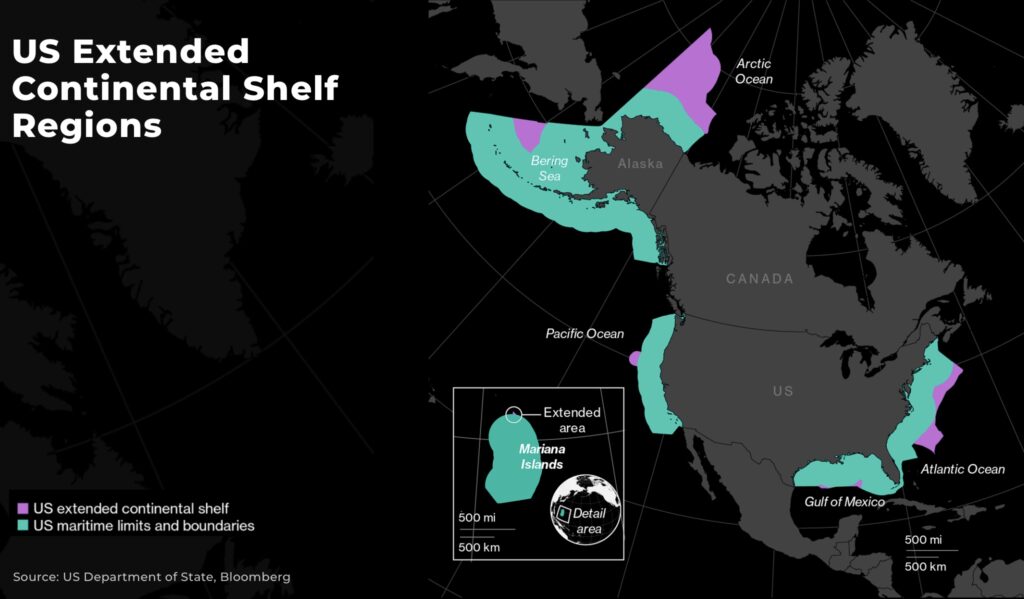
Trump’s Executive order marked a significant escalation in US efforts to secure domestic supplies of key metals and counter China’s dominance in the sector through deep-sea mining, as well as a boost for America’s offshore critical minerals industry.
“This determination marks an important step forward in NOAA’s transparent, rules-based process, and brings us ever closer to providing the US with a new, abundant and lower-impact source of critical metals” — said Gerard Barron, Chairman and CEO of The Metals Company.
TMC said it expects the latest review process to conclude before the end of Q1 2027.
Final approval is still not guaranteed. Environmental review, public comment and political scrutiny remain. But NOAA’s determination is a signal to the wider sector: the US is starting to build a permitting route for commercial deep-sea mining. For an industry waiting for a trigger, this may be the moment the race begins.
As we projected in 2024, deep sea mining is coming, whether the environmental lobby like it, or not.