
The copper price hit an all time high above US$14,000 in May 2026 as mine disruptions, sulphur and diesel shortages, collide against rising demand from electricity grids, AI and defence.
The current copper project pipeline could leave the market with a 30% supply shortfall by 2035.
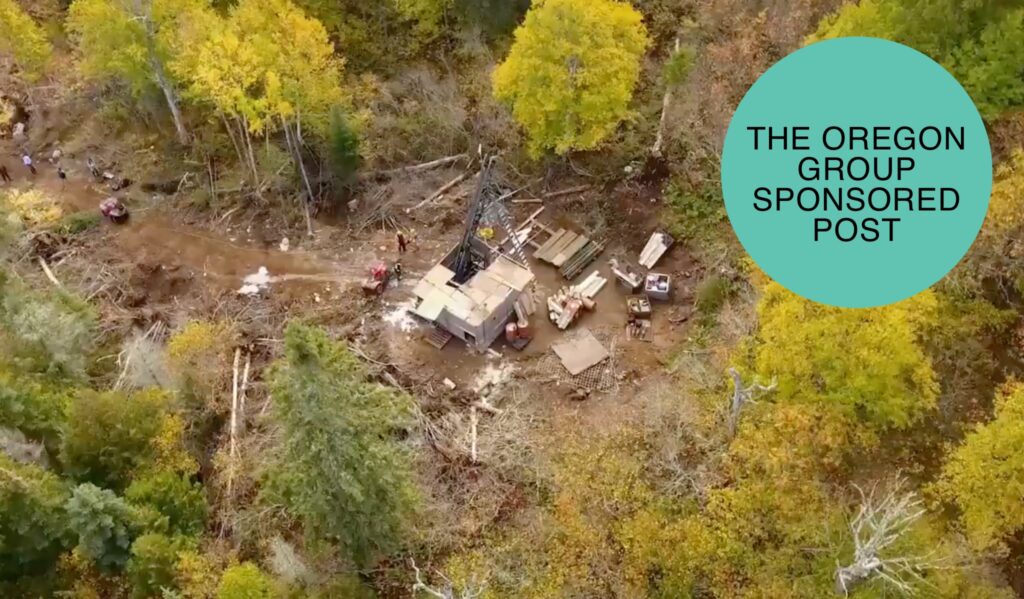
That is the backdrop for Generation Mining (TSX: GENM | OTCQB: GENMF), a Canadian developer advancing the Marathon Project, a large, shovel-ready copper-palladium deposit in Canada’s Ontario province.
Average annual copper production is projected at 42 million lbs of copper, as well as additional upside with 168,000 oz of palladium, and 38,000 oz of platinum.
Copper accounts for 44% of Marathon’s payable metal revenue at recent spot prices, and 41% at long-term consensus prices in the company’s Marathon feasibility study, updated in March 2025, that provides three mix cases:
| Price case | Copper share of payable metal revenue | Palladium share |
| Base case | 34% | 52% |
| Long-term consensus prices | 41% | 41% |
| Recent spot prices | 44% | 37% |
The project has an after-tax NPV6% of C$1.07 billion, IRR of 28% and payback of 1.9 years under the base-case feasibility study, and is one of the few fully permitted critical mineral projects in North America. At recent spot prices, mainly due to the action in the copper market, the NPV more than doubles to C$2.2 billion. Construction is expected to begin in later 2026, subject to final financing arrangements.
The project has already been discovered geologically – but the copper story has yet to be discovered by the market.
The copper market tightens
By 2040, the world faces a copper supply deficit of approx 10 million tonnes annually, as AI infrastructure, defence systems and electrification drive demand beyond 42 million tonnes, a 23.8% shortfall.
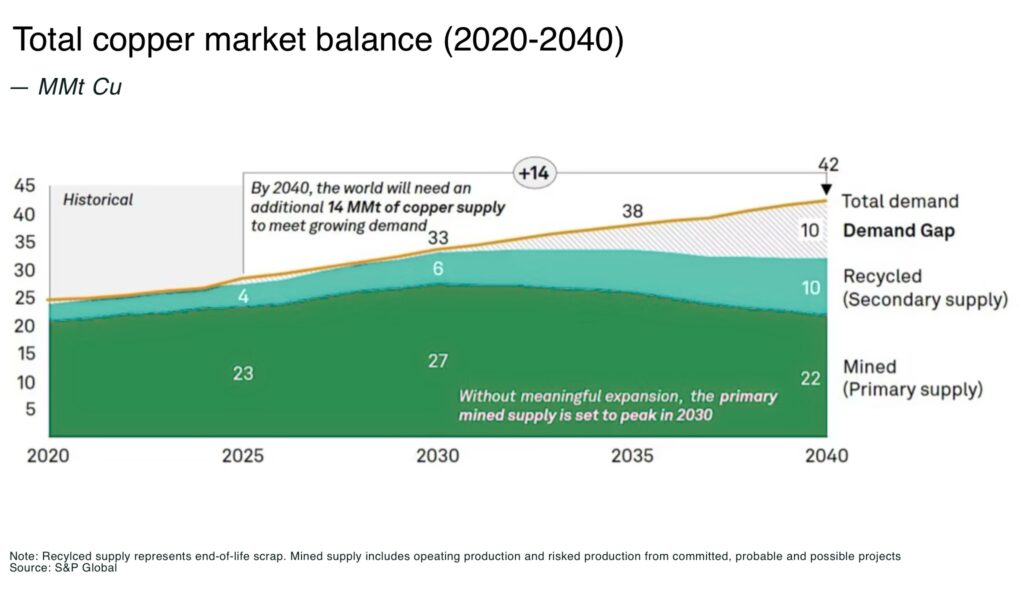
The challenge is that supply is struggling to keep up, not just in the long-term, but with significant immediate-term disruption, including:
- a reported delay to the restart of Freeport Indonesia’s Grasberg Block Cave copper mine into early 2028
- a fatal tunnel collapse at Codelco’s flagship El Teniente mine forced the Chilean state copper producer to cut its 2025 production guidance to 1.34-1.37 million tonnes, down from 1.37-1.40 million tonnes
- significant downward guidance revisions of copper output at mines operated by Ivanhoe and Teck
- diesel and sulphuric acid (used in processing about one-sixth of the world’s copper) supply shocks are also raising mine operating risks and costs
- average copper grades have fallen from 1.02% in 2022 to 0.66% in 2025 across the Codelco (the state-owned mine and largest copper producer in the world) aging portfolio; output from the world’s third-largest copper producer saw a sharp 12% year-on-year decline in 2025 in Peru
All this, just as demand for copper, no longer just an industrial, but now a strategic metal, is expected to increase sharply.
Why location matters
Marathon’s location may be one of its most important assets.
The project is in northwestern Ontario, Canada’s top-rated mining jurisdiction, and the second highest ranking in the world, reflecting stronger investor confidence in the province’s geology, policy framework and permitting environment.
The location also has established infrastructure, close to the Trans-Canada Highway, as well as power and regional transport infrastructure, and, of course, the town of Marathon.
Canada is also ramping up support for the mining industry with:
- its Critical Minerals Infrastructure Fund to provide federal funding until 2030 for clean energy and transportation infrastructure
- the Critical Mineral Exploration Tax Credit provides a 30% tax credit for eligible flow-through share financings targeting specified critical minerals, including copper
- proposed reforms to simplify federal regulatory reviews and target decisions on major projects within one year, aiming to reduce approval timelines
- Canada has also created a Major Projects Office to improve coordination on large projects. Its stated priority is to help more critical mineral projects reach final investment decisions by improving regulatory certainty and sustainability
- the CAD$15 billion Canada Growth Fund is making direct investments into critical minerals projects, including US$85 million for the Thompson nickel complex in Manitoba in February 2026, and US$82 million to support construction of Nouveau Monde Graphite’s Matawinie mine in April 2026
The jurisdictional and policy backdrop matters as projects are no longer just competing on grade, mine life or metal mix, but a world of volatile geopolitics where investors and governments want secure supply, lower jurisdictional risk, and accelerated permitting.
Why Generation Mining matters now
Generation’s feasibility study outlined an NPV of around $1 billion, rising to more than $2 billion at spot prices, yet the company still trades at a market cap of only a little over $200 million.
The copper angle is the part that is easy to miss, but it critically changes the investment frame.
As the company moves toward a fully financed construction decision, there appears to be considerable re-rating potential, with strong leverage to higher copper prices.