

The oil price move above US$100 has repriced the world’s energy market just as the Middle East crisis redraws the global energy map — magnifying both the cost and security advantage of uranium.
- with Brent crude moving above $100 during the crisis, oil-fired power fuel costs are roughly $185/MWh, versus about $4.6/MWh for nuclear fuel. That is not a close contest, based on EIA power output per barrel and World Nuclear fuel-cost data
- even with North American Natural Gas far cheaper than crisis-priced oil, Henry Hub at about $3.80/MMBtu still implies gas fuel costs of roughly $26.6/MWh at a 7,000 Btu/kWh heat rate, well above nuclear fuel cost, based on EIA’s latest outlook
The sharp price move in oil has also brought clarity — if any more were needed — to energy supply chain security. So, when it comes to uranium supply for the West, that means Canada’s Athabasca basin.
We don’t know how long the conflict in the Middle East will continue pushing energy prices higher, but that is the point.
This is not a story about uranium suddenly becoming cost-effective. On a fuel-cost basis, it already was (the cost issue with nuclear energy is instead with building the reactors, see below). What the Middle East crisis has done is expose that advantage more clearly by driving fossil fuel prices higher, raising volatility across global energy markets, and increasing the value of fuels that are less exposed to war, shipping disruption, and commodity-price shocks.
The Athabasca Basin sits where these themes meet: uranium’s price advantage and Canada’s strategic position as a secure source of supply.
How much more cost-efficient is uranium?
The World Nuclear Association estimates typical nuclear fuel cost at about 0.46 cents/kWh, or $4.6/MWh. By contrast, the EIA says:
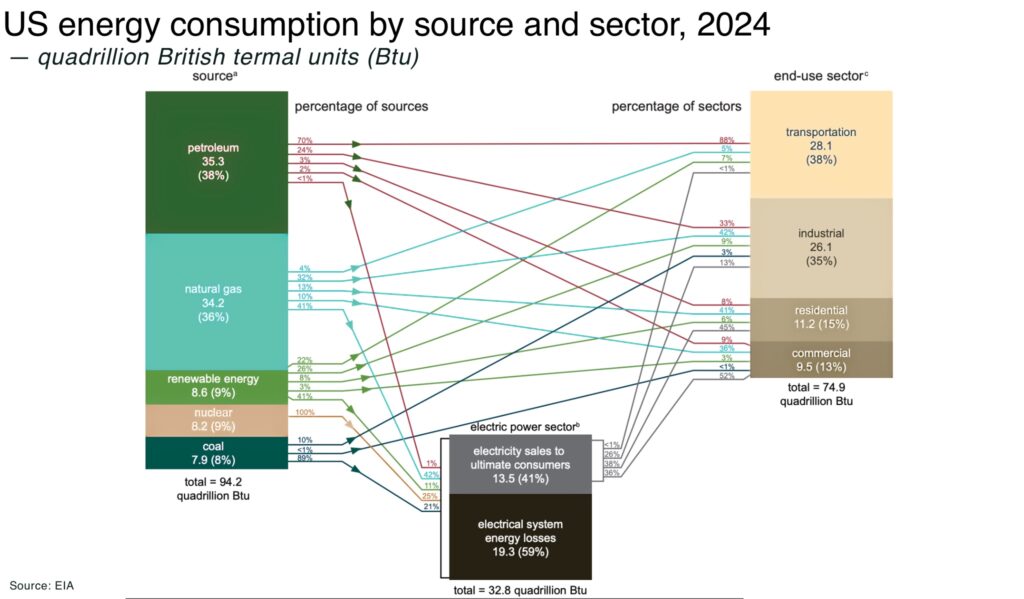
- US power plants generated about 13.1 kWh per gallon of petroleum liquids in 2024, up from roughly 12.9 kWh in 2022. That works out to about 551 kWh per barrel, implying a fuel cost of roughly $181/MWh at $100 oil. At Brent levels seen this week, the fuel-cost gap versus uranium is wider still
- and, in Natural Gas (a better benchmark in both North American and European power markets as it is the main marginal fuel competing with nuclear in electricity generation), the EIA’s latest Short-Term Energy Outlook forecasts Henry Hub at about $3.80/MMBtu in 2026. Using a 7,000 Btu/kWh combined-cycle heat rate, that implies gas fuel cost of about $26.6/MWh. That is far cheaper than oil-fired power, but still nearly x6 uranium’s fuel cost
Oil above US$100 does not mean the electricity grid suddenly stops using gas or oil to keep the lights on in the immediate-term. However, on the decades-long timescales of building out new energy infrastructure — especially new nuclear reactors — massive oil and gas price shocks more investment decisions built at the margins: through life extensions, new reactors, fuel contracts, supply-chain policy, and capital flowing toward the next source of secure power.
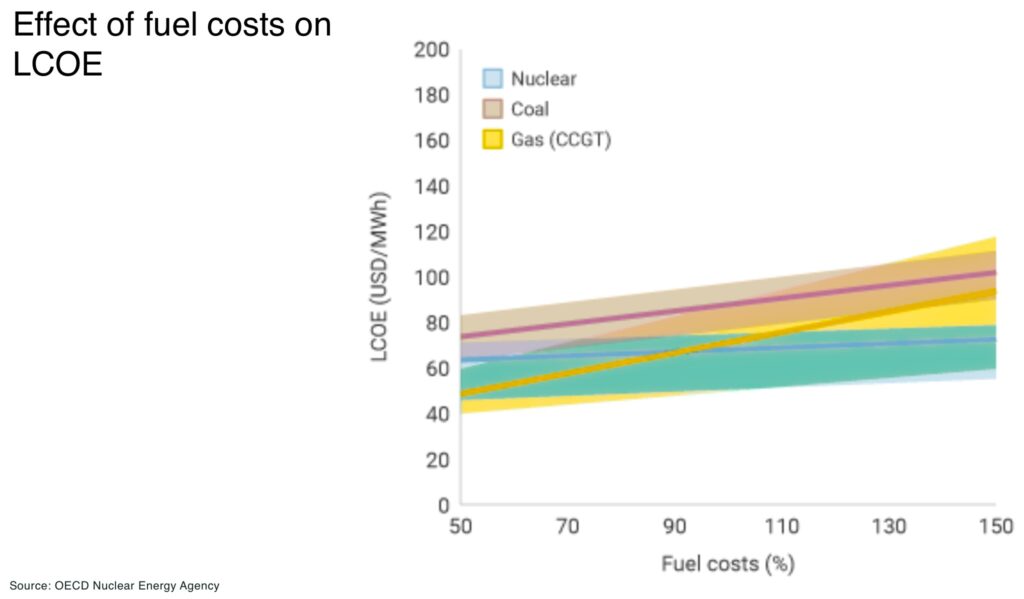
The stability offered by nuclear and uranium fuel is not marginal — doubling the uranium price raises fuel cost only from 0.50 to 0.62 cents/kWh — while the expected generation cost of the best US nuclear plants rises from 1.3 to 1.42 cents/kWh. Natural gas has proved itself through the Russian invasion of Ukraine and now the Middle Easat crisis to behave with much more volatility.
Why does Canada matter more in this setup?
Canada matters because cost efficiency is only half the story. The other half is supply security.
In the Middle East conflict, some of the world’s most important LNG facilities have been attacked: eg in just one attack, Iran took out 17% of Qatar’s LNG capacity for up to five years.
Canada (despite Trump’s threats to seize Canada) the North American region is simply not so volatile as many other regions in the world.
And Canada is already the world’s second-largest uranium supplier (in 2024, Kazakhstan produced 39% of global mined uranium and Canada produced 24%), with some of the highest grades in the world.
This matters because the nuclear fuel cycle is being re-engineered around security:
- $2.7 billion for enrichment: in 2026, Washington awarded US$2.7 billion of enrichment-related orders to three companies backing domestic uranium enrichment to reduce dependence on foreign supply and rebuild the front end of the fuel cycle
- HALEU processing buildout: DOE awarded contracts to six companies to process HALEU fuel for advanced reactors, with total contract value of up to $800 million
- broader fuel-chain push: in 2025, the White House’s May 2025 Executive Orders on nuclear energy explicitly targeted fuel availability, civil nuclear supply chains, and industrial capacity
- HALEU fuel reserve: DOE to establish a readily available HALEU reserve to support reactor deployment tied to national security and AI infrastructure
- Reactor demand growth: expansion of US nuclear capacity from about 100 GW today to 400 GW by 2050
All of these moves — against an increasingly volatile geopolitical backdrop — increase the value of reliable feedstock from jurisdictions the US and its allies trust. Canada fits that requirement better than almost anywhere else.
Why does the Athabasca Basin stand out?
The Athabasca Basin combines jurisdictional safety with some of the best uranium grades on the planet.
- Canada’s Athabasca basin has the highest grade uranium deposits in the world, with grades up to x100 higher than averages mined elsewhere in the world
- the Athabasca Basin is home to the world’s largest, high-grade uranium mine at McArthur River and world’s second largest high-grade deposit at Cigar Lake
- the US is the world’s largest producer of nuclear energy, and Canada is just next door with a stable geopolitical environment and established infrastructure (Saskatchewan province is one of the top rated mining jurisdictions in the world)
eg Cameco said in its 2025 year-end release that it produced 21.0 million pounds of uranium on its share basis, including 19.1 million pounds at Cigar Lake on a 100% basis and 15.1 million pounds at McArthur River/Key Lake on a 100% basis.
Athabasca’s value in a crisis is straightforward: Ii sits in a top-tier mining jurisdiction, inside a G7 country, tied into a North American supply chain that Washington now explicitly wants to strengthen. It is also far removed from the maritime chokepoints and geopolitical fault lines now pushing up energy risk premiums elsewhere.
That does not mean Athabasca is immune from operational risk. No mining district is. But the risk profile is different, meaning Athabasca’s location matters almost as much as its grade.
“As North America gets more serious about long-term energy security, investment will increasingly move into high-quality uranium projects in safe jurisdictions.
That is exactly why the Athabasca Basin stands out, and why F3 is well positioned with our Patterson Lake North project. This is one of the premier uranium districts in the world, not just because of grade, but because it sits in a stable Canadian jurisdiction with the experience, infrastructure, and credibility to support long-term supply. We believe Patterson Lake North is well suited to this environment because it offers exposure to high-grade uranium in a part of the world that Western markets can rely on.
As geopolitical tensions rise and energy security becomes more important, the value of projects that combine scale, grade, and jurisdictional safety only increases”
— Dev Randhawa, Chairman & CEO, F3 Uranium
Is this just about energy costs?
The main counterargument is not fuel cost but capital cost: the reactors needed to use uranium are expensive.
Capital accounts for at least 60% of new nuclear Levelized Cost of Energy (LCOE), while the IEA notes that long lead times, technical complexity, and cost overruns remain major barriers; eg Vogtle’s final cost rose to more than US$35 billion from an original estimate of about US$14 billion.
That remains true, but it is becoming less absolute as governments move to reduce financing risk, permitting hurdles, support restarts and extensions, and back more standardized reactor buildouts (eg analysis of Sizewell-style financing suggests that public support could cut the cost of capital from 8% to 3.5% and lower LCOE from £96/MWh to £52/MWh)
And, of course, once operating, those high capital costs are offset by low and stable variable costs — with the average nuclear generation cost in the US at $31.76/MWh in 2023, down 40% from 2012.
Conclusion
US electricity demand is projected to rise from a record 4,195 billion kWh in 2025 to 4,260 billion kWh in 2026 and 4,388 billion kWh in 2027, driven in part by AI data centers and wider electrification — with nuclear power’s share set to rise (before the latest crisis) from 18% in 2025 to 19% in 2026.
High energy prices do not solve nuclear’s financing problem, but they do make secure, low-volatility baseload more valuable — and make the political case for backing both new build and secure upstream supply stronger in two ways at once:
- First, it makes uranium look more cost-efficient relative to hydrocarbons whose economics remain hostage to war, shipping risk, and global trade disruption
- Second, it increases the premium on secure supply chains. That is where Canada — and especially the Athabasca Basin — really stands apart
This is not a niche trade on uranium spot. It is a broader repricing of secure nuclear fuel. As North American power demand rises and Washington spends billions to rebuild the fuel cycle, uranium from Canada moves from being just another commodity and closer to being a strategic commodity.
Middle East turmoil is making uranium more cost-efficient and secure, with Canada and the Athabasca Basin emerging as strategic winners.