
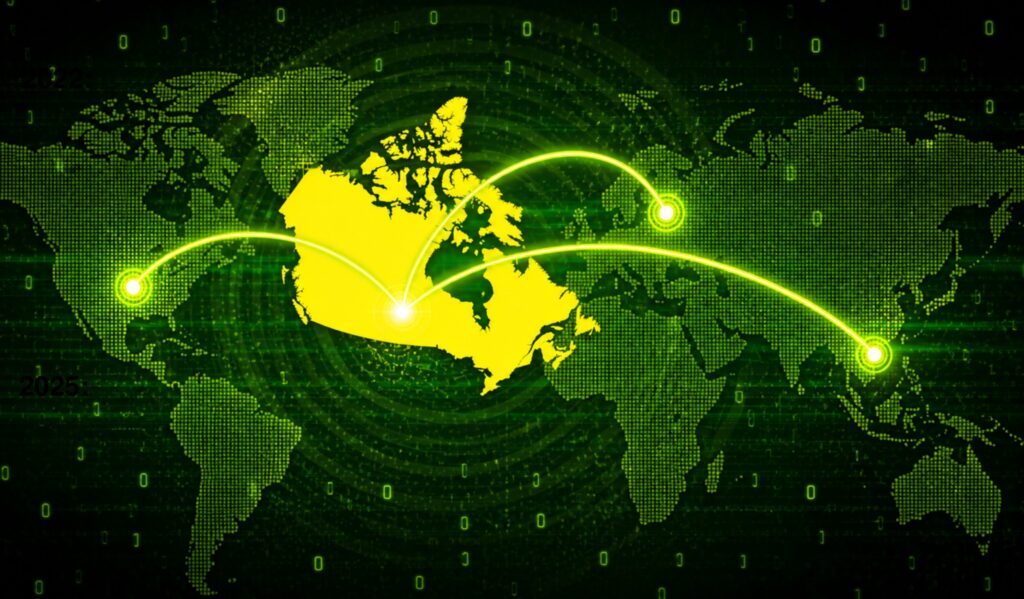
Canada’s uranium story is scaling from a North American to a more global story as both production and exports surge:
- Canada’s uranium output rose from 7,351 tonnes in 2022 to 14,309 tonnes in 2024. That is a 94.7% increase in two years; year-on-year, output rose 49.7% in 2023 and then 30.1% in 2024
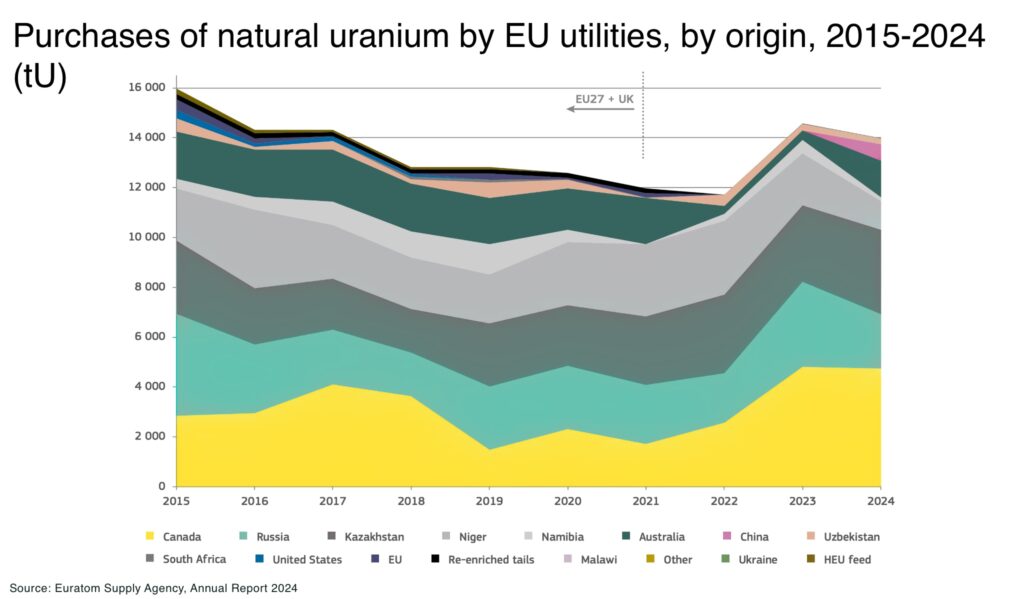
Approx 90% of Canadian uranium production is exported, traditionally mostly to North America — but is increasingly central to the global market, especially Europe’s nuclear fuel chain:
- Canada’s share of natural uranium delivered to EU utilities rose from 31.9% in 2023 to 33.9% in 2024. That is approx 6.3% relative increase in share year-on-year
- in Asia the most visible confirmed increase is South Korea, where imports rose 22% between 2022 and 2024
- in France, imports increased from 579,757 kg in 2023 to 1.21 million kg in 2024, a 109% jump year on year, with Orano now reportedly getting about 5,000 of its 8,000 tonnes of annual mined uranium from Canada
- imports to the Netherlands increased from 2.75 million kg in 2022 to 3.72 million kg in 2024, a 35.4% increase
- and in Germany, 1.88 million kg in 2022 to 2.15 million kg in 2024, a 14.3% increase
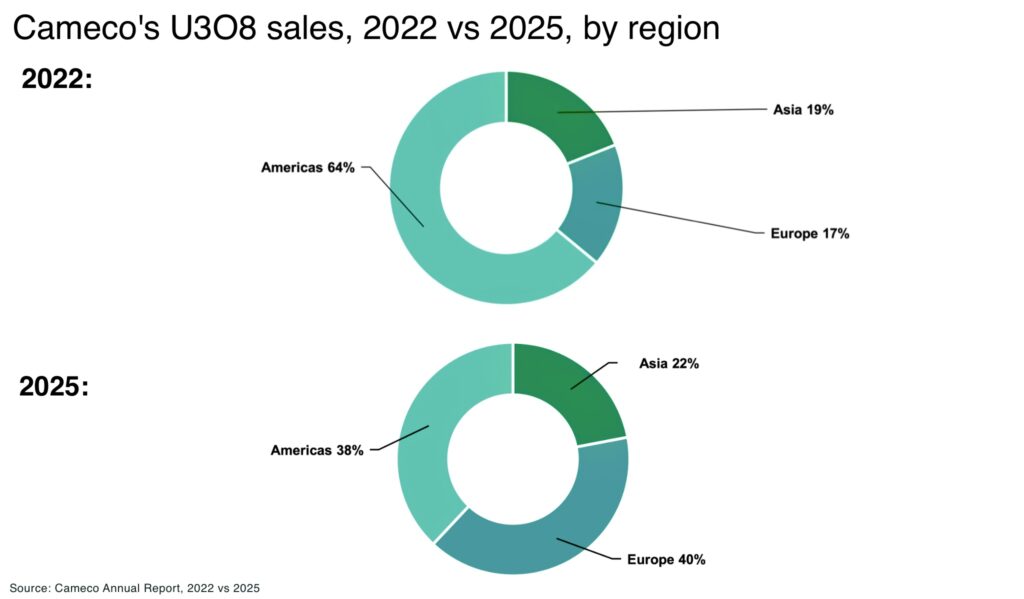
Cameco’s regional mix of committed sales for its U3O8 nuclear fuel products exports also back up the trends of a significant increase of exports from 2022–2025 to Europe and Asia:
- Europe’s share rose from 17% in 2022 to 40% in 2025, about a 135% relative increase in share
- Asia rose from 19% in 2022 to 22% in 2025, or approx a 15.8% relative increase in share
- Americas fell from 64% in 2022 to 38% in 2025, about a 40.6% relative drop in share
Rising global risks: uranium buyers are paying up for trust
This is not just a volume story. It is a risk story.
The market is putting a higher premium on uranium from jurisdictions that are safe for sizeable investments (eg uranium mine development can take 10-15 years, with investment often reaching billions of dollars), with secure logistics and supply chains, and in the region that is politically stable. Canada checks these boxes better than many other regions as geopolitical risk has soared.
Some of the most recent, major geopolitical events driving this shift include:
- Russia’s invasion of Ukraine in 2022: Russia’s share of natural uranium delivered to EU utilities fell to 15.63% in 2024 from 23.81% in 2023, as Canada’s rose to 33.9%, the largest share of any supplier. Euratom has also stated EU utilities continued stockpiling after the invasion and bought more uranium than they loaded into reactors in 2024
- Niger’s coup and seizure of Somaïr mine in 2023: political turmoil and the blocked export of more than 1,000 tonnes of uranium, meant Orano, France’s state nuclear company, was forced to source alternative supply from Asia, Australia — and also Canada
- the latest Middle East conflict reinforces the same trend: with the closure of the Strait of Hormuz and destruction of fossil fuel energy infrastructure has increased more pressure on nuclear energy sources both Asia and the West. It also throws into question recent, significant investment plans to put Saudi Arabia at the heart of global uranium enrichment supply chains
“We expect continued competition to secure uranium, conversion services and enrichment services under long-term contracts with proven sustainable producers and suppliers who have a diversified portfolio of assets in geopolitically attractive jurisdictions, and on terms that help ensure a reliable supply is available to satisfy demand” — Cameco, 2025 Annual Report
The Athabasca Basin is gaining global market share because, not only is traditional fossil fuel energy supply under increased strain, but nuclear fuel supply chains are becoming less tolerant of supply from politically fragile, sanction-exposed or conflict-adjacent jurisdictions.
And, in this market, uranium pounds from Canada’s Athabasca Basin are not just some of the most high grade in the world, but they are also lower risk.
Canada’s Athabasca Basin at the centre
Canada produced 14,309 tonnes of uranium in 2024, up from 7,351 tonnes in 2022, lifting its share of global mine supply to about 24% — with production is concentrated in the Athabasca Basin. But it’s more than just production increases that puts Canada and the Athabasca Basin at the centre of global supply chains:
- high-grade deposits: the concentration of uranium in the Athabasca Basin deposits is exceptionally high, exceeding the global average by x10 – x100, allowing for cost effective extraction
- stable geopolitical environment: Canada’s stable political landscape and supportive regulatory framework provide a secure environment for uranium investment and mining companies
- established infrastructure: the Athabasca Basin benefits from well-developed infrastructure, including roads, power lines, and a skilled workforce
- technological advancements: Canadian companies operating in the Athabasca Basin are at the forefront of innovation in uranium extraction and processing. For example:
- Jet Boring System (JBS), at Cigar Lake, Cameco uses high-pressure water to carve out cavities in the orebody and collects the ore slurry through pipes with high concentration extraction
- SABRE (Surface Access Borehole Resource Extraction), at McClean North deposit, developed by Orano and Denison Mines, uses high-pressure water jet drilling from the surface to make small, high-grade deposits economically viable
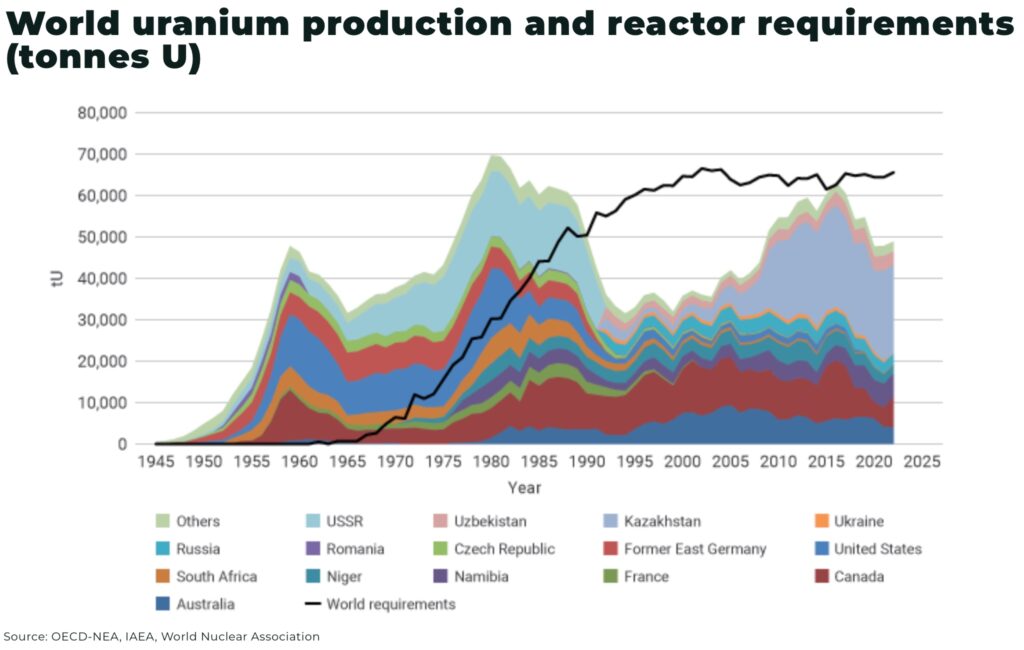
Meanwhile, global uranium demand is projected to rise, with forecasts indicating a 28% increase by 2030 and more than doubling by 2040.
Opportunity in the Athabasca Basin
F3 Uranium (TSXV: FUU, OTCQB: FUUFF)‘s 100%-owned Patterson Lake North (PLN) Project in northern Saskatchewan totals 44,613 hectares and includes the Patterson Lake North, Minto, and Broach properties, according to the company, with a maiden Indicated resource at the JR Zone of 11.801 million lbs U₃O₈ at 4.39% (including a high-grade domain of 10.788 million lbs at 12.23%)— offering both scale and grade.
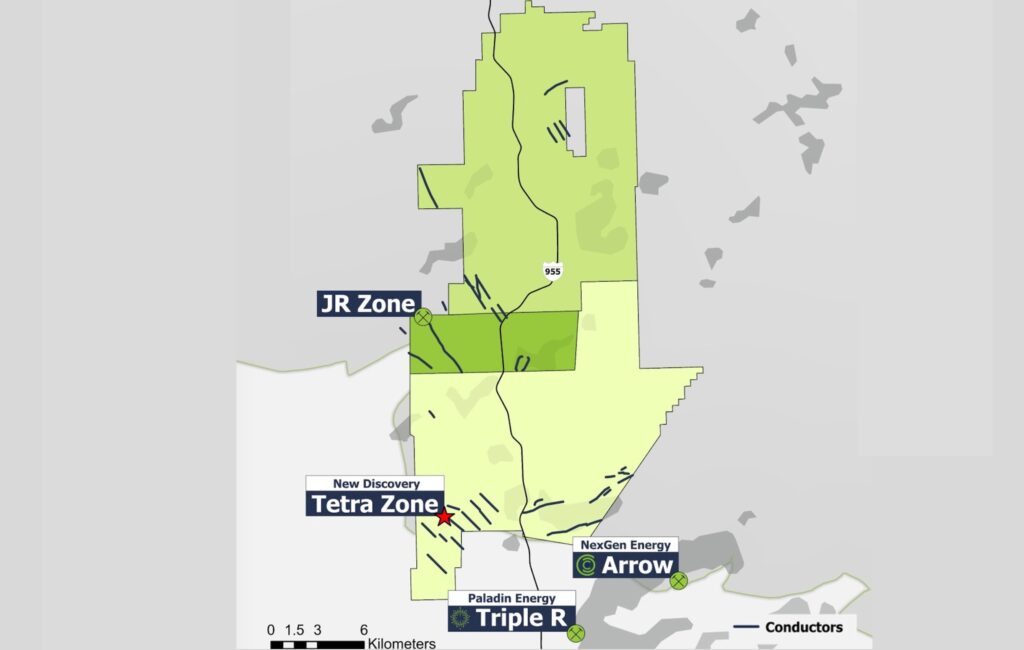
The JR Zone Uranium deposit is located approximately 25km northwest of Paladin’s Triple R Deposit and NexGen’s Arrow Deposit in the southwest Athabasca Basin and is accessible via Provincial Highway 955.
Canaccord Genuity has initiated coverage on F3 Uranium with a Buy rating and a CAD$0.30 target. Other broker targets are materially higher: SCP at CAD$0.70, Red Cloud at CAD$0.55, and Haywood at CAD$0.55.
That spread in target prices underscores two things: first, analysts are modelling meaningful exploration upside; second, valuation remains leveraged to additional discovery success in a tightening basin.
F3 recently disclosed US$25 million in treasury to advance drilling through 2026.
The higher-grade cores mirror the structure of Athabasca’s biggest deposits. Geologically, Tetra is hosted in basement rocks, similar to NexGen’s Arrow, indicating the potential for sizeable pods of mineralization controlled by fault structures.
Conclusion
As we have higlighted (many times!) before on The Oregon Group: nuclear energy is back. Across the US, Europe, China, Japan, etc nuclear reactors are being built and restarted.
Canadian uranium will not replace everything, Kazakhstan remains the world’s largest producer, other regions such as Namibia are coming online, and dependencies on suppliers like Russia run deep.
But the “Athabasca goes global” trade is not just one sudden spike in exports after one conflict, but a steady rewiring and deepening of Canada’s nuclear fuel supply chains as the world shifts to secure supply.