- antimony explorers would gain access to Canada’s 30% critical-mineral exploration tax credit, an existing incentive proposed for a wider range of eligible exploration
- canada has 78,000 metric tonnes of antimony reserves but recorded no mine production in 2025, giving it a geological base from which to rebuild supply
- the US was 91% reliant on net imports for antimony in 2025, underlining the potential market for additional allied supply
- teck’s proposed Trail initiative could double existing antimony production capacity, adding a processing opportunity alongside exploration
Canada’s federal budget proposes adding antimony to the metals that qualify for its 30% Critical Mineral Exploration Tax Credit and extending the credit by five years to 2032, potentially giving explorers a stronger tool to fund the hunt for a metal Canada does not currently mine.
The proposal comes after warnings that, by 2030, antimony smelters outside China will be able to meet only 73% of projected ex-China demand — and that’s only if every project currently announced is built.
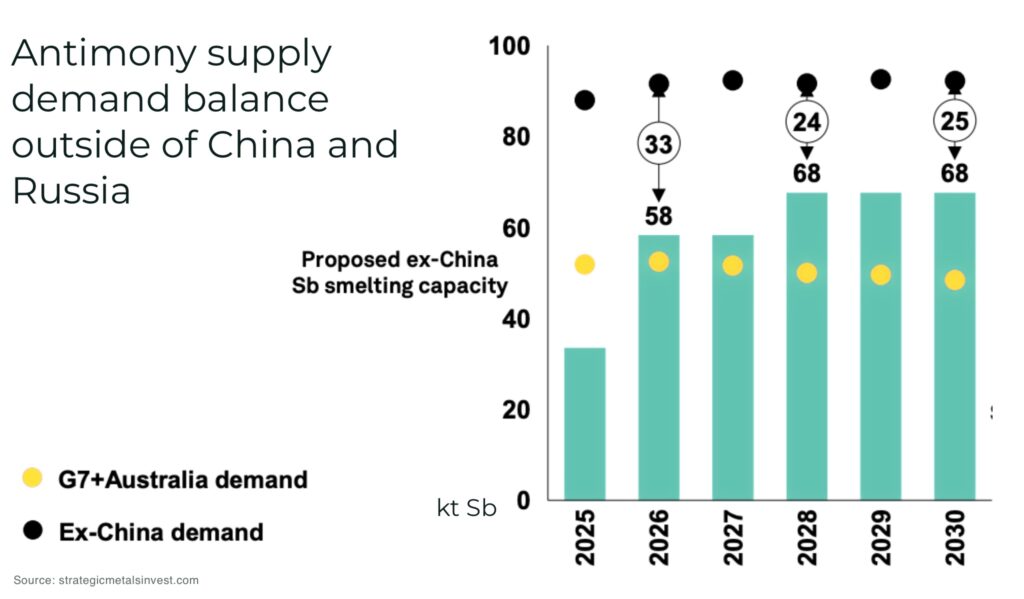
Western manufacturers are seeking more secure sources of antimony, critical across ammunition, semi-conductors, military equipment, batteries and flame retardants.
The budget also proposes extending that credit and the separate 15% Mineral Exploration Tax Credit to eligible agreements signed through March 31, 2032; both currently expire on March 31, 2027.
How big is antimony mining in Canada?
Canada’s immediate opportunity is to rebuild an industry rather than expand a large operating base — currently the country’s mine output of antimony in 2025 was zero, meaning it contributed nothing to the estimated global total of 110,000 tonnes that year.
Canada has 78,000 metric tonnes of antimony reserves, but recorded no mine production in 2025.
Beaver Brook in Newfoundland and Labrador describes itself as Canada’s only primary antimony mine, but its operator confirms the site is on care and maintenance, with mining and processing stopped.
The US Geological Survey’s national reserve estimate establishes that Canada has identified antimony in the ground, as exploration companies are working to define additional opportunities and establish which deposits can support future development.
Antimony already appears on Canada’s list of 34 critical minerals, and the budget proposal would connect that strategic recognition to the higher-rate exploration incentive.
The mechanism is straightforward. Flow-through shares allow companies to transfer eligible exploration expenses to investors, who can deduct them when calculating taxable income. The exploration credit provides an additional benefit for eligible individuals financing qualifying grassroots exploration. For junior miners without operating revenue, that can make a fundraising more attractive and support drilling, geological work and technical progress.
Canada’s untapped antimony potential
A national assessment published in FACETS identifies Nova Scotia, Yukon, British Columbia and New Brunswick as particularly promising areas for antimony exploration; and the publisher’s summary also highlights recovering antimony from old mine waste across several provinces and territories.
This creates several routes to new supply:
- dedicated antimony deposits
- recovery alongside gold or other metals
- and reprocessing material already mined
Better geological mapping and metallurgical work can help companies identify which route offers the strongest economics. For example:
- Canagold’s New Polaris gold-antimony project in British Columbia shows how this could work, with its April 2025 indicated resource includes 5,630 tonnes of contained antimony, with 5,173 tonnes included in the feasibility-study mine plan. In October, Canagold announced that laboratory refining produced antimony metal grading more than 99% from New Polaris concentrate. The result establishes a technical route towards capturing value from refined metal as well as gold
- elsewhere, Antimony Resources is advancing Bald Hill in New Brunswick
- and Armory Mining’s Ammo gold-antimony project in Nova Scotia surrounds the historic West Gore mine, illustrating the scope for new exploration around established mineral districts
Canada is building support beyond exploration
The policy opportunity also extends into processing.
In July 2026, Teck, Canada Growth Fund and the Canada Critical Minerals Accelerator signed a strategic investment framework for Trail Operations in British Columbia. The initiative could double Trail’s existing antimony and germanium production capacity, and provides for government purchasing rights over part of future antimony, germanium and gallium production.
This is an important distinction: Canada’s lack of antimony mine output does not mean it lacks antimony processing capability.
The broader Canada Critical Minerals Accelerator prioritises projects serving defence and allied supply chains, using tools including equity, loan guarantees and supply agreements. Canada’s Defence Industrial Strategy also identifies secure supplies of essential inputs as part of strengthening the defence industrial base.
Why Western buyers need more supply
China produced an estimated 40,000 tonnes of antimony in 2025, against 110,000 tonnes worldwide, roughly 36% of global mine output.
Russia produced 32,000 tonnes and Tajikistan 22,000 tonnes. So, together with China, they accounted for roughly 85% of the reported global total, illustrating how concentrated the mine-supply base remains.
China’s influence also runs through trade policy. Its antimony export-licensing controls took effect on September 15, 2024. Beijing subsequently restricted shipments to the US before suspending the US-specific mineral prohibition under a separate November 2025 notice.
As we wrote in China lifts export ban gallium, germanium, antimony:
“investors and policymakers should view the move as a reprieve, not a resolution”
The US Geological Survey estimates US net import reliance at 91% of apparent antimony consumption in 2025, with China supplying 55% of US metal and oxide imports during 2021–2024, showing why buyers have an incentive to develop alternative suppliers.
And prices demonstrate the effect of disruption, with the annual average antimony metal price rose from US$10.24 a pound in 2024 to US$25 in 2025, using the survey’s minimum 99.65%-purity benchmark.
The opportunity extends beyond digging ore. As we explained in Why antimony’s supply crisis is far from over:
“And the problem is not only a shortage of mines, but also a shortage of processing capacity.”
For Canada, developing deposits alongside a viable processing route would give Western buyers a more complete alternative supply chain. It would also create opportunities for technical services, refining investment and long-term purchasing agreements.
Why Washington cares: antimony and US defence
The defence market needs particular antimony products, not just ore.
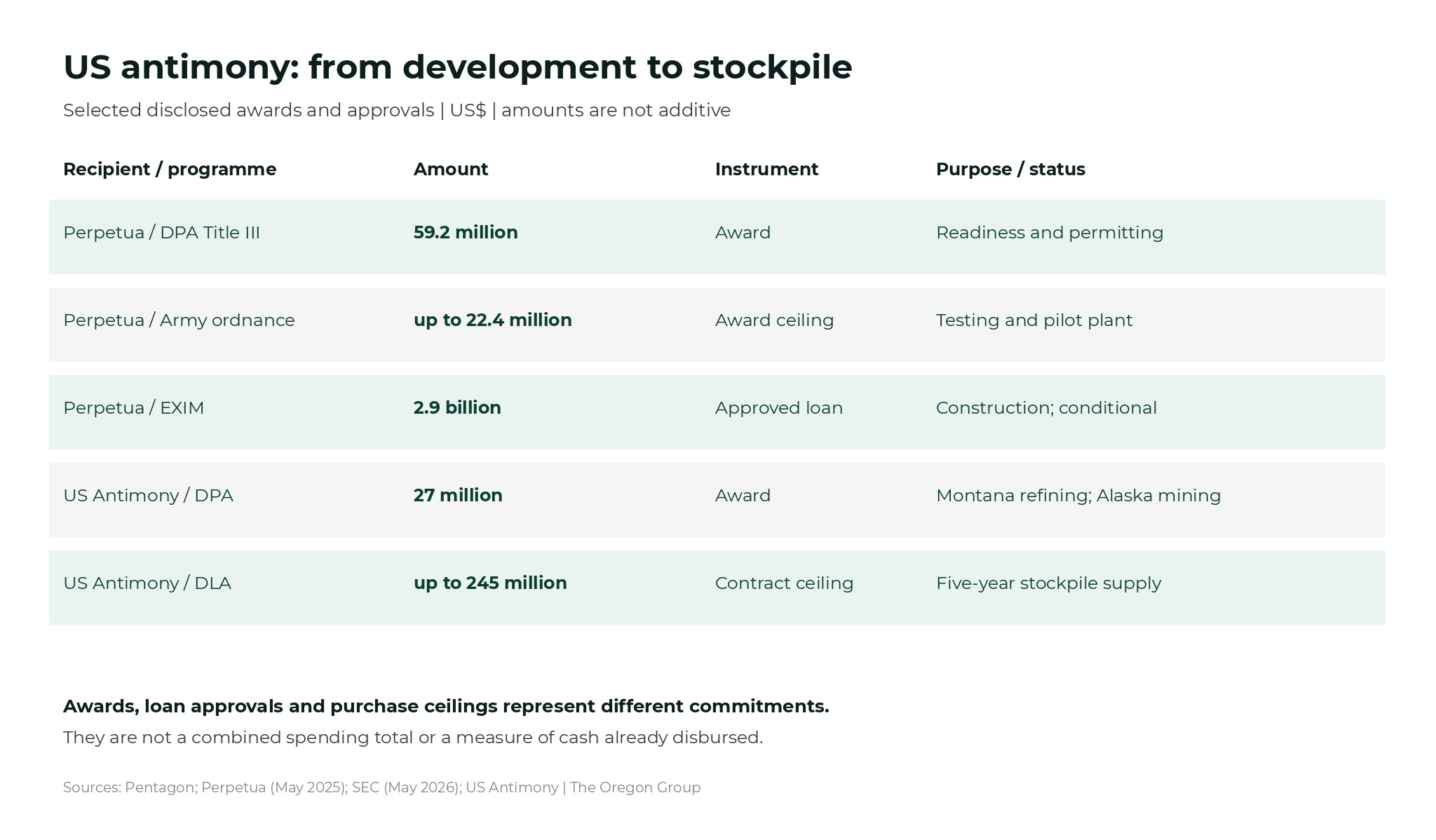
For example, in May 2025, Perpetua disclosed US$59.2 million in Defense Production Act support and up to US$22.4 million under an Army ordnance programme. The latter supports testing and a modular pilot plant to produce military-specification antimony trisulfide from Stibnite material.
That is a strategy spanning the full supply chain: help develop the mine, establish suitable processing and qualify the product for ammunition manufacturers.
Construction finance is another part of the pipeline so, in May 2026, the Export-Import Bank approved a US$2.9 billion loan for Stibnite, including an upfront facility of US$2.4 billion and the balance for capitalised interest and fees.
Meanwhile, the Pentagon announced US$27 million for US Antimony Corporation to expand Montana refining and support extraction in Alaska. The company also holds a five-year National Defense Stockpile supply contract worth up to US$245 million, with shipments described in its September update.
Development grants support technical work, loans support construction and stockpile contracts create a customer for qualified output.
The Iran war has added urgency to the debate over defence-metal supply. Reporting on Canada’s antimony gap highlighted uses in explosive formulations, flares and infrared sensors, alongside industry calls for more targeted Canadian support.
“The country has only a handful of meaningful projects, most tied to gold systems rather than stand-alone antimony mines and still lacks a clear domestic route from mine to metal”
— Northern Miner, Canada’s antimony gap shows as Iran war sharpens focus on defence metals
The pipeline is real, with the Pentagon’s Defense Production Act programme works with US and Canadian companies, and the two governments have already co-invested in Yukon critical-minerals development.
And trade policy is moving in the same direction: the January Section 232 proclamation directed negotiations over secure supplies of processed critical minerals and identified price floors as a possible tool, establishing a policy route towards supporting reliable supply agreements.
Canada’s budget eligibility
The tax changes are budget proposals, and eligibility depends on the final rules and investors’ circumstances, with the antimony expansion covering eligible agreements entered into after Budget Day and through March 31, 2032 — it does not automatically qualify every antimony company or finance mine construction.
However, the potential national security pipeline demand and government support to accelerate is now taking shape across North America — connecting those capabilities to allied purchasing programmes would turn a geological opportunity into a stronger position in Western defence manufacturing.