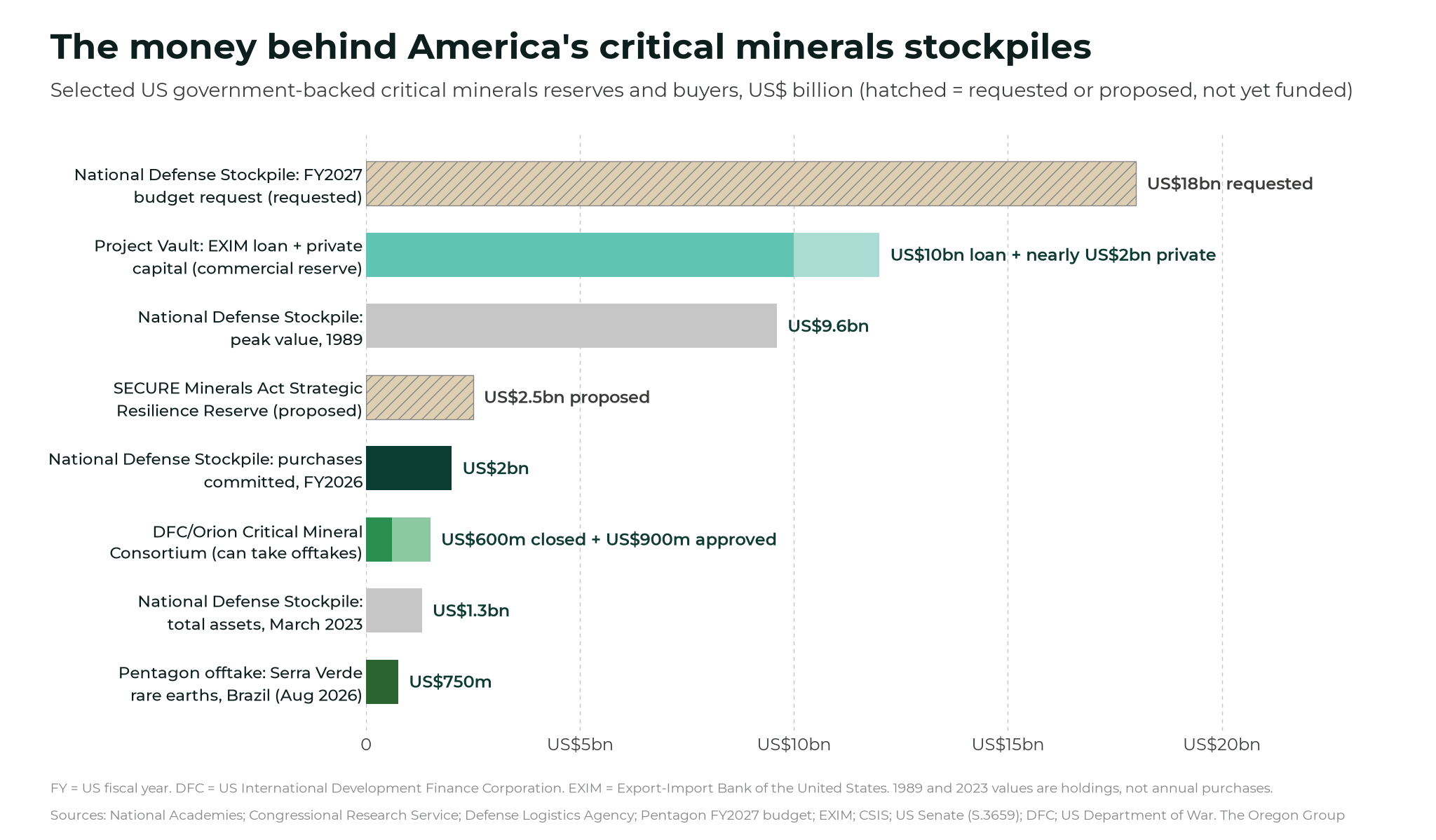
- the Pentagon’s Defense Logistics Agency committed US$2 billion in the 2026 fiscal year to buy critical minerals for the National Defense Stockpile, including tungsten and cobalt, and has requested US$18 billion for the 2027 fiscal year
- Project Vault, a US$12 billion commercial reserve built on a US$10 billion loan from the Export-Import Bank of the United States, can hold all 60 minerals on the US critical minerals list, so it overlaps with every metal the Pentagon is buying
- the two reserves are meant to do different jobs, one for war and one for the market shocks before a war, but they compete for the same kinds of material in thin markets for rare earths, antimony, germanium, cobalt and tungsten, where China refines more than 90% of the world’s rare earths and gallium
- they are not the only buyers: the Pentagon has put US$750 million behind buying rare earth carbonate from Brazil’s Serra Verde for dysprosium, terbium, neodymium and praseodymium, while the US International Development Finance Corporation has approved US$1.5 billion for a minerals fund that can also buy output
- Glencore is already on both sides: it holds US$451 million of Pentagon cobalt orders and has committed US$500 million to buy minerals for Project Vault
The Pentagon has committed US$2 billion to buying critical minerals for its National Defense Stockpile, the Defense Logistics Agency said on November 6, just as Washington’s new commercial reserve, Project Vault, starts filling its own warehouses from the same markets, which are already tight.
Two government-backed reserves are now chasing the same metals, from rare earth magnets to tungsten, antimony and cobalt, while other US agencies, Japan and the EU buy from the same suppliers. The Pentagon has already had to cancel stockpile tenders for cobalt and indium because the market could not supply them on its terms.
The urgency is because of China.
China refines more than 90% of the world’s gallium, graphite, manganese and rare earths, according to the International Energy Agency. Since 2023, Beijing has put export restrictions on gallium, graphite, tungsten and rare earths, pausing the most sweeping rare earth controls only until January 10, 2027, so any stockpile buyer faces the risk that supply is switched off again.
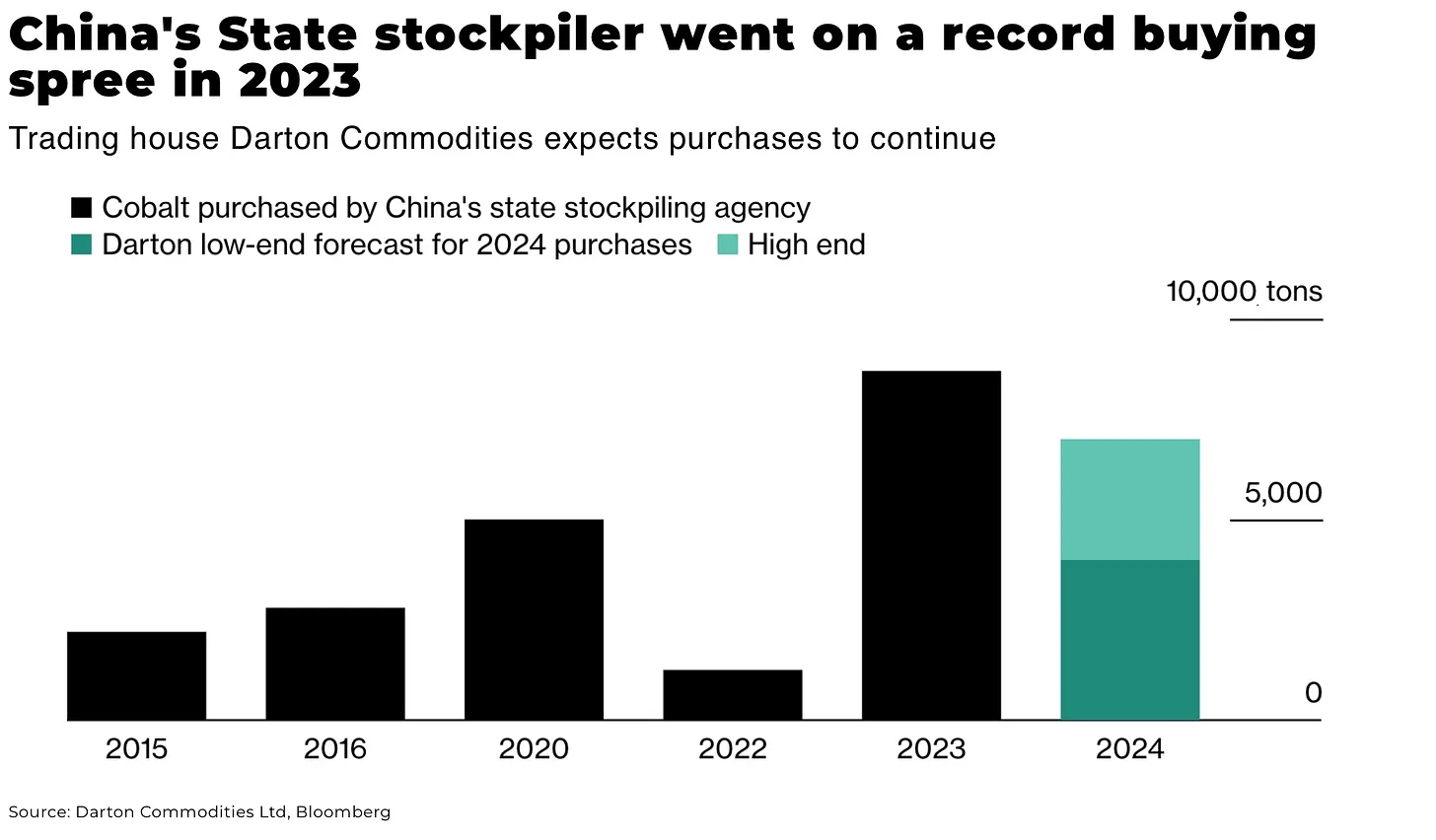
And China is also stockpiling. Its state reserve agency tendered 8,700 tonnes of cobalt metal in 2023, the largest volume it had ever bought in a single year, according to the US Geological Survey, and planned to buy up to 15,000 tonnes in 2024, Reuters reported. In March 2025 it sought bids for cobalt, copper, nickel and lithium for its reserves, as we showed when the US launched its US$12 billion strategic minerals stockpile:
For example, the world mined about 85,000 tonnes of tungsten last year, 67,000 tonnes of it in China. Amid new export controls and strong demand, tungsten prices rose x6 between January 2025 and April 2026.
In most of the minerals both reserves want, one country supplies the bulk of world mine output, US Geological Survey data show:
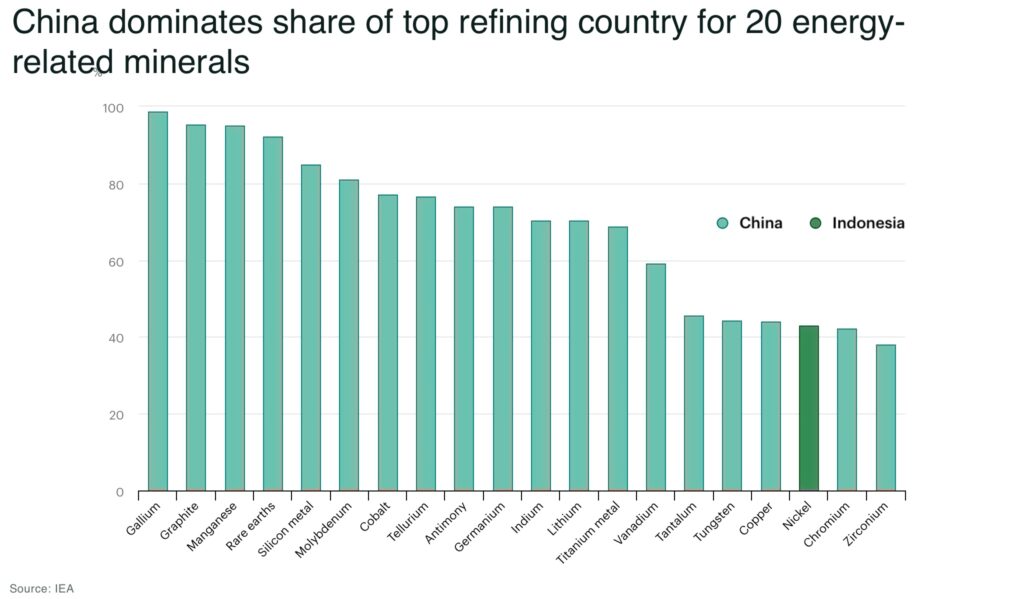
And demand is rising fast. Demand for copper, lithium, nickel, cobalt, graphite and rare earths has grown by close to 10% a year on average, against about 1% for aluminium, lead and zinc, according to the International Energy Agency. Electric vehicles, battery storage, grids and magnets drive that growth, while defence, aerospace and the servers inside artificial intelligence data centres add more.
“Given the highly concentrated nature of supply and the relatively small size of these markets, small shifts in supply patterns or purchasing behaviour had an outsized impact on prices,” the International Energy Agency said.
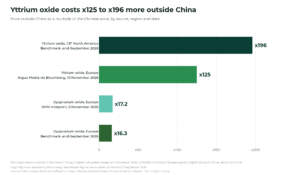
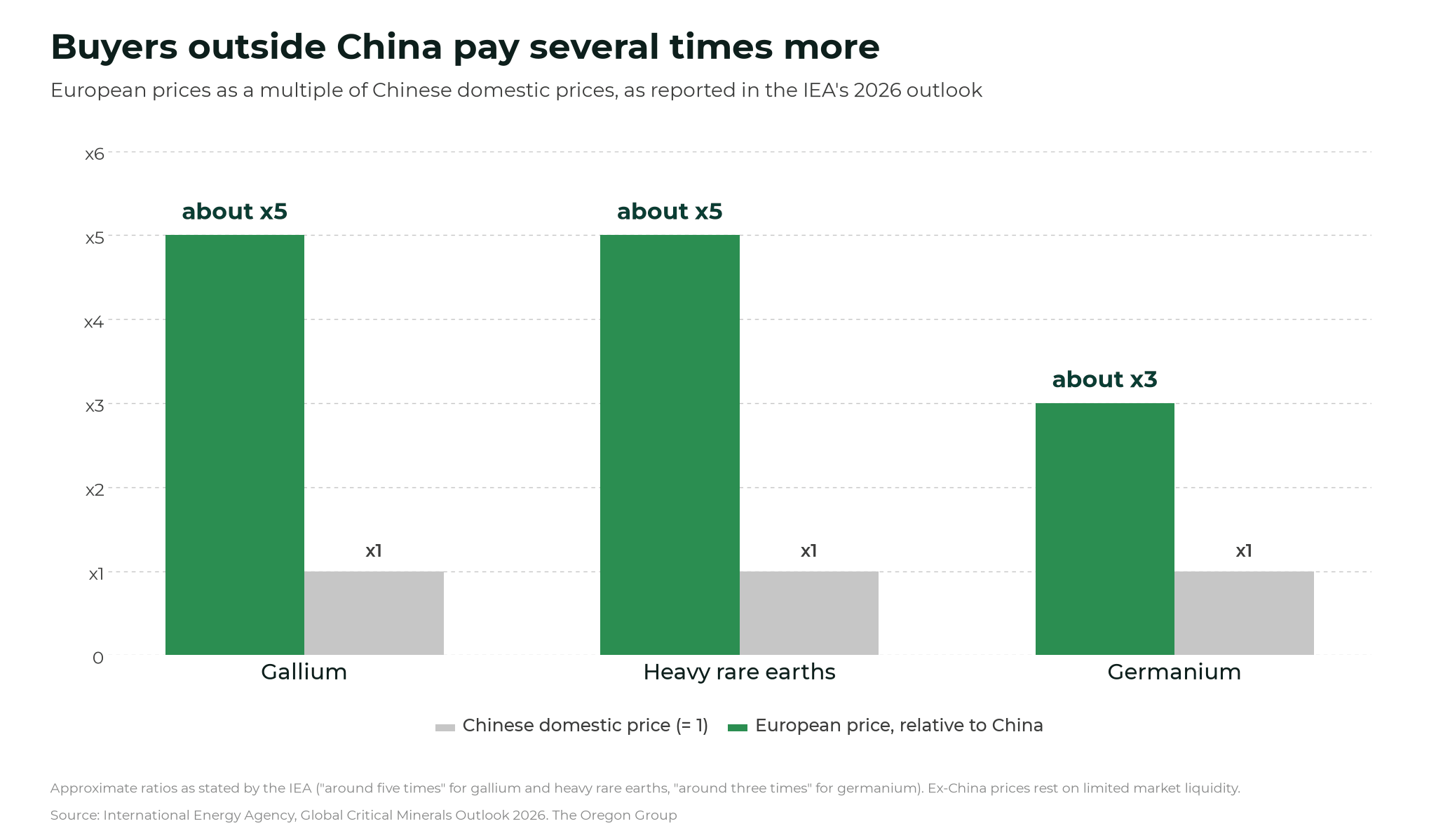
Meanwhile, buyers outside China already pay several times more than Chinese buyers for some of these metals, the agency found:
The two reserves give the US something it has not had for decades: real money behind critical minerals stockpiles on both the defence and the commercial side, with more than US$30 billion of committed and requested funding between them. That money, and the other state-backed buyers lining up behind it, dwarfs the US$1.3 billion of assets the defence stockpile held in 2023:
There is little sign yet that they work together, so the money could build new mines and refineries, or simply bid up the price of what already exists, and the companies the reserves are meant to protect are already warning about the second.
Two stockpiles, two jobs
The National Defense Stockpile (NDS) is the Pentagon’s emergency store. US law says its purpose “is to serve the interest of national defense only” and that it “is not to be used for economic or budgetary purposes”, the Congressional Research Service notes. The stockpile’s own notices go further: “It is not intended to influence prices in the market or insulate private industry from supply shocks.”
It held assets of US$1.3 billion in March 2023, against a 1989 peak of US$9.6 billion across 91 items, according to the National Academies. It is now growing fast, with the agency describing most of the critical mineral contracts behind its US$2 billion for the 2026 fiscal year as “targeted demand signals to enable domestic production”, and the Pentagon has requested US$18 billion for the stockpile in the 2027 fiscal year, x9 the 2026 figure.
The push fits the Pentagon’s new FORTRESS America programme.
In his state of the force address, Secretary of War Pete Hegseth called for “strategic reserves deep enough to fight through disruption” and said the military had become “dependent on foreign mines for rare earths”.
Project Vault does a different job.
The Export-Import Bank of the United States (EXIM) approved a loan of up to US$10 billion in February to set up the US Strategic Critical Minerals Reserve, with nearly US$2 billion of private money alongside it. Its aim is to give manufacturers “stable access to critical raw materials during periods of market disruption”, and manufacturers that signalled early interest include Boeing, GE Vernova, Western Digital and Clarios.
The reserve is run by VaultCo, an independent company. Manufacturers choose the materials, grades and volumes they want held, pay a fee and cover storage and interest, which allows them to draw down material when agreed market triggers are met.
Two Atlantic Council analysts put the split neatly:
“The NDS prepares for a crisis, while Vault prevents one … This division of labor makes the NDS the reserve for war, and Vault the reserve for the ‘war before the war’,” wrote Morgan Bazilian and Jahara Matisek of the Atlantic Council.
In theory the two reserves complement each other: a carmaker or turbine maker that rides out a Chinese export ban on Vault stock does not need to call on the defence store, and a defence store that is not raided for civilian factories stays ready for war.
The defence industry is not convinced. The Aerospace Industries Association, the main US aerospace and defence lobby, said in September that its member companies feared Project Vault “competing with A&D companies to secure compliant materials and critical minerals amid an already-constrained global supply”, where A&D means aerospace and defence. That, it said, could raise prices and volatility.
Which minerals each reserve wants
The Pentagon’s buying is specific, with its plan for the 2025 fiscal year, published by the US Geological Survey, listing:
- up to 300 tonnes of neodymium-praseodymium oxide
- 450 tonnes of neodymium-iron-boron magnet block
- 60 tonnes of samarium-cobalt alloy
- plus 2,041 tonnes of tungsten, 700 tonnes of antimony, 29 tonnes of tantalum metal and 60 tonnes of cobalt alloys
The agency has already signed a five-year deal worth up to US$245 million for antimony ingots from US Antimony, and a tungsten contract with Elmet worth up to US$2 billion, of which US$150 million is guaranteed.
Project Vault is broad by design, set to include “all 60 minerals listed on the U.S. Geological Survey’s 2025 Critical Minerals List”. Its first known delivery was 12,000 tonnes of Congolese copper from Mercuria, and VaultCo’s executive chairman, Brett Lambert, told Bloomberg that manufacturers are also asking for particular magnets, powders, alloys and other processed materials.
“There isn’t any one mineral that stands out, but the specificity of the requests have surprised me,” Lambert said.
That means every mineral the Pentagon is buying, from rare earth magnets to tungsten, is also eligible for Vault.
Where the two reserves could collide
The same small markets.
Bazilian and Matisek warned that if the line between the two blurs, “the Vault risks becoming a second buyer, chasing the same bottlenecked materials that the defense stockpile is trying to secure”.
For example, two well-funded US buyers in a tungsten market of about 85,000 tonnes a year could push up prices for the very manufacturers Vault is meant to protect.
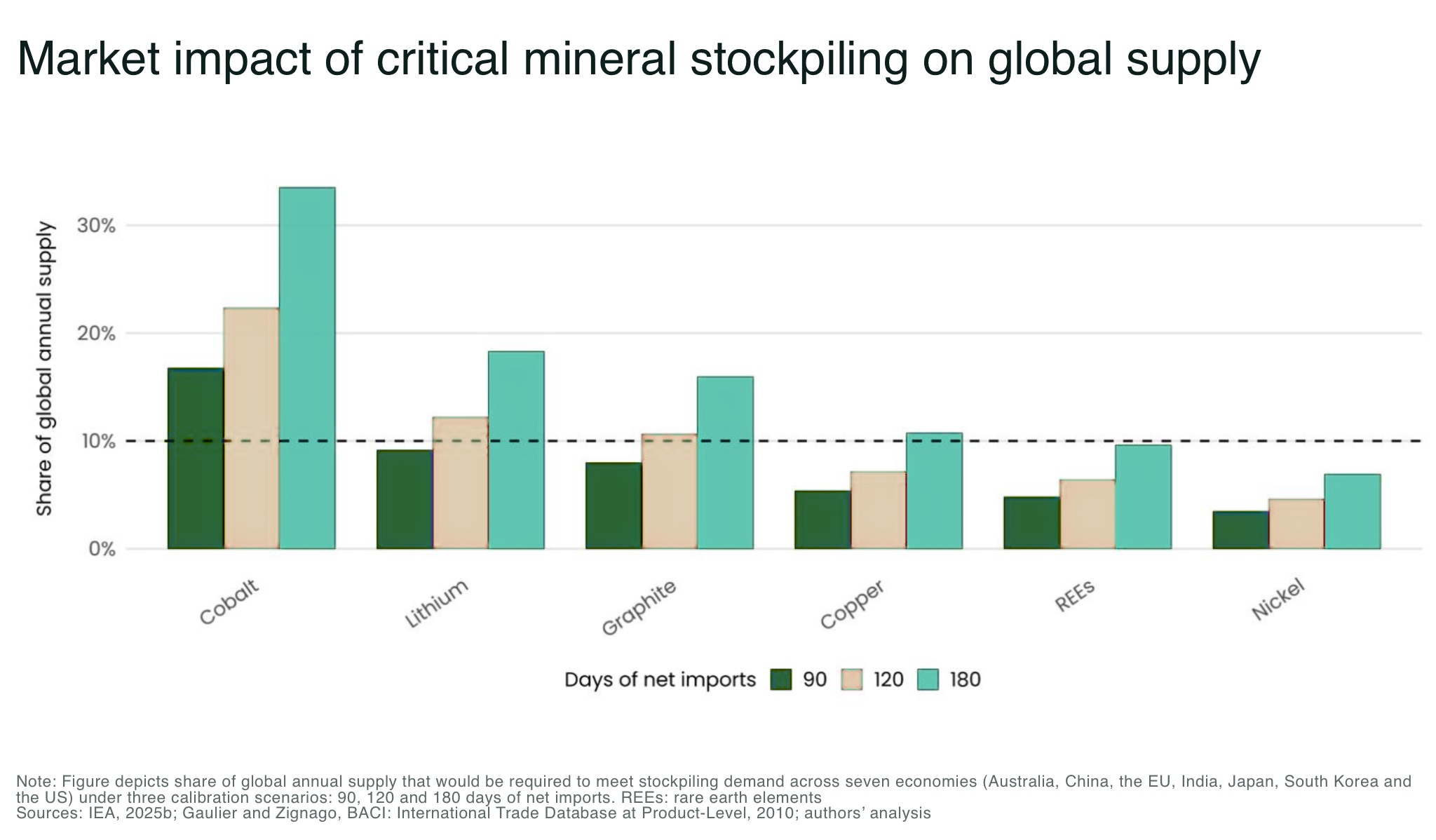
And that is before the rest of the world joins in. If Australia, China, the EU, India, Japan, South Korea and the US each held 180 days of net imports of refined material, their stockpiles could absorb up to 34% of global annual cobalt supply and more than 10% of lithium, graphite and copper supply, the London School of Economics’ Centre for Economic Transition Expertise estimated in June. That is a modelled scenario, not announced targets, but the same report found a sudden 10% rise in demand could lift prices by roughly 29% to 31% for the least flexible minerals, as we reported at the time:
The Pentagon has already hit that wall: its first attempt to buy cobalt since 1990, for up to 7,480 tonnes over five years, invited offers from only three producers outside China and was cancelled on October 15, 2025 after 10 amendments. By December, cobalt prices were up 50% on August, when the tender was launched.
On September 30 this year, the agency cancelled without an award a request for more than 400 tonnes of indium over three years, about a year’s supply outside China by one trader’s estimate.
“You have a player in the market now with almost endlessly deep pockets,” Jan Giese of the metals trader Tradium said of Vault when it was launched in February.
Lambert is apparently alert to the risk, saying Vault will not publish how much it plans to buy. “We want to be very careful not to influence the markets,” he said.
The same supplier.
So far, Glencore is the only supplier we can verify that is on both sides.
It holds Pentagon cobalt delivery orders worth US$451 million under a stockpile contract running from 2026 to 2031. In September it committed US$500 million to source minerals for Project Vault, alongside a matching US$500 million from Mercuria.
Vault’s other traders are also locking up new supply; for example, Traxys has signed an exclusive deal for the tungsten concentrate from Abenójar Tungsten’s El Moto project in Spain for at least 10 years from the start of production, apart from output the company may keep for its own processing.
Where the metal comes from.
The defence stockpile must buy material of domestic origin first, then prioritise close allies such as Britain, Canada and Australia. Vault has “no predetermined geographic restrictions”, according to the Center for Strategic and International Studies, which adds that “some materials may be sourced from China”.
But US officials said in April that Vault would initially need to buy minerals from “anywhere in the world,” including China. That matters because from January 1, 2027, a Pentagon sourcing rule bars defence contractors from delivering rare earth magnets, tantalum, tungsten metal powder and tungsten heavy alloy “mined, refined, separated, melted, or produced” in China, Russia, North Korea or Iran. Chinese-origin stock in Vault could help Boeing’s airliner lines in a shock, but not its defence work.
Ore or finished metal.
The Atlantic Council’s reminder that “ore is not a magnet, oxide is not a metal” cuts both ways. The Pentagon’s Elmet contract buys tungsten ores, concentrates and sodium tungstate, while Vault’s manufacturers want finished magnets and alloys. Both depend on the same small number of processing plants outside China, which is where the Atlantic Council fears Vault could end up “absorbing scarce midstream capacity at the worst possible time”.
Who gets the metal first.
In Vault, “decisions about drawing down material rest with participating manufacturers, not federal officials”, CSIS notes. We have found no public rule giving the Pentagon first call on Vault stock in a war. The Atlantic Council recommends “defense priority clauses” and procurement coordinated through the Defense Logistics Agency to prevent “self-defeating bidding wars”.
There also appears to be no official statement of how the two buyers coordinate, so the two programmes are “not interdependent”, according to Fastmarkets.
The other US buyers in the queue
The defence stockpile and Project Vault are the only two US programmes built to hold critical minerals in reserve, but they are not the only government-backed buyers in these markets.
Pentagon offtakes: under its July 2025 deal with MP Materials, the Pentagon agreed that for 10 years “100% of the magnets produced at the 10X Facility will be purchased by defense and commercial customers”, alongside a US$110 per kilogram floor price for neodymium-praseodymium “stockpiled or sold”, the company said.
On August 24 the Pentagon put US$750 million behind an offtake of mixed rare earth carbonate from Serra Verde’s mine in Brazil, part of a US$1.55 billion package that includes a US$300 million purchase commitment from the Defense Logistics Agency. It is meant to secure dysprosium, terbium, neodymium and praseodymium, the same magnet metals Vault’s manufacturers want.
Development finance: the US International Development Finance Corporation (DFC) has put US$600 million into a US$1.8 billion critical minerals fund with Orion Resource Partners and Abu Dhabi’s ADQ, which can take offtakes as well as equity and debt. Its board has since approved a further US$900 million. The DFC also said in February that Congo’s state miner Gécamines, through its trading venture with Mercuria, had started shipping about 100,000 tons of copper committed to the United States.
A third reserve on the table: the bipartisan SECURE Minerals Act, introduced on January 15, 2026, would create a Strategic Resilience Reserve with US$2.5 billion to support prices, stockpiles and production. It is still before the Senate Energy and Natural Resources Committee.
Other government money works on the supply side rather than as a buyer, such as the Pentagon Office of Strategic Capital’s conditional loans of US$620 million to Vulcan Elements and US$80 million to ReElement Technologies for rare earth magnets. That money adds tonnes rather than chasing them.
The same mines abroad
Allies are already competing for the same mines. EU Industry Commissioner Stéphane Séjourné says he was three days from flying to Brazil to sign a rare earths deal when he found the US had bought a local miner’s entire output through 2030. Japan has secured 75% of Lynas’s heavy rare earth oxides for its industry until 2038, days before the Pentagon reset its own US$96 million Lynas deal.
The EU is also preparing its own stockpile, with tungsten, rare earths and gallium on its first shortlist, overlapping with what the Pentagon and Vault are buying.
Allies buying too: the US–Australia framework of October 2025 draws on US stockpiling and Australia’s Critical Mineral Strategic Reserve, and the US–Japan framework the same month commits both sides to consider “a mutually complementary stockpiling arrangement”.
In June 2026, G7 leaders agreed to “cooperate on stockpiling and crisis management and establish a joint cooperation mechanism”, according to the summit annex. These deals could ease competition between allies, but they also add more state buyers to the same markets.
What could prove this wrong
The clash is not inevitable.
For example, Elmet does not intend to deliver tungsten into the stockpile until new supply from the mines and processing it is backing becomes available, so the stockpile adds to supply rather than taking from factories. The Pentagon’s 10-year floor price for MP Materials’ neodymium-praseodymium works the same way, by giving a new producer a reason to build.
That only holds if Vault pays for new, non-Chinese output. It has published no such rule, and Columbia University’s Center on Global Energy Policy warns that fast emergency access “would require sourcing many critical minerals from China”. “In essence then, the stockpile would source from China to absorb a shock from China,” the center said.
And new supply is slow to arrive, as we wrote in our earlier article on the Pentagon’s China minerals ban:
“A new mine or refining source to replace that supply can take up to 10 years to identify, build and certify”
Conclusion
The US now has a reserve for war and a reserve for the war before the war. If the two are run as one system, they can pull new mines and refineries into being; if they are not, they will bid against each other, and against Japan and Europe, for the same scarce tonnes, and drive up prices for the manufacturers Vault was set up to protect.