
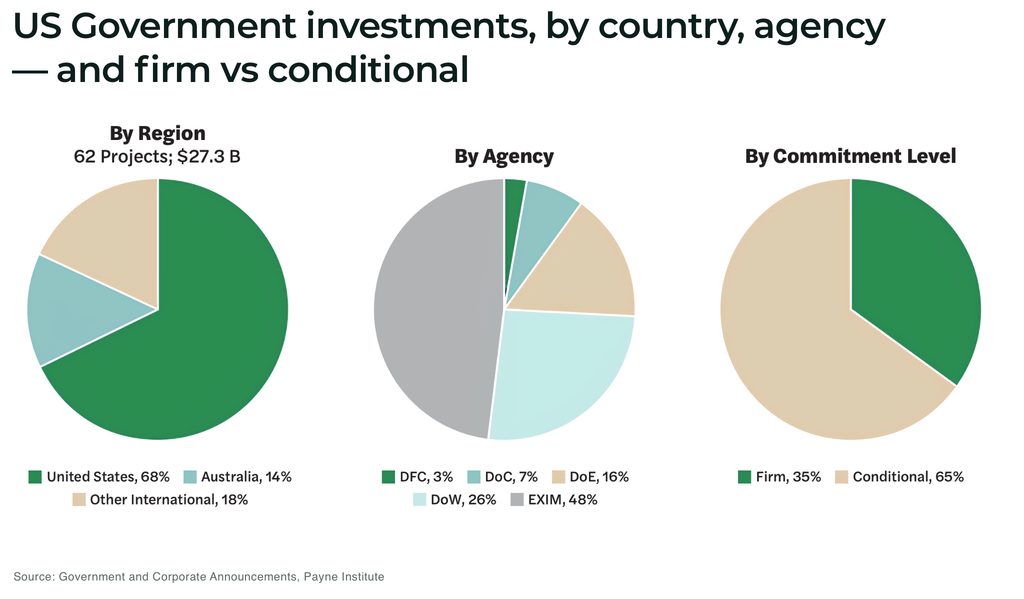
The US has committed or conditionally committed at least US$27.3 billion to 62 critical minerals projects since the start of 2025, according to the Payne Institute’s State of Critical Minerals Report 2026 — as Washington takes a leading role in financing alternatives to China-dominated supply chains.
The commitments span nine countries and more than three dozen minerals, withpprox 68% of their value targets US projects, with Australia accounting for another 14%.
The scale matters, but the more consequential shift is how Washington is putting its balance sheet to work: taking equity stakes, providing loans, supporting prices and backing customers’ purchases.
Together, these interventions help address the question that determines whether a mineral deposit becomes an operating business, will someone finance construction, and whether the producer earn enough to keep running.
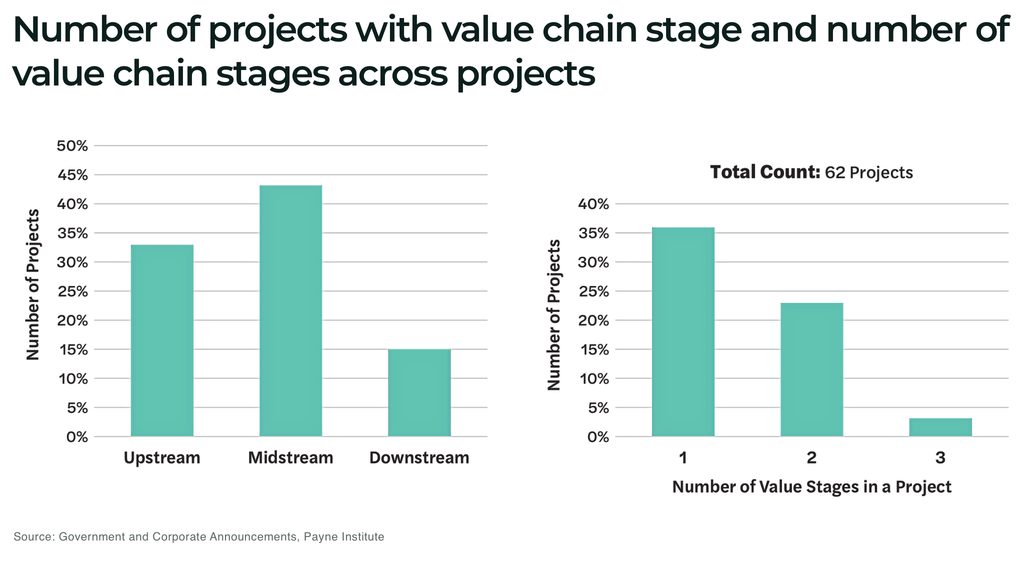
The majority of the investments made upstream (eg mining) and/or midstream (eg refining or processing), as well as 15 include a downstream (eg product manufacturing) component.
The push comes against a difficult investment backdrop. Global critical mineral investment fell 9% in 2025, while spending by battery metals companies dropped more than 20%, according to the International Energy Agency’s latest outlook.
Washington is increasingly willing to absorb risks that private investors struggle to price.
For example, MP Materials illustrates the approach: its July 2025 Pentagon agreement combined a US$400 million preferred-equity investment with a ten-year US$110-per-kilogram price floor for its neodymium-praseodymium products. The package also included a ten-year commitment to ensure purchases of all magnets produced by its planned 10X facility. That protection is already appearing in company accounts. MP reported US$17.6 million in price-protection income in the second quarter of 2026, alongside US$108.5 million in revenue.
For investors, the significance extends beyond one company as a government-backed price floor can help reduce exposure to a market downturn; a purchase commitment can give lenders greater confidence that new capacity will have customers; equity and loans help pay for construction.
The US is also financing protection against supply interruptions when, in February, the Export-Import Bank approved a direct loan of up to US$10 billion for Project Vault, a public-private strategic critical minerals reserve intended to store materials for American manufacturers.
The new research identifies the US as a major driver of critical mineral investment diversification — and the leading player in the Western hemisphere — howeer does not establish that America has overtaken China in mineral supply investment.
Nor does every US announcement represent secured funding. Payne classifies 65% of the US$27.3 billion as conditional, with 35% firm. Even firm commitments should not be confused with disbursements or operating capacity.
The institute’s central recommendation is therefore consequential: support complete supply chains. A new mine cannot remove dependence if its output must still pass through a vulnerable processing bottleneck. A refinery needs reliable feedstock both need customers.
America is helping change the financing terms for critical minerals. The next test is whether those commitments produce complete, commercially durable supply chains.