
- the US Army announces conditional long-term lease awards on for at least four companies to build and operate critical mineral processing facilities on Army installations
- the Army has preliminary lease agreements with Titan Mining, EnergyX, Ioneer and REalloys for graphite, lithium, boron and rare earth processing
- the awards cover graphite at Anniston Army Depot and Pine Bluff Arsenal, lithium at Red River Army Depot, and boron plus dysprosium and terbium at Tooele Army Depot
- Titan Mining said its Empire State Mines subsidiary received conditional selections for Pine Bluff and Anniston, with construction of its Kilbourne Graphite Purification Plant targeted for the second half of 2027
- the companies are expected to invest about US$2 billion, with construction starting as early as 2027 and mineral production targeted for 2028
The US Army is will host critical minerals processing plants on military bases, leasing land to companies that can refine materials including lithium, graphite, boron and rare earths.
The conditional lease awards cover four companies: Titan Mining subsidiary Empire State Mines for graphite at Anniston Army Depot in Alabama and Pine Bluff Arsenal in Arkansas; EnergyX for lithium at Red River Army Depot in Texas; Ioneer USA for boron at Tooele Army Depot in Utah; and REalloys for dysprosium and terbium, also at Tooele.
“The ability to process critical minerals on US soil is a national-defense priority required for munitions, missiles, sensors, batteries, and the platforms our Soldiers depend on” — said Dr. Jeff Waksman, Principal Deputy Assistant Secretary of the Army for Installations, Energy and Environment
Formal lease agreements are still in negotiation, with development expected to start in 2027 with initial operating capability targeted by 2028. The bases involved include:
- graphite at Anniston Army Depot and Pine Bluff Arsenal with Empire State Mines, LLC, a wholly owned subsidiary of Titan Mining Corporation
- lithium at Red River Army Depot with Energy X
- boron at Tooele Army Depot with Ioneer USA Corporation
- dysprosium and terbium at Tooele Army Depot with REalloys
Titan Mining said its Empire State Mines subsidiary has received conditional selection notices for Enhanced Use Lease opportunities at Pine Bluff and Anniston, with construction of its Kilbourne Graphite Purification Plant targeted for the second half of 2027.
“By establishing robust domestic processing capabilities on Army installations, we are actively reducing our reliance on foreign sources and ensuring the Joint Force has uninterrupted access to the foundational materials required for next-generation defense technologies” — Rita Adiani, President and CEO of Titan Mining
Titan’s graphite award shows how this could work. The company said Pine Bluff is the primary site at about 245 acres, Anniston is the secondary site at about 97 acres, and the planned Kilbourne facility would produce purified micronized graphite and coated spherical purified graphite for defense, energy and industrial markets through a public-private partnership with the Army.
The announcement signals that critical minerals are no longer being treated as a conventional mining problem. They are national-security infrastructure and part of that supply-chain defense.
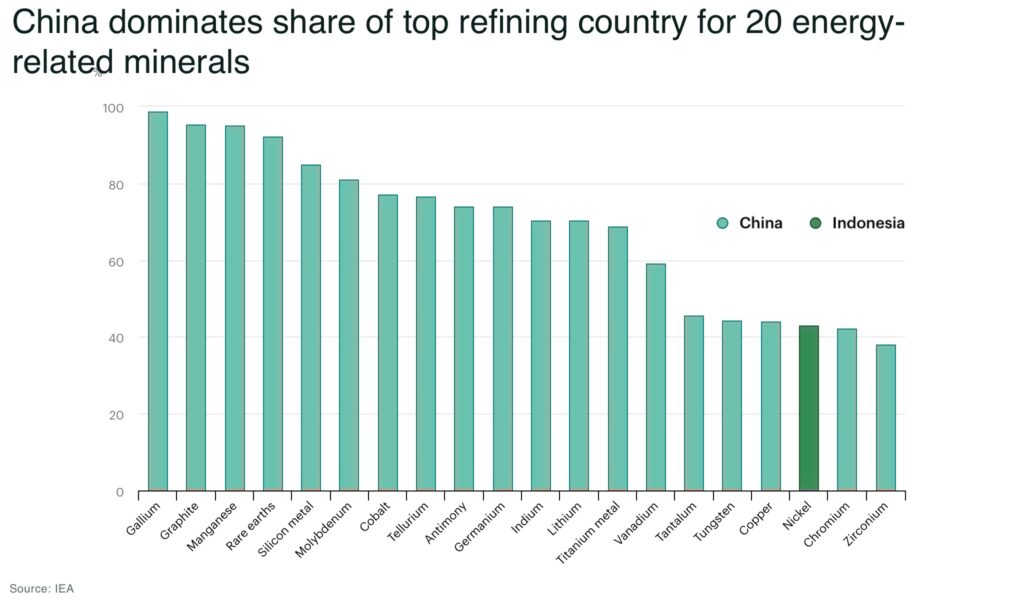
The reason is that China dominates global processing capacity across many critical minerals:
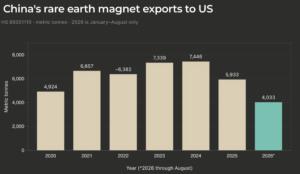
- rare earth supply chain — accounting for approx 60% of global mined production of magnet rare earths, its share of refining is above 90%, and almost 95% of permanent magnet production. But has increasingly been willing to use its dominance to threaten Western supply chains through export restrictions. For example, adding MP Materials and USA Rare Earth to its export control list in June 2026, and exports of yttrium to Japan collapsing since January 2026
- the US is 100% reliant on imports for natural flake graphite, and China controls more than 90% of global battery-grade graphite processing capacity, a chokehold over materials essential to munitions, missiles, sensors, energy storage and electric vehicles
- Chinese companies accounted for over two-thirds of the world’s cobalt and lithium processing capacity
Refining plants are expensive, politically difficult and often need power, water, waste handling and heavy-industrial zoning. Building on military infrastructure allows the metals companies to fast-track permitting that can otherwise take years. By offering industrial land on Army bases, the US is trying to compress permitting, infrastructure and offtake into one national-security package.
And this may well be just the start, with the US Department of the Interior identifing 60 minerals as vital to the US economy and national security, and added boron, copper, uranium, silver and six other minerals to the US critical minerals list.
The US Army is moving critical minerals inside the defense perimeter.
Q&A
What are US Army critical minerals plants?
They are proposed processing and refining facilities on Army bases for minerals including graphite, lithium, boron and rare earths, under preliminary agreements.
Why is the US Army involved in critical minerals?
Critical minerals feed defense, energy and technology supply chains, and the Interior Department says 60 minerals now face supply-chain risks tied to US economic and national security in the 2025 critical minerals list.
When could production begin?
The companies are expected to begin construction as early as 2027 and target production in 2028.
Why does this matter for China supply risk?
The IEA says refining concentration has increased, with China driving major growth in graphite and rare earth refining, making diversification a core issue.