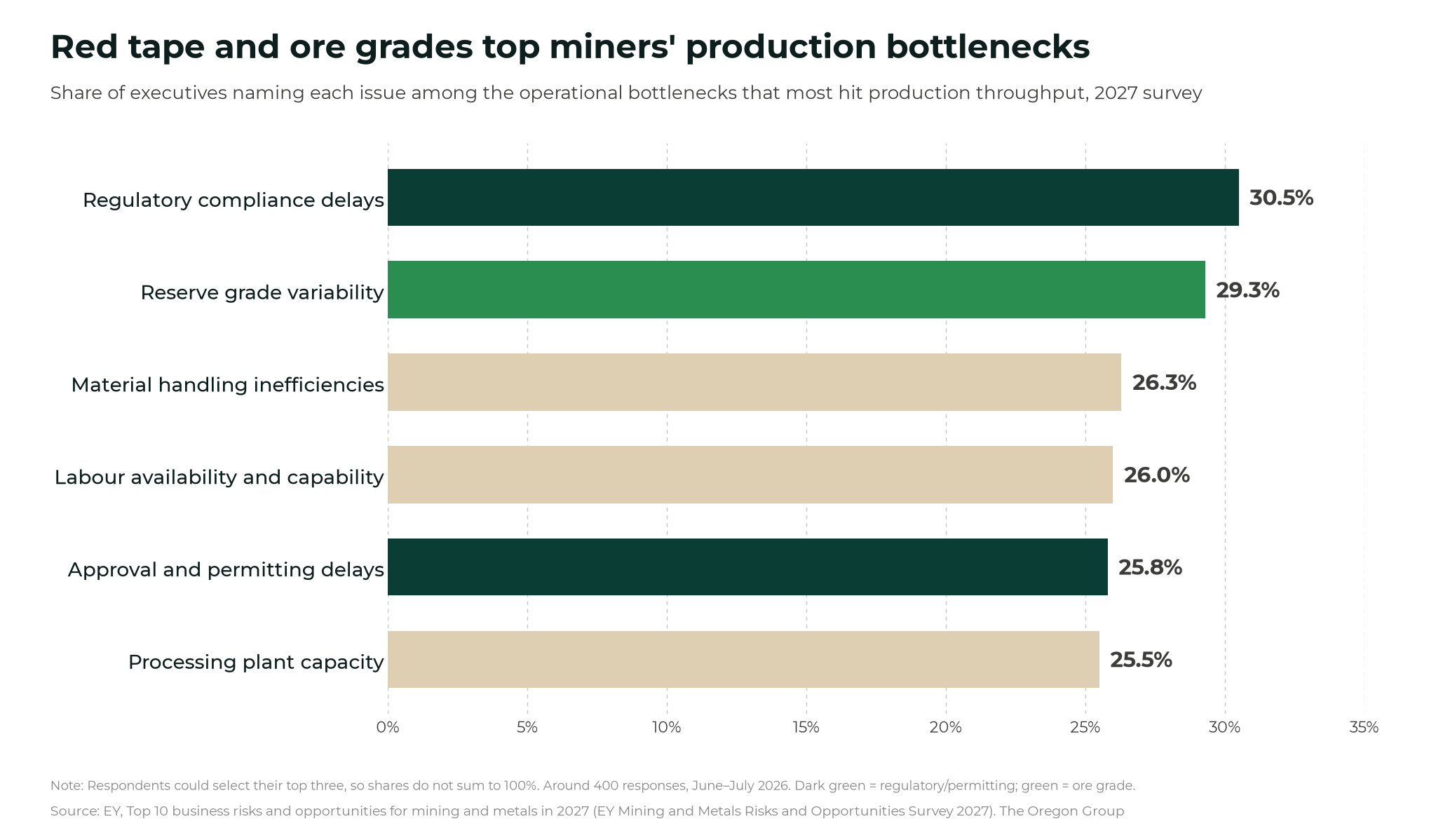
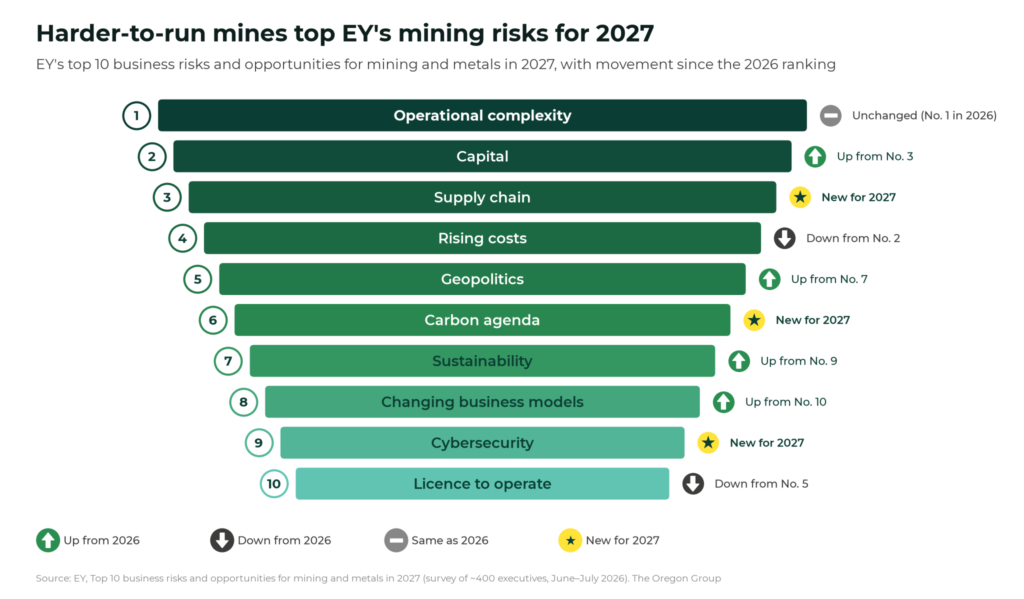
- operational complexity, meaning ageing deposits, variable ore grades and regulatory delays, is the No. 1 business risk for mining and metals in 2027 for a second year, according to an EY survey of around 400 executives
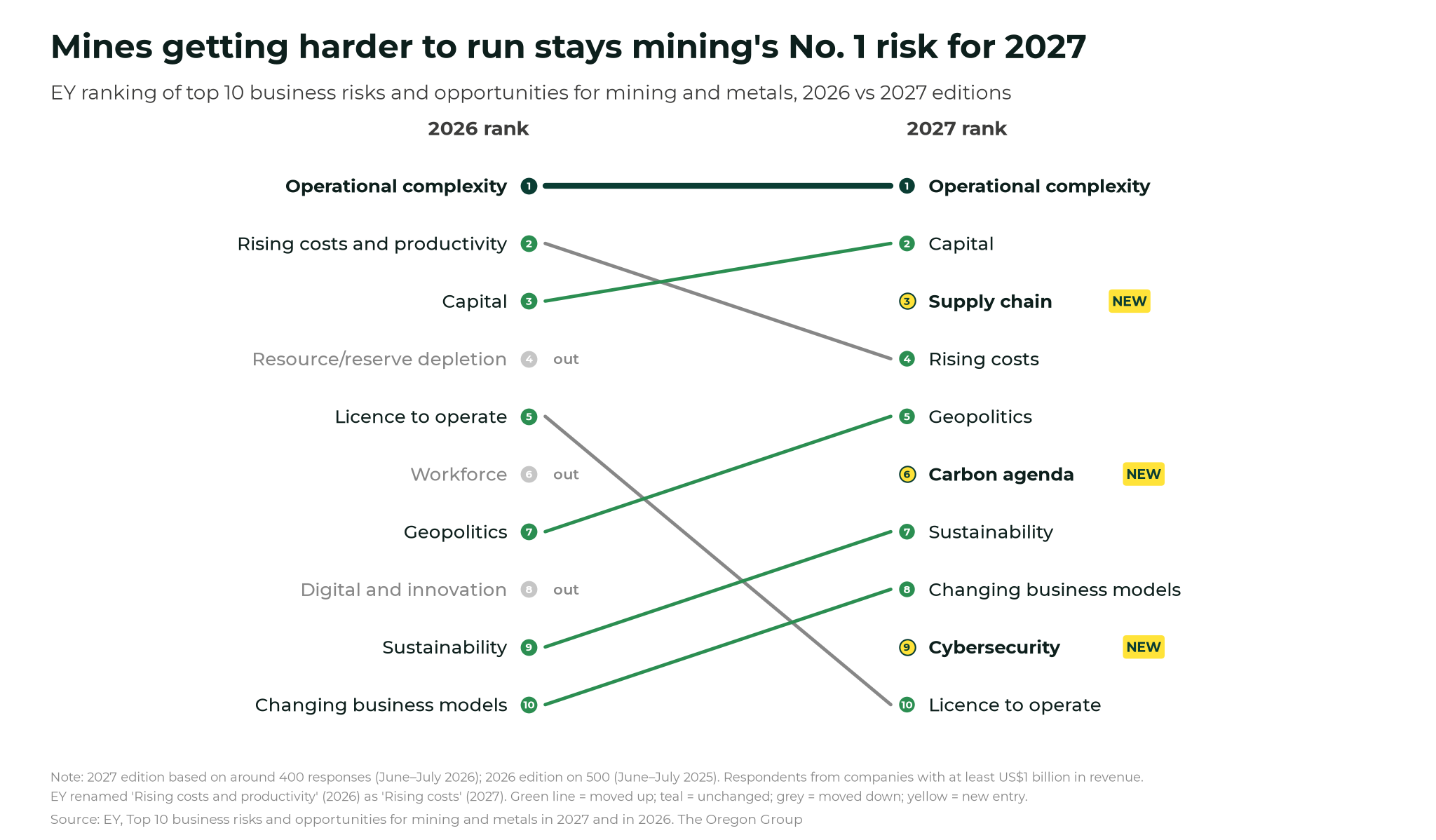
- 30.5% of executives named regulatory compliance delays and 29.3% named reserve grade variability among their top three production bottlenecks, the same grade problems now cutting copper output at BHP’s Escondida and Spence mines
Mines getting harder to run is the mining industry’s biggest risk for 2027, according to EY’s Top 10 business risks and opportunities for mining and metals in 2027.
The ranking is based on around 400 responses from executives at mining and metals companies with at least US$1 billion in revenue, surveyed in June-July 2026.
EY blames ageing deposits, more variable ore grades and slow regulatory approvals — “Older mines are tougher and more expensive to mine,” it said.
The ranking comes as Chile, the world’s largest copper producer, cut its 2026 copper output forecast for the third time this year.
What is slowing mines down
The biggest challenges to running mines include:
- regulatory compliance delays were the most cited bottleneck to production throughput, named by 30.5% of respondents
- reserve grade variability followed at 29.3%, ahead of material handling inefficiencies at 26.3%. Respondents could pick three issues
- labour availability (26.0%), approval and permitting delays (25.8%) and processing plant capacity (25.5%) were close behind
And EY’s global mining and metals leader says the problem is getting worse, with Paul Mitchell, EY’s global mining and metals leader, saying in a statement.
“Mining has always been complex, but the degree of operational complexity is increasing as mines age and reserves are depleted and the new ones are more difficult to mine and process.”
The decline is a long-running problem; for example, in last year’s edition, EY noted that the average grade of copper mined worldwide has declined by about 40% since 1991.
Chile shows the risk in practice
One of the most high-profile examples is Chile produced 3.63 million tonnes of copper in the first nine months of 2026, down 8.5% from a year earlier, according to Cochilco’s third-quarter copper market report, published on October 30. The state copper agency now expects full-year output of 4.94 million tonnes, down 8.4% on 2025. Its fourth-quarter 2025 report had expected 5.61 million tonnes.
Cochilco blames lower grades, maintenance, interruptions and ore variability — the same problems EY’s respondents ranked near the top.
Escondida, Codelco and Spence explain 77.3% of the national decline; for example:
- Escondida produced 891,000 tonnes in January–September, down 12.5%. Its concentrator feed grade fell to 0.81% in the September quarter from 0.94% a year earlier, BHP said
- Spence’s output fell 25.7%. BHP cited a lower feed grade of 0.53%, from 0.65%, and “ongoing challenges in managing ore variability”
- Codelco’s own output fell 9.0%. Cochilco linked restrictions at El Teniente, down 17.1%, to the 2025 accident, and a 32.4% fall at Ministro Hales to lower grades
Supply chains and cybersecurity enter the top 10
But it’s not just operational challenges:
- capital rose to No. 2 from No. 3.
- supply chain enters the list at No. 3
- geopolitics climbed to No. 5 from No. 7
- the carbon agenda at No. 6
- and cybersecurity at No. 9.
Notably, resource and reserve depletion, No. 4 last year, dropped out of the top 10. So did workforce and digital and innovation. That does not mean depletion stopped mattering. “Depletion can reduce operators’ choices,” EY said, leaving less flexibility to manage disruption.
Also, regards financing, EY says public financing for critical minerals more than quadrupled between 2023-2025 to about US$65 billion.
The caveats
EY’s ranking measures executive perception, not output, and it’s sample also fell to around 400 responses from 500 in last year’s survey.