
Canada’s NexGen Energy’s CEO has revealed the company is in talks with data-centre providers to help finance a new mine to secure long-term uranium supply for nuclear plants powering AI data centres.
“It’s coming. You’ve seen it with automakers. These tech companies, they’re under an obligation to ensure the hundreds of billions that they are investing in the data centres are going to be powered,” Leigh Curyer founder and CEO of NexGen said, speaking at a Melbourne Mining Club event. “So there’s a very high risk profile over their supply of nuclear fuel. I would say it’s in the early stages, but it’s happening. And we’re keeping exposed to that.”
NexGen did not name any of the companies they’re talking to or specify the mine location but, with the company’s project pipeline centred in Canada’s Athabasca Basin, we are assuming these are US buyers looking to lock in Canadian uranium.
The timing is not accidental:
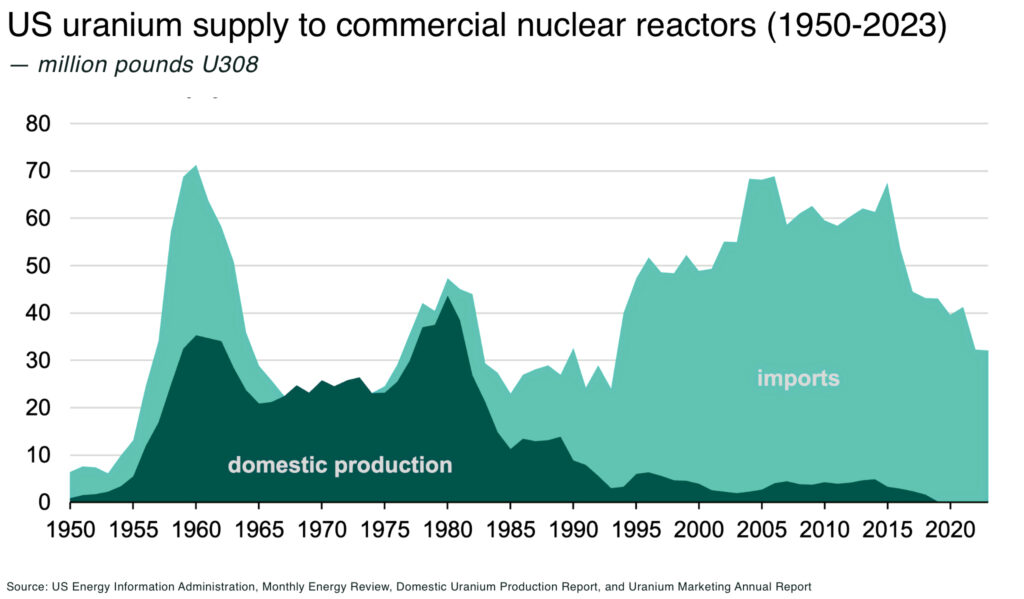
- US nuclear generators used 32 million pounds of imported U₃O₈ in 2023 versus 0.05 million pounds of domestic production — 99% import dependence at the front end of the fuel cycle, according to the US EIA — and Canada is the largest source of US utility uranium purchases (27% in 2023)
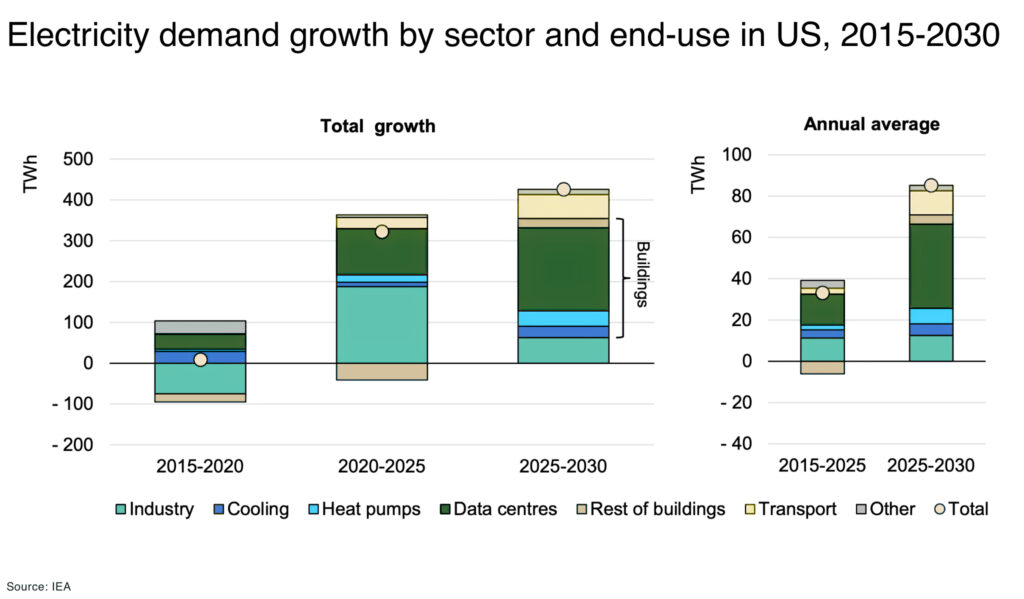
- and US electricity use is projected to add more than 420 TWh in total over the next five years, with the rapid expansion of data centres expected to make up about 50% of growth to 2030
NexGen’s announcement reinforces what we’ve been tracking: Canada, specifically the Athabasca Basin, is the cornerstone of Western uranium supply and, by extension, a key pillar of US energy security.
And this shift could create a rising tide across the Athabasca Basin that lifts many boats in the region.
The (new) financing model
Data centre growth is driving demand for long-duration, low-carbon baseload power, with nuclear energy emerging as the preferred choice over intermittent renewables like wind and solar.
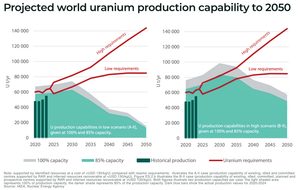
The challenge is securing the uranium supply, as fuel availability and contracting lead times tighten across global supply chains, causing volatililty in prices (spiking above US$100/lb in January 2026, before settling around US$88/lb in February).

The traditional toolkit isn’t closing the gap: spot is too small to underwrite build decisions (only 9% of 2024 deliveries were spot, vs 91% long-term), and delivery-weighted pricing (US$52.71/lb average in 2024) can lag the incentive levels miners need with large capex; for example, NexGen Energy’s Rook I has an initial capex of CAD$2.2 billion.
So, buyers increasingly face a critical choice: pay premium prices later if supply fails to keep pace, or secure supply today through direct investment. This is why NexGen’s CEO is suggesting a (new) model tested with other mineral miners (eg lithium miners in the US), where companies (and government) buyers underwrite upstream uranium projects, effectively shifting from passive procurement to active supply-chain partnership.
Tech-backed structures (prepay or offtake-linked facilities, minority equity, royalty/stream-style funding, or corporate backstops) can change bankability by converting future AI power demand into investment-grade cash-flow certainty that expands debt capacity and lowers the blended cost of capital versus miner equity alone, while still allowing market-linked delivery pricing — something NexGen’s CEO explicitly says he wants.
Automakers moved upstream into lithium to de-risk EV supply. Now it appears data centres are planning the same for uranium: finance first, secure supply, avoid future shortages.
Why Canada is the logical target
If you’re a US-based load buyer trying to make nuclear work, Canada is the lowest-friction place to start.
Canada already supplies the largest share of US utility uranium purchases at 27% (2022), ahead of Kazakhstan at 25%. And the US is still overwhelmingly import-reliant at the front end of the fuel cycle, per the 99% import share in 2023. And most of it comes from the Athabasca Basin which currently produces approximately 20% of global uranium supply:
- Canada’s Athabasca basin has the highest grade uranium deposits in the world, with grades up to x100 higher than averages mined elsewhere in the world
- the Athabasca Basin is home to the world’s largest, high-grade uranium mine at McArthur River and world’s second largest high-grade deposit at Cigar Lake
- the US is the world’s largest producer of nuclear energy, and Canada is just next door with a stable geopolitical environment and established infrastructure (Saskatchewan province is one of the top rated mining jurisdictions in the world)
Opportunities in the Athabasca Basin
And it’s not just NexGen that offers exposure to this opportunity.
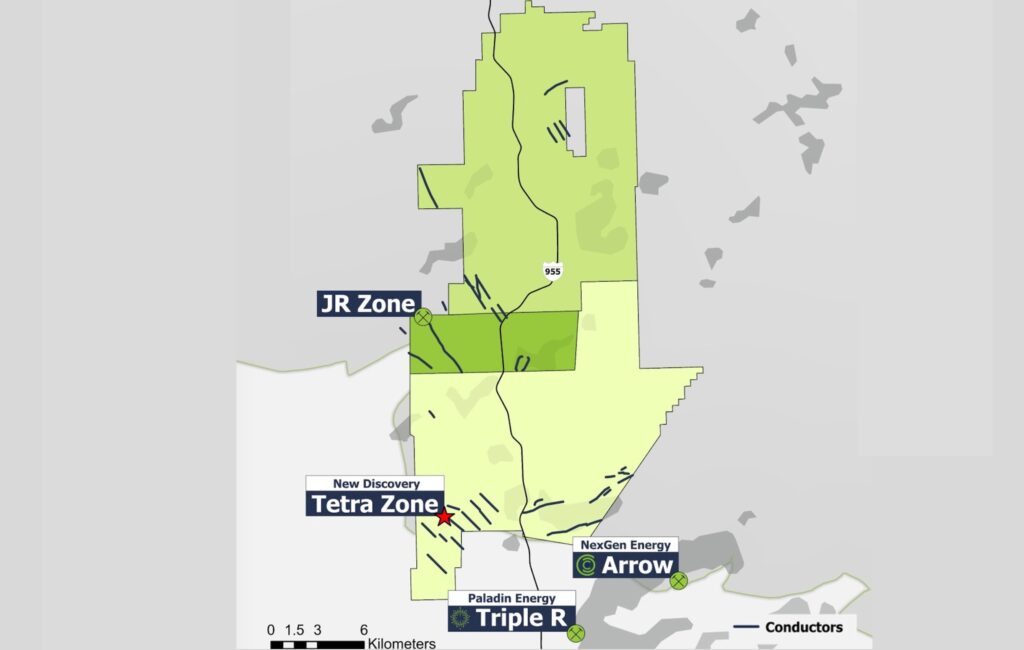
F3 Uranium (TSXV: FUU, OTCQB: FUUFF)‘s 100%-owned Patterson Lake North (PLN) Project in northern Saskatchewan totals 44,613 hectares and includes the Patterson Lake North, Minto, and Broach properties, according to the company, with a maiden Indicated resource at the JR Zone of 11.801 million lbs U₃O₈ at 4.39% (including a high-grade domain of 10.788 million lbs at 12.23%)— offering both scale and grade.
The JR Zone Uranium deposit is located approximately 25km northwest of Paladin’s Triple R Deposit and NexGen’s Arrow Deposit in the southwest Athabasca Basin and is accessible via Provincial Highway 955.
Canaccord Genuity has initiated coverage on F3 Uranium with a Buy rating and a CAD$0.30 target. Other broker targets are materially higher: SCP at CAD$0.70, Red Cloud at CAD$0.55, and Haywood at CAD$0.55.
That spread in target prices underscores two things: first, analysts are modelling meaningful exploration upside; second, valuation remains leveraged to additional discovery success in a tightening basin.
F3 recently disclosed US$26.1 million in treasury to advance drilling through 2026.
The higher-grade cores mirror the structure of Athabasca’s biggest deposits. Geologically, Tetra is hosted in basement rocks, similar to NexGen’s Arrow, indicating the potential for sizeable pods of mineralization controlled by fault structures.
What does US enrichment have to do with this?
US Secretary for Energy Chris Wright announced the US plans to restart domestic uranium enrichment, partnering with French nuclear fuels group Orano awarded $900 million in funding from the US Department of Energy to help build a uranium enrichment facility in Tennessee.
It’s all part of plans by Washington to rebuild the domestic fuel chain midstream; including DOE’s January awards of US$900 million each to Centrus-linked American Centrifuge Operating, Orano Federal Services, and General Matter are explicitly aimed at expanding enrichment capacity for both LEU and HALEU, per Reuters.
But enrichment capacity only sharpens upstream concerns as domestic enrichment is not secure unless the supply is reliable.
Investment and policy implications
If data centres start underwriting uranium projects, it changes market behaviour in three ways:
- widens the buyer base: uranium stops being a utility-only contracting story and becomes a strategic procurement story for tech
- shifts project finance: new capital pools can pull supply forward
- tightens the Canada premium: the US may rebuild enrichment capacity, but the near-to-medium-term answer to secure supply is consistent with Canada’s leading share of US purchases
Conclusion
AI data centres are starting to treat uranium supply as critical infrastructure—and they’re looking to Canada first.
That’s the new North American fuel-security map: US midstream rebuild, Canadian upstream lock-in, and tech buyers entering a market built for utilities.