

Goldman Sachs has increased its forecast for the 2026 refined-copper deficit outside the US by more than tenfold, from 60,000 tonnes to 640,000 tonnes (and 170,000 tonnes in 2027) — after cutting its global mine-supply estimate by 350,000 tonnes.
And it’s not the only one:
- UBS forecasts a 520,000-tonne global copper deficit in 2026 and a US$14,500 year-end price
- Citi said copper could reach US$14,500 during June 2026 and US$15,000 within a year
- among annual-average forecasts, BMO Economics expects US$5.90 per pound, approximately US$13,000 per tonne, compared with just above US$12,100 from S&P Global and US$12,000 from the World Bank
Codelco, the world’s largest copper producer, has warned there is “no possibility” of reaching a previous target of 1.7 million tons of copper production within four or five years.
“For seven years, Codelco hasn’t met its projections — and this year is no exception… It will be a difficult year for production” — Bernardo Fontaine, Codelco chairman, said in an interview with Radio Infinita.
As we warned, in our recent copper analysis on “Copper’s new demand stack“, HSBC is also warning of a “super-squeeze” across copper (and other commodities) due to the closure of the Strait of Hormuz.
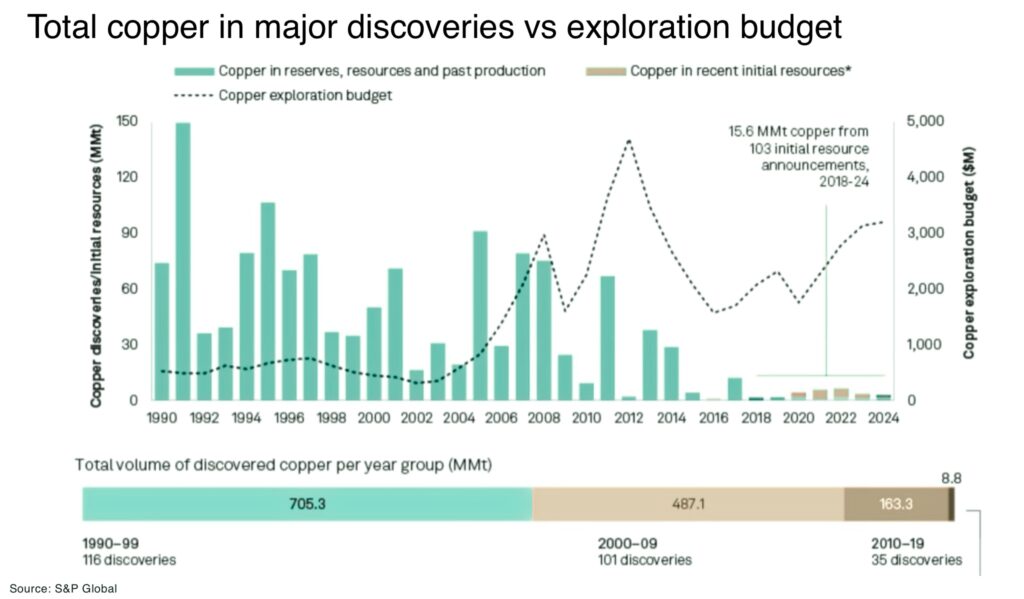
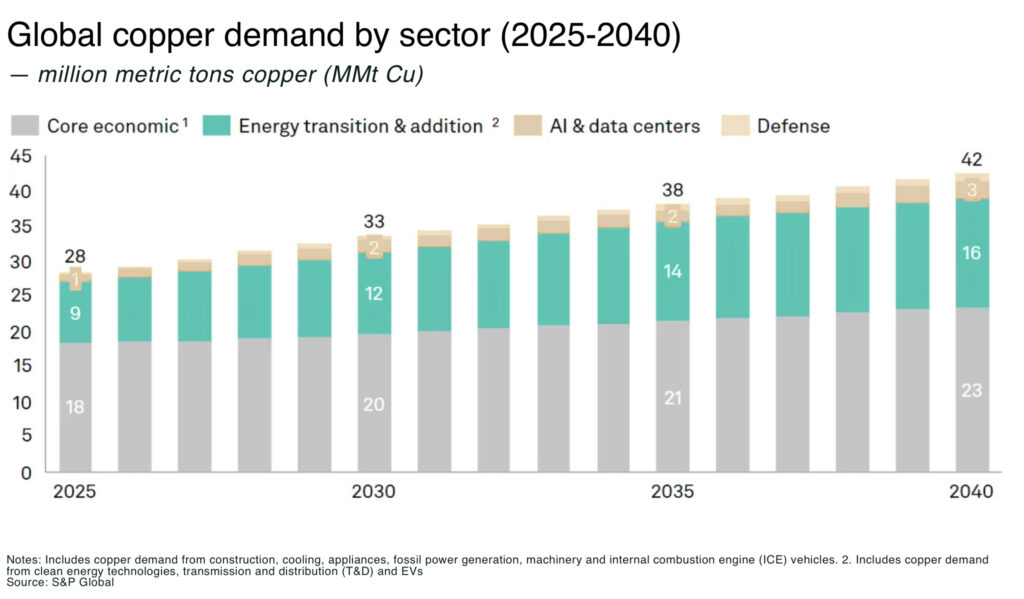
The challenge is global copper supply is exposed to rising demand (from AI, EVs, defence and re-industrialisation), to falling ore grades (the average global grade of copper mines has decreased 40% since 1991), rising capital costs, increasing project complexity, as well as volatile geopolitics and fragile supply chains.
The result is a more selective copper market, with stability increasingly influencing where capital is deployed — strengthening the position of secure, well-connected jurisdictions such as Canada.
And investment is already starting to reflect this new reality with more than US$5 billion dollars announced in Canadian copper-linked projects in 2025, and more expected in the coming year:
- Highland Valley Copper: Teck has approved the Highland Valley Copper mine-life extension, a roughly US$1.5–1.7 billion equivalent investment that will take Canada’s largest copper mine from 2028 to 2046, with average production of 132,000 tonnes a year
- Red Chris: Newmont received major British Columbia approvals in June 2026 for the US$2.4 billion Red Chris block-cave expansion, expected to increase Canada’s copper output by roughly 15%
- McIlvenna Bay: Eldorado Gold’s US$2.79 billion Foran Mining deal gives it exposure to the McIlvenna Bay copper project in Saskatchewan, which produced first copper concentrate on June 7 2026, and commercial production is targeted for Q3 2026
- Sudbury Basin: Vale and Glencore announced plans for a US$1.6–2.0 billion copper joint venture in Canada’s Sudbury Basin, targeting 880,000 tonnes of copper over 21 years
- Anglo Teck: as part of the Teck–Anglo American merger commitments, the combined company pledged to spend at least US$3.2 billion in Canada over five years
- Generation Mining: secured a US$142 million Canada Infrastructure Bank subordinated debt commitment for its Marathon Copper-Palladium Project in northwestern Ontario, bringing committed project funding to approx US$710 million. The project is expected to produce 532 million pounds of copper over a 13-year mine life, alongside palladium, platinum, gold and silver
Canadian copper-zinc mining capex was projected to more than double in 2025, rising 113% to roughly US$1.34 billion, with recent preliminary data showing spending at US$1.37 billion.
For a country that mined an estimated 500,000 tonnes of copper in 2025 (about 2% of global mined output) the recent momentum is a big step-change in capital intensity relative to its production base.
In comparison, global mine output is expected to grow only 1.6% in 2026, with the IEA forecasting the current copper project pipeline could leave a 30% copper supply deficit by 2035.
Now, of course, the scale of investment into Canada may not match some of the world’s largest copper producers, such as Chile or Peru, but that is not the point. Canada’s premium lies in reducing supply-chain risk for the West with its risk‑adjusted profile almost inverted.
For example, Chile and Peru are battling declining grades, water constraints, social protests and permitting delays; DRC has governance, power and security risk. The result is supply “optionality” but high disruption risk.
And the supply risk is no longer just about grade, mine life or local community relations. In particular, the latest Middle East conflict has added a location premium, distance from vulnerable energy routes, access to reliable power, control of processing (eg sulphur supply) and the ability to ship without crossing a geopolitical choke point.
Canada, by contrast, offers jurisdictional premium rather than volume dominance: NATO ally, USMCA framework, strong rule of law, and — critically — Canada supplied more than 99% of US copper ore and concentrate imports in 2021–24, and 16% of US refined copper imports.
In other words, each Canadian tonne of copper is disproportionately valuable to US supply security.
Why Canada earns a location premium
Canada is, of course, not immune to global diesel, equipment or freight disruption. Its advantage is relative:
- British Columbia produced 48% of Canadian mine supply in 2024 and has an electricity system that generated 97.2% of its power from renewable sources in 2023
- shipping west to Asian refiners does not require a route through Hormuz
- Saskatchewan’s new McIlvenna Bay mine has an energised 110 kV transmission line. Quebec combines hydroelectric power with Canada’s only primary copper smelter and refinery
That mix matters because S&P Global’s recent copper-cost estimates suggest reagents were the largest contributor to the conflict shock and that mines on oil — and LNG-fired power grids face greater exposure — with a projected 5.1% increase in global copper mining costs under updated 2026 assumptions, impacting mines in South America in particular.
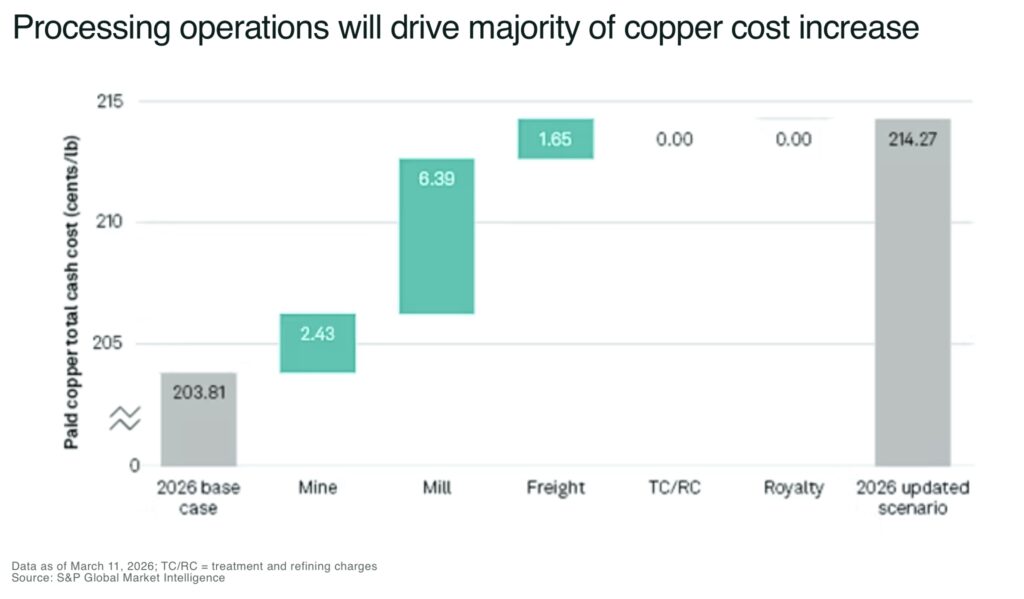
Global copper producers expected to feel margin squeeze:
| Ranking | Equity owner | Base case 2026 paid copper TCC (cents/lb) | Scenario 2026 paid copper TCC (cents/lb) | Change (%) |
| 1 | Codelco | 207 | 216 | ↑ 4.1 |
| 2 | BHP Group Ltd. | 203 | 211 | ↑ 3.9 |
| 3 | Freeport-McMoRan Inc. | 277 | 292 | ↑ 5.4 |
| 4 | Zijin Mining Group Co. Ltd. | 185 | 194 | ↑ 5.0 |
| 5 | Glencore PLC | 185 | 196 | ↑ 5.5 |
| 6 | Southern Copper Corp. | 176 | 188 | ↑ 6.7 |
| 7 | Rio Tinto Group | 210 | 219 | ↑ 4.5 |
| 8 | Anglo American PLC | 186 | 197 | ↑ 6.2 |
| 9 | KGHM Polska Miedz SA | 280 | 286 | ↑ 2.1 |
| 10 | CMOC Group Ltd. | 188 | 202 | ↑ 7.5 |
“Canada is moving from being a strong to a strategic supply-chain jurisdiction. The world does not just need more copper, it needs copper from places with rule of law, established infrastructure, reliable power, permitting certainty and direct access to allied markets. This is especially so as the United States looks to reduce exposure to fragile supply chains and geopolitical choke points.
Generation Mining is positioned directly in that shift. Our Marathon Copper-Palladium Project in Northwestern Ontario is a fully permitted Canadian critical minerals project located in a tier-one jurisdiction, with access to existing infrastructure and proximity to North American end markets.
Our recent CAD$200 million subordinated debt commitment from the Canada Infrastructure Bank is an important signal of how Canada is beginning to back the next generation of domestic critical minerals projects. With approximately CAD$969 million of project financing now committed, Marathon is advancing at a moment when security of supply is becoming as important as grade. Marathon gives Generation Mining exposure to that location premium: a large critical minerals project in Canada, aligned with North American supply-chain security”
— Jamie Levy, President, CEO and Director, Generation Mining (TSX: GENM | OTCQB: GENMF)
New roads, transmission, and a new smelter
Canada is no longer treating critical minerals as an exploration policy.
- March 2026, Ottawa announced more than US$2.5 billion in new critical minerals programs and investments, combining infrastructure (roads, transmission, processing) funding, project finance and permitting support into a mine-to-market strategy.
- April 2026, Canada launched the Canada Strong Fund, a US$17.6 billion sovereign wealth fund designed to invest alongside private capital in strategic Canadian infrastructure, energy, advanced manufacturing and mining projects
This builds on a wider policy framework that includes the 30% Critical Mineral Exploration Tax Credit and formal Canada-US critical minerals cooperation aimed at securing supply chains for strategic manufacturing, defence and clean technology.
And the policy is already impacting copper assets, with up to US$31.2 million for BC Hydro transmission upgrades conditionally approved to support major northwest British Columbia mine developments, including Newmont’s Red Chris copper expansion.
And, arguably the most important signal, Natural Resources Canada has asked industry to test the economics and location of a new copper smelter and refinery in Western Canada (nearly all copper concentrate mined in Western Canada is currently exported for overseas processing). If built, it would be Canada’s second domestic copper smelter-refinery system — and a direct attempt to turn copper security from a mining story into a processing story.
Conclusion
Canada may not be the largest producer, but it offers a mix the market increasingly lacks: rule of law, allied-market access, low-risk logistics, renewable-heavy power in key provinces, and an active policy push to fund roads, transmission and processing.
Copper exposure is no longer only about grade and scale. Instead, as geopolitical friction rises, the location of the copper can now earn a significant premium. And Canada is turning location into positioning.