

- Bank of America expects uranium to average $130/lb in 2027, around 52% above the $85–86/lb spot price when its latest Cameco update was published
- Cameco expects to produce 19.5–21.5 million pounds in 2026, but deliver 29–32 million pounds, leaving purchases and inventory to bridge the portfolio gap
- US utilities contracted maximum deliveries covering only 48% of anticipated uranium requirements through 2035, while Kazakh production remains exposed to sulphuric acid constraints
Bank of America now expects uranium to average US$130/lb in 2027, 52% above its US$85–86/lb spot price range when the forecast was reported in August 2026.
The target extends a bullish outlook reported in January, when BofA strategist Michael Widmer forecast uranium reaching US$130/lb by late 2026 and US$135/lb in 2027.
Days before the latest update, BofA analyst Lawson Winder joined Cameco’s July 31 earnings call — so, what did Cameco reveal that pointed to uranium averaging US$130/lb?
Winder’s questions focused on the pipeline of reactor opportunities for Westinghouse — one of the world’s largest nuclear-reactor technology and services companies, owned 49% by Cameco and 51% by Brookfield — rather than the uranium price directly.
Management’s answers confirmed that Westinghouse is pursuing as many as 91 potential AP1000 projects (note: opportunities, not orders), signalling how quickly reactor demand could grow. Yet Cameco expects to mine only 19.5–21.5 million pounds or uranium in 2026 while delivering 29–32 million, relying on inventories and purchased uranium to bridge the gap.
In short, Westinghouse’s reactor pipeline is expanding faster than Cameco’s uranium supply.
Bank of America reportedly maintained its Buy rating on Cameco while cutting its price target by 5% to reflect higher near-term production costs. The distinction matters as operational pressures that weigh on Cameco’s earnings can also constrain uranium supply and support higher prices.
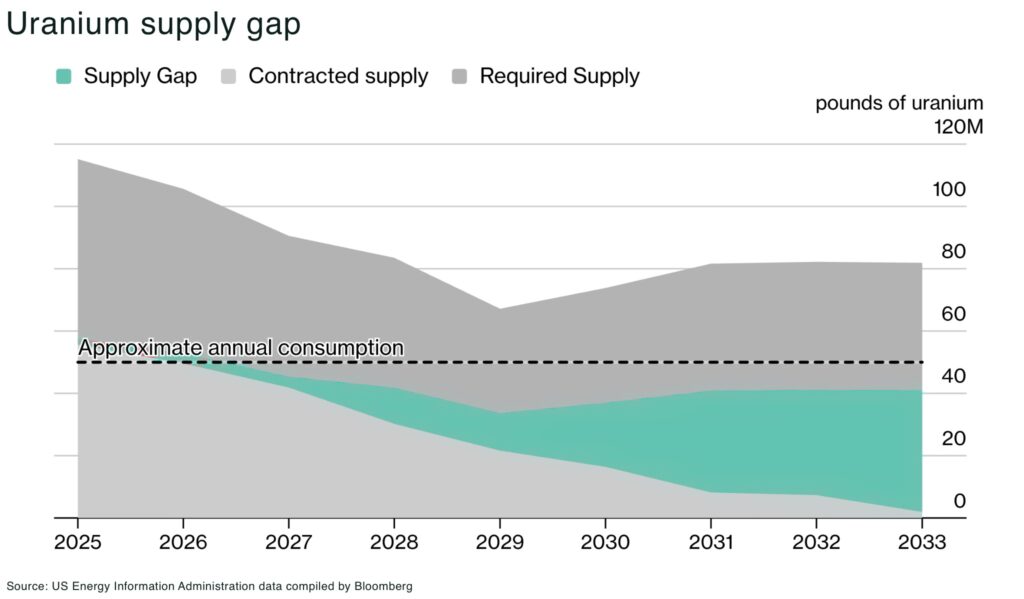
Utility contracting data support this outlook with the maximum ten-year contract coverage among US nuclear utilities falling from approx 56% at the end of 2024 to 48% at the end of 2025. The periods roll forward by one year, but the direction is clear: utilities are consuming contracted uranium faster than they are replacing it.
Demand is now being written into industrial policy
AI data centres, energy security and lower-carbon electricity is accelerating nuclear energy demand, argues BofA’s Lawson Winder, senior research analyst for metals and mining.
In particular, as we have highlighted in our recent analysis, US electricity demand alone from data centers is projected to more than double by 2027–2030, with facilities expected to consume up to 12% of the nation’s total electricity by 2030.
In response, the accelerated US nuclear timeline now includes having three advanced reactor projects to criticality by July 4, 2026, as well as having 400 GW of nuclear capacity by 2050 to secure reliable, low-carbon electricity.
This demand case no longer rests on projections alone, but is instead being embedded in government policy, public financing and binding agreements to expand nuclear capacity and rebuild the fuel supply chain.
For example:
- Cameco and Brookfield’s Westinghouse partnership signed a term sheet in 2025 with the US government intended to facilitate at least US$80 billion of new nuclear-reactor construction. It remains dependent on financing, definitive agreements and individual investment decisions, but it introduces government backing into what had previously been a utility-led market
- Washington has also awarded US$2.7 billion to expand domestic uranium enrichment
- at least 79 nuclear reactors are under construction, 124 planned and 331 proposed (and Japan alone has 15 reactors restarted with 10 more in the restart approval process since Fukushima)
- the Department of Energy has posted criticality announcements for Antares, Valar and Aalo, completing zero-power fueled criticality demonstrations
- Global reactor requirements are projected to rise from 68,920 tU in 2025 to just over 150,000 tU by 2040, just as current ore-grades are declining
This does not mean every reactor in Westinghouse’s reported 91-reactor opportunity pipeline will be built, not a reactor announced today consume its first uranium tomorrow. But it signals to utilities and producers — who cannot wait until a reactor is built before entering the market — that security of supply is now national policy.
The IAEA estimates that natural uranium is typically procured about two years before loading, while Cameco says most deliveries begin one to three years after a long-term contract is awarded.
The challenge is that new uranium mines can take an average of 10–15 years from discovery to production.
And the uranium price is already responding to these longer timelines accordingly.
At July 31, Cameco’s price indicators put spot uranium at US$86.38/lb and long-term uranium at US$95.50/lb; and the US$9.12 premium suggests buyers already value secure future supply more highly than uranium available today.
Cameco is becoming the uranium market’s balance sheet
The strongest evidence for a higher uranium price is not what Cameco says, it is what Cameco has to do to meet its contracts.
| Million lb U₃O₈ | 2025 actual | 2026 outlook |
| Cameco production, own share | 21.0 | 19.5–21.5 |
| Uranium purchases | 9.6 | Up to 3 market purchases, plus about 8 committed purchases including Inkai |
| Deliveries | 33.0 | 29–32 |
| Inventory | 9.7 at year-end | 8.7 at June 30 |
Sources: Cameco 2025 annual report and 2026 Q2 report.
At the midpoint of Cameco’s 2026 outlook, it plans to produce approx 20.5 million pounds of uranium and deliver 30.5 million.
This does not necessarily mean Cameco is physically short 10 million pounds of uranium. The company has inventory, committed purchases from joint ventures, product loans and market-purchase flexibility, and it also deliberately operates an integrated trading and contracting portfolio.
But, what it does mean, is that one of the world’s largest high-grade uranium producers cannot satisfy its contracted deliveries from its owned production alone.
In 2025, Cameco produced 21 million pounds, purchased 9.6 million and delivered 33 million. By June 2026, its inventory had declined to 8.7 million pounds from 9.7 million at the end of 2025.
So, instead of supplying more uranium to an already tight market, Cameco can become another buyer competing for available pounds if any disruption impacts production further.
Three Cameco fault lines
- the first is McArthur River and Key Lake:
The operation produced 15.1 million pounds on a 100% basis in 2025, below Cameco’s original 18-million-pound plan after development delays, ground-freezing constraints and commissioning problems.
Then, in May 2026, flooding damaged the primary transport route into the operations. Key Lake stopped production and McArthur River reduced activities for around two weeks because critical materials and reagents could not move normally. Production resumed and guidance was maintained, but the episode showed that even world-class uranium assets can be constrained by roads, bridges, labour and mine development. - the second is Cigar Lake:
Production was suspended in July after operating problems at Orano’s McClean Lake mill, where Cigar Lake ore is processed. Repairs involved the mill’s sulphuric acid plant and sourcing replacement acid. Operations resumed on July 14 without a change to guidance, but the shutdown exposed a dependency beyond the mine itself. - the third is Inkai:
Cameco expects a 4.2-million-pound purchase allocation from its Kazakh joint venture in 2026, however only 0.8 million pounds had been delivered during the first half, leaving most of the allocation to arrive before year-end. Meanwhile, sulphuric acid availability, procurement, transportation and construction delays are ongoing risks.
None of these events alone creates a global uranium shortage. However, taken together they highlight how quickly production risk can become further purchasing demand.
Utility inventories conceal the contracting problem
US nuclear utilities held 118 million pounds of uranium-equivalent inventory at the end of 2025, which helps provides a buffer, but it does not resolve the longer-term contracting gap.
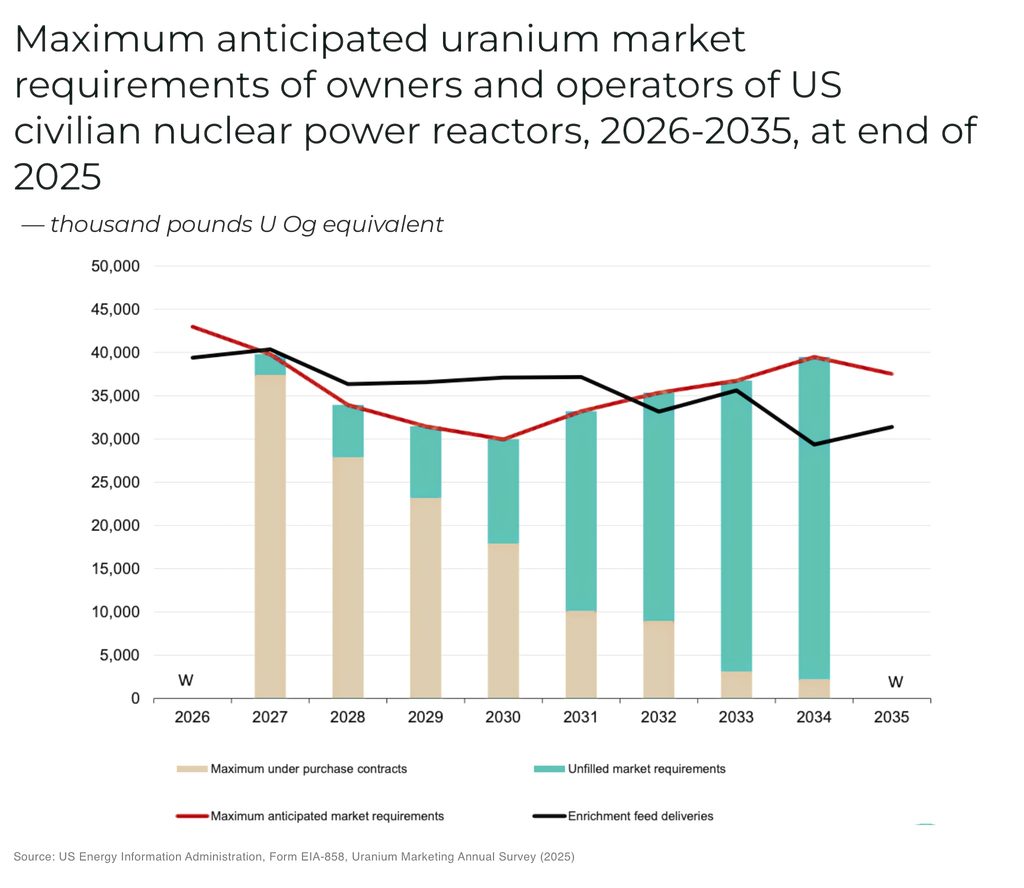
According to the EIA, maximum deliveries under contract for 2026–2035 totalled 174 million pounds, against maximum anticipated requirements of 360 million. That leaves 186 million pounds unfilled, meaning utilities have contracted for only 48% of their maximum ten-year requirements.
And even the 118-million-pound inventory headline overstates the amount of yellowcake potentially available to the market. Only 22.6 million pounds, or 19%, was held as uranium concentrate, with the remaining 81% already converted into natural UF₆, enriched into enriched UF₆ or fabricated into reactor fuel. (The EIA does not indicate that even the concentrate was uncommitted or available for sale.)
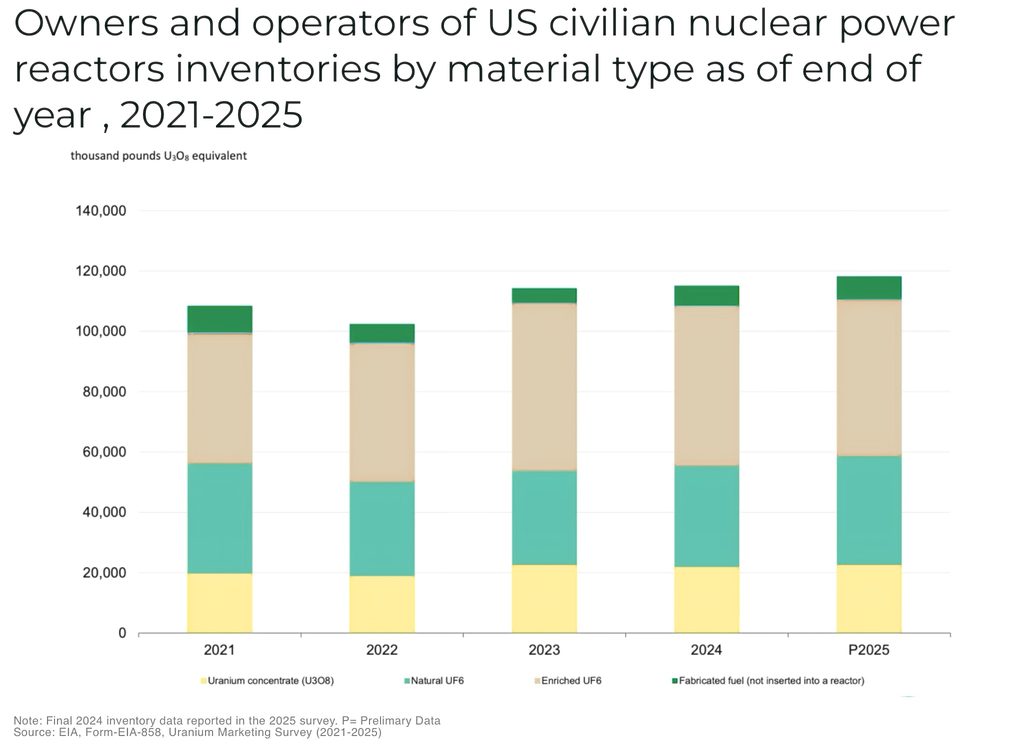
So, at least for now, the headline inventory cannot therefore be treated as 118 million pounds of readily available spot supply.
Manhattan Uranium: a US uranium platform for the policy window
Manhattan Uranium (TSXV: MANU | OTCQB: MAUUF) is positioning itself for the uranium demand set to fuel America’s uranium supply squeeze: historic domestic uranium districts, permitted targets and near-term drill catalysts at the front end of the fuel cycle.
Created in May 2026 through the combination of Aero Energy, Urano Energy and Pegasus Resources, the company reports a North American portfolio that includes 15 past-producing uranium mines across 25 US properties covering 25,099 acres. Its assets span established uranium districts in Utah, Colorado and Nevada, complemented by high-grade exploration exposure in Saskatchewan’s Athabasca Basin.
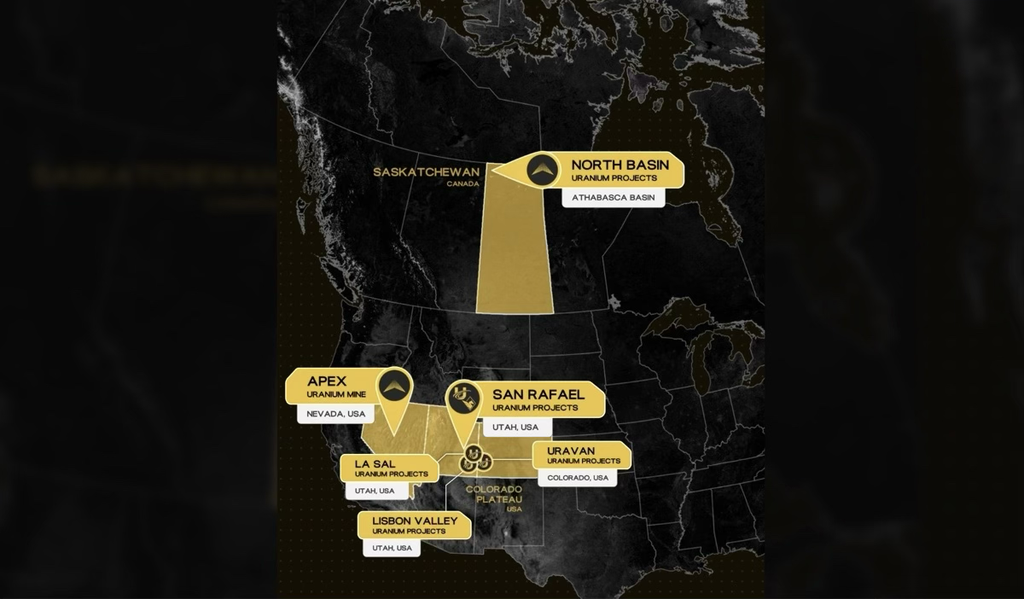
The brownfield advantage is clearest at I-70 and Apex. The I-70 project in Utah is permitted for underground mining, while Manhattan’s July database programme compiled approximately 5,668 historical drill collars. Of the 2,769 holes with recovered gamma data, 72% contained at least one historical interval grading 0.10% eU₃O₈ or higher. Recovered records included 1.22 metres at 1.59% eU₃O₈, while the digitised data and underground workings have been used to generate preliminary 3D drill targets.
At Apex in Nevada, the US Forest Service has approved a Plan of Operations authorising up to seven drill pads at the state’s largest historical past-producing uranium mine. That gives Manhattan a defined route to test historic mineralisation at a brownfield US asset rather than beginning a new permitting process from scratch.
The Canadian portfolio adds a separate discovery catalyst. In June, Manhattan and Fortune Bay started a fully funded drilling programme at Murmac, beginning with 15 priority targets before planned work at Strike. The wider programme comprises approximately 5,000 metres across up to 25 targets and follows previous drilling at Murmac that returned 8.40 metres grading 0.30% U₃O₈, including 1.20 metres at 1.79% U₃O₈.
Manhattan has also been building its US capital-markets and policy presence:
- its shares began trading on the OTCQB under MAUUF on June 22, 2026, widening access for US investors
- before the combination, the predecessor companies upsized the proposed financing package to as much as C$11.5 million and subsequently closed a C$10.5 million subscription-receipt financing, with proceeds earmarked partly for advancing the North American uranium portfolio
- on August 13, 2026, Manhattan appointed Dennis W. Bartow II as strategic adviser, a former Deputy Assistant Secretary of Defense for African Affairs Policy who now advises critical-minerals companies on government financing and strategic partnerships. His experience includes the Defense Production Act, DOE Loan Programs Office, Department of Defense programmes and US Export-Import Bank financing.
Bartow’s appointment does not mean Manhattan has secured federal funding. It does, however, give the company a more direct interface with the agencies and financing programmes shaping America’s nuclear-fuel rebuild
This puts the company at the intersection of fuel scarcity, security policy and project timing with North American-located uranium just as utilities and policymakers compete for secure uranium supply.
Kazatomprom turns Cameco’s supply gap global
Cameco is the warning from the Western uranium market, but Kazatomprom — the largest uranium producer in the world — is where the stakes become global.
Cameco partly relies on Kazakhstan to bridge the gap between production and deliveries. Its Inkai joint venture is owned 40% by Cameco and 60% by Kazatomprom is expected to purchase 4.2 million pounds from Inkai in 2026, but had received only 0.8 million pounds by mid-year.
The delivery-prduction shortfall in Cameco makes Kazatomprom critical. Yet, the company reduced its nominal 2026 production level from 85.21 million to 77.21 million pounds, a cut of eight million pounds. For comparison, Cameco purchased 9.6 million pounds during all of 2025.
Kazatomprom’s current guidance is lower still at 71.49–75.39 million pounds and remains subject to sulphuric acid availability. Meanwhile, the expected growth from Budenovskoye will not provide freely available supply: its 2025–2026 production is already committed under an offtake contract.
Cameco reveals the fragility of high-grade Western supply; Kazatomprom determines whether the world’s largest production base can fill the gap. If Kazakhstan also underdelivers, the pressure pushes Cameco and other buyers towards an already thin uranium market.
Conclusion
Bank of America did not discover uranium scarcity during one Cameco conference call, instead it It confirmed the mechanism behind it.
- reactor opportunities are multiplying
- utility coverage is thinning
- and even a major producer, like Cameco, plans to deliver substantially more uranium than it mines
Cameco showed that scarcity is already moving through producer inventories, purchase commitments, operating costs and contract structures.
For example, Cameco management said newer market-related contracts can carry escalated floors in the high US$70s and ceilings around US$160/lb. That wide price corridor is being set before utilities have returned to replacement-rate contracting.
The US$130/lb is a forecast of what happens when buying from utilities accelerates in a limited supply pipeline of available production.