- the UK’s state-owned National Wealth Fund (NWF) is putting US$55.7m (£41.7m) into Cornish Metals, the largest share of a US$180m (£135m) raise confirmed on October 22, 2026 to reopen the South Crofty tin mine
- the deal lifts the NWF’s stake to 29.50%, ahead of Vision Blue Resources on 28.58%, subject to a shareholder vote on November 9
- it follows NWF deals in Cornish Lithium and Tungsten West, as the UK’s critical minerals strategy targets at least 10% of domestic demand from UK production by 2035
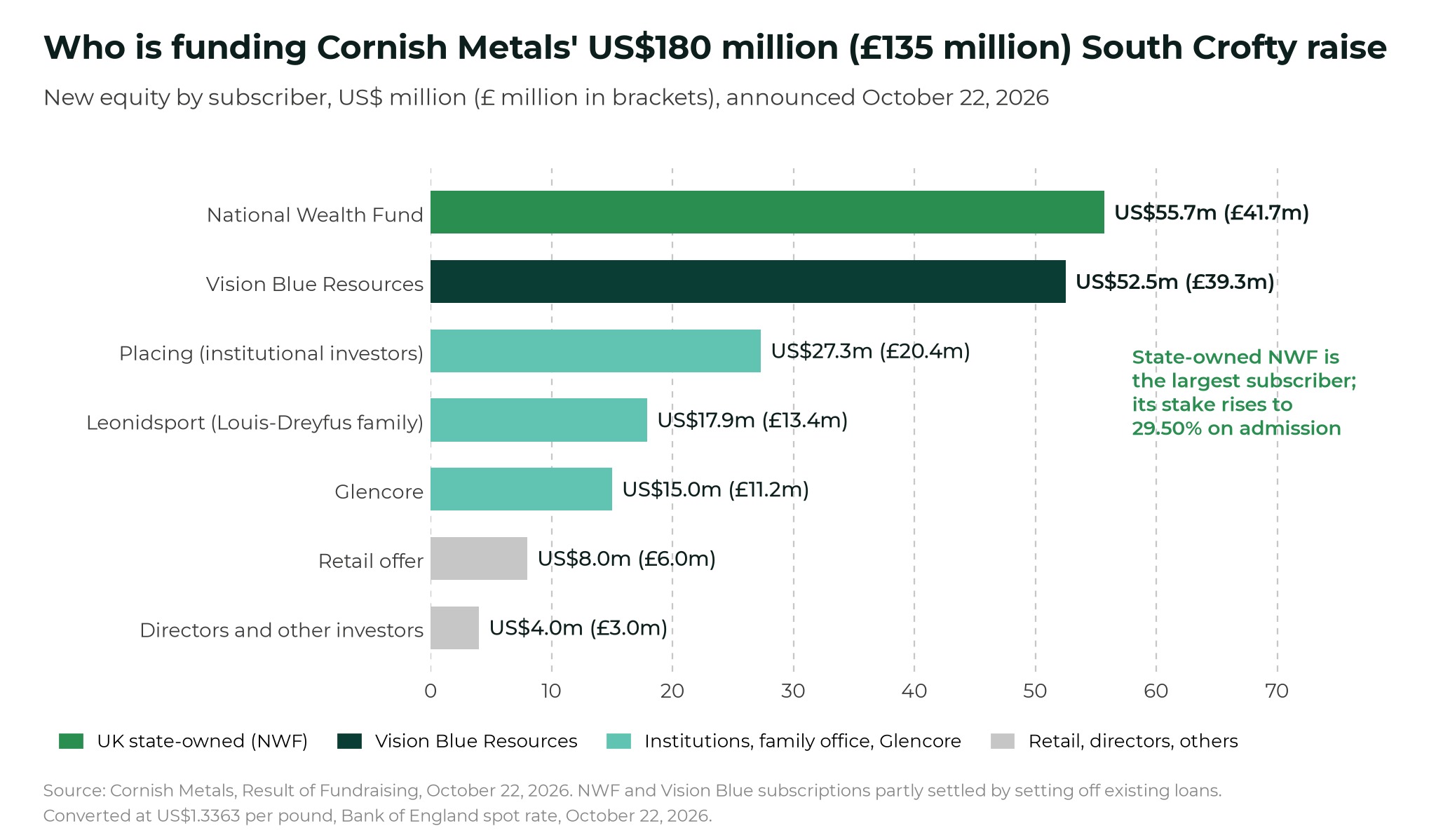
The UK’s state-owned National Wealth Fund (NWF) is putting US$55.7m (£41.7m) into Cornish Metals, the largest single cheque in a US$180m (£135m) raise to restart tin mining in Cornwall by mid-2028.
The result was announced on October 22, a day after the government approved the Jackdaw gas field while restating its commitment not to issue new licences to explore new oil and gas fields.
Once the new shares are issued, the NWF will own 29.50% of Cornish Metals (AIM: TIN), according to the company, more than mining investor Vision Blue Resources, on 28.58%. In other words, a fund wholly owned by HM Treasury is set to become the largest shareholder in a British mine developer.
What is the National Wealth Fund?
The NWF is the former UK Infrastructure Bank, renamed in October 2024 and capitalised with US$37.1bn (£27.8bn) to “catalyse private investment”.
Critical minerals are in its mandate, but equity is meant to be the exception. Its five-year strategic plan, published in January 2026, says that in critical minerals it will:
“primarily explore debt financing and – as capacity allows – equity investments by exception”
South Crofty is now one of those exceptions, for the second time.
The NWF made a US$38.2m (£28.6m) direct equity investment in the company in January 2025. Its other UK mining deals include, for example:
- Cornish Lithium: about US$32.1m (£24m) in 2023 and a US$41.4m (£31m) commitment in September 2025
- Tungsten West: up to US$94.9m (£71m) in August 2026 for the Hemerdon mine in Devon, including US$48.1m (£36m) of equity, with the government securing exclusive talks on buying up to 50% of Hemerdon’s annual production
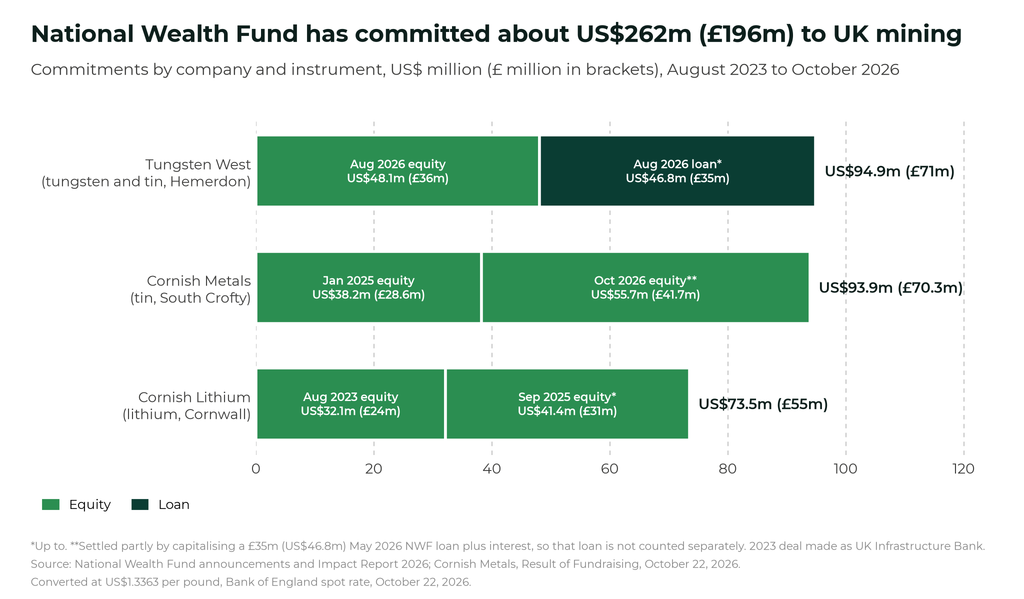
The fund’s Impact Report 2026 put the fund’s critical minerals commitments at US$253.9m (£190m) as of October 5, before the Cornish Metals raise. These are commitments, not cash paid out, and some are “up to” amounts. Part of the new US$55.7m (£41.7m) Cornish Metals subscription is paid by converting a US$46.8m (£35m) NWF loan agreed in May, so that loan is not counted twice.
NWF chief executive Oliver Holbourn framed the deal as bringing in private money:
“Our continued investment in South Crofty is a compelling example of how the National Wealth Fund can give private investors the confidence to help revive a strategically important asset and rebuild our domestic critical mineral capabilities.”
Who is paying for South Crofty?
Cornish Metals is selling 225 million new shares at 60p each.
Vision Blue is subscribing for US$52.5m (£39.3m), the Louis-Dreyfus family’s Leonidsport US$17.9m (£13.4m) and Glencore about US$15.0m (£11.2m), according to the company.
Not all of the NWF’s money is new cash.
Its subscription effectively capitalises the principal and accrued interest of a US$46.8m (£35m) loan facility it agreed in May. Vision Blue’s loan is being converted the same way. Glencore has also signed an offtake deal for 100% of South Crofty’s tin concentrate for six years. The equity sits alongside US$210m of Nordic bonds, held in escrow.
Cornish Metals chief executive Don Turvey said the raise:
“completes the financing package for the construction of South Crofty through to first tin in mid-2028.”
South Crofty, closed since 1998, is expected to produce about 4,700 tonnes of tin-in-concentrate a year in its first five years.
A mine inside a net zero agenda
The same government that backs South Crofty has ruled out new oil and gas exploration.
On October 21, Energy Secretary Miatta Fahnbulleh said ministers remain “resolute in ending new licences for oil and gas” and in reaching net zero by 2050. The same announcement placed a new US$2.7bn (£2bn) Energy Wealth Fund for renewable and low carbon energy inside the NWF.
The government does not see a contradiction. It has described tin as a metal used in solar panels, wind turbines and electric vehicles as Britain aims to become a “clean energy superpower”.
Its Vision 2035 critical minerals strategy, published in November 2025, targets at least 10% of UK demand from domestic production by 2035, and no more than 60% from any one country.
Then-Chancellor Rachel Reeves made the political case on a visit to Cornwall in July 2025:
“Our investment to revive Cornwall’s proud tin mining industry and the thousands of jobs it will create for years to come is one way we are renewing the county…”
That marks a shift. As we wrote in our December 2024 article The UK’s critical mineral and energy supply, between revolution and disaster:
“the government has ruled out a US-style subsidies approach due to costs and instead opted for a market-first approach.”
Why tin, and why now?
Demand from AI-related electronics is driving new demand. As we wrote in our September 17 article BMI raises tin price forecast to US$51,000 as AI demand strains supply:
“BMI has raised its 2026 average tin price forecast by 4.1% to US$51,000 a tonne, as semiconductor demand and constrained supply sustain pressure on the metal used to connect electronic components.”
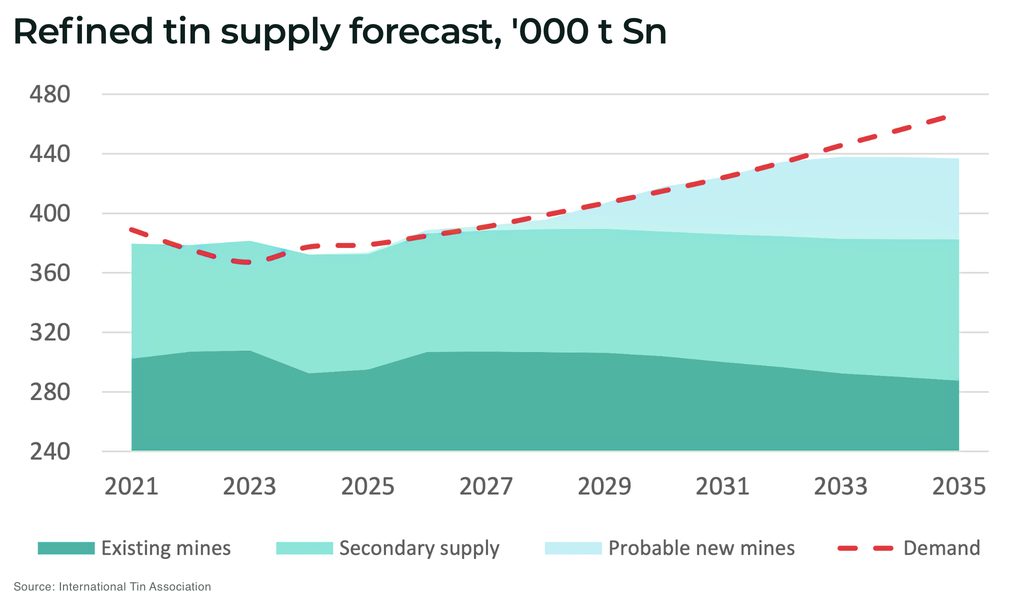
Supply is concentrated. China mined an estimated 71,000 tonnes and Indonesia 61,000 tonnes of the world’s 290,000 tonnes in 2025, according to the US Geological Survey.
Myanmar’s output fell to an estimated 12,000 tonnes from 20,000 tonnes in 2024, and its Man Maw mine is only gradually restarting, according to International Crisis Group findings reported by AFP on September 10 and cited in that article.
Conclusion
The deal still carries risks, for example, including if shareholders reject the deal on November 9, the company says it would likely miss a bond condition to raise at least US$161m of equity by November 21 and “would not be able to satisfy its debts”.
The company still needs permits, including “certain planning, environmental and other consents, approvals and variations” before first production.
But the shift is clear: the UK is no longer only regulating mines — it is set to become the largest shareholder in one.