- Nickel Industries managing director Justin Werner said on October 22 that “there will be coordinated cuts across all of the operations” in the Indonesia Morowali Industrial Park (IMIP), without giving a percentage
- Chinese producers are reportedly weighing halving mixed hydroxide precipitate (MHP) output and cutting nickel pig iron (NPI) by 20%, according to sources cited by Reuters, while Bloomberg reported the cuts were agreed at a meeting on October 20
- Huayou Cobalt told Cailian Press the meeting “isn’t true”, and GEM said it had received no notice and was producing normally
Nickel producers in Indonesia’s biggest nickel hub will coordinate output cuts, Australia-listed Nickel Industries says, as Chinese operators weigh steep reductions after prices slumped to their lowest since December 2025.
“There will be coordinated cuts across all of the operations within the IMIP,” Managing Director Justin Werner told analysts on an earnings call, Reuters reported. IMIP is the Indonesia Morowali Industrial Park, the huge nickel processing hub in Central Sulawesi where Tsingshan, Huayou and others run their smelters.
Justin Werner did not give a percentage, but said who would be hit first:
“Certainly what we’re seeing is the non-integrated producers … are the ones that are going to suffer the hardest here,” Justin Werner said.
Nickel Industries is well placed to know as it holds a 10% stake in the Huayue nickel and cobalt project in the IMIP alongside China’s Huayou Cobalt, and Tsingshan Group is a major shareholder. And it has already cut its own output – in its September quarter report, the company said it had reduced rotary kiln electric furnace (RKEF) production to about 75% of nameplate capacity in October, with its Morowali lines running at just 44–48%.
The primary reported reason is drought, as nickel smelters at Morowali rely on water to cool their furnaces and the coal power plants that run them, so a lack of rain forces them to cut production.
The company’s Hengjaya mine recorded just 7 millimetres of rain from the start of August to October 21, against a 10-year average of 474 millimetres for August to October. As we reported in September, the El Niño drought had already forced Morowali to cut output. The dry weather has also delayed the full ramp-up of its Excelsior Nickel Cobalt (ENC) high-pressure acid leach plant “until the wet season commences, which is usually in December”, the company said.
What are Chinese producers weighing?
Chinese producers are considering coordinated cuts following a meeting earlier in the week, people familiar with the matter told Reuters, but have not decided on the size or duration. The reported options are, for example:
- halving MHP production, the battery feedstock made by Indonesia’s high-pressure acid leach (HPAL) plants, according to three sources
- cutting NPI output, the low-cost feed for stainless steel, by 20%, according to four sources
Companies involved in the meeting include Tsingshan, CNGR Advanced Material, Lygend Resources, Huayou Cobalt and GEM, the sources said.
Bloomberg went further, reporting on October 22 that the cuts were agreed at the Tuesday meeting, attended by Tsingshan chairman Xiang Guangda and executives from GEM, Lygend and Huayou, with MHP to be cut 50% from current levels and NPI by about 20%.
A previous attempt to agree on cuts in August was unsuccessful, according to Bloomberg.
If cuts of that size were realised, Shanghai Metals Market (SMM) estimates they would remove 15,000–18,000 tonnes of contained nickel a month from MHP, about 7,900 tonnes from nickel matte and more than 20,000 tonnes from NPI.
Producers deny the meeting
The companies named have been less forthcoming. Speaking to Cailian Press, which called them as an investor on October 22, several denied taking part:
“The meeting isn’t true. At current nickel prices no company is making a profit. Cutting production is a market choice, and our project’s cut was already announced — in April,” a Huayou representative said.
Other responses, for example:
- GEM’s securities department said the company had received no notice, was scheduling production as normal and would make an announcement if it cut
- Lygend’s investor relations team said it had heard of the plan but did not know the details, and had not been invited to attend
- CNGR said its Indonesian lines were stable and it had not heard of the meeting, while Shengtun Mining said it did not attend
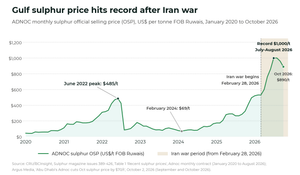
Huayou’s April announcement covered temporary maintenance at its Huafei project from May 1, affecting about half of Huafei’s output, after a surge in sulphur prices, according to Cailian Press. As we reported, Gulf sulphur is still not getting out of Hormuz.
Shi Zheqi, a senior analyst at Fubao, told Cailian Press that real MHP cuts at leading firms are more likely to be 15–25%. He called a 20% NPI cut “a very low-probability scenario”, with localised cuts of 5–10% more likely.
Why cut now?
One of the main reasons for cutting now is prices. LME nickel fell nearly 25% from this year’s US$20,000-a-ton peak to US$15,070 last week. NPI prices fell to 1,009 yuan per nickel unit on October 21, from more than 1,100 yuan in early September, according to SMM data.
MHP is where the squeeze is tightest, with the MHP cash cost, net of cobalt credits, at about US$14,500 a tonne of nickel in mid-October, while spot MHP was below US$13,000 a tonne of nickel FOB. NPI, by contrast, remains cash-positive.
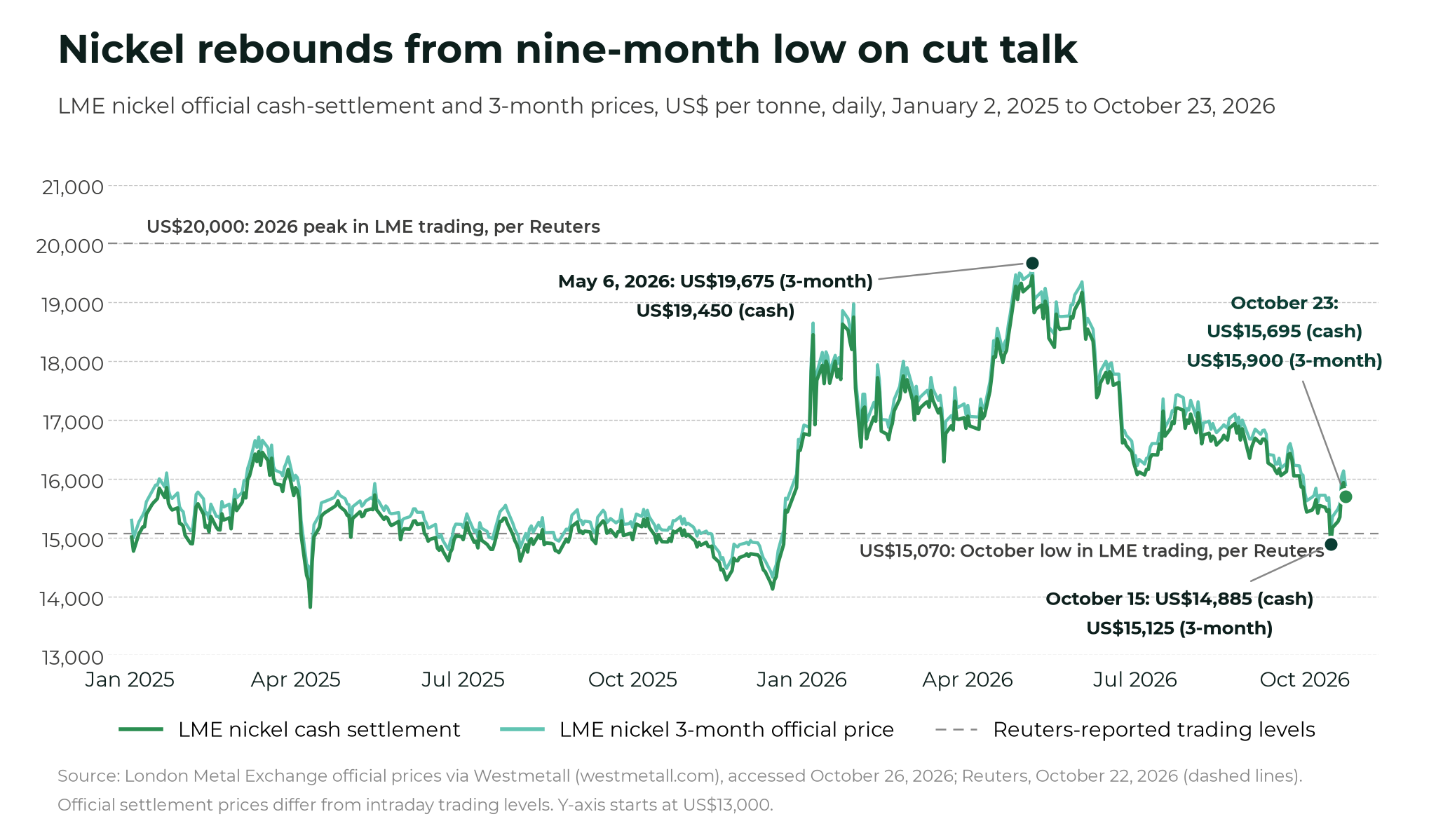
And the talk of cuts has already moved the market with the LME nickel jumping 3.7% on October 21 after Bloomberg first reported plans for the meeting, and climbed above US$16,000 a tonne.
“What everyone is really focused on right now is the size of the production cuts,” Gao Yin, an analyst at Shuohe Asset Management, told Bloomberg. “The numbers being circulated in the market are quite significant.”
Indonesia accounted for about two-thirds of global mined nickel output in 2025. The battery side is also where the supply is growing fastest. The Indonesian Nickel Industry Forum (FINI) projects MHP capacity will exceed 900,000 tonnes of nickel by the end of 2027, compared with HPAL output of about 450,000 tonnes.
Wood Mackenzie said on October 22 that Class I and chemical nickel face ongoing surplus from expanding Indonesian HPAL projects, while Class II, which includes NPI, faces widening deficits from 2027.
Jakarta gets what it asked for
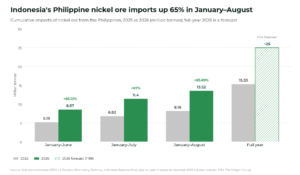
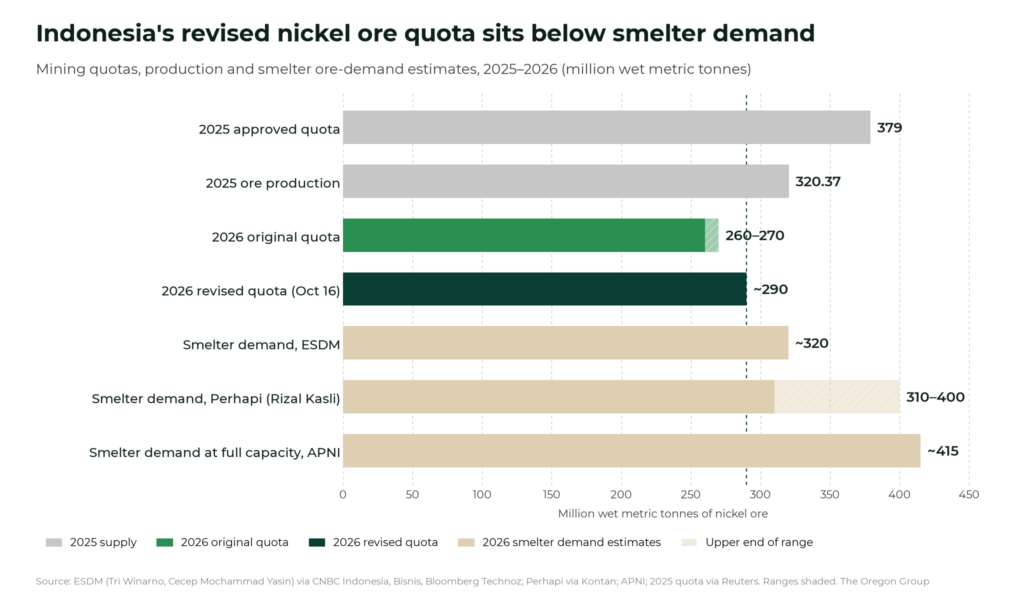
This follows our October 21 article, Indonesia’s revised nickel quota leaves smelters leaning on Philippine ore, in which Energy and Mineral Resources Minister Bahlil Lahadalia signalled that smelters may not be allowed to run at full capacity while there is oversupply:
“Our goods cannot be sold cheaply. So most likely, even if installed capacity is, say, 10, what may be able to produce, as long as we still have oversupply, will not reach 10. That is what we will regulate,” Bahlil Lahadalia said on October 7.
We concluded:
“In other words, the ore deficit is not a flaw in Jakarta’s quota system. It is the policy, and so far Philippine ore, smelter stockpiles and a drought at Morowali have stopped it from biting.”
The ministry is already looking at the knock-on effect. Tri Winarno, director general of minerals and coal, said on October 24 it anticipates lower ore uptake if the smelters cut, and that ore production could then be evaluated. He also said he hoped the nickel price would rise so that royalties stay high.
Caveats
The cut figures are reported, not announced, for example:
- no company has publicly announced a cut plan, JRJ reported on October 26; the circulated plan would run from October 23 to the end of the year
- the baseline is unclear: Bloomberg reported cuts from current levels, while JRJ said the circulated plan did not specify nameplate capacity or actual output
- it is unclear whether the cuts would count reductions already underway, a trading source told Reuters; SMM says IMIP output is already down more than 20% because of the drought
- LME nickel stocks stood at 280,674 tonnes on October 23, compared with 162,474 tonnes at the start of 2025, according to LME data published by Westmetall
“If final cuts fall short of the rumours, nickel prices risk a pullback,” SMM warned.
Jakarta said it would regulate smelters below capacity. Low prices may get there first.