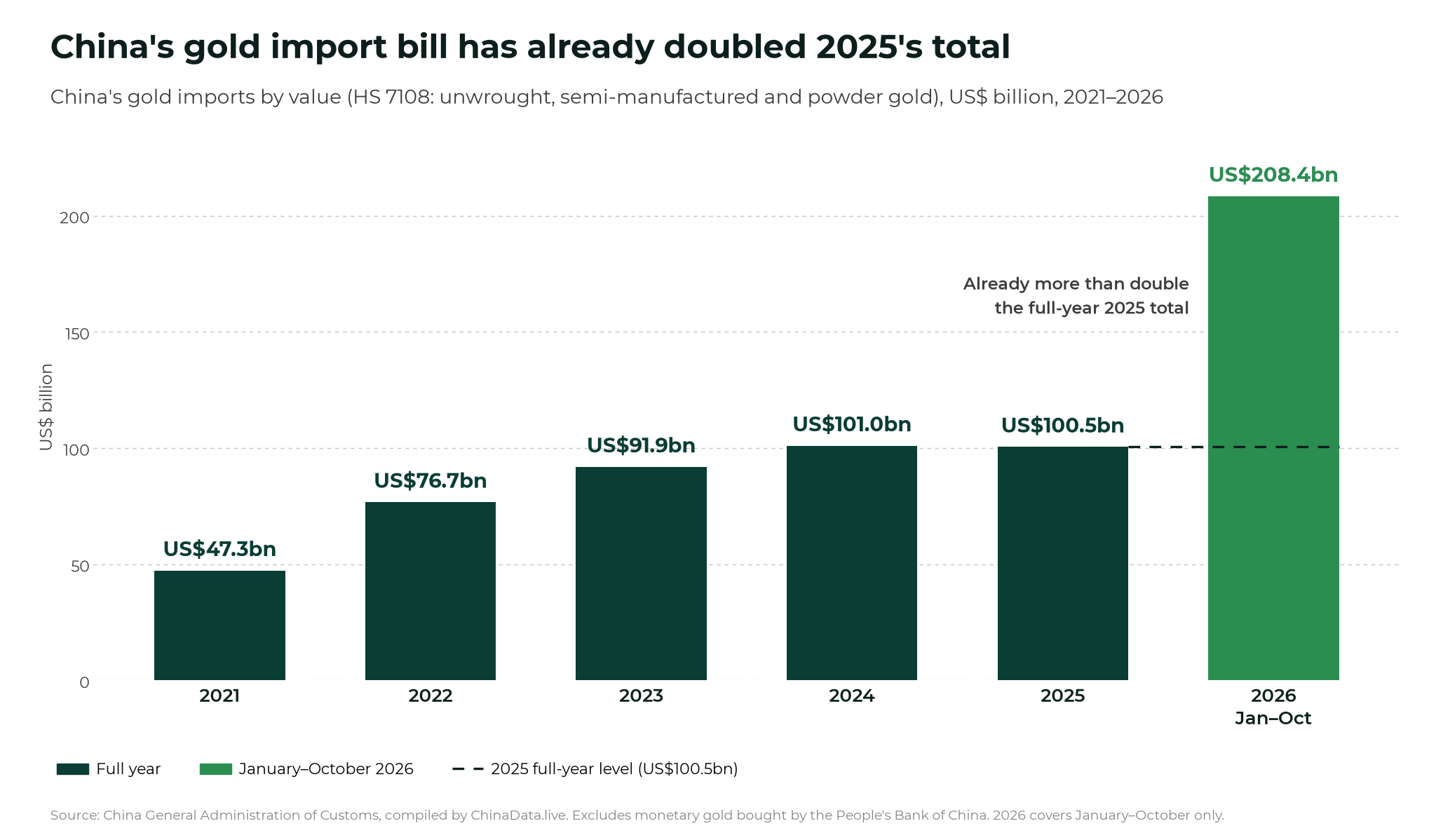
- China imported a record US$209 billion of non-monetary gold in January–October, equal to nearly 8% of its total goods imports and more than double the US$100.5 billion it spent on gold imports in all of 2025
- in October alone, unwrought gold imports rose 183.5% from a year earlier to US$20.73 billion, making gold China’s third-largest import after memory chips and crude oil
- the buying comes as gold trades about 35% below its record of US$5,594.82 an ounce on 29 January, while the People’s Bank of China (PBOC) has added to its own reserves for 24 consecutive months
China’s gold imports have reached a record US$209 billion so far this year, as households, investment funds and banks keep buying bullion while the price falls.
The figure covers non-monetary gold, meaning bullion held privately rather than by the central bank, and is equivalent to nearly 8% of all Chinese imports in the first ten months, according to Bloomberg.
A record bill, partly inflated by price
China spent US$91.9 billion importing gold in 2023 and US$101.0 billion in 2024, based on customs data. This year’s ten-month total is already more than twice either figure.
Higher prices explain part of the jump. In January–July, the value of unwrought gold imports rose 151% from a year earlier, while volumes rose 69%.
Gold is down 35% from its January record
Gold hit a record US$5,594.82 an ounce on 29 January. By late morning in London on 24 November, spot gold was trading at US$3,622.50, about 35% lower in less than ten months.
Much of that fall followed the start of the US-Iran war in late February, as higher energy costs pushed up inflation and pushed back expectations of US interest rate cuts, according to Bloomberg. The Federal Reserve is now expected to raise rates instead: traders see a 96% chance of a quarter-point rise in December, and the US dollar is near a 20-month high, which makes gold more expensive for buyers paying in other currencies.
Last week’s 8.9% drop had a different trigger. A sell-off in AI and technology stocks set off broader deleveraging across markets, and gold, as a highly liquid asset, was caught in it, according to the WGC. European gold ETFs have shed 16 tonnes in November and North American funds 12 tonnes last week, while net positions held by money managers and other traders on the COMEX futures exchange fell by a combined 75 tonnes in the week to 17 November.
For Chinese importers, cheaper gold has helped rather than hurt. Higher local prices and a stronger yuan made it cheaper for licensed importers to buy gold overseas, and demand held up as prices fell, widening the local premium over global benchmarks, according to Bloomberg. The WGC also pointed to a rising local premium as an incentive to import in September, although dealers quoted by Reuters put mainland premiums at only US$3 to US$6 an ounce in mid-November. Retail buyers are also responding: ANZ noted that gold retailers in Shenzhen were reportedly crowded over the weekend as prices dipped.
However, the US$209 billion record is a value figure, and much of it was bought at higher prices than last year. Even after the slide, gold averaged US$4,262 an ounce in the third quarter, 23% more than a year earlier, and the average price China paid per tonne of unwrought gold in January–July was 48% higher than a year earlier. In other words, falling prices encourage buying, but the record bill reflects both more gold and dearer gold.
Gold is shrinking China’s trade surplus
Without gold, China’s trade surplus would have crossed US$1 trillion in September rather than October. Brad Setser, a former US Treasury official now at the Council on Foreign Relations, estimates the full-year surplus would reach US$1.5 trillion without gold, against about US$1.3 trillion at the current pace.
That matters because China’s record surplus is drawing growing scrutiny from trading partners, including the European Union. As Brad Setser put it, China is:
“importing a financial asset in a way that registers in the goods data and reduces the reported surplus”
The PBOC controls how much gold enters the country by issuing import quotas to a select list of banks, and the volumes are not public. A new licensing rule from 1 June lets frequent importers use one permit for unlimited shipments over nine months, within an approved quantity.
Setser said it is “certainly plausible” that quotas were expanded to allow more imports and reduce the surplus. The PBOC and the customs agency did not immediately reply to Bloomberg’s requests for comment.
Can the numbers be trusted?
China’s gold data has a patchy record. In 2015, the PBOC revealed a 57% jump in reserves in its first update in six years, having treated its holdings as a state secret, according to Reuters; for years Beijing also did not publish gold trade data, so analysts used Hong Kong’s figures instead. Today, Goldman Sachs estimates Chinese buying through London’s over-the-counter market at 148 tonnes in May–August, against 65 tonnes of reported PBOC additions, and the World Gold Council (WGC) says around 63% of central bank demand in the third quarter was unreported, although neither figure proves that China is hiding purchases.
The import data itself is broadly backed up by China’s trading partners: Hong Kong’s net gold exports to the mainland rose to 75 tonnes in September from 58 tonnes in August, and Swiss shipments to China reached their highest since March in October. The bigger question is not whether the gold is arriving but why; because the PBOC sets the quotas, the pace of imports is partly a policy choice, which makes China’s headline trade surplus, rather than the gold figures, the number to read with care.
Investment, not jewellery, is driving demand
Investors, rather than jewellery buyers, are now the main source of demand. Chinese bar and coin demand reached a record 393 tonnes in the first nine months, 11% above the previous high in 2013, according to the WGC. At US$59 billion, that spending already exceeds every full year in its data.
Jewellery is moving the other way. Chinese jewellery consumption fell 22% to 66 tonnes in the third quarter from a year earlier.
Funds are buying too. Chinese gold exchange-traded funds (ETFs) held a month-end record of 310 tonnes in October, after adding 62 tonnes this year, although the WGC reported modest outflows in early November.
The central bank is a separate buyer. The PBOC added 26 tonnes in October, its largest monthly purchase in three years, lifting reserves to 2,435 tonnes, or 8.1% of its foreign exchange reserves. These purchases are excluded from the trade data.
What it means for gold investors
In September, when imports topped 1,000 tonnes, we wrote in our article on China’s gold imports hitting their highest January-August total since 2017:
“Sustained Chinese buying could help absorb selling elsewhere”
It has absorbed selling, but it has not stopped the fall. The price is largely being set by US interest rate expectations, as we explained in our article on the commodity sell-off that wiped US$186 billion off copper miners.
Even so, Xing Zhaopeng, senior China strategist at ANZ, expects gold imports to remain elevated, describing gold as one of the few assets China can buy in large volume that “can also preserve value”.
And any turn in expectations on US interest rates (or fiscal stimulus by a Democrat-led House and Senate) would likely see a sharp reversal in the gold price.
So, for now, US interest rates are driving the gold price, but Chinese demand is cushioning its fall to try and shrink a politically sensitive trade surplus.