- MP Materials has completed General Motors qualification and is starting saleable neodymium-iron-boron magnet deliveries from Fort Worth in the fourth quarter
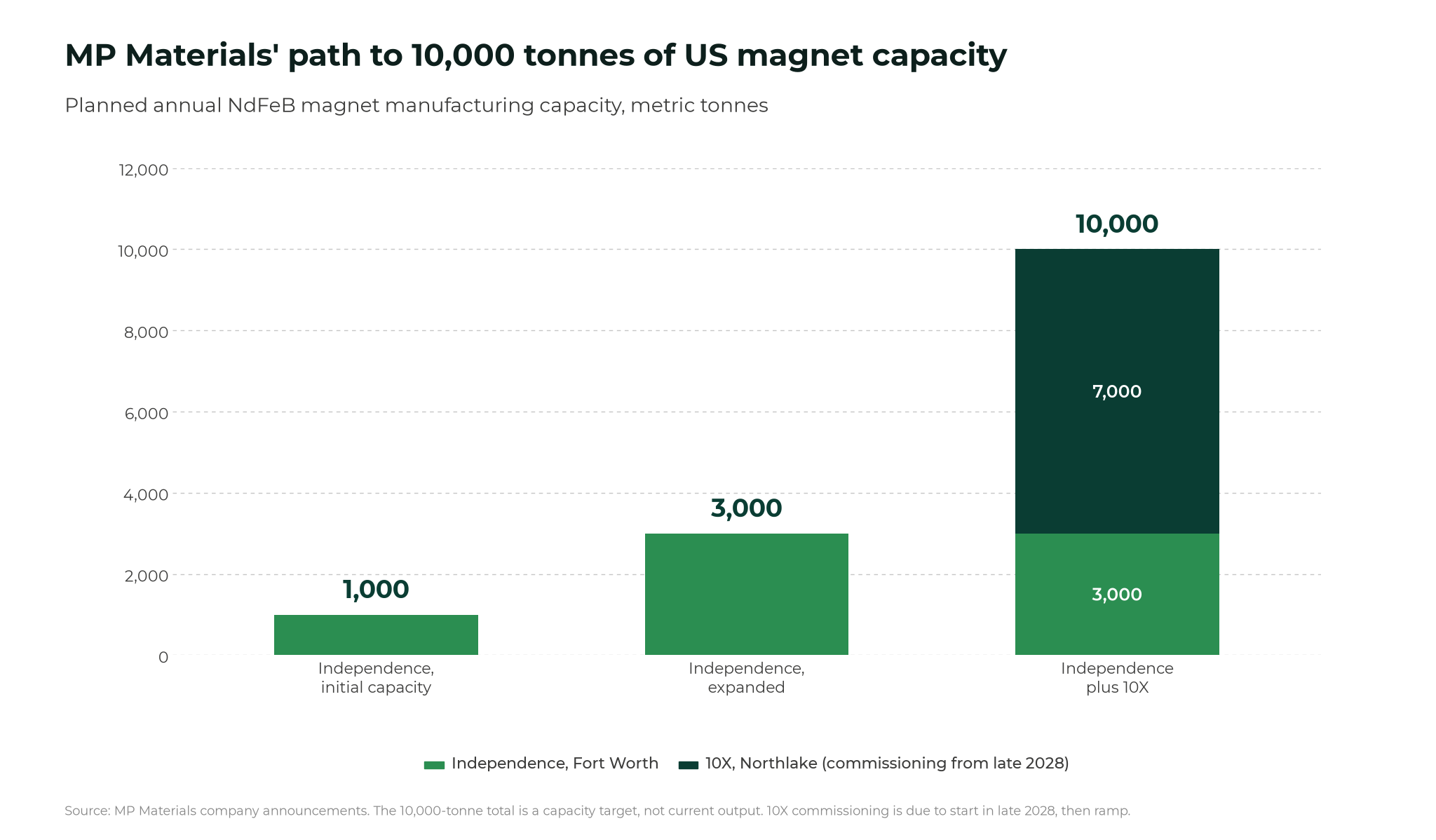
- the Independence plant’s initial capacity is 1,000 metric tonnes a year, against a long-term US target of 10,000 tonnes once the 10X plant begins commissioning in late 2028
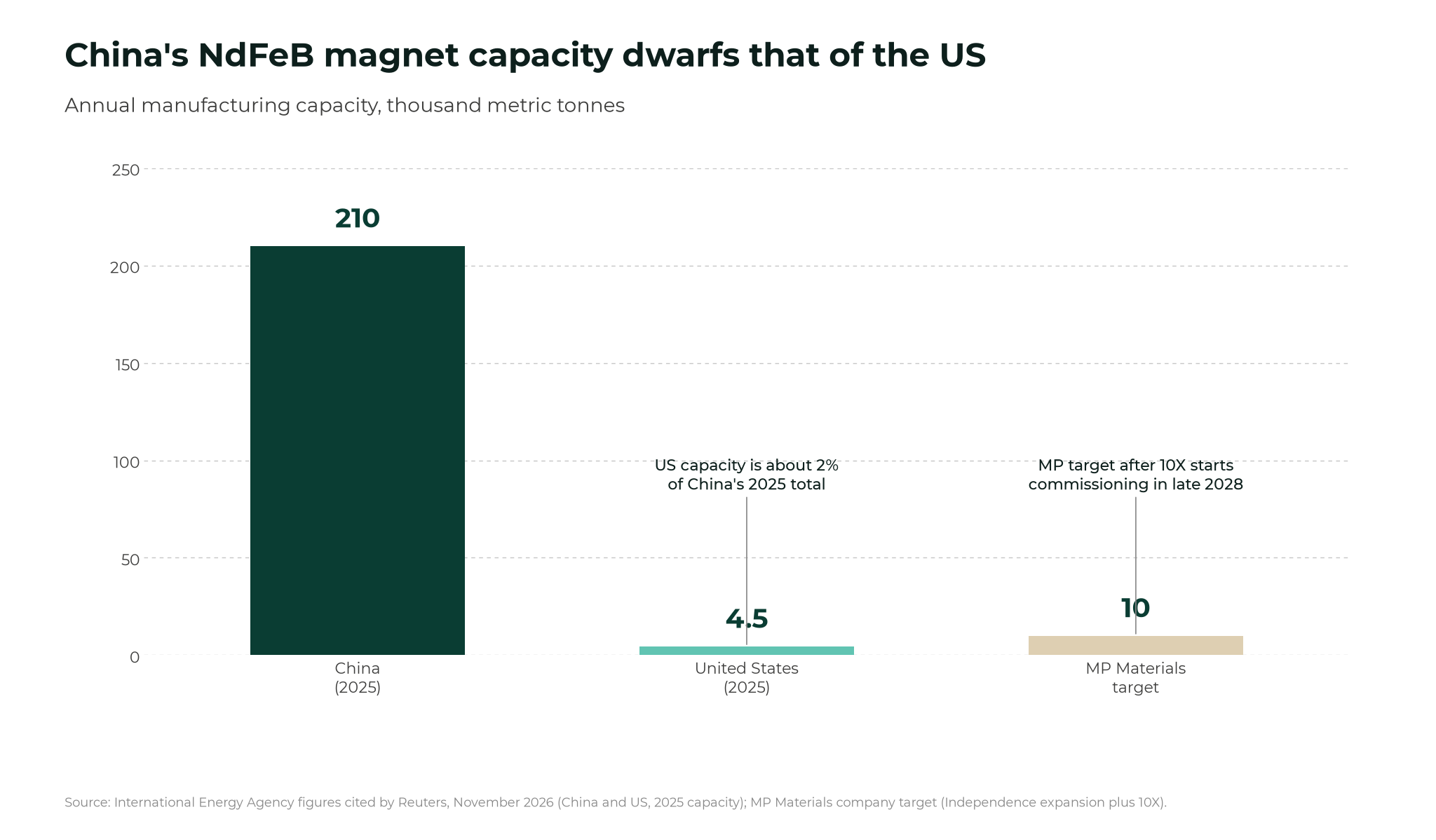
- China had about 210,000 tonnes of annual NdFeB magnet capacity in 2025, against roughly 4,500 tonnes in the United States, according to International Energy Agency figures cited by Reuters
US-made rare earth magnets, using neodymium mined at Mountain Pass in California, are heading to General Motors after MP Materials completed qualification at its Fort Worth plant.
The magnets are made from neodymium-praseodymium oxide produced at the company’s Mountain Pass mine in California, rebuilding a US mine-to-magnet chain that policymakers have spent years trying to restore.
The volumes, however, are modest: the Independence plant’s initial capacity is 1,000 metric tonnes a year, but China had about 210,000 tonnes of annual NdFeB magnet manufacturing capacity in 2025.
Qualification is the harder step
Making a magnet is not the same as getting a carmaker to use it. For example, Vulcan Elements has begun making rare earth magnets in North Carolina, although its customers have not yet approved them for use.
MP’s completion of the GM process matters because automotive qualification tests the equipment, work instructions and material flow, not just whether a part meets a specification, chief financial officer Ryan Corbett told analysts. The company started the magnet business from scratch in 2021.
James Litinsky, founder, chairman and chief executive, called the milestone “an inflection point for our business and mission,” with saleable magnet deliveries and revenue beginning in the fourth quarter.
The ramp will be slow. Management expects the next couple of quarters to be quite modest, with volumes rising in the second half of 2027, when production for Apple is also due to begin.
That Apple agreement is a US$500 million commitment to buy recycled rare earth magnets made at Independence, not a second order for material mined at Mountain Pass.
A 1,000-tonne start against a 210,000-tonne industry
Independence is designed for about 1,000 tonnes a year at the outset and is being expanded to 3,000 tonnes. A second plant, 10X, is under construction in Northlake, Texas, with about 7,000 tonnes of planned capacity and commissioning due to start in late 2028 — together, that is MP’s target of about 10,000 tonnes a year.
Even then, the company’s entire planned platform would be a small fraction of China’s 2025 capacity. The United States as a whole had roughly 4,500 tonnes of NdFeB magnet capacity in 2025, figures form the IEA show.
China also accounted for 94% of global sintered permanent-magnet production in 2024, up from about 50% in 2005, and for 91% of refined magnet rare earths. The chokepoint is not the mine, instead it is the plant that turns oxide into a magnet.
That is the same bottleneck we flagged in Pentagon’s China rare earth ban starts on Jan 1, but new supply can take 10 years, when we noted that significant US processing, refining and magnet capacity is not expected “until 2028 or later.”
China has extended its pause on additional rare earth export controls until 10 January 2027, giving manufacturers in Europe and the US more time to plan. The pause does not lift earlier restrictions, however, and the European Union’s own Critical Raw Materials Act aims to process only 40% of its strategic minerals at home by 2030, and to rely on no single country for more than 65% of any of them. A qualified magnet plant in Texas gives the West a foothold, but the breathing space Beijing has granted can be withdrawn faster than new plants can be built.
The Pentagon already sits at the centre of MP’s plan, after becoming the company’s largest shareholder in 2025 through a US$400 million preferred-stock investment, a US$110 per kilogram neodymium-praseodymium price floor and a 10-year commitment to take the output of 10X.
The remaining gaps
The neodymium in the first GM magnets comes from Mountain Pass, America’s only rare earth mine of scale. High-temperature electric-vehicle magnets also need small amounts of the heavy rare earths dysprosium and terbium, which Mountain Pass produces only as a minor fraction of its ore.
MP said commercial-scale production of dysprosium and terbium would begin in the fourth quarter to support Independence. Until that circuit is running and proven, heavy rare earth supply remains a point of vulnerability. China and Myanmar together accounted for about 83% of mined heavy magnet rare earths in 2024.
MP is restoring a fully integrated US mine-to-magnet chain (although, to note, it is not the only company making magnets on US soil, as the Vulcan plant in North Carolina already shows.
What it means for investors
For the Pentagon, which is due to stop buying China-sourced rare earth magnets from 1 January 2027, a qualified US magnet plant is a significant first step. MP has cleared the qualification hurdle that other US magnet start-ups have not, it has offtake from GM, Apple and the Pentagon, and it has a government price floor under its neodymium-praseodymium.
However, it is not large enough, on today’s capacity, to replace Chinese supply for defence, let alone for the car and electronics industries.
The risk is that a first shipment is mistaken for a sign that the supply gap has closed.
The risks to watch
Magnet revenue will be uneven as GM phases the material into specific plants and models. 10X is a construction project, not a factory. And the 210,000-tonne Chinese figure is capacity, not output; some industry estimates of China’s installed sintered capacity are higher, which would make the gap wider, not narrower.
A qualified magnet from Texas shows the US can make them, however, until the tonnes catch up with the purchase orders, China remains the swing supplier.