
Critical Minerals and Energy Intelligence

America’s $27 billion push to break China’s minerals grip

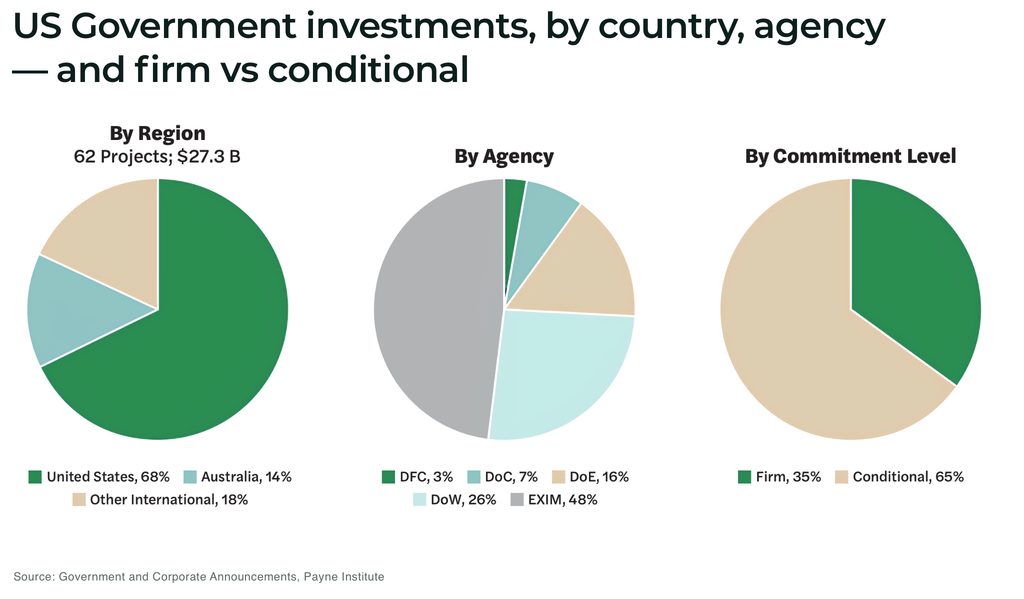
The US has committed or conditionally committed at least US$27.3 billion to 62 critical minerals projects since the start of 2025, according to the Payne Institute’s State of Critical Minerals Report 2026 — as Washington takes a leading role in financing alternatives to China-dominated supply chains.

The commitments span nine countries and more than three dozen minerals, withpprox 68% of their value targets US projects, with Australia accounting for another 14%.
US Government investments by country agency — and firm vs conditional - The Oregon Group

The scale matters, but the more consequential shift is how Washington is putting its balance sheet to work: taking equity stakes, providing loans, supporting prices and backing customers’ purchases.

Together, these interventions help address the question that determines whether a mineral deposit becomes an operating business, will someone finance construction, and whether the producer earn enough to keep running.

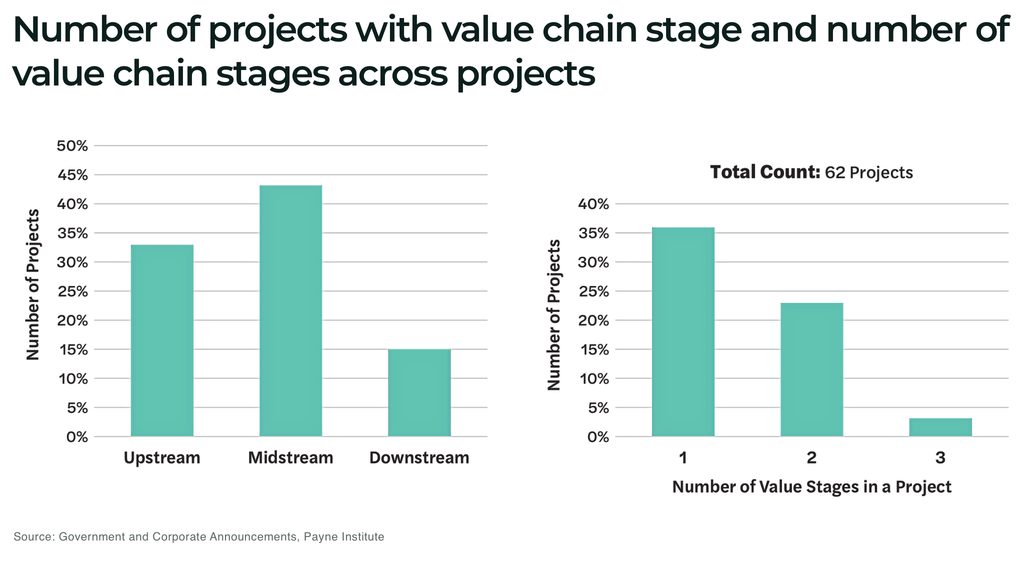
The majority of the investments made upstream (eg mining) and/or midstream (eg refining or processing), as well as 15 include a downstream (eg product manufacturing) component.
Number of projects with value chain stage and number of value chain stages across projects - The Oregon Group

The push comes against a difficult investment backdrop. Global critical mineral investment fell 9% in 2025, while spending by battery metals companies dropped more than 20%, according to the International Energy Agency’s latest outlook.

Washington is increasingly willing to absorb risks that private investors struggle to price.

For example, MP Materials illustrates the approach: its July 2025 Pentagon agreement combined a US$400 million preferred-equity investment with a ten-year US$110-per-kilogram price floor for its neodymium-praseodymium products. The package also included a ten-year commitment to ensure purchases of all magnets produced by its planned 10X facility. That protection is already appearing in company accounts. MP reported US$17.6 million in price-protection income in the second quarter of 2026, alongside US$108.5 million in revenue.

For investors, the significance extends beyond one company as a government-backed price floor can help reduce exposure to a market downturn; a purchase commitment can give lenders greater confidence that new capacity will have customers; equity and loans help pay for construction.

The US is also financing protection against supply interruptions when, in February, the Export-Import Bank approved a direct loan of up to US$10 billion for Project Vault, a public-private strategic critical minerals reserve intended to store materials for American manufacturers.

The new research identifies the US as a major driver of critical mineral investment diversification — and the leading player in the Western hemisphere — howeer does not establish that America has overtaken China in mineral supply investment.

Nor does every US announcement represent secured funding. Payne classifies 65% of the US$27.3 billion as conditional, with 35% firm. Even firm commitments should not be confused with disbursements or operating capacity.

The institute’s central recommendation is therefore consequential: support complete supply chains. A new mine cannot remove dependence if its output must still pass through a vulnerable processing bottleneck. A refinery needs reliable feedstock both need customers.

America is helping change the financing terms for critical minerals. The next test is whether those commitments produce complete, commercially durable supply chains.

Subscribe for Investment Insights. Stay Ahead.

Investment market and industry insights delivered to you in real-time.

Disclaimer

The Oregon Group maintains full editorial control over all content published on this website. While sponsored and advertised placements may be featured, the content remains the sole opinion of The Oregon Group. The author may receive compensation or remuneration for providing content, but all statements and expressions are made independently and are not influenced by sponsors or advertisers. From time to time, The Oregon Group and its directors, officers, partners, employees, authors, or members of their families, as well as persons who are interviewed for articles on this website, may have a long or short position in securities or commodities mentioned and may make purchases and/or sales of those securities or commodities in the open market or otherwise. By accessing and using this website, readers are cautioned to assume that each of the foregoing persons may have a financial interest in all companies and sectors mentioned on this website. Any projections, market outlooks or estimates herein are forward looking statements and are inherently unreliable., and any such statements are based upon certain assumptions and should not be construed to be indicative of the actual events that will occur.  Other events that were not taken into account may occur and may significantly affect the returns or performance of the securities or commodities discussed herein. The information provided herein is based on matters as they exist as of the date of preparation and not as of any future date, and The Oregon Group undertakes no obligation to correct, update or revise the information in this document or to otherwise provide any additional material. The information provided on this website is for informational purposes only and is not, directly or indirectly, an offer, solicitation of an offer and/or a recommendation to buy or sell any security or commodity, and the information provided on this website should not be construed as any advice or an opinion as to the price at which the securities of any company or commodity may trade at any time. The Oregon Group is a publisher of financial information, not an investment advisor.  We do not provide personalized or individualized investment advice or information that is tailored to the needs of any particular recipient, and the information provided on this website is not and should not be construed as personal, financial, investment or professional advice. Readers are cautioned to always do their own research and review of publicly available information and to consult their professional and registered advisors before purchasing or selling any securities or commodities and should not rely on the information contained herein. Neither The Oregon Group nor any of its affiliates accepts any liability whatsoever for any direct or consequential loss howsoever arising, directly or indirectly, from any use of the information contained herein. By using the Site or any affiliated social media account, you are indicating your consent and agreement to this disclaimer and our terms of use. Unauthorized reproduction of this newsletter or its contents by photocopy, facsimile or any other means is illegal and punishable by law.

Share this article

about the author

Picture of The Oregon Group

The Oregon Group

The Oregon Group is an investment research team focused on critical minerals, mining, energy and geopolitics.

Tags

Subscribe Now

Subscribe for in-depth market and industry intelligence you won’t find in the headlines.

Recommended to Read NEXT

GET FREE INVESTMENT INSIGHTS

Investment intelligence and in-depth reports on critical minerals, mining, energy and geopolitics — from capital-markets professionals with boardroom and institutional experience.