
- President Trump announced approximately US$2.1 billion for critical-mineral projects and more than US$180 million for mining education
- roughly 93% of the project funding consists of conditional loans that must still reach financial close
- government capital targets the full supply chain: mining, processing, magnets, battery materials and advanced manufacturing
- prospective EXIM financing for Ivanhoe Electric could take the wider project pipeline above US$3 billion
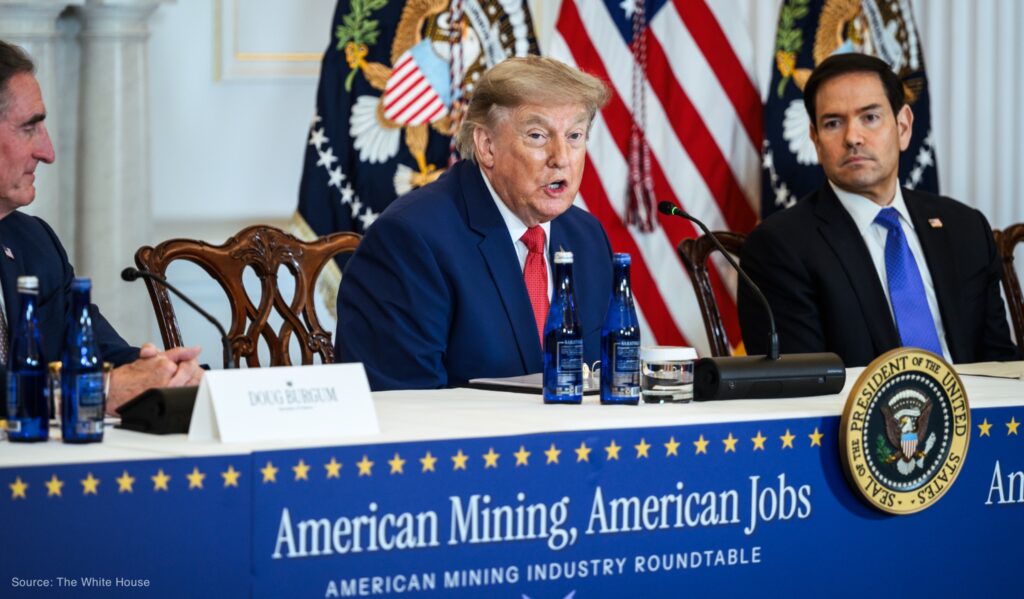
President Donald Trump has announced more than US$2 billion in government support for critical mineral and mining-related projects, alongside more than US$180 million for the schools expected to supply America’s next generation of mining engineers, metallurgists and geologists.
“I am delighted… to be announcing some of the largest ever investments in American mining,” said US President Donald Trump. “We’re putting America’s miners back to work and reclaiming America’s rightful place as the minerals superpower of the world.”
The package was unveiled at an American Mining Roundtable on August 7 and covers silicon-carbon battery anodes, rare-earth-free magnets, scandium, graphite, boron, tantalum, niobium and refractory-grade bauxite.
By our calculation, the named government commitments total approximately US$2.10 billion, and adding the workforce package takes the total to at least US$2.28 billion — but the structure matters with around US$1.95 billion, or 93% of the project funding, is made up of conditional loans.
The capital is significant, but borrowers must still satisfy financial, technical, legal and other conditions before reaching financial close.
Where the +$2 billion is going
| Project | Public support | What it is intended to build |
|---|---|---|
| Sila Nanotechnologies | US$1.4 billion conditional loan | expanded US silicon-carbon anode production and a lithium-ion battery-cell manufacturing facility |
| Sunrise Energy Metals | US$400 million conditional loan | an Australian scandium mine, metallisation and additive-manufacturing supply chain |
| Niron Magnetics | US$150 million conditional loan | rare-earth-free iron-nitride magnet production in Minnesota |
| Strategic Bauxite USA | US$85.5 million equity investment | a Guyana bauxite mine, primary processing and a US brown-fused-alumina facility |
| Westwater Resources | US$25 million EXIM loan | development of Alabama’s Coosa graphite deposit |
| Global Advanced Metals | US$25 million EXIM loan | tantalum and niobium production in Pennsylvania |
| 5E Advanced Materials | US$8 million EXIM loan | development of the 5E Boron Americas project in California |
| Harena Rare Earths | up to US$4.84 million in development funding | permitting, environmental studies and pilot work at Madagascar’s Ampasindava rare-earth project |
The three EXIM transactions — Westwater Resources, Global Advanced Metals and 5E Advanced Materials — were confirmed in an official US Export-Import Bank announcement.
The Department of War identifies the bauxite recipient as Strategic Bauxite USA, rather than “Standard Bauxite,” as it appears in the White House fact sheet.
Harena’s funding was originally disclosed through the company’s official regulatory announcement. The US International Development Finance Corporation committed up to US$4.84 million for permitting, environmental and social studies and development of a proof-of-concept pilot plant.
This is not simply a mining financial package
The largest financial commitment is not going to a conventional mine:
The Office of Strategic Capital’s US$1.4 billion conditional loan to Sila would fund expanded production of silicon-carbon battery anodes and the construction of a lithium-ion battery-cell manufacturing facility. The materials are intended for satellites, unmanned aerial systems, munitions, energy storage, artificial intelligence and data-centre applications.
Sila also announced a separate US$300 million private-equity raise in July to accelerate production at its Moses Lake facility.
Niron’s US$150 million conditional loan would support construction of a US$605 million manufacturing plant in Sartell, Minnesota. The facility is designed to produce up to 1,500 tonnes of rare-earth-free magnets annually. Niron’s technology uses domestically abundant iron and nitrogen in an attempt to bypass the concentrated rare-earth supply chain.
Its Syerston Scandium Project in New South Wales is intended to become the world’s first primary mine-source scandium operation. The wider public-private transaction is valued at nearly US$1 billion and extends beyond extraction into metallisation and additive manufacturing. The Department of War will also receive a right of first offer over Sunrise’s output.
Strategic Bauxite follows the same mine-to-manufacturing model. The US$85.5 million government equity investment will be combined with US$64.5 million of private capital to:
- acquire and expand the First Bauxite mine in Guyana
- develop calcination facilities for primary processing
- support construction of a brown-fused-alumina facility in the US
Once fully operational, the project is expected to supply 100% of US military demand for brown-fused alumina and 100% of total US demand for refractory-grade bauxite, according to the Department of War.
The message is clear: Washington is not funding ore bodies in isolation. It is targeting the processing and manufacturing bottlenecks between the mine and the weapon, battery, aircraft or semiconductor.
Allied supply now counts as strategic supply
Several of the supported projects are located outside the United States.
Sunrise is in Australia, Strategic Bauxite’s mine is in Guyana and Harena’s Ampasindava project is in Madagascar.
What links them is US financing, Western-aligned ownership, downstream processing and preferential access to output. This builds on efforts by the G7 to secure critical mineral supply.
In 2025, of the 58 mineral commodities included in the America’s List of Critical Minerals (excluding metallurgical coal and uranium), the US was 100% net import reliant for 13 mineral commodities, and an additional 20 critical mineral commodities (including 14 lanthanides, which are listed under rare earths) had a net import reliance greater than 50% of apparent consumption.
In particular, the US was 100% net import-reliant in 2025 for natural graphite, niobium, scandium and tantalum — all four appear in the roundtable package.
“We all look forward to working not just nationally, but with our allies around the world, to ensure we have supply chains that are diversified, reliable, so no country can ever hold this over our head and threaten us in the future” — Secretary of State, Marco Rubio
Westwater’s Coosa Graphite Deposit, for example, contains more than 1.8 million tonnes of indicated graphite resources and is being advanced as a future feedstock source for the company’s Kellyton processing plant.
Global Advanced Metals operates the only fully integrated tantalum and niobium production facility in the United States at Boyertown, Pennsylvania.
5E Advanced Materials is developing a vertically integrated boron operation in Southern California, covering extraction, refining and distribution.
Is another $1 billion coming for copper?
Ivanhoe Electric founder Robert Friedland said EXIM is working to provide more than US$1 billion for the Santa Cruz copper project in Arizona. However, investors should treat the latest US$1 billion figure as prospective financing, not a completed loan.
Ivanhoe previously received a non-binding EXIM letter of interest for up to US$825 million in April 2025. That indication carried a possible 15-year repayment term but remained subject to an application, underwriting, authorization and final documentation.
America’s mining bottleneck is also human
The government will invest US$100 million across 14 mining schools and more than US$80 million in three additional workforce-development and technology programmes, according to the White House.
Trump said accredited American mining programmes now graduate fewer than 170 mining engineers annually, compared with more than 3,000 in China. He also said half of the current US mining workforce could retire within three years, as reported in the roundtable footage.
The broader workforce shortage has also been documented by the US House Select Committee on China, and something The Oregon Group highlighted as far back in 2023 in our analysis on how the Mining industry is running out of miners.
US critical minerals policy transformed
The roundtable marks another step in the transformation of US critical minerals policy from permitting reform and strategic rhetoric into state-backed project finance.
The White House says the administration has signed or approved 160 mineral deals worth almost US$40 billion since January 2025.
The Office of Strategic Capital says it has committed more than US$8.4 billion in debt during fiscal 2026, helping mobilise over US$17.8 billion in total public and private capital.
That sits alongside Project Vault, the US strategic critical-minerals reserve backed by a US$10 billion EXIM loan and nearly US$2 billion in private investment.
Washington has proven itself willing to use substantial loans, equity, development funding and rights over production depending on the supply-chain bottleneck to help reduce financing risk.
Policy is now about deciding which projects will sit inside a government-supported industrial system stretching from ore to finished material.
The next divide in critical minerals may not be between explorers and producers. It may be between projects that have secured a place inside that system — and those still trying to get in.
Subscribe for Investment Insights. Stay Ahead.
Investment market and industry insights delivered to you in real-time.