
Critical Minerals and Energy Intelligence

Chinese firm wins US$498 million copper deal on US-backed Lobito railway

China NERIN Engineering will build a copper-recovery plant at the planned Zambian terminus of the Western-backed Lobito Corridor railway — exposing a gap in the strategy to secure African critical minerals.

Konkola Copper Mines has signed a US$498 million contract with China NERIN Engineering to build a tailings-recovery plant at Chingola designed to add 70,000 metric tonnes of annual copper output.

The location matters.

Chingola is also the proposed endpoint of an 830-kilometre railway connecting Zambia with Angola’s Benguela line. The US-backed route is intended to give Zambia and the Democratic Republic of Congo faster access to the Atlantic and provide Western markets with a more secure critical-minerals supply chain.
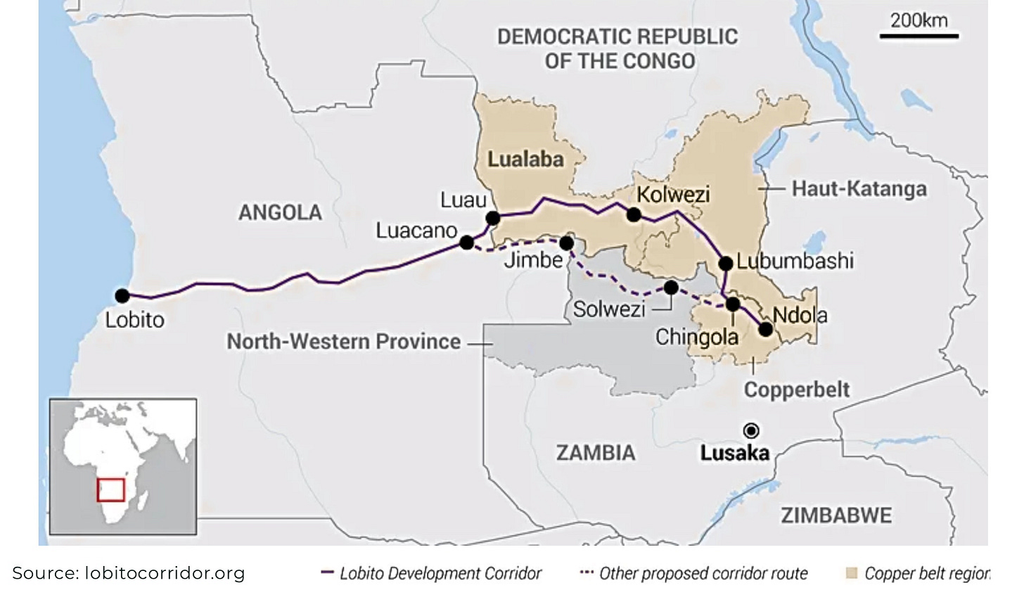
image 8 - The Oregon Group

The new financing highlights concerns that the railway itself does not determine who builds the mines, controls the processing technology or buys the metal.

The Konkola Copper Mines project is designed to recover 70,000 metric tonnes of copper annually from tailings at Chingola. China NERIN will provide engineering, procurement and construction services, commissioning support, performance testing and training. The new KCM plant will use leaching technology to extract copper from existing mine tailings. China NERIN will provide engineering, procurement and construction services, as well as commissioning, performance testing and training.

There is no disclosed agreement requiring KCM’s additional copper to travel through Lobito or be sold to a Western buyer. Nor does China NERIN’s construction contract give it ownership of the plant or its output. KCM is 79.4% owned by Vedanta Resources and 20.6% by ZCCM-IH.

That distinction matters — but so does the contradiction. The US and its partners are financing the export infrastructure while Chinese companies continue to secure commercial positions at the production end of the supply chain.

The African Development Bank also approved a US$255 million loan and US$10 million grant in August for the Lobito railway to support Zambia’s participation. The loan represents a first tranche, with the bank planning to mobilise additional resources toward a potential US$500 million contribution. That financing is separate from the existing Angolan section. In July, the Africa Finance Corporation announced financial close on a US$753 million package, comprising US$553 million from the US International Development Finance Corporation and US$200 million from the Development Bank of Southern Africa.

The money will rehabilitate and operate the 1,300-kilometre railway between Lobito and Angola’s border with the Democratic Republic of Congo. The DFC expects the programme to increase transport capacity to 4.6 million metric tonnes annually — around ten times the end-2024 level — and reduce critical-mineral transport costs by as much as 30%.
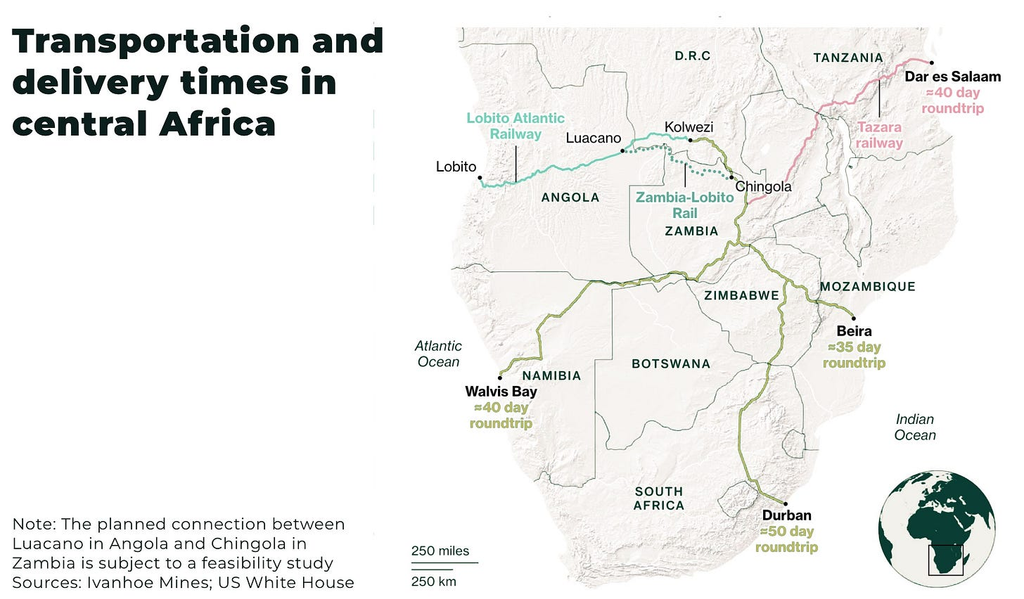
image 9 - The Oregon Group

The corridor is already carrying copper. Ivanhoe Mines sent its first shipment of 99.7%-pure Kamoa-Kakula copper anodes to Lobito during the first quarter of 2026. Ivanhoe said the rail journey from the DRC Copperbelt averaged seven days, compared with more than three weeks by truck to Durban or Dar es Salaam.

The new Konkola project places another potential source of copper freight directly beside the proposed Zambian rail connection, with KCM saying the investment forms part of Zambia’s plan to raise national copper production from 890,346 metric tonnes in 2025 to 3 million metric tonnes annually by 2031.

Lobito can reduce transport times and open a western export route. It cannot secure minerals for the West without accompanying investment in mines, processing capacity and offtake agreements. China NERIN’s KCM contract shows that the competition for African copper will be decided before the first wagon reaches the railway.

Our analysis on whether Africa’s “Copper Express” will ever be built:

Subscribe for Investment Insights. Stay Ahead.

Investment market and industry insights delivered to you in real-time.

Disclaimer

The Oregon Group maintains full editorial control over all content published on this website. While sponsored and advertised placements may be featured, the content remains the sole opinion of The Oregon Group. The author may receive compensation or remuneration for providing content, but all statements and expressions are made independently and are not influenced by sponsors or advertisers. From time to time, The Oregon Group and its directors, officers, partners, employees, authors, or members of their families, as well as persons who are interviewed for articles on this website, may have a long or short position in securities or commodities mentioned and may make purchases and/or sales of those securities or commodities in the open market or otherwise. By accessing and using this website, readers are cautioned to assume that each of the foregoing persons may have a financial interest in all companies and sectors mentioned on this website. Any projections, market outlooks or estimates herein are forward looking statements and are inherently unreliable., and any such statements are based upon certain assumptions and should not be construed to be indicative of the actual events that will occur.  Other events that were not taken into account may occur and may significantly affect the returns or performance of the securities or commodities discussed herein. The information provided herein is based on matters as they exist as of the date of preparation and not as of any future date, and The Oregon Group undertakes no obligation to correct, update or revise the information in this document or to otherwise provide any additional material. The information provided on this website is for informational purposes only and is not, directly or indirectly, an offer, solicitation of an offer and/or a recommendation to buy or sell any security or commodity, and the information provided on this website should not be construed as any advice or an opinion as to the price at which the securities of any company or commodity may trade at any time. The Oregon Group is a publisher of financial information, not an investment advisor.  We do not provide personalized or individualized investment advice or information that is tailored to the needs of any particular recipient, and the information provided on this website is not and should not be construed as personal, financial, investment or professional advice. Readers are cautioned to always do their own research and review of publicly available information and to consult their professional and registered advisors before purchasing or selling any securities or commodities and should not rely on the information contained herein. Neither The Oregon Group nor any of its affiliates accepts any liability whatsoever for any direct or consequential loss howsoever arising, directly or indirectly, from any use of the information contained herein. By using the Site or any affiliated social media account, you are indicating your consent and agreement to this disclaimer and our terms of use. Unauthorized reproduction of this newsletter or its contents by photocopy, facsimile or any other means is illegal and punishable by law.

Share this article

about the author

Picture of The Oregon Group

The Oregon Group

The Oregon Group is an investment research team focused on critical minerals, mining, energy and geopolitics.

Tags

Subscribe Now

Subscribe for in-depth market and industry intelligence you won’t find in the headlines.

Recommended to Read NEXT

GET FREE INVESTMENT INSIGHTS

Investment intelligence and in-depth reports on critical minerals, mining, energy and geopolitics — from capital-markets professionals with boardroom and institutional experience.