

Critical Minerals and Energy Intelligence

US announces US$15 billion Iowa steel mill, boosting manganese and graphite electrode demand

Mesabi Metallics plans to invest US$15 billion in an Iowa steel complex capable of producing an initial 7.5 million US tons annually, rising to approximately 10 million tons in later phases.

The planned electric arc furnace complex will use direct-reduction-grade iron pellets from Mesabi’s new mine and processing operation in Nashwauk, Minnesota, creating a domestic supply chain from ore extraction to finished steel.

The wider US$18 billion Mesabi investment comprises approx US$3 billion for the Minnesota mine and pellet plant and US$15 billion for the Iowa steelmaking complex. The US Export-Import Bank approved a US$770 million direct loan for the mine, but Mesabi has not disclosed complete financing, permitting or construction details for the US$15 billion Iowa plant.
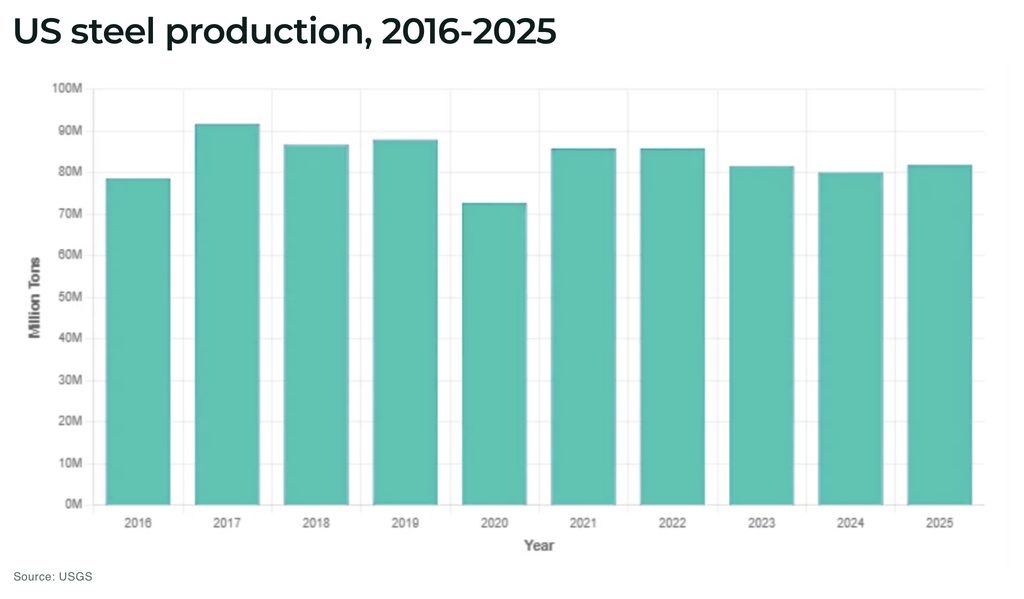
US steel production 2016 2025 - The Oregon Group

The Iowa development is designed to produce up to 7 million tons of high-grade pellets annually, and expected to support more than 6,000 construction jobs and employ approx 1,750 people once operational.

The project could reduce US reliance on imported iron products, but producing steel domestically does not make the entire supply chain domestic.

Steelmaking shifts the mineral bottleneck

Electric arc furnaces require scrap or direct-reduced iron, electricity, graphite electrodes and alloying materials. The exact requirement will depend on Mesabi’s feed mix and the steel grades it intends to produce, neither of which has been disclosed:

Manganese is the clearest exposure: the mineral is essential for removing sulphur and oxygen and improving steel strength — and the US was 100% net import reliant for manganese in 2025, with Gabon, South Africa, Malaysia and Australia supplying most imports.

At the Iowa plant’s initial capacity — equivalent to about 6.8 million metric tonnes — the mill could require approximately 41,000–61,000 metric tonnes of contained manganese annually. The estimate applies the USGS range of 6–9 kilograms of manganese for every metric tonne of steel and is illustrative rather than company guidance.
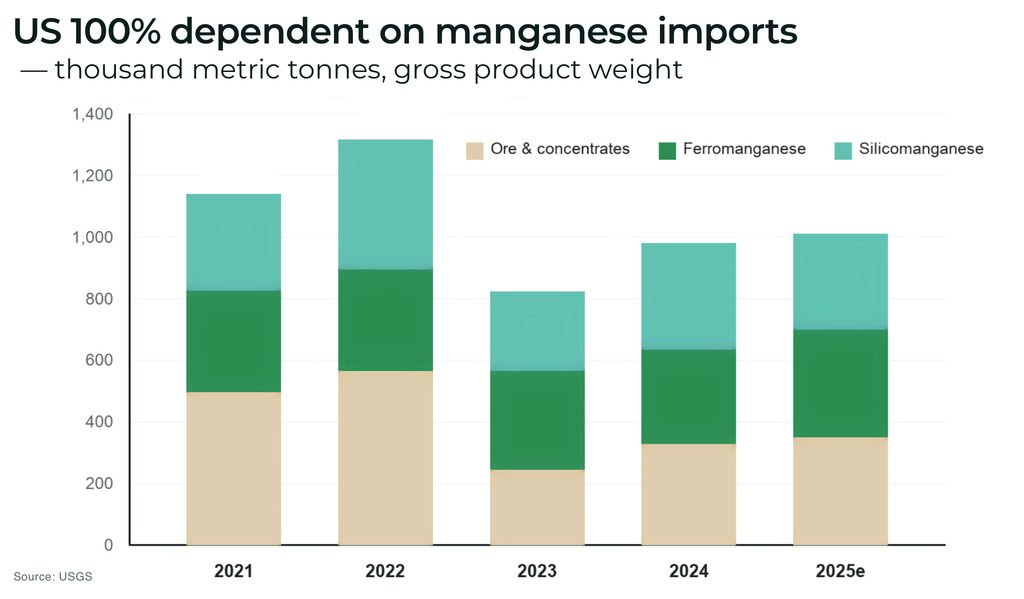
US 100 dependent on manganese imports - The Oregon Group

The furnaces will also consume graphite electrodes. Applying the approx 1.7 kilograms used per metric tonne of EAF steel implies demand of around 12,000 metric tonnes annually at initial capacity. These electrodes are primarily manufactured from synthetic graphite and petroleum needle coke, rather than mined natural graphite.

Demand for chromium, nickel, vanadium, niobium, boron and silicon will depend on whether the new steel mill produces stainless, automotive, defence or other high-strength steels — the Department of Energy identifies these materials as critical inputs for steel production and strengthening.

Feedstock could present another constraint, with high-specification EAF steel requires low-contaminant scrap or additional virgin iron units to dilute copper and other residual metals, and the US Department of Energy expects prime scrap availability to tighten as more mills move towards electric production.

Mesabi’s project may well anchor a major domestic iron and steel corridor, but its wider strategic value will depend on whether the US can also secure the imported ferroalloys, graphite electrodes, high-quality scrap and energy needed to keep it running.


Subscribe for Investment Insights. Stay Ahead.

Investment market and industry insights delivered to you in real-time.

Disclaimer

The Oregon Group maintains full editorial control over all content published on this website. While sponsored and advertised placements may be featured, the content remains the sole opinion of The Oregon Group. The author may receive compensation or remuneration for providing content, but all statements and expressions are made independently and are not influenced by sponsors or advertisers. From time to time, The Oregon Group and its directors, officers, partners, employees, authors, or members of their families, as well as persons who are interviewed for articles on this website, may have a long or short position in securities or commodities mentioned and may make purchases and/or sales of those securities or commodities in the open market or otherwise. By accessing and using this website, readers are cautioned to assume that each of the foregoing persons may have a financial interest in all companies and sectors mentioned on this website. Any projections, market outlooks or estimates herein are forward looking statements and are inherently unreliable., and any such statements are based upon certain assumptions and should not be construed to be indicative of the actual events that will occur.  Other events that were not taken into account may occur and may significantly affect the returns or performance of the securities or commodities discussed herein. The information provided herein is based on matters as they exist as of the date of preparation and not as of any future date, and The Oregon Group undertakes no obligation to correct, update or revise the information in this document or to otherwise provide any additional material. The information provided on this website is for informational purposes only and is not, directly or indirectly, an offer, solicitation of an offer and/or a recommendation to buy or sell any security or commodity, and the information provided on this website should not be construed as any advice or an opinion as to the price at which the securities of any company or commodity may trade at any time. The Oregon Group is a publisher of financial information, not an investment advisor.  We do not provide personalized or individualized investment advice or information that is tailored to the needs of any particular recipient, and the information provided on this website is not and should not be construed as personal, financial, investment or professional advice. Readers are cautioned to always do their own research and review of publicly available information and to consult their professional and registered advisors before purchasing or selling any securities or commodities and should not rely on the information contained herein. Neither The Oregon Group nor any of its affiliates accepts any liability whatsoever for any direct or consequential loss howsoever arising, directly or indirectly, from any use of the information contained herein. By using the Site or any affiliated social media account, you are indicating your consent and agreement to this disclaimer and our terms of use. Unauthorized reproduction of this newsletter or its contents by photocopy, facsimile or any other means is illegal and punishable by law.

Share this article

about the author

Picture of The Oregon Group

The Oregon Group

The Oregon Group is an investment research team focused on critical minerals, mining, energy and geopolitics.

Tags

Subscribe Now

Subscribe for in-depth market and industry intelligence you won’t find in the headlines.

Recommended to Read NEXT

GET FREE INVESTMENT INSIGHTS

Investment intelligence and in-depth reports on critical minerals, mining, energy and geopolitics — from capital-markets professionals with boardroom and institutional experience.