
- global observed oil inventories fell by 129 million barrels in March and another 117 million barrels in April, according to the IEA
- IEA member countries have agreed to release 426 million barrels of emergency oil stocks, including 172.2 million barrels from the US
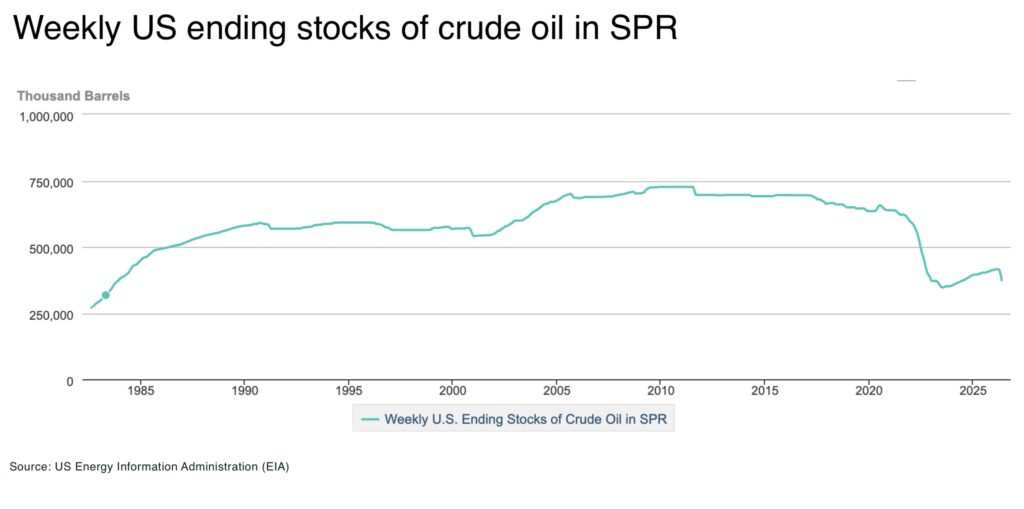
- US Strategic Petroleum Reserve fell another 9.1 million barrels to 365.1 million barrels in the week ending May 22, after a 9.9 million barrel draw the previous week
- ExxonMobil Senior Vice President Neil Chapman warned that inventories are approaching “unheard-of inventory levels”, with models pointing to Dated Brent at US$150-US$160 if stocks hit minimum levels
- for miners, the pressure point is diesel. BMO estimates every 10% rise in oil prices lifts costs by 4.2% for iron ore, 3.5% for copper and 2% for gold
Oil drawdowns are accelerating worldwide as governments and refiners drain emergency and commercial inventories to cushion the Strait of Hormuz shock.
The US Strategic Petroleum Reserve fell 9.1 million barrels to 365.1 million barrels in the week ending May 22, after a 9.9 million barrel draw the previous week. Total US petroleum stocks, including the SPR, fell 17.4 million barrels to 1.584 billion barrels.
“The weekly release is the second highest on record, just a notch below the all-time high set the previous week of 9.9 million barrels,” Javier Blas, Energy and Commodities at Bloomberg.
The International Energy Agency says global observed oil inventories fell by 250 million barrels over March and April, or about 4 million barrels per day. On-land stocks fell even faster in April, dropping 170 million barrels. IEA members have approved the largest emergency oil release in the agency’s history, making 426 million barrels available. The US share is 172.2 million barrels, Japan’s is 79.8 million barrels and Europe’s contribution is weighted more heavily toward refined products.
The latest warning comes from ExxonMobil.
“We’re approaching unheard of inventory levels. I mean really, really, really low levels,” warned ExxonMobil Senior Vice President Neil Chapman at Bernstein’s Strategic Decisions conference.
Chapman warned the industry is approaching very low inventory levels, and said models point to Dated Brent jumping to US$150-US$160 per barrel if inventories fall to minimum operating levels.
Chevron CEO Mike Wirth made a similar point to the Financial Times, warning the “buffers and shock absorbers are gradually being reduced, and the market’s ability to absorb this imbalance is drastically diminished today compared to where we started.”
Statistics on strategic oil drawdowns from China — which imported approx 50% of its crude oil from the Middle East in 2025 — are much more opaque. EIA estimates China entered the crisis with nearly 1.4 billion barrels of strategic oil inventories, including government-held and commercial stocks.
However, Rory Johnston, oil market researcher for Commodity Context, argues China is “the largest blind spot to the market’s collective statistical model of the oil industry” and that the country’s crude import collapse looks less like pure demand destruction and more like strategic supply injection. Chinese crude imports have fallen more than 40%, from about 11.5 million barrels per day in February to less than 7 million barrels per day in May, while flights, trucking and road congestion remain relatively healthy.
The shipping data points the same way. The Maritime Executive reports Chinese crude imports have dropped from a normal 11 million barrels per day to about 6.6 million barrels per day in May, absorbing roughly one-third of the seaborne shortage. Kpler says May imports are tracking near the lowest level since 2016.
And, as we argued in Strait of Hormuz diesel shock threatens mining industry, diesel is the mining industry’s pressure point. It powers haul trucks, generators, rail, ports and the supply chain between ore and revenue.
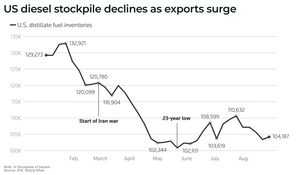
US commercial crude inventories fell 3.3 million barrels to 441.7 million barrels, while distillate stocks fell 2.1 million barrels to 100.8 million barrels, about 11% below the five-year average. That matters because distillates are the diesel-heavy part of the barrel.
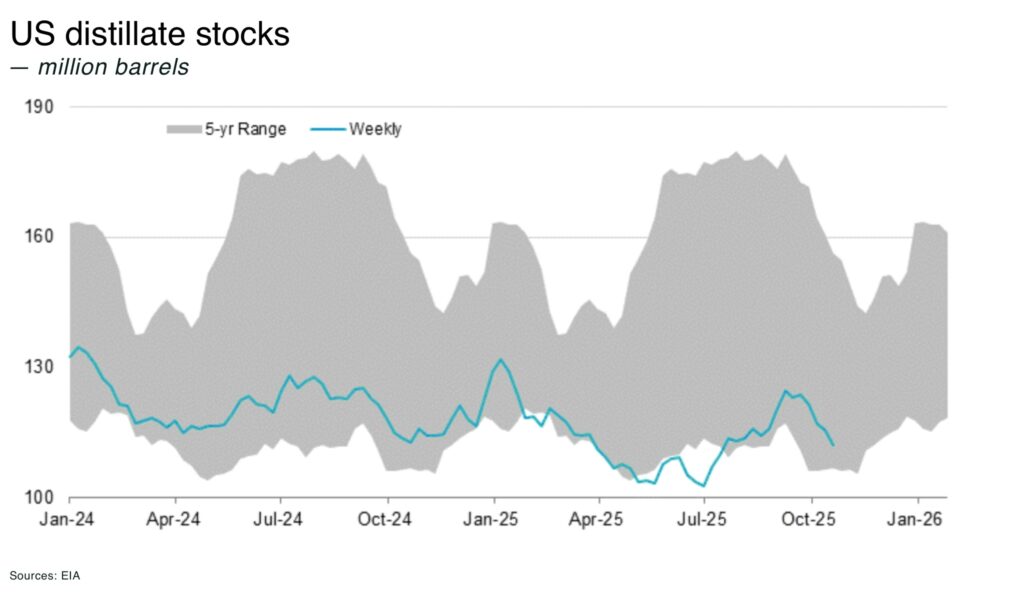
The product market is tightening too. US gasoline inventories fell 2.6 million barrels last week and are 6% below the five-year average. Distillate inventories, which include diesel and heating oil, fell 2.1 million barrels and are 11% below the five-year average.
BMO estimates every 10% rise in oil prices lifts mining costs by about 4.2% for iron ore, 3.5% for copper and 2% for gold. Fortescue has said every 10-cent move in diesel prices affects the company by US$70 million, while the top four iron ore miners face roughly US$500 million in cost impact.
Brent futures, supported by the drawdowns, the futures market and reports of a possible US-Iran ceasefire, have fallen below $100 a barrel. But the massive drawdowns from global reserves suggests, whatever is happening with price, the risk is shifting from oil prices to fuel availability.
SPR drawdowns are now doing what tanker traffic cannot: buying time, but they do not create new diesel.
That is the key market shift. The crisis is moving from price volatility to inventory scarcity.
The Operational Minimum problem
Oil markets do not need inventories to hit zero to break.
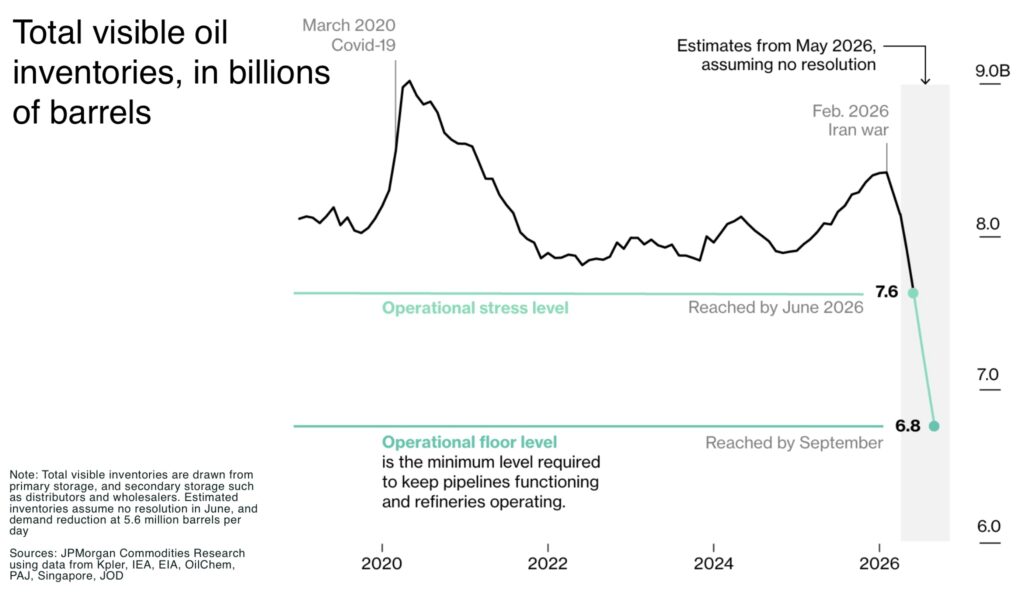
JPMorgan has framed the issue as an “operational minimum” problem: the world can hold billions of barrels on paper, but only a smaller share is practically available without causing refinery, pipeline, shipping or storage stress. So, for example, of about 8.4 billion barrels in global oil inventories at the start of 2026, only around 0.8 billion barrels were realistically available before the system moves into operational stress.
That is why the drawdown matters more than the absolute stock number.
HFI Research has made a similar point in the US refined-products market, estimating that gasoline and distillate stocks are only about 9 million barrels above a “paycheck-to-paycheck” threshold, where even a minor refinery outage, pipeline disruption or demand spike could create visible shortages.
The IEA’s May report supports the broader concern. It says global refinery throughputs are forecast to fall by 4.5 million barrels per day in the second quarter, while record middle distillate cracks are supporting refining margins.
This is exactly where mining is exposed.
What the oil and diesel supply shock means for mining
For miners, the issue is not just crude oil. It is diesel.
As we wrote in Strait of Hormuz diesel shock threatens mining industry, diesel powers haul trucks, generators, rail, port logistics, contractors and the supply chain between ore and revenue.
BMO estimates every 10% rise in oil prices lifts mining costs by about 4.2% for iron ore, 3.5% for copper and 2% for gold. Fortescue has said every 10-cent move in diesel prices affects the company by US$70 million, while the top four iron ore miners face roughly US$500 million in cost impact.
The risk is sharper for remote mines.
Iron ore, copper, gold, uranium and critical minerals projects in diesel-heavy jurisdictions often rely on long road hauls, fly-in/fly-out labour, imported fuel, contractor fleets and off-grid power. If diesel inventories tighten, the problem is no longer only margin compression. It becomes operational reliability.
That matters for Canada, Australia, Latin America and parts of Africa, where mine economics can depend on long fuel supply chains as much as ore grade.
The same logic applies downstream, particular as other critical minerals — such as sulphur — are also blocked by the closure of the Strait. Mineral processors in countries with secure refining capacity, fuel storage and emergency energy policy are better positioned than processors exposed to imported diesel or disrupted shipping lanes.
Conclusion
Even if the Strait of Hormuz were to open tomorrow (it won’t), it will take months for the backlog to clear, infrastructure to be repaired and tankers to risk in quantity returning to the Strait.
In fact, full oil transit flows through the Strait of Hormuz are unlikely to recover before the first half of 2027, according to Sultan Ahmed Al Jaber, CEO of ADNOC.
The market is still debating whether the war premium is fading. Mining should be asking a different question: how much of the fuel system’s safety margin has already been spent. Any additional risk, whether local or global with refining and logistics may mean the difference between significant premiums or compelte shutdown.
Q&A
Why are oil drawdowns important for mining?
Oil drawdowns matter for mining because diesel is a major operating input. Falling crude and distillate inventories can raise fuel costs and create supply risk for remote mines, contractors and logistics chains.
How low is the US Strategic Petroleum Reserve?
The US Strategic Petroleum Reserve fell to 365.1 million barrels in the week ending May 22, 2026, down 9.1 million barrels from the prior week.
What did Exxon say about oil inventories?
ExxonMobil Senior Vice President Neil Chapman warned that inventories are approaching unusually low levels, with models pointing to Dated Brent at US$150-US$160 if minimum inventory levels are reached.
Why does China matter to the oil drawdown story?
China matters because EIA estimates it held nearly 1.4 billion barrels of strategic oil inventories at the end of 2025. If China is drawing inventories rather than truly reducing demand, the global oil market may be tighter than headline import data suggest.
Which mining companies are most exposed?
The most exposed miners are diesel-heavy operations with remote locations, long logistics chains, imported fuel dependence and limited grid power. Mines with electrified fleets, hydro or grid power, shorter transport routes and strong fuel hedges are better positioned.