
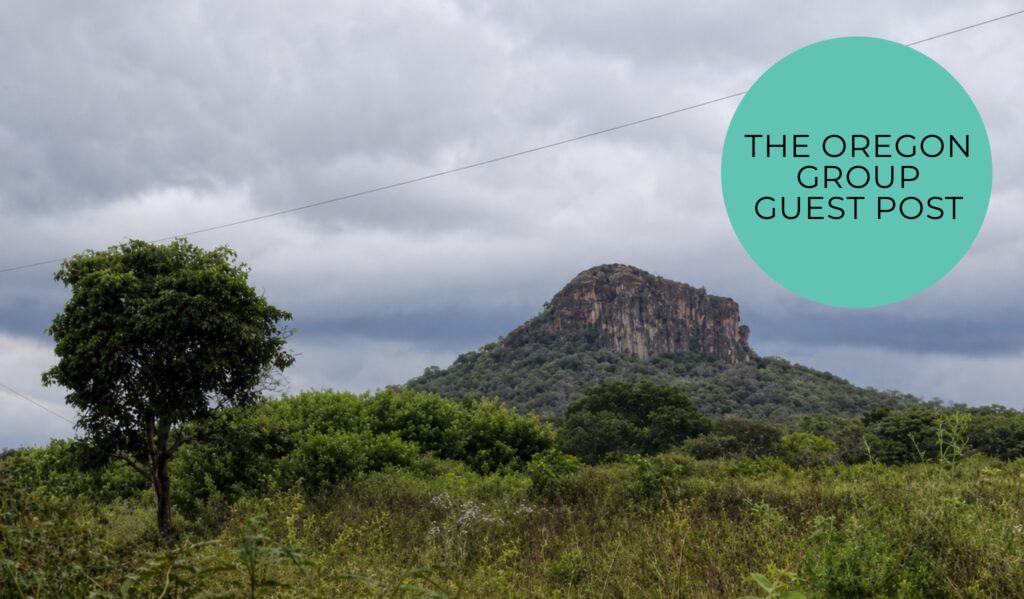
FROM EXPLORATION TO OPPORTUNITY, an executive feature with Stephen Goodman, CEO and DIrector
The new nickel imperative
“The next generation of critical mineral supply won’t be defined simply by what is discovered. Increasingly, it will be defined by where those resources are located, how responsibly they can be produced, and whether they can support increasingly secure global supply chains.”
For much of the past decade, discussions surrounding critical minerals have been dominated by one narrative: the global transition to electric vehicles. Nickel, copper, cobalt, lithium and graphite became synonymous with battery manufacturing, and investment capital flowed rapidly into companies seeking to supply what many anticipated would be an unprecedented surge in demand.
Today, however, the conversation has become considerably more nuanced.
While electrification remains an important long-term demand driver, governments and industry leaders are increasingly viewing critical minerals through a broader strategic lens. Energy security, industrial resilience, defence applications, supply chain diversification, environmental regulation and supportive government policy, have all emerged as important considerations. The question is no longer simply whether the world needs more nickel, it is where that nickel will come from, how it will be produced and whether it can be supplied from jurisdictions capable of supporting reliable, long-term investment.
This broader shift is reflected across the global mining industry. PwC’s latest Mine report examines how changing commodity demand, geopolitical uncertainty, capital allocation and the growing strategic importance of critical minerals are reshaping the sector and the decisions facing mining companies and investors.
That shift is changing the way investors evaluate mining projects.
Rather than focusing solely on grade or exploration upside, greater attention is being paid to jurisdictional stability, efficient permitting pathways, infrastructure, metallurgical characteristics and carbon intensity. In other words, projects are increasingly assessed not just for what they contain beneath the surface, but for their ability to become economically and socially sustainable mining operations over time.
Nickel occupies a particularly interesting position within that discussion.
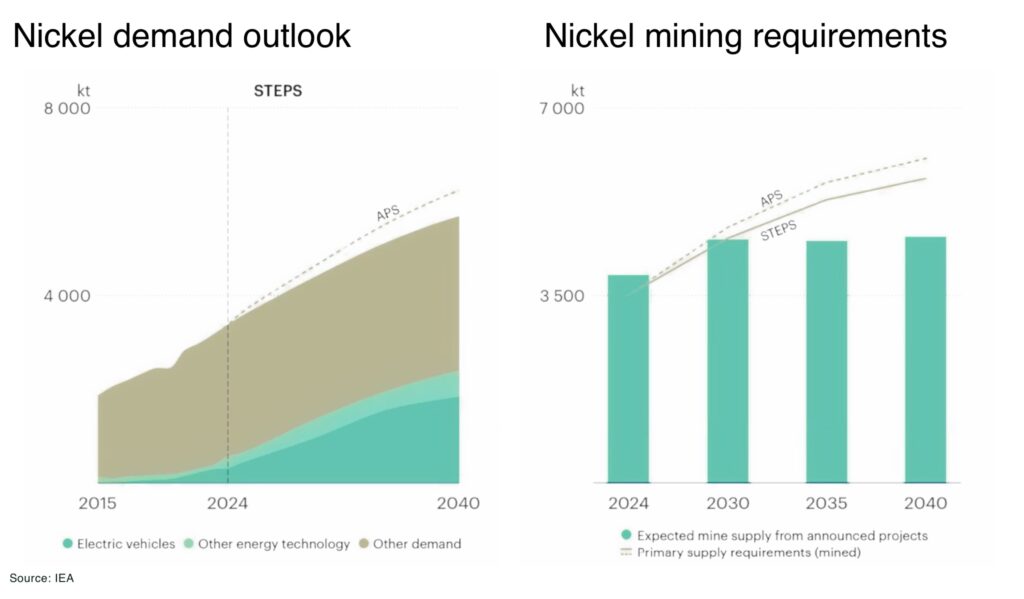
Although battery demand continues to attract significant attention, nickel remains fundamentally an industrial metal. Stainless steel production still accounts for the majority of global consumption, while demand from aerospace, advanced manufacturing, energy infrastructure and defence applications continues to expand. At the same time, high-nickel battery chemistries remain an important component of many electric vehicle platforms, reinforcing nickel’s role as a metal with multiple long-term demand drivers rather than dependence on a single end market.
Recent market performance also points to renewed momentum in nickel. Jefferies’ August 2026 Metals, Mining & Transition Materials Monthly Statement reported LME nickel at approximately US$17,064 per tonne at the end of July, up 6% over the month and 16% over the preceding 12 months.
Yet supply remains increasingly complex.
Much of the world’s recent nickel production growth has originated from laterite deposits processed through energy-intensive operations. While these projects have expanded global supply, they have also intensified discussions around environmental performance, carbon emissions and the long-term sustainability of various processing routes. Nickel sulphide deposits present a different technical proposition. As the Nickel Institute notes, sulphide ores can generally be upgraded at the mine site into a nickel concentrate and may also contain valuable associated metals including copper, cobalt, platinum and palladium.
This issue is particularly relevant for nickel. The International Energy Agency has highlighted the increasing geographic concentration of global nickel supply, with the share of mined production from the three largest producing countries projected to rise significantly over the coming decade. The result is a market that may appear adequately supplied in aggregate, while remaining increasingly exposed to geographic concentration and potential supply disruptions.
For junior mining companies, this changing landscape presents both opportunity and responsibility.
The opportunity lies in identifying and advancing projects capable of meeting future supply requirements. The responsibility lies in demonstrating that those projects possess the technical characteristics necessary to justify continued investment. Increasingly, exploration success alone is no longer sufficient. Investors want to understand metallurgy. They want to understand infrastructure. They want to understand permitting, logistics and access to power. In short, they are looking for projects capable of progressing beyond discovery toward long-term value creation.
Few jurisdictions illustrate this evolution more clearly than Brazil.
Traditionally recognised for its world-class iron ore, gold and base metal industries, Brazil has steadily strengthened its position within the global critical minerals landscape. The country combines extensive geological potential with established mining legislation, experienced technical expertise and significant industrial infrastructure. In many regions, access to renewable hydroelectric and wind-generated power further enhances its attractiveness as mining companies seek to reduce operational carbon intensity while maintaining competitive production costs.
Within Brazil, Bahia State has emerged as one of the country’s most significant mining regions. Home to a diversified mining industry and well-developed infrastructure, the state has attracted sustained investment across a range of commodities. Existing transportation networks, available power, skilled labour and supportive communities provide many of the practical advantages that can influence a project’s long-term viability. While no mining project is without technical, environmental or commercial challenges, jurisdictional strengths such as these increasingly form part of the investment equation.
It is within this broader context that Bahia Metals Corp. (CSE:BMT) (“Bahia Metals”) has begun establishing its presence.
Listed on the Canadian Securities Exchange earlier this year, the company is advancing its 100%-owned Mangueiros Project in Bahia State. Bahia Metals acquired a project that was advanced by a company related to Appian Capital. The extensive historical drilling, geophysical surveys and preliminary metallurgical work, provided management with a substantial technical foundation upon which to build.
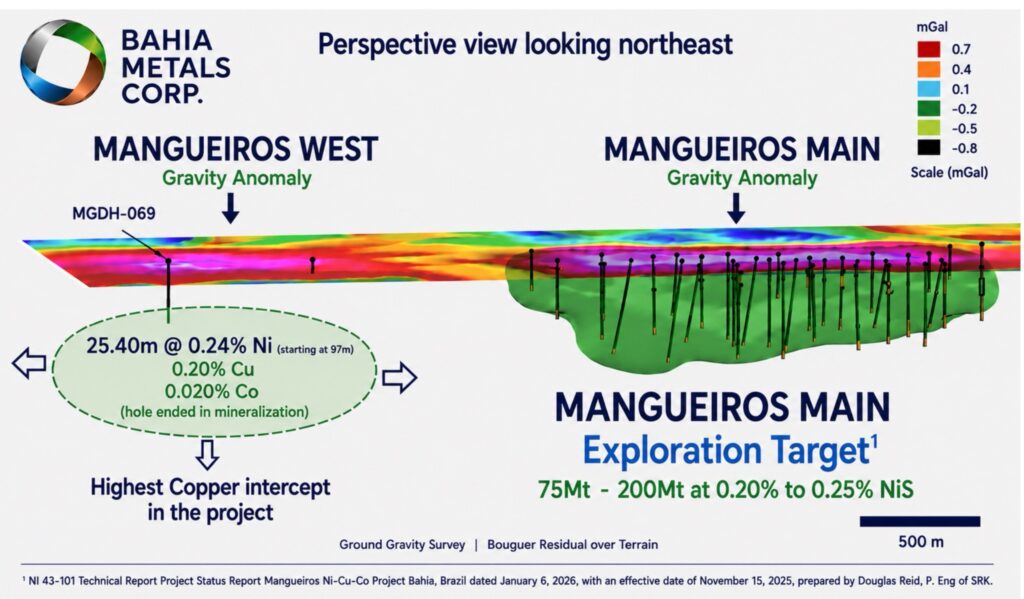
Recent internal technical reviews have reinforced the company’s confidence that its flagship asset, Mangueiros Main possesses many of the characteristics associated with an emerging nickel sulphide copper cobalt project of potential significance. Historical drilling has outlined mineralization across a strike length of approximately two kilometres, while an independent exploration target has highlighted the potential scale of the system of 75 MT to 200 MT. Beyond the flagship project, the priority nearby prospect, is Mangueiros West, located approximately 1 km away. Two other projects, Lagoa da Onça and Lagoa da Onça North, suggest the broader district may offer additional opportunities for growth as technical work continues. These developments have strengthened management’s view that Mangueiros should be evaluated not simply as a single prospect, but as part of a broader mineralized district with multiple avenues for advancement.
For Stephen Goodman, President, Chief Executive Officer and Director of Bahia Metals, the significance of the project extends beyond its geological potential.
Throughout his career, Goodman has evaluated mining opportunities across numerous jurisdictions and commodity cycles. His central question is basic, but fundamental to creating long term value. “Does the asset have a reasonable chance of becoming a producing mine.” Experience, he suggests, has taught him, enduring value is created through disciplined technical work, systematic risk reduction and consistent execution in a jurisdiction where efficiency in development, leading to production is possible.
That philosophy has become central to Bahia Metals strategy.
Management has adopted a deliberate approach focused on establishing an initial Mineral Resource Estimate on its flaghip asset Mangueiros Main, expanding technical confidence and advancing the project through clearly defined milestones. Each stage, Goodman believes, should contribute to a better understanding of the asset while progressively reducing the uncertainties that inevitably accompany mineral exploration.
It is an approach that reflects a broader evolution occurring across the mining industry itself. As capital becomes increasingly selective and strategic partnerships place greater emphasis on technical quality, companies are being challenged to demonstrate not only exploration potential, but also a credible pathway toward long-term project advancement.
Mangueiros Main has commenced this journey.
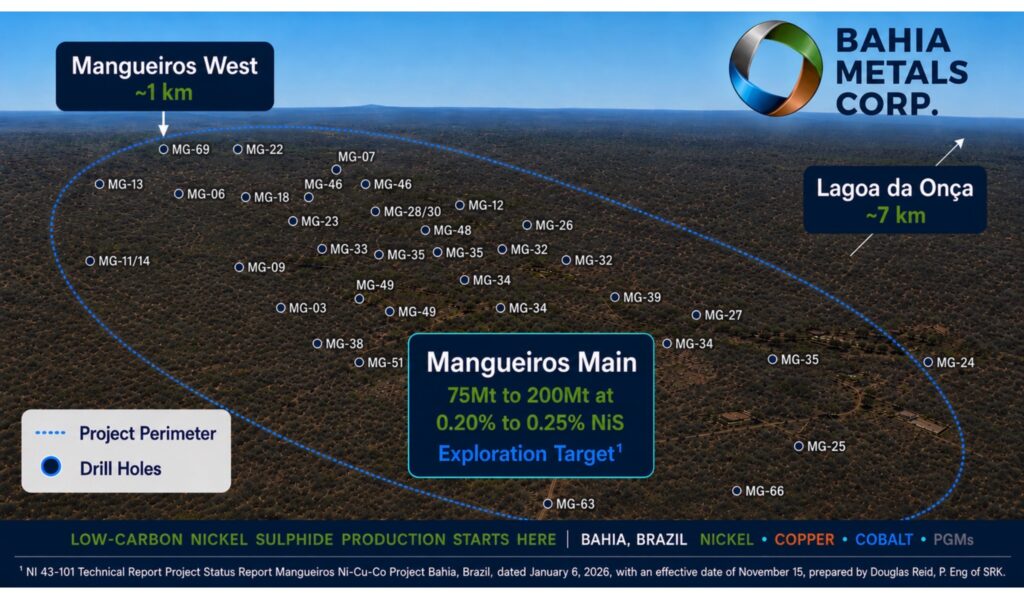
Whether it ultimately becomes one of Brazil’s next significant nickel sulphide operations remains to be determined through continued technical evaluation and disciplined execution. What is already evident, however, is that Bahia Metals is seeking to build its future on more than exploration optimism alone. The company’s ambition is to transform a substantial technical foundation into a project capable of earning confidence one milestone at a time continually assessing the development opportunity.
It was against this backdrop that we sat down with Stephen Goodman to discuss the origins of Bahia Metals, the opportunity he believes Mangueiros Main represents, and why the company sees itself as building far more than a single exploration project.
More than a discovery story
Why Bahia Metals believes technical confidence, not promotional headlines, creates lasting shareholder value.
From the outside, Bahia Metals could easily be mistaken for another newly listed junior exploration company pursuing the next critical minerals discovery.
The reality, according to Chief Executive Officer Stephen Goodman, is slightly different.
“We’ve never viewed Bahia Metals as a traditional exploration story,” he says early in our conversation. “Exploration will always remain important, but what attracted us to the asset, wasn’t simply the possibility of finding something. It was the amount of work that had already been completed before we arrived. And that we believed based, on several factors that the flagship asset had a reasonable chance of becoming a producing mine.”
That distinction becomes a recurring theme throughout the interview.
Rather than speaking primarily about discovery potential, Goodman repeatedly returns to his check list; asset size, geological formation, technical confidence, metallurgy, infrastructure, government policy, and a disciplined project advancement plan. It is a philosophy that reflects decades of experience evaluating, acquiring and financing mining opportunities across multiple commodity cycles and jurisdictions.
“The market naturally becomes excited about drill results,” he says. “And rightly so, discovery is the lifeblood of our industry. But ultimately, great mining projects are built by progressively reducing uncertainty. Every technical milestone should is data for the investment, development first priority.”
That measured perspective appears to underpin virtually every strategic decision Bahia Metals has made since acquiring the Mangueiros Project.
Unlike many exploration companies that begin with limited geological information and spend years establishing the fundamentals of a project, Bahia acquired an asset portfolio with a substantial technical foundation already in place. Historical ownership had completed approximately 12,800 metres of drilling across 86 holes, conducted geophysical survey. Combined with an independent technical report prepared by SRK, the project offered a depth of technical understanding that is uncommon among companies at a similar stage of corporate development.
For Goodman, that history immediately shaped the nature of the opportunity.
The amount of data provided a positive response to his central questions focused on development and production. Goodman stated that “Mangueiros Main was acquired with a target range large enough to consider a production profile should de-risking efforts have positive results.”
He is careful, however, not to overstate what that means.
“Historical work doesn’t eliminate risk,” he says. “Our responsibility is to verify, interpret and build upon that work using current standards and independent technical reviews. That’s exactly what we’re doing.”
That emphasis on validation rather than assumption has become one of Bahia Metals’ defining characteristics.
The Company has stated its objectives include reviewing the historical database, refining geological models and preparing for what management considers the project’s next major milestone: an independent NI 43-101 Mineral Resource Estimate on its flagship asset Mangueiros Main.
“The resource estimate is much more than a regulatory requirement,” Goodman explains. “It’s a foundation. Once you establish a well-supported mineral resource, you begin creating the framework for future engineering, metallurgy and economic studies. It gives both management and investors a much clearer understanding of where the project stands.”
That long-term view extends beyond Mangueiros Main itself.
While the flagship target naturally receives most of the market’s attention, Goodman repeatedly returns to the broader land package. Mangueiros West, located approximately one kilometre from the main deposit, has already demonstrated geological characteristics that management believes warrant continued evaluation. Additional prospects across the district, including Lagoa da Onça and Lagoa da Onça North, suggest that the mineralized system may extend well beyond the Company’s current primary focus.
It is a point he returns to several times.
“We’ve intentionally referred to Mangueiros as a district rather than simply a project,” he says. “Mangueiros Main is where we’re concentrating our efforts today because that’s the asset at this stage most likely to be developed into a mine. We also recognise that the broader district has considerable exploration potential. The opportunity may ultimately prove to be much larger than any single deposit.”
That distinction reflects an increasingly common evolution within successful mining camps around the world.
Many of today’s major mining districts did not emerge from a single discovery. Instead, they evolved over time as geological understanding improved, exploration expanded and additional deposits were identified around an original flagship asset. While Goodman is careful not to suggest that the Mangueiros portfolio will necessarily follow the same trajectory, he believes the broader geological setting justifies continued investigation.
Throughout the discussion, another theme consistently emerges: patience.
In a market where junior mining companies often face pressure to produce a steady stream of announcements, Goodman appears comfortable allowing technical work to dictate the pace of advancement.
“I’ve always believed credibility is built through execution,” he says. “Anyone can talk about what a project might become. Our responsibility is to demonstrate progress through measurable technical milestones. If we continue doing that, the market can make its own assessment.”
It is a philosophy that also explains Bahia Metals’ repeated references to what it calls a “Development and Production First” strategy.
Rather than viewing the Company solely as an exploration vehicle, management has consistently framed Mangueiros Main within the context of eventual mine development, recognizing, of course, that considerable technical work remains before such an outcome could be contemplated.
“We’re always asking ourselves one question,” Goodman says. “Does the work we’re doing today move the project closer to becoming a viable mining operation tomorrow? If the answer is yes, then we’re focusing our resources in the right place.”
As our conversation progresses, it becomes increasingly apparent that Bahia Metals Strategy is built upon a relatively simple premise.
Discovery creates opportunity.
Technical confidence creates value.
And this moves the assets closer to the ultimate goal of developing a producing mine
The challenge, Goodman believes, is transforming one into the other.
It is at this point in the discussion that we turn from the broader philosophy behind Bahia Metals to the project itself, beginning with the question that sits at the heart of the Company’s strategy: what first convinced management that the Mangueiros Project deserved to be financed and advanced?
Building confidence, one milestone at a time
Stephen Goodman discusses why Bahia Metals is focused on disciplined execution rather than short-term market excitement.
If there is one characteristic that distinguishes successful mining companies, it is their ability to consistently execute a technical strategy while navigating changing commodity markets, evolving regulations and shifting investor sentiment.
That philosophy appears deeply embedded within Bahia Metals.
Throughout our conversation, Stephen Goodman emphasizes that successful mining companies are built by reducing uncertainty.
Bahia Metals has deliberately centered its strategy on advancing the Mangueiros Project through a series of measurable technical milestones. It is a disciplined approach that reflects both the maturity of the underlying project and management’s view that long-term credibility is earned through technical execution.
With that in mind, our conversation turns to the origins of the Mangueiros Project itself.
“We Didn’t Need to Invent the Story. We Needed to Understand It.”
The Oregon Group: Stephen, every mining company has an origin story. What convinced you that Mangueiros Main was Project was worth acquiring, financing and building a company around?
Stephen Goodman:
When we first began evaluating Mangueiros Main, the amount of credible technical work that had already been completed immediately stood out.
Across the portfolio there was approximately 12,800 metres of historical drilling across 86 drill holes, detailed geophysical surveys, encouraging preliminary metallurgical testing and preliminary water and power studies. That represented a considerable investment in understanding the system before Bahia Metals even became involved.
To me, that changed the nature of the opportunity.
We were presented with a project that already possessed a substantial technical foundation. Our responsibility was to understand the work completed and, verify it according to NI 43-101 standards and determine how best to continue assessing the development opportunity.
Mining projects can create shareholder value by progressively answering technical questions. The more confidence you build in the geology, metallurgy and engineering, the better positioned you are to make informed decisions about the next stage of advancement.
The work completed by a credible vendor at Mangueiros provided Bahia Metals the opportunity to begin with a significant amount of risk potentially already removed
In the Oregon Group’s opinion, Goodman’s sentiment reflects an increasingly important shift occurring across the junior mining sector.
While grassroots discoveries will always remain essential to replenishing the industry’s project pipeline, investors have become noticeably more selective. Access to capital is increasingly influenced not only by exploration potential but also by a project’s ability to demonstrate technical credibility.
That evolution appears well aligned with Bahia Metals strategy.
Why the Initial Resource Matters
TOG: Investors often hear companies talk about delivering a maiden or initial mineral resource estimate. Why is that such an important milestone?
SG:
For Bahia Metals, the completion of an MRE on or flagship asset, that has an independent target of 75 MT to 200 MT provides will provide a certain level of validation.
And hopefully it will provide and information to establish the basis upon which future engineering studies can be undertaken.
For Bahia Metals, completing an independent Mineral Resource Estimate represents the logical next step in the evolution of Mangueiros Main.
Once we have established this foundation, we can determine the merits of continuing towards assessing the development potential of the project through further studies such as a preliminary economic assessment.
That’s why we’re placing so much emphasis on getting our MRE completed.
A Project with Room to Grow
While Mangueiros Main naturally remains Bahia Metals’ immediate priority, management appears equally interested in understanding the broader geological picture.
The Company’s recent technical review highlighted several additional targets across the property, reinforcing management’s view that Mangueiros should be considered within the context of an emerging mineral district rather than a single occurrence.
That perspective leads naturally to our next topic.
“Districts Create Long-Term Mining Companies.”
TOG: Your recent news release devoted considerable attention to Mangueiros West and the broader property portfolio. Why is that so important?
SG:
We are focused on building long term shareholder value. Mangueiros Main may become a development opportunity. And with that, a foundation for building out the district.
Our asset portfolio includes Mangueiros West, located only about one kilometre from Mangueiros Main, and displays many of the same geological and geophysical characteristics.
It is a priority to further evaluate the potential contribution this project could make to building long term sharholder value.
The Advantage Above Ground
Why jurisdiction, infrastructure and responsible production may prove just as important as geology in the next generation of nickel projects.
For decades, mining investment was often driven by one overriding question: How large is the deposit?
Today, that question is only the beginning.
Across the mining industry, investors have become increasingly sophisticated in how they evaluate projects. Grade and tonnage remain fundamental, but they are now considered alongside a broader range of factors that can ultimately determine whether a project advances successfully. Infrastructure, access to power, permitting frameworks, community relationships, metallurgy, logistics and environmental performance have become integral components of the investment equation.
In many respects, the industry’s definition of a quality asset has evolved.
A project located in a stable mining jurisdiction with established infrastructure and conventional processing characteristics may offer advantages that extend well beyond the geological model. As capital becomes more selective and downstream consumers place greater emphasis on supply chain transparency, these “above-ground” characteristics increasingly influence strategic investment decisions.
For Bahia Metals, those considerations form an important part of the Company’s long-term vision for the Mangueiros portfolio.
As our conversation continues, Stephen Goodman explains why the project’s location in Bahia State is not simply a geographic detail, it is one of the asset’s defining strengths.
“A Great Project Needs More Than Good Geology.”
The Oregon Group: Stephen, you’ve spoken frequently about the importance of Brazil and Bahia State. Can you expand on this?”
Stephen Goodman:
The investor activity in the mining sector in Brazil and specifically Bahia State suggests this a jurisdiction where efficient development and production is possible. To state the obvious, this is essential to building long term value for shareholders.
Bahia Metals benefits from supportive mining policy.
In addition, we are assessing the potential to operate a mine with 100% renewable power.
Goodman is careful not to portray jurisdiction as a guarantee of success. Instead, he views it as one of several variables that can reduce risk over the life of a project.
That measured perspective reflects a broader trend within the mining industry. Increasingly, institutional investors are looking beyond mineral inventories alone, recognizing that the path from exploration to production is shaped as much by practical execution as by geology.
The Strategic Importance of Brazil
Brazil’s position within the global mining industry continues to evolve.
Long recognized as one of the world’s leading producers of iron ore, bauxite and gold, the country has become an increasingly important participant in the critical minerals sector. Government initiatives, international investment and a growing emphasis on supply chain diversification have drawn renewed attention to Brazil’s potential to supply the raw materials needed for electrification, advanced manufacturing and energy security.
For nickel producers, Brazil offers another important advantage.
Many of the country’s mining regions benefit from established infrastructure and significant renewable electricity generation, providing an opportunity for companies to evaluate lower-carbon operating models as projects advance.
Goodman believes this changing landscape creates opportunities for companies prepared to think beyond the next drill program.
“Responsible Production Isn’t a Trend. It’s Becoming an Expectation.”
TOG: Bahia Metals has referred to a long-term vision of developing a low-carbon nickel operation. How does that objective influence the way you’re approaching the project today?
SG:
I think it’s important to distinguish between aspiration and execution.
Today, our focus remains on advancing the technical work required to better understand Mangueiros Main. That includes resource definition, metallurgy and the studies necessary to support future decision-making.
At the same time, we believe it’s important to consider what a future operation could look like.
Governments, investors and downstream customers are increasingly interested in understanding not only where metals come from, but how they are produced.
If opportunities exist to incorporate renewable energy, conventional sulphide processing and efficient infrastructure into a future operation, those are certainly considerations we want to understand this as early as possible.
Throughout the interview, Goodman consistently avoids presenting future concepts as predetermined outcomes. Instead, he frames them as strategic objectives that must ultimately be supported by technical studies, engineering and economics.
That measured approach lends credibility to Bahia Metals’ broader vision of positioning Mangueiros as a potential source of responsibly produced nickel sulphide copper and cobalt.
Looking Beyond the Next Drill Hole
Stephen Goodman on leadership, patience and building a company designed to endure.
By the time our conversation begins to draw to a close, it becomes clear Goodman is interested in defining the culture he hopes will shape Bahia Metals over the coming years.
Throughout the interview, he has returned repeatedly to his focus of efficiency in development leading to production. This is a theme that have guided the Company’s strategy since acquiring Mangueiros Project.
We asked Goodman to reflect not only on the next milestone for Bahia Metals, but on where he hopes the Company will stand several years from now.
“Every Milestone Should Reduce Risk.”
The Oregon Group: What is the next major catalyst for the company?
Stephen Goodman:
Our objective is to complete an independent NI 43-101 Mineral Resource Estimate for Mangueiros Main. We see that as a foundational step because it provides an independently verified understanding of the project’s mineral inventory and establishes the basis for future technical work.
Thinking Beyond a Single Deposit
While Mangueiros Main remains the Company’s immediate focus, Goodman is equally mindful of the broader opportunity represented by the surrounding district.
“We’ve consistently said that Mangueiros Main is our priority because that’s where the technical work is most advanced,” he explains. “But broader portfolio deserves attention.”
He points to Mangueiros West, being approximately 1 km away as examples of a potential opportunity to build out a larger sulphide nickel copper cobalt district.
A Company Assessing Development and Production Potential
The road ahead remains well defined.
Complete an independent Mineral Resource Estimate for Mangueiros Main as the basis for further assessment of the development and production opportunity. And continue to review the portfolio of assets with a focus on Mangueiros West.
Throughout our conversation, it was clear Goodman is focused on responsible development and production.
As governments, industry and investors seek secure, responsibly produced supplies of critical minerals, companies capable of combining geological potential with technical discipline may become increasingly important participants in the evolving resource landscape. Bahia Metals may have the potential to credibly warrant attention.
Authored by Mitchell Smith, a seasoned finance professional with over 15 years of entrepreneurship, executive leadership, and capital markets experience. In addition to his command in accessing capital markets he has extensive hands-on experience as a key stakeholder, management, and board member for private and public resource companies. Mitchell’s considerable board and executive leadership experience together with his extensive sectoral expertise in battery and energy technology has positioned him as a recognized global voice on critical mineral supply chain security.