
China has added MP Materials and USA Rare Earth to its export control list, restricting Chinese companies from supplying the two US rare earth firms with certain dual-use goods and technologies, putting two of America’s most important rare earth producers directly in Beijing’s sights.
China has added MP Materials and USA Rare Earth to its export control list, escalating the minerals and technology fight with Washington by restricting Chinese companies from supplying the two US rare earth firms with certain dual-use goods and technologies, and escalating the minerals and technology fight with Washington.
The move, announced Monday, adds 10 US entities to China’s export control list, including companies across rare earths, drones, robotics, aerospace and defence. Chinese companies and individuals are now barred from supplying the named firms with dual-use goods, a step Beijing said was needed to protect national security and meet non-proliferation obligations.
The list includes MP Materials operator of Mountain Pass in California — the only producing rare earth mine in the US and, last year, the company got a US$400 million equity investment from the Department of Defense. — and USA Rare Earth, which is developing a mine-to-magnet supply chain in Texas. Also named were Aveox, Red Cat Holdings, Teal Drones, IMSAR, Jaia Robotics, Ball Aerospace & Technologies, Oshkosh Defence and L3Harris Maritime Services.
China also restricted 46 US companies from government procurement, widening the retaliation after Washington expanded its own military-linked blacklist of Chinese companies.
A spokesperson for the Ministry of Commerce told the South China Morning Post, the decisions were made in response to “malicious actions” by the US government, after the US Department of Defence expanded the Pentagon’s 1260H list of Chinese tech companies it believes to be aiding the Chinese military.
The commercial impact may be limited in the near term. Several of the targeted US firms have little direct exposure to China. But the signal is bigger than the immediate disruption: Beijing is again showing it is prepared to use critical minerals supply chains as leverage in its fight with Washington.
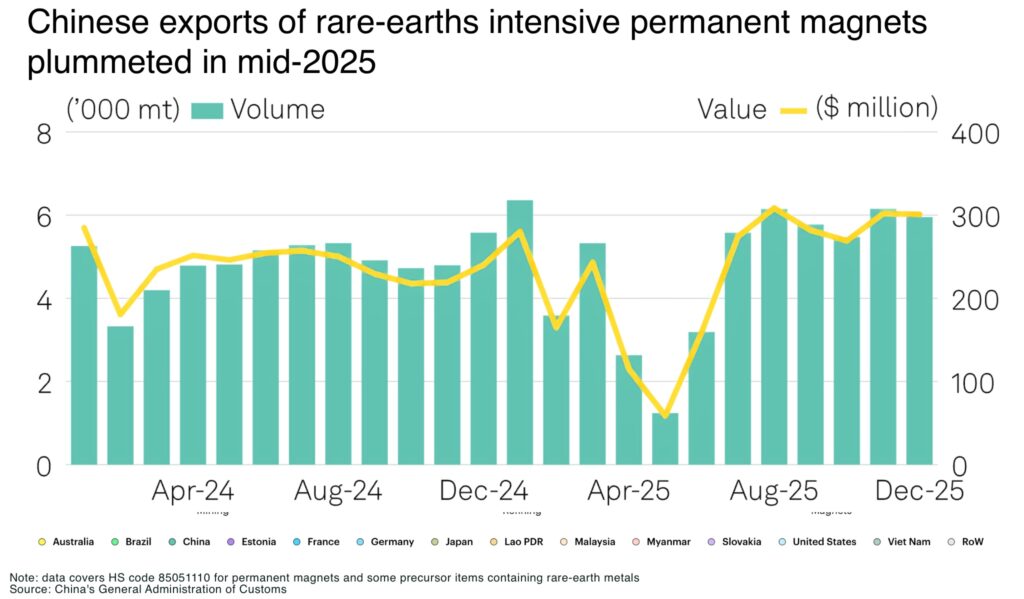
Rare Earth exports plunged 74.3% year over year to 1,239 mt in May 2025 in the immediate aftermath of US President Donald Trump’s country-specific tariffs. China’s global exports of less processed rare earths fell to 4,392 mt in December 2025, 15.8% below the 2025 monthly average of 5,215 mt. And, S&P Global warns in January that rare earth supply bottlenecks are expected to persistt hrough 2026.
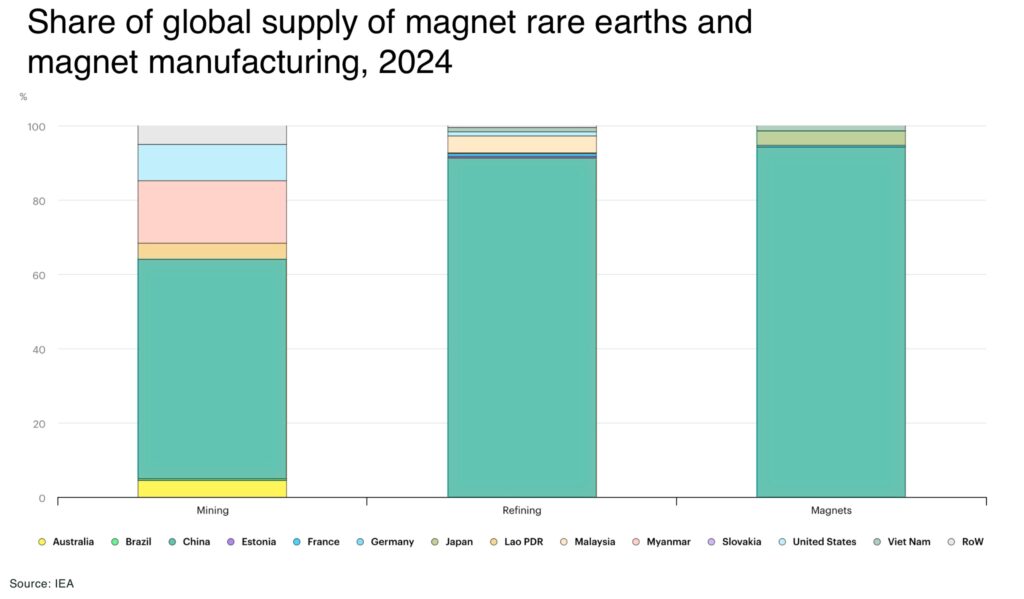
Rare earths are essential for high-performance magnets used in electric vehicles, wind turbines, drones, missiles, fighter jets and other advanced defence systems. China dominates rare earth processing and magnet production, giving Beijing influence over the parts of the supply chain the US is still trying to rebuild.
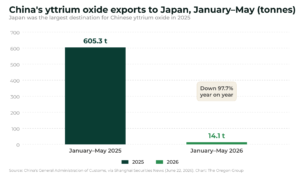
The latest restrictions follow a broader pattern. China tightened controls on several rare earth elements and permanent magnets in 2025, including materials used in defence, energy and automotive supply chains. Exports of some key magnet materials to Japan have already been constrained, showing how quickly licensing rules can become a geopolitical tool.
Washington has spent years trying to rebuild domestic critical mineral supply chains. Beijing’s latest move shows why that effort is accelerating — and why rare earth mining, processing and magnet capacity outside China are becoming central to the next phase of the US-China rivalry.