
- the US nuclear timeline now includes having three advanced reactor projects to criticality by July 4, 2026, as well as having 400 GW of nuclear capacity by 2050
- Antares Nuclear’s Mark-0 reached zero-power criticality at Idaho National Laboratory on June 4, 2026, making the first pilot deadline look feasible
- the Department of Energy’s “Nuclear Dominance — 3 by 33” campaign aims to rebuild milling, conversion, enrichment, fabrication, recycling and reprocessing by 2033, or 7 years
- US reactor owners loaded 50.6 million pounds U3O8e into fuel assemblies in 2024, while domestic mine output remains only a fraction of current reactor demand
Washington has put the nuclear industry on the clock: advanced reactors starting up by 2026, new large reactors under construction by 2030, a rebuilt fuel cycle by 2033, even a nuclear-powered military base by 2028 (not to mention the nuclear powered battleships in the 2030s).
The question is: can secure uranium supply move fast enough to be ready in time?
And the schedule is already moving: on June 4 2026, the US Department of Energy (DoE) Reactor Pilot Program, Antares Nuclear’s advanced reactor design, the Mark-0, successfully completed a zero-power fueled criticality demonstration.
The challenge by the DoE pilot program was to bring at least three advanced reactor designs to criticality by July 4, 2026 — forcing an advanced reactor milestone into months, not decades.
“We are witnessing a historic moment for American energy,” said US Energy Secretary Chris Wright. “For the first time in more than four decades, a new privately developed non-light-water reactor has reached criticality in the United States.”
That puts real pressure on a uranium mining industry where new uranium mines can take 10 to 20 years to move from discovery to production.
The US nuclear deadline stack
| Deadline | Target |
| July 4, 2026 | DoE wants at least three advanced reactors outside national labs to reach criticality under the Reactor Pilot Program |
| November 2026 | NRC must finish rule and guidance revisions, including fixed deadlines of no more than 18 months for new reactor decisions |
| Late 2027 | DoE-site advanced reactors should be operating within 30 months of the May 2025 order |
| January 1, 2028 | Russian uranium import waivers end under the Prohibiting Russian Uranium Imports Act |
| September 30, 2028 | The army must begin operating a nuclear reactor at a domestic military installation under the national security reactor order |
| 2030 | DoE is directed to support 5 GW of uprates and 10 new large reactors under construction |
| 2033 | DoE’s DPA consortium wants a secure domestic fuel cycle under Nuclear Dominance — 3 by 33 |
| 2050 | US policy targets 400 GW of nuclear capacity, up from roughly 100 GW in 2024 |
The schedule
The strongest progress, so far, is in test reactors and enrichment funding. The DoE selected 11 Reactor Pilot Program projects, including Antares, Oklo, Radiant, Valar and Terrestrial Energy. Antares then became the first to reach advanced reactor criticality, validating at least part of the accelerated DoE pathway.
On the nuclear fuel cycle, the DoE has moved from rhetoric to money, awarded, in January 2026, US$2.7 billion over 10 years to American Centrifuge Operating, General Matter and Orano Federal Services for LEU and HALEU enrichment services. This matters because the US still depends heavily on foreign enrichment – in 2024, 81% of enrichment services purchased by US reactor owners were foreign-origin, including 20% from Russia.
The “3 by 33” campaign has been launched and includes more than 90 companies across the nuclear industrial base.
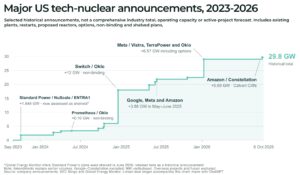
And the reactor schedule is no longer theoretical. Palisades, Three Mile Island and Duane Arnold have all moved from closed-plant history into restart pipelines, while Diablo Canyon has been kept alive with federal support.
| Project / funding | Timeline hook |
| Palisades, Michigan | Holtec is trying to restart the 800 MW plant after it shut in 2022; DOE backed it with a US$1.5 billion loan, while NRC says the plant still has to restore its licensing basis and prove systems are ready for safe operation under the Palisades restart review. |
| Three Mile Island Unit 1 / Crane Clean Energy Center | Constellation plans to restart the 835 MW unit by 2028 under a 20-year Microsoft power deal, with DOE later approving a US$1 billion loan. |
| Duane Arnold, Iowa | NextEra and Google are pursuing a restart of the 615 MW plant for 2029, tied to a 25-year power agreement, according to reports on the Duane Arnold restart. |
| Diablo Canyon, California | Not a restart, but a life-extension case: DOE finalized US$1.1 billion to keep Diablo Canyon operating to at least 2030. |
| Domestic enrichment funding | DOE awarded US$2.7 billion over 10 years to American Centrifuge Operating, General Matter and Orano Federal Services for LEU and HALEU enrichment. |
The tension is certainly not over political ambition. Instead, it is industrial sequencing, as the list of required work is huge: mining, building, milling, conversion, enrichment, deconversion, fabrication, recycling and reprocessing.
How is the US uranium supply timeline progressing?
On the mining side, the rebound is real but still significantly small.
US uranium mines produced 677,000 pounds of U3O8 in 2024, up from just 50,000 pounds in 2023. By the fourth quarter of 2025, quarterly US uranium concentrate production had risen to 1.04 million pounds U3O8, with output from seven facilities across Wyoming, Texas, Utah and Nebraska.
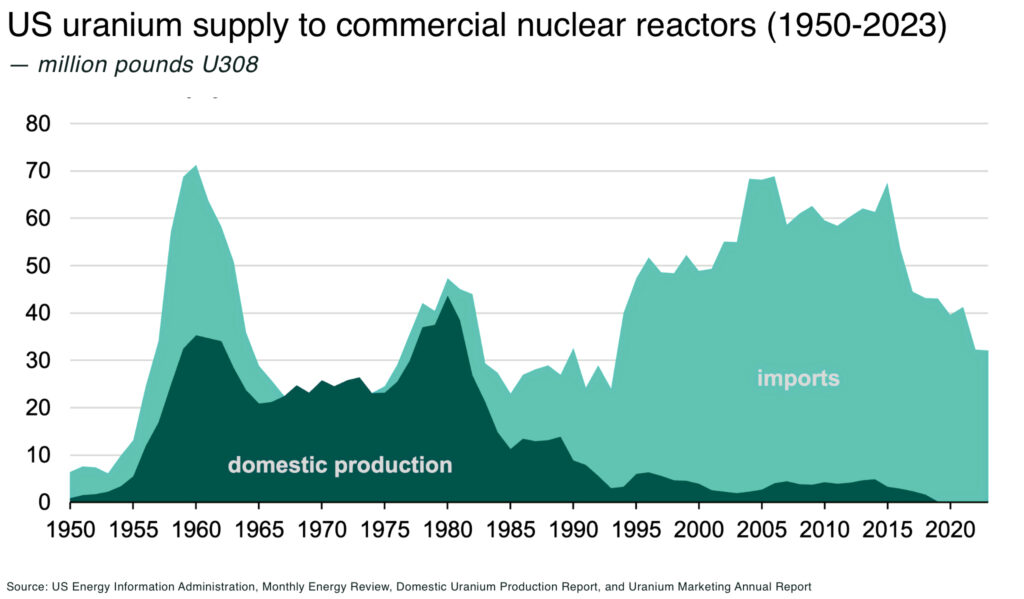
That’s progress, but a long way from national fuel security as US reactor owners purchased 55.9 million pounds U3O8e for 2024 delivery — and this demand reflects the existing fleet, before a full wave of new reactors, restarts and uprates.
The downstream fuel chain is also moving — at least on paper — in January 2026, the DoE awarded US$2.7 billion over 10 years to American Centrifuge Operating, General Matter and Orano Federal Services to rebuild domestic LEU and HALEU enrichment capacity.
The problem is the US bought 81% of its enrichment services from foreign suppliers in 2024, including 20% from Russia. Waivers under the Russian uranium import ban must terminate by January 1, 2028. This deadline gives Washington less than two years to replace a major piece of the enrichment supply chain before the waiver window closes.
“The US nuclear buildout is no longer just an energy story. It is a fuel security story. Reactor demand is rising at the same time the West is trying to reduce dependence on foreign enrichment, fragile supply chains and unstable jurisdictions. If the US wants nuclear power to deliver reliable baseload electricity for AI, industry and the grid, it needs secure uranium supply in place before the reactors arrive.
F3 is focused on that front end of the fuel cycle. Our Patterson Lake North project is in Saskatchewan’s Athabasca Basin, one of the world’s leading high-grade uranium districts, and we believe new Western uranium discoveries will be essential if North America is serious about rebuilding long-term nuclear fuel security”
— Dev Randhawa, CEO and Chairman, F3 Uranium (TSXV: FUU, OTCQB: FUUFF)
What is the uranium squeeze timeline?
The uranium demand timeline starts before the reactor timeline.
- the first squeeze is expected 2026-2028 as existing reactors still need reloads, Russian LEU waivers expire by 2028, and advanced reactor developers need HALEU or specialized fuel forms. The White House has ordered the DoE to release at least 20 metric tonnes of HALEU for qualifying DOE-site projects, but that is a bridge, not a full commercial supply chain
- the second squeeze is 2028-2033 if military microreactors, DOE-site reactors, restarts and uprates arrive on schedule
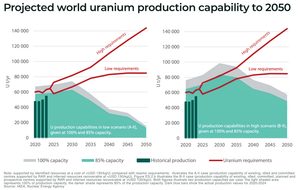
- the third squeeze is 2035-2040. Global reactor buildout is competing for the same uranium, conversion and enrichment capacity. The World Nuclear Association’s nuclear fuel outlook points to sharply rising uranium requirements by 2040, just as older mines face depletion risk
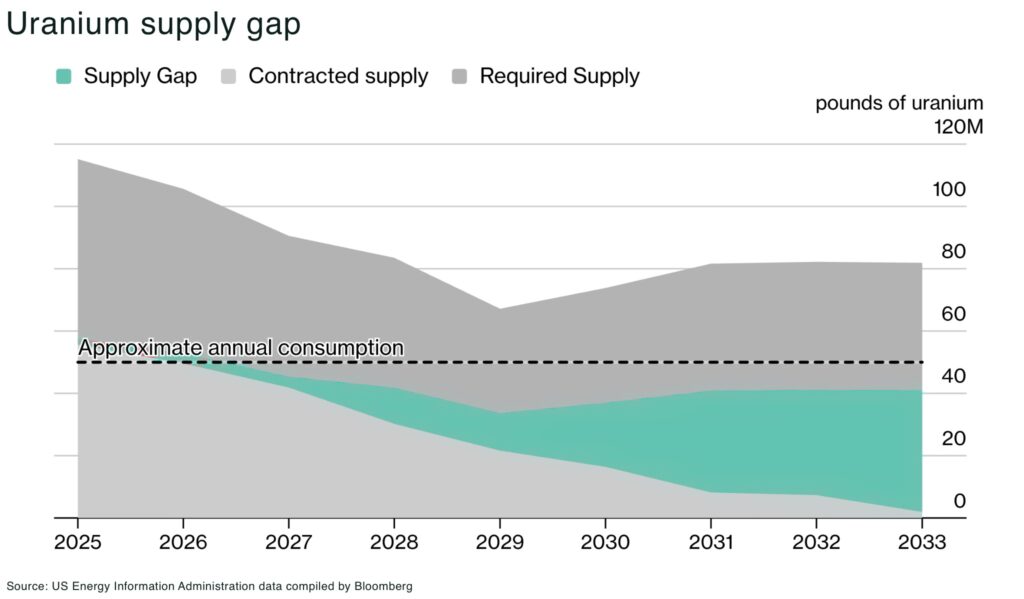
Importantly, uranium is normally contracted long before use, then has to move through conversion, enrichment and fuel fabrication before it becomes reactor-ready fuel — in other words, the uranium supply must be ready before any reactors are turned on.
There is no exact timeline, but it’s, on average, at least three years ahead (91% of US reactor uranium delivered in 2024 came under long-term contracts, and most uranium trade is through 3-15 year term contracts). Also, a new reactor also needs a larger first core: roughly 300-450 tonnes of uranium per GWe, versus about 150 tonnes per year after that.
This is where Nuclear Dominance by 2033 becomes more than a slogan. It is an offtake clock, and the strategic point is simple: America can miss a reactor deadline and still recover. But if it misses the fuel-cycle deadline, the reactors become stranded policy.
Conclusion
As the successful test of the Antares Nuclear’s advanced reactor design highlights — America’s nuclear renaissance is already being tested and built. But all of the pledged infrastructure is worthless without the fuel to run it. That is why uranium is shifting from a spot-price story to a logistics story.
And time is already running out.
Q&A
What is the US nuclear timeline?
The US nuclear timeline includes three pilot reactors by July 4, 2026, a military reactor by September 30, 2028, 10 large reactors under construction by 2030, fuel-chain security by 2033, and 400 GW by 2050.
Is the US on track for its 2026 reactor deadline?
Partly. Antares Nuclear reached zero-power criticality on June 4, 2026, but DOE’s target is at least three advanced reactors by July 4, 2026.
Why does uranium supply matter before reactors are built?
Fuel has to be mined, converted, enriched, fabricated and qualified before reactors operate. US reactor owners already loaded 50.6 million pounds U3O8e into fuel assemblies in 2024, before the next wave of advanced reactors.
What is Nuclear Dominance 3 by 33?
Nuclear Dominance 3 by 33 is DOE’s campaign to secure the domestic nuclear fuel cycle, accelerate advanced reactor deployment and align workforce, finance and innovation by 2033.