
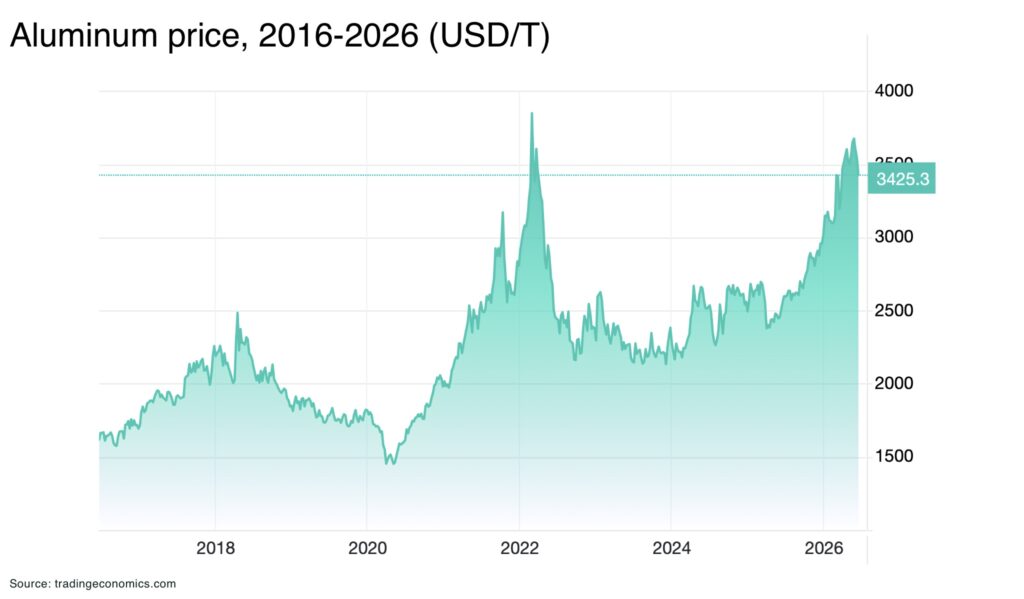
- the aluminium energy war is already visible in prices: the LME aluminium benchmark hit US$3,707.50 per tonne on June 1, a four-year high, as Middle East supply risk escalated
- the biggest producers have little spare room: China produced 45 million tonnes of primary aluminium in 2025 against 45 million tonnes of capacity, while Canada produced 3.3 million tonnes against 3.31 million tonnes of capacity
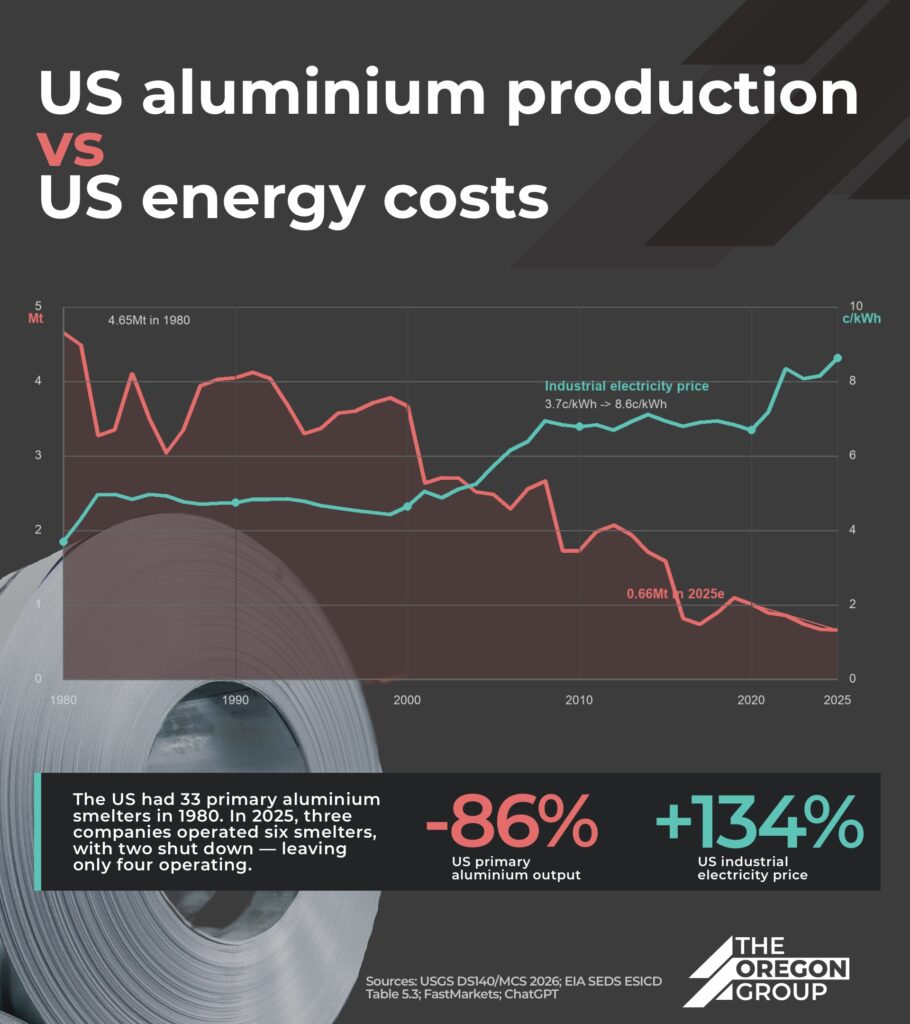
- the US is exposed: domestic primary aluminium output was just 660,000 tonnes in 2025, net import reliance reached 60%, and Canada supplied 56% of US aluminium import sources over 2021-24
Aluminium is no longer just a base metal. It is becoming the first hard test of America’s energy war.
The US needs aluminium to build the grid, data centers, vehicles, weapons systems and factories behind reindustrialisation. But aluminium smelting itself needs vast amounts of cheap, reliable electricity.
That is the squeeze: the metal needed to build America’s next energy system is also competing against other priorities for energy, pushing up prices.
That squeeze has been building for decades. The US had 33 primary aluminium smelters in 1980; today, only four remain operating. But the Middle East war — with disruptions potentially removing 3–3.5 million tonnes from the global market — has turned a slow industrial decline into an urgent supply shock.
The LME benchmark hit US$3,707.50 per tonne on June 1, while China, India and Canada are all producing near stated capacity. The US, meanwhile, has become heavily dependent on imports.
“The Strait of Hormuz is effectively a chokepoint for the global aluminium market. Disruptions here could cut off up to 60% of alumina supply to Middle Eastern smelters, rapidly deepening the market deficit” — said Charvi Trivedi, principal analyst, at Wood Mackenzie.
This puts aluminium at the front of America’s energy war.
Aluminium’s supply shock is concentrated
Aluminium is not geologically scarce. Global bauxite resources are estimated at 55 billion to 75 billion tonnes, enough to meet aluminium demand well into the future projected demand.
The bottleneck is smelting. Primary aluminium needs power, stable logistics and secure industrial infrastructure — and those are exactly the pressure points now under stress.
The immediate crisis point is the Gulf crisis:
- the UAE produced an estimated 2.7 million tonnes of primary aluminium in 2025, while Bahrain produced 1.6 million tonnes
- EGA’s Al Taweelah site in the UAE alone produced 1.6 million tonnes in 2025 — roughly half of Canada’s total 2025 primary aluminium output — before the company reported “significant damage” from Iranian missile and drone attacks
- Bahrain’s Alba smelter had already taken about 19% of its 1.6 million-tonne capacity offline and Qatalum had halted production, while Alba cut production because it could not ship metal through the Strait of Hormuz
- aluminium smelting is also extremely power-intensive, so any war premium in oil and gas also feeds into aluminium through power costs, not just freight
Output from affected smelters in the region is estimated at 3.445 million tonnes in 2026, down by around 44% from 6.151 million tonnes in 2025.
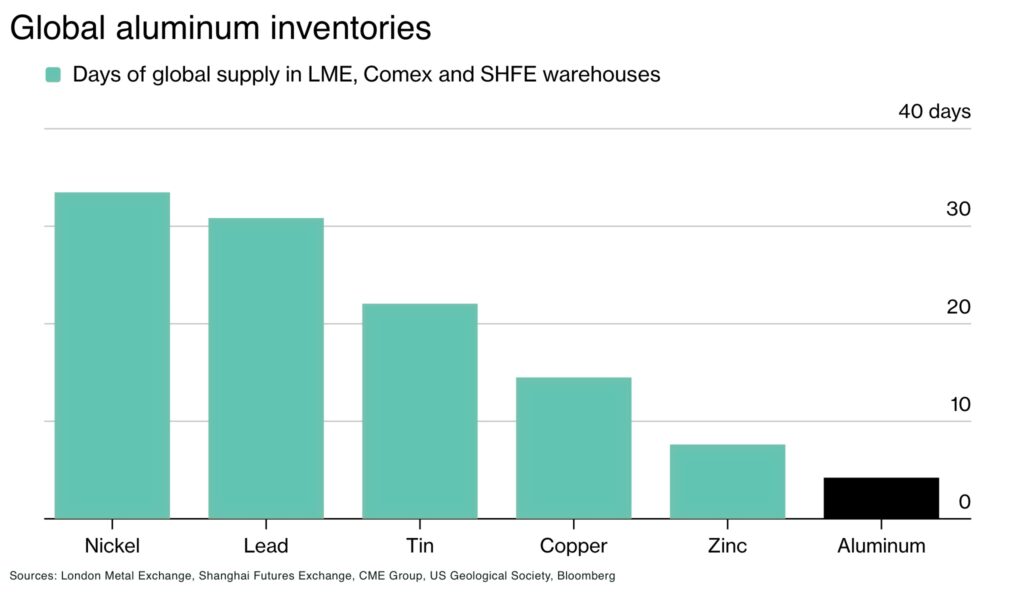
The problem is exacerbated as visible aluminium inventories fell to less than five days of global supply in June 2026, the lowest cover among the six main metals traded on the London Metal Exchange.
“Aluminium’s surge underscored how fragile supply chains have become, with the Hormuz disruption pushing spreads into historic backwardation” — Neil Welsh, Head of Metals, Britannia Global Markets
And no one else is able to step in as a swing producer:
China, the world’s largest aluminium supplier, has increased aluminium exports by 16% in May 2026 from the previous year, but only to an additional 630,000 tons; US domestic primary aluminium output was just 660,000 tonnes in 2025, net import reliance reached 60%, with new US smelter requiring around 11 TWh of electricity a year; Canada was almost as tight, producing 3.3 million tonnes against 3.31 million tonnes of capacity — with exports shifting from the USA to Europe; and, Russian-origin aluminium is restricted from major Western exchanges and derivatives trading, after the invasion of Ukraine in 2024.
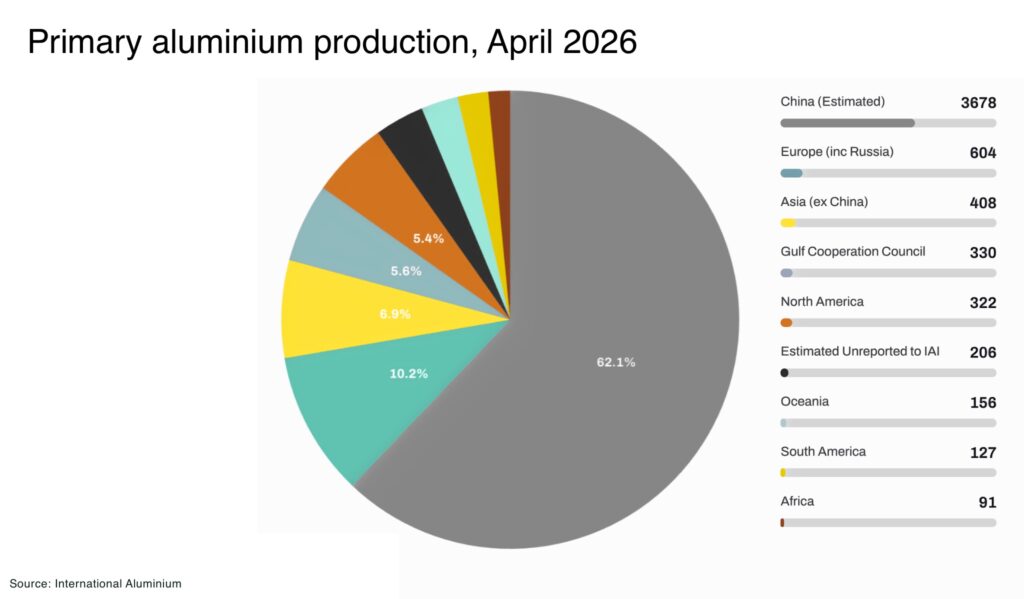
So, with inventories so low, global aluminium supply, especially in the West, has a very limited buffer — but, demand continues to rise.
The AI-grid link
US aluminium consumption went into transportation at 36%, packaging at 24%, building at 13% and electrical uses at 9% in 2025.
But, it’s not demand for “cans and cars” that is driving future growth and crushing margins — it’s the AI data center build out and electricifcation of the global economy, including:
- global data centre construction is forecast to consume more than 1 million tonnes annually of copper and aluminium by 2030, mostly for wiring, transmission, and substations
- by 2030, aluminium demand from electric vehicles (EVs) is expected to reach 10 million tonnes, a x10 increase from 2017
Data centres are, however, compounding the problem, with projections suggesting they will consume up to 6.7-12% of total US electricity by 2028. The problem: a single new aluminium smelter uses about 11 TWh of electricity. So, as artfical intelligence needs more energy infrastructure, energy infrastructure needs aluminium, but aluminium smelters compete with data centers for the same firm electricity.
Canada, Europe and the Energy War premium
Canada is not a classic swing producer, but Canada is increasingly acting as a swing supplier.
Canada produced 3.3 million tonnes of primary aluminium in 2025, almost exactly matching its 3.31 million tonnes of capacity. It cannot flood the market with new supply. Over 2021-24, Canada accounted for 56% of US aluminium import sources (which was net import reliant on 60% of its aluminium) — but that began to change in 2025-26.
Trump’s tariffs, including a 25% tariff on aluminium and aluminium derivative products in 2025, have created a US price wedge. US buyers pay the LME price plus the Midwest premium, which reflects transport, storage, financing and tariff costs. After the US doubled aluminium tariffs to 50% in June 2025, that premium had to rise to keep Canadian metal flowing south.
But Europe now has its own premium: security and carbon.
Canadian aluminium exports to Europe jumped 276% to more than 590,000 tonnes in 2025, while exports to the US fell 25% to around two million tonnes. The Iran war sharpened that shift, because Europe sources 14% of its aluminium imports from the Persian Gulf, making secure non-Gulf supply more valuable.
Then CBAM adds the second layer. The EU’s Carbon Border Adjustment Mechanism entered its definitive regime on January 1, 2026, and aluminium is one of the covered sectors. Importers must declare embedded emissions and buy certificates tied to the EU carbon price. This gives Canadian hydro-powered aluminium an advantage, with Canadian smelters benefiting from low-cost , clean hydroelectric power.
This is the clean energy-war premium.
Europe is not just bidding for aluminium tonnes. It is bidding for the clean, reliable electricity embedded inside those tonnes. Canadian aluminium helps Europe solve three problems at once: Gulf supply risk, Russian supply constraints and carbon compliance.
For the US, this adds to the strategic complications of competing priorities.
America’s smelter problem is an energy problem
The AI data centre build out is a national security priority in the US, but they demand huge amounts of energy to run.
Last year, a Bloomberg report found electricity costs increased 267% more for a single month than it did five years ago in areas located near significant data center activity. In the US, power demand from data centers is set to double by 2035, to almost 9% of all demand.
But these AI data centers needs aluminium to build, which, if you want to re-build domestic smelter production — as Trump’s tariff’s suggest — will, in turn, increase energy costs.
The industry warns electricity remains a decisive constraint as a new aluminium smelter needs a long-term power contract roughly equivalent to powering a city the size of Boston, while the Aluminum Association says a new smelter requires about US$5 billion and five years.
For example, in May 2025, Emirates Global Aluminium announced it was building a new, US$4 billion smelter in Oklahoma (partnered with Century Aluminum). The facility could require over 11 terawatt-hours of power and further development is unlikely to continue until a power agreement is in place.
“I think the government simply thought [the tariffs] would encourage additional smelting capacity to either re-open here or start back up again,” Lucy Winchel, international commodities trader Traxys Global’s director of aluminium, said at the Recycled Materials Association’s (ReMA) Roundtables in Chicago. “It’s not practical because you need assurances that the prices will stay at a certain level and also on the inputs, especially energy, which is a huge component to making aluminium.”
Conclusion
America wants to reindustrialise, build data centers, expand the grid, secure critical mineral supply and preserve geopolitical leverage in regions such as the Middle East. US Energy Secretary Chris Wright has described the AI-power challenge as the start of a new Manhattan Project.
Aluminium sits at the center of that project.
It is needed for transmission, vehicles, defence, factories and data-center infrastructure. But producing it requires huge amounts of reliable electricity, and the US has spent decades losing smelting capacity exactly because of energy costs.
This makes aluminium an early test of America’s energy — metals — AI strategy. Will the US choose secure metal supply or cheaper electricity prices?
The Trump tariff policies to shut out foreign aluminium imports are working just as domestic demand is rising and a the global supply crisis is acute.
Aluminium, whether the US government knows it or not, has become a test case for what gets prioritised — expensive domestic metals production that raise energy costs, or cheaper metals to reduce costs and speed up data center build out — AI power demand or industrial metal security.