
- F3 Uranium resource at JR Zone totals 11.801 million pounds U3O8 Indicated at 4.41% U3O8, including 10.788 million pounds at 12.23% U3O8
- estimate prepared by SLR International for F3’s NI 43-101 technical report, supporting third-party resource confidence
- F3 is now pairing JR Zone with exploration upside at Tetra, where 2026 drilling confirmed uranium mineralization in multiple step-out holes
- timing matters, with approx 80 nuclear reactors under construction and 120 planned worldwide, with nuclear energy generation hitting an all-time high in 2025
The Athabasca Basin is where investors go looking for exceptional uranium grades, and F3 Uranium (TSXV: FUU, OTCQB: FUUFF) has given them a number worth paying attention to: 10.8 million pounds of U3O8 grading 12.23% inside an 11.8 million pound Indicated resource.
To put this in context:
- the uranium in Canada’s Athabasca Basin are mostly in high-grade deposits, up to 100 times the world average, with McArthur River and Cigar Lake among the largest and highest-grade uranium mines in the world
- outside the Athabasca, many major sandstone uranium deposits are commonly low-to-medium grade at 0.05% to 0.35% uranium
F3 Uranium’s JR Zone looks less like a typical global uranium deposit and more like the kind of exceptional-grade system that makes the Athabasca famous.
This matters because uranium investors are not short of discovery stories, but are short of credible pounds in a market where primary mine supply covered only 90% of 2024 reactor requirements, leaving a deficit of 18 million pounds U3O8 before inventories and secondary supply.
And the world is currently building into that deficit, with at least 79 reactors under construction, 121 planned and 315 proposed (and Japan alone has 15 reactors restarted with 10 more in the restart approval process since Fukushima). Uranium requirements are projected to rise 86,000 tU by 2030 and 150,000 tU by 2040, just as current ore-grades are declining.
High-grade Indicated Resource
The word “Indicated” is not marketing language. It is a confidence category.
Most junior uranium stories start with a drill hole, but F3 Uranium now has something more valuable: an independently supported Indicated resource. That matters because uranium investors are not necessarily short of discovery stories, but they are short of credible pounds.
Under internationally recognized resource definitions followed by Canadian NI 43-101 reporting, an Indicated mineral resource has enough exploration, sampling and testing information to assume geological and grade continuity with reasonable confidence.
F3’s JR Zone resource is 121,259 tonnes grading 4.41% U3O8 for 11.801 million pounds U3O8, with the headline figure of 39,997 tonnes grading 12.23% U3O8 for 10.788 million pounds U3O8.
| JR Zone domain | Classification | Tonnes | Grade | Contained U3O8 |
| High-grade domain | Indicated | 39,997 | 12.23% U3O8 | 10.788 million lb |
| Low-grade domain | Indicated | 81,262 | 0.57% U3O8 | 1.031 million lb |
| Total JR Zone | Indicated | 121,259 | 4.41% U3O8 | 11.801 million lb |
That does not make JR Zone a reserve. F3 is explicit that mineral resources are not mineral reserves and do not have demonstrated economic viability. But for a junior explorer, it changes the conversation.
Canaccord Genuity has initiated coverage on F3 Uranium with a Buy rating and a CAD$0.30 target. Other broker targets are materially higher: SCP at CAD$0.70, Red Cloud at CAD$0.55, and Haywood at CAD$0.55.
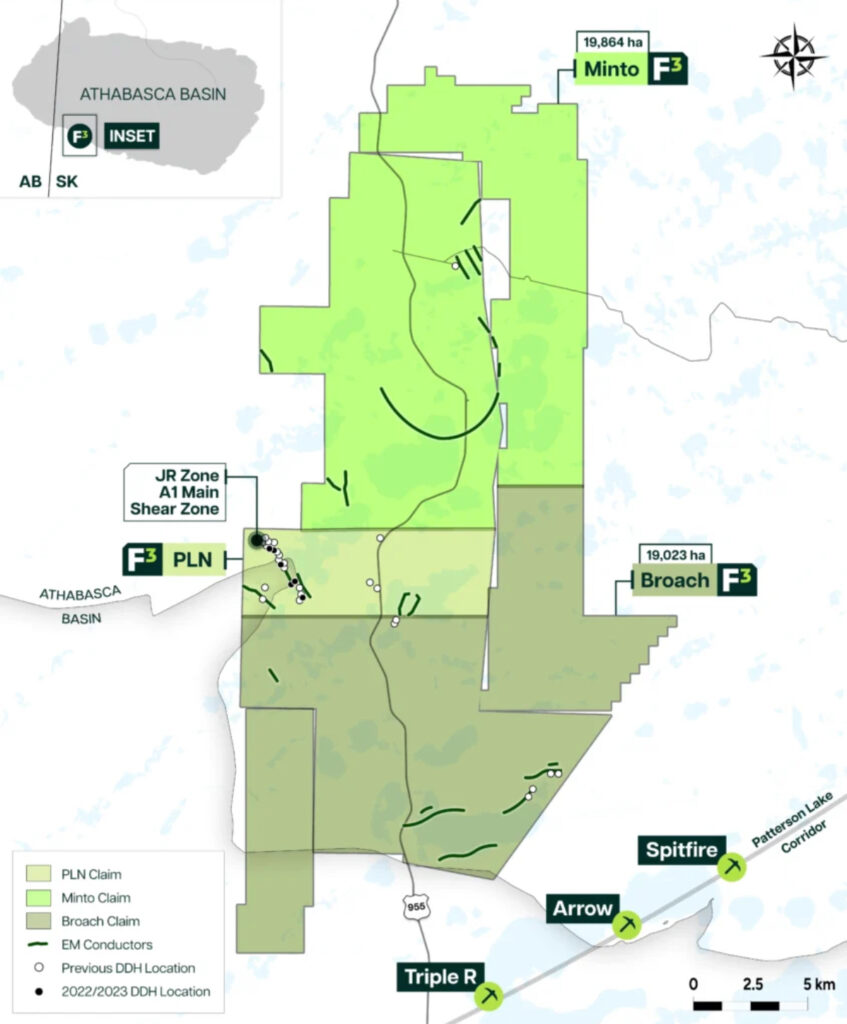
F3 is no longer asking the market to value only potential. It has a third-party resource base, a high-grade core and a district-scale exploration plan across Patterson Lake North.
Tetra Zone gives F3 another discovery front
F3 reported in April 2026 that its winter drilling at Tetra intersected uranium mineralization in three of six step-out holes, with geological work supporting a link between Tetra and the high-grade JR Zone system.
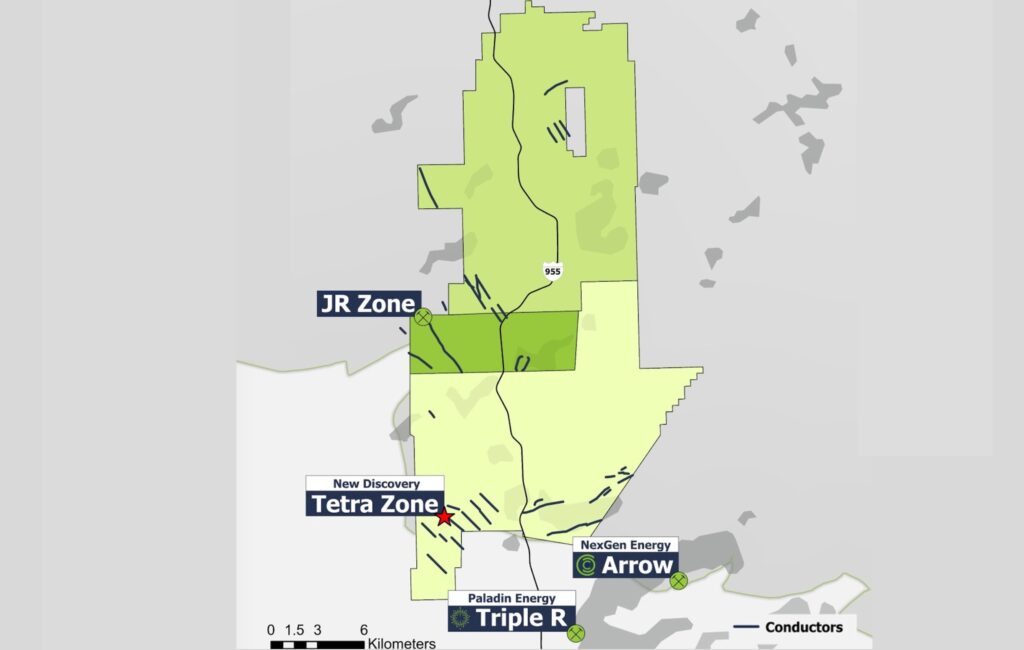
In June 2026, the company said its summer program would advance new targets across Patterson Lake North, Minto and Broach, with drilling expected to start in early July and initially comprise about 4,000 metres.
In other words, PLN is not a single-zone project, with Tetra and the broader PLN package giving it room to grow.
“Just as the team was completing the work to release the maiden resource estimate for JR Zone, the new game-changing Tetra Zone Discovery was made, the first in the Clearwater domain. At the same time, we continued a systematic project wide approach that has now advanced several additional prospective trends on the PLN Project to the drill-target stage. The PLN Project is one of the largest land packages in the highly prospective south-western Athabasca Basin, home to Paladin’s Triple R, and NexGen Energy’s Arrow deposits.
With our exploration funding in place, in parallel with the continued evaluation of the JR and Tetra Zones, the upcoming summer program will also include drill testing some of the most prospective of the newly defined trends to continue to realize the considerable exploration upside that remains across the three properties”
— Raymond Ashley, President & COO
Conclusion
F3 has an Indicated resource, a high-grade core, a 100%-owned PLN project and recently disclosed Cdn$23 million to advance drilling across multiple target areas in 2026.
The near-term milestone is drill-driven. If Tetra, Broach, Minto or other PLN targets begin showing continuity, F3’s story shifts from high-grade resource to district-scale system.
Q&A
What is the F3 Uranium resource?
F3’s JR Zone has an initial Indicated resource of 11.801 million pounds U3O8 at 4.41% U3O8, including a high-grade domain of 10.788 million pounds at 12.23% U3O8.
Why is F3’s Indicated resource important?
An Indicated mineral resource carries a higher confidence level than an Inferred resource, making it a stronger technical foundation for future studies.
Where is F3 Uranium’s JR Zone?
The JR Zone is on F3’s Patterson Lake North Project in Saskatchewan’s southwest Athabasca Basin, with the company describing it as about 23 km northwest of Paladin’s Triple R deposit.
What is the next catalyst for F3 Uranium?
F3’s 2026 summer exploration program is expected to start with about 4,000 metres of drilling across new PLN target areas, while Tetra remains a key follow-up zone.