
- Google is reportedly nearing a multiyear nuclear power agreement with Constellation worth at least US$1 billion
- the talks follow Amazon’s 690 MW Constellation deal and a US$4.2 billion conditional federal loan commitment for Vistra’s nuclear fleet
- US tech companies are backing reactor life extensions, restarts and new construction, with different implications for future uranium demand
Google is nearing an agreement to purchase nuclear electricity from Constellation Energy for US$1 billion or more over several years, according to Bloomberg, in a deal that could be announced as soon as this week.
Neither company confirmed the talks, and the generating capacity, plant location and detailed terms remain undisclosed — and the reported value represents electricity purchases over the agreement’s life.
The potential deal comes less than a week after Amazon signed a 20-year agreement for 690 MW from Constellation’s Calvert Cliffs nuclear plant in Maryland, as America’s technology companies compete to secure power for expanding AI and cloud infrastructure. The Amazon-Constellation agreement includes approx 190 MW of additional generating capacity expected between 2030 and 2032. Constellation says the agreement will support more than US$3 billion in infrastructure investment and help underpin a further 20 years of plant operation.
The scale of tech’s nuclear push to power data centers and AI is becoming clear with selected US technology and data-centre nuclear announcements now representing an estimated cumulative 29.8 GW of capacity, as the chart below shows.
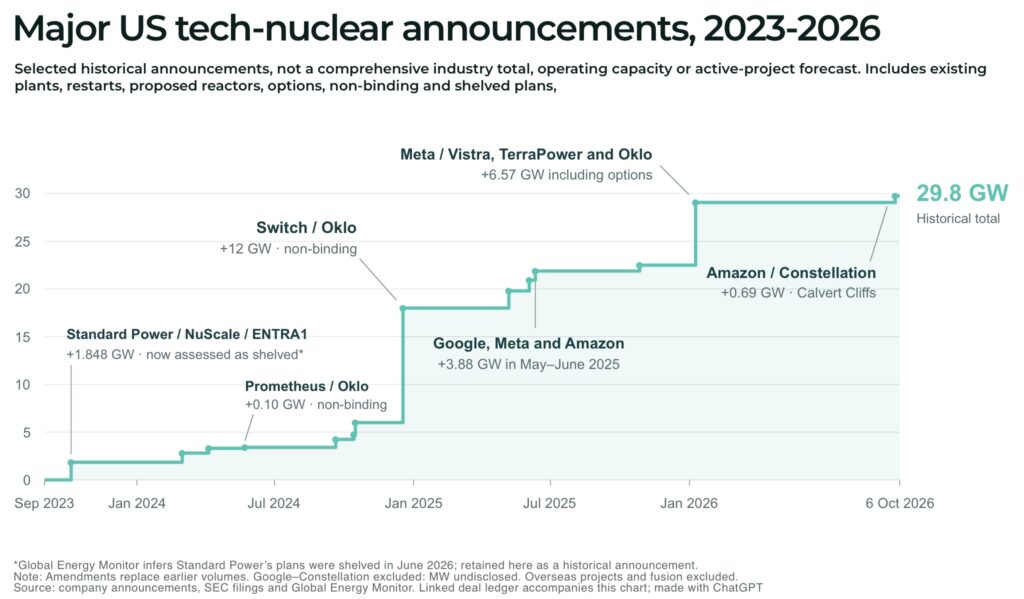
Note: the figure measures the scale of announced ambitions, not operating capacity or guaranteed future supply.
And, for the uranium supply chain, the distinction matters as purchasing electricity from an operating reactor does not automatically create additional fuel demand, but increasing its output, extending its life or bringing a closed plant back into service can strengthen demand over years or decades.
Washington adds US$4.2 billion to the picture
On October 5, the US Department of Energy announced a conditional loan commitment of up to US$4.2 billion for upgrades and modernisation at Vistra’s Beaver Valley plant in Pennsylvania and its Davis-Besse and Perry plants in Ohio.
The projects aim to preserve nearly 4 GW of existing generation and add 433 MW of capacity. They would also support operation for another 20 years beyond the plants’ existing licences.
These are the same three Pennsylvania and Ohio plants covered by Meta’s January agreements with Vistra, when Meta committed to buying more than 2.1 GW from existing generation, alongside 433 MW of planned additional output. (The federal financing and corporate purchases therefore support overlapping projects; the capacity figures should not be added together).
A similar combination is developing in Iowa. In September, the Department of Energy closed a loan of up to US$1.9 billion to help NextEra Energy restart the 615 MW Duane Arnold plant. Google’s 25-year electricity agreement underpins that project, which targets a return to service in early 2029, subject to regulatory approval.
The US tech–nuclear tie-ups (so far)
The major publicly announced US-focused partnerships span operating reactors, planned restarts and technologies still under development:
| Technology company | Nuclear partner | Agreement and development status |
|---|---|---|
| Constellation | Reported Google–Constellation nuclear power agreement worth at least US$1 billion over several years. Capacity, location and duration undisclosed; not yet confirmed. | |
| Kairos Power | October 2024 advanced nuclear energy agreement supporting up to 500 MW, with initial deployment targeted for 2030 and further reactors through 2035. | |
| Elementl Power | May 2025 US nuclear site development agreement providing early capital for three potential sites of at least 600 MW each. Google has an option to purchase electricity; these are development targets. | |
| NextEra Energy | October 2025 25-year power agreement supporting the restart of Iowa’s 615 MW Duane Arnold nuclear plant, targeted for early 2029. CIPCO will purchase the remaining portion of output. | |
| Microsoft | Constellation | September 2024 20-year agreement supporting the Three Mile Island Unit 1 restart as the 835 MW Crane Clean Energy Center. Constellation’s August 2026 update targets Crane nuclear plant operations in 2027. |
| Amazon / AWS | Talen Energy | June 2025 Amazon–Talen nuclear power agreement expanding supply to 1,920 MW from Susquehanna through 2042, reaching full contracted volume no later than 2032. Includes exploration of uprates and SMRs. |
| Amazon | Constellation | September 2026 20-year Calvert Cliffs nuclear power agreement for 690 MW, including approximately 190 MW of new capacity targeted for 2030–2032. |
| Amazon | X-energy / Energy Northwest | Investment and development partnerships supporting the Cascade small modular reactor project in Washington: 320 MW initially, expandable to 960 MW, with operations targeted for the 2030s. |
| Amazon | Dominion Energy | October 2024 agreement to explore a small modular reactor project near North Anna in Virginia, with at least 300 MW of capacity. An exploratory arrangement. |
| Meta | Constellation | June 2025 20-year Clinton nuclear energy agreement, beginning in 2027, supporting continued operation of the Illinois plant and 1,121 MW of nuclear generation. |
| Meta | Vistra | January 2026 Meta–Vistra nuclear power agreements covering 20 years, more than 2.1 GW of existing generation and 433 MW of uprates at Perry, Davis-Besse and Beaver Valley. |
| Meta | TerraPower | January 2026 TerraPower Natrium reactor development agreement supporting two units totalling 690 MW, potentially delivering from 2032, plus rights to energy from six further units. Total potential baseload capacity: approximately 2.8 GW. |
| Meta | Oklo | January 2026 development partnership supporting a proposed 1.2 GW advanced nuclear campus in Ohio, potentially beginning operations from 2030. |
| Switch | Oklo | December 2024 non-binding advanced nuclear power agreement targeting 12 GW of deployment through 2044. A framework for future projects. |
| Equinix | Oklo / Radiant | Equinix nuclear energy partnerships include a 2024 agreement for 500 MW from Oklo and an August 2025 preorder for 20 Radiant microreactors. Both concern future deployment. |
The next constraint is delivery
The commercial logic is becoming clearer: long-term technology customers can give nuclear operators greater revenue certainty, helping justify investment in existing plants and future projects.
But contracts alone cannot deliver reactors, regulatory approvals or fuel.
Washington is addressing the supply chain alongside generation. For example, in January, the Department of Energy announced US$2.7 billion for domestic uranium enrichment services over the next decade, covering conventional low-enriched uranium and the higher-assay fuel required by several advanced reactor designs.
Google’s reported Constellation agreement would add another major buyer to that market. The details still to come — where the power originates, when delivery begins and whether the contract enables additional generation — will determine how much it changes the supply picture.