
- US studying commercial nuclear powered ships through a MARAD request in 2026 for information covering SMRs, port access, insurance, liability, workforce and standards
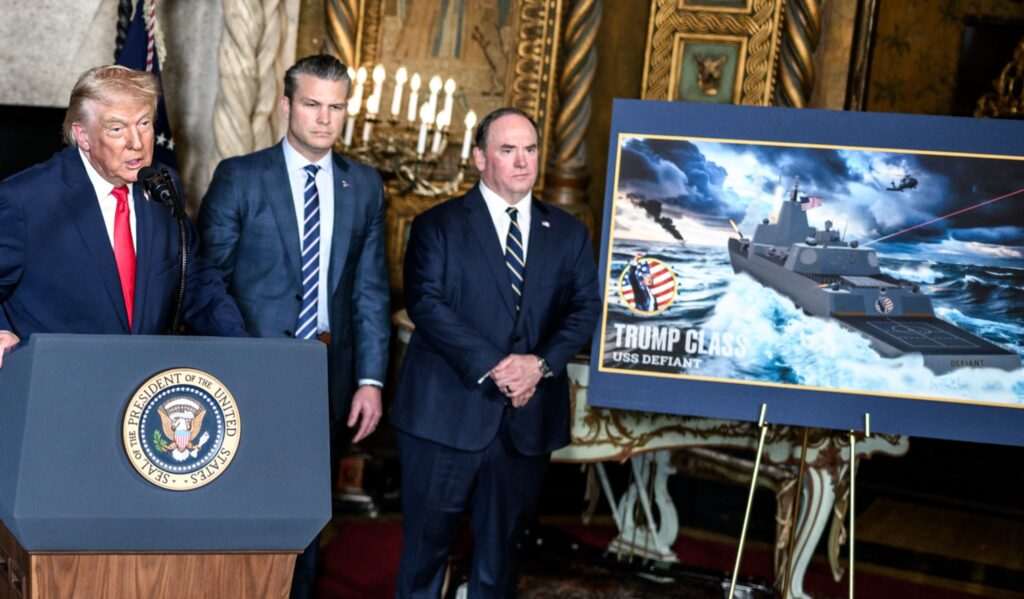
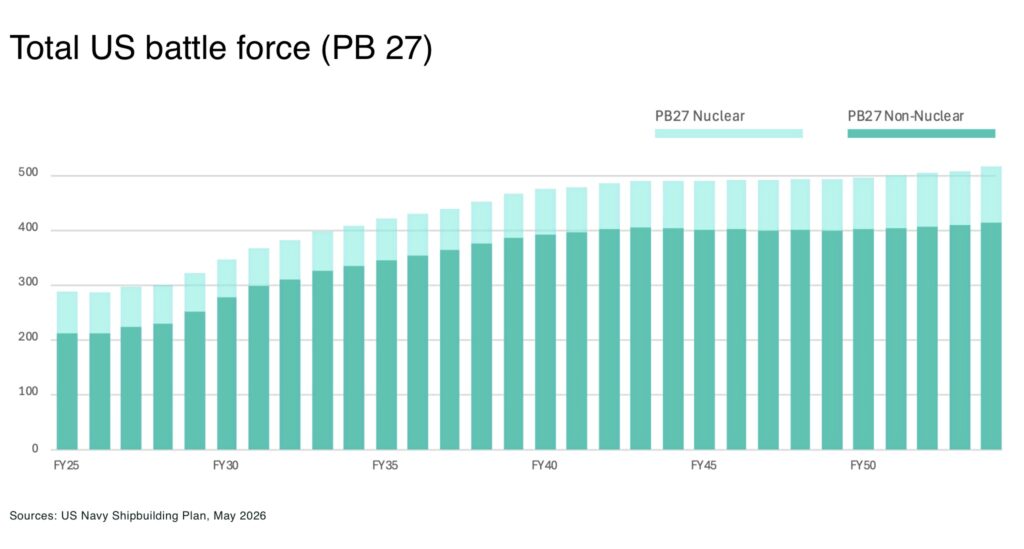
- US Navy’s 30-year shipbuilding blueprint plans for the Trump-class battleship to be nuclear-powered
- the moves build on assessments by Lloyds Register, Core Power and AP Moller-Maersk to explore the feasibility and regulatory frameworks necessary for a nuclear-powered containership using a fourth-generation reactor to conduct cargo operations
- US military also moving nuclear onto bases, with the Army’s Janus Program selecting nine installations for possible microreactors and the Navy soliciting SMRs for resilient installation power
US Chief of Naval Operations Admiral Daryl Caudle called the decision to abandon nuclear-powered surface ships “one of the largest mistakes the navy ever did”, in testimony before the House Armed Services Committee in May 2026.
But, the US navy is working to restore nuclear propulsion — and, they’re not the only ones, with global shipping giants, like Maersk, also exploring nuclear powered ships.
“We walked away from surface nuclear power decades ago, and that was one of the largest mistakes the Navy ever did, and we’re bringing it back… “We need nuclear-powered surface ships to sustain combat operations with our nuclear-powered aircraft carriers” — Chief of Naval Operations Admiral Daryl Caudle.
The moves put the need to secure uranium supply at the centre of, not just energy policy, but military power projection and the protection of global trade.
Why nuclear powered ships are so important
The global economy is built on freedom of the seas.
Approx 90% of global trade travels by sea; approx 99% of the international internet traffic goes through submarine cables; oil, LNG, grain, critical minerals, consumer goods, and so much more depend on open sea lanes.
And American naval power underwrites this economic power, both of which are increasingly under threat.
For example, the closure of the Strait of Hormuz to free movement for shipping by Iran challenges the global economy and US command of the maritime commons. And, although there are typically 150-200 cable incidents each year, averaging about three to four per week, many due to accidents but others increasingly intentional.
Nuclear-powered ships matter because they change the energy equation.
- a nuclear reactor contains enormous energy in a small mass of fuel, allowing ships to sail for years without refuelling, instead of weeks, and so deploy globally without depending on vulnerable fuel convoys
- nuclear reactors have very high energy density, which means more of the ship’s volume and weight can go to payload (planes, cargo) instead of fuel tanks
- shipping account for approx 3% of global CO₂ emissions; nuclear propulsion would help cut CO₂, NOₓ, SOₓ particulates from the heaviest fuel oil users
The US Navy already knows nuclear propulsion works with more than 70 years of experience with nuclear aircraft carriers and submarines.
Now, the Navy plans a significant expansion of its nuclear maritime capacity.
For example, in May 2026, the Maritime Administration (MARAD) launched an initiative to develop Small Modular Nuclear Reactors (SMR) for commercial shipping, and in the navy’s annual 30-year shipbuilding blueprint, it was revealed the new Trump-class battleship (with construction of the first ship targeted for the early 2030s) will be powered by a nuclear reactor.
United States
| Program | Type | Status | Scale |
| Trump-class / BBG(X) | Nuclear-powered surface battleship | New Navy program | 3 funded in FY2027-FY2031; 15 planned in long-range profile |
| Ford-class CVN follow-ons | Nuclear aircraft carriers | Continuing | CVN 80/81 under construction; CVN 82 accelerated; 7 carrier procurements in 30-year plan |
| Columbia-class SSBN | Nuclear ballistic missile submarine | Program of record | Minimum 12 ships |
| Virginia-class SSN | Nuclear attack submarine | Continuing | 10 funded FY2027-FY2031; 2 per year target |
| SSN(X) | Next-generation nuclear attack submarine | Design/R&D | Lead boat planned early 2040s |
| Future SSGN / large-payload submarine | Nuclear guided-missile submarine | Long-range plan | 7 shown in long-range procurement profile, subject to review |
| Commercial SMR vessel/demo | Nuclear merchant ship | MARAD RFI | Single vessel or technology demonstration, no order yet |
And, it’s not just America. China is building what is likely to be its first nuclear powered aircraft carrier, and plans one of the largest ever contianer ships powered by a thorium reactor; Russia is building a number of nuclear-powered icebreakers; and France and the UK are planning a series of nuclear submarines (for example, AUKUS).
Uranium rules the waves
The expansion of the nuclear fleet ties maritime security directly to uranium security — making uranium, no longer just a power-sector commodity, but a strategic fuel.
For the US, the implication is clear: secure maritime power will require secure nuclear fuel supply. This means uranium mines, conversion, enrichment and fuel fabrication inside trusted supply chains.
And, as we have highlighted in our recent analysis, this makes Canada’s Athabasca Basin the cornerstone of Western uranium supply and US national security.
How much uranium would a nuclear shipping fleet need?
One nuclear ship will not move the uranium market, but a fleet could. If nuclear-powered shipping proves commercially viable (and international port and nuclear regulations are rebuilt to support it), scale would begin to materially affect global uranium demand.
The first commercial floating nuclear power plants are anticipated in 2030, and the first nuclear commercial ships in 2032.
The numbers are still scenario-based because MARAD has not chosen a reactor design, enrichment level, vessel class or refueling cycle. But the scale can be estimated.
For now, the US commercial effort is not a fleet order. MARAD’s 2026 RFI is for a single vessel or technology demonstration, but it is explicitly asking for a scalable, repeatable SMR model that could apply across the marine transportation system.
The military side is more concrete. The Navy’s latest shipbuilding plan calls for 15 nuclear-powered Trump-class battleships over 30 years, while the original Navy announcement described a new 30,000 to 40,000-ton class of large surface combatants.
For commercial shipping, the best public reference point is the ABS study of a 14,000 TEU container ship using two 30 MW fast reactors over a 25-year lifespan, and HD KSOE’s 15,000 TEU SMR-powered container vessel design capable of 24 knots.
Using World Nuclear Association’s generic reactor fuel requirement of 163 tonnes of natural uranium per GWe-year, a 60-100 MWe nuclear merchant ship would need roughly 200-350 tonnes of uranium over a 25-year life, annualized at 8-14 tonnes per year.
| Scenario | Annualized uranium demand | 25-year uranium equivalent | Supply-chain impact |
| 1 ship, 60 MWe | ~8 tU/year | ~208 tU | Negligible |
| 1 ship, 100 MWe | ~14 tU/year | ~346 tU | Negligible |
| 100 ships, 60 MWe | ~831 tU/year | ~20,800 tU | ~1.4% of 2024 global mine supply |
| 100 ships, 100 MWe | ~1,386 tU/year | ~34,600 tU | ~2.3% of 2024 global mine supply |
| 500 ships, 100 MWe | ~6,928 tU/year | ~173,000 tU | ~11.5% of 2024 global mine supply |
- a 100-ship nuclear commercial fleet would require the equivalent of 6-10% of Canada’s 2024 uranium output each year, depending on reactor size (note, there are more than 7000 container and roro ships globally, so 100 ships is only 1.4% of the global fleet).
- a 500-ship fleet at 100 MWe would require nearly half of Canada’s 2024 mine production if supplied entirely from Canadian uranium in 2024
Are these numbers fantastical?
A study by consulting firm Roland Berger in 2025, commissioned by offshore shipping company Allseas, estimates potential for deploying 700 small modular nuclear reactors across the global maritime sector by 2050.
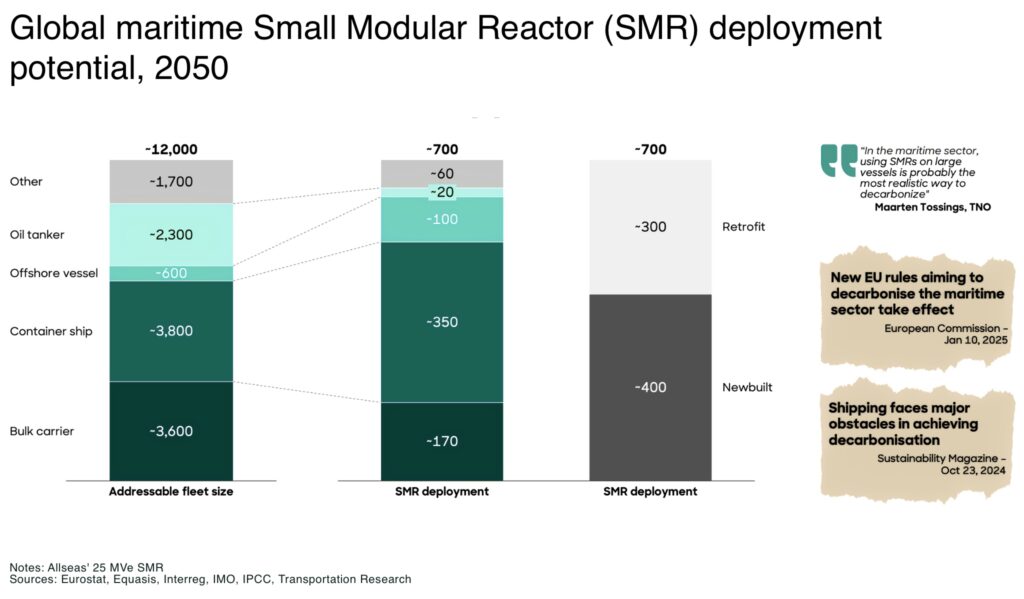
The first commercial floating nuclear power plants are expected in 2030, and the first nuclear commercial ships in 2032. As readers will know, these timeframes, may seem a long time on paper, but new uranium mines can take 10-20 years to permit, finance and build.
The US military uranium stockpile
The US Navy’s current nuclear fuel system is still living off the Cold War.
For its naval reactors, the US military mainly sources uranium from existing US government highly enriched uranium (HEU) stockpiles, especially material recovered from dismantled nuclear weapons.
The Y‑12 National Security Complex, responsible for fuelling the nation’s naval reactors from dismatled nculear weapons, says its support is planned through 2050 — but the total number of warheads in America has fallen dramatically since the 1980s.
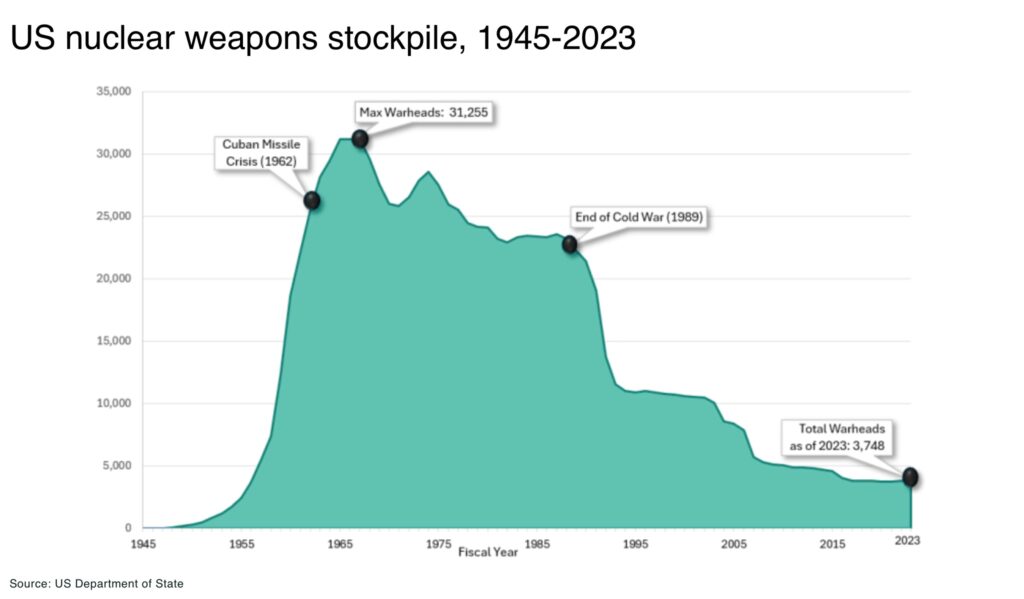
If (when) nuclear propulsion expands beyond submarines and carriers into surface combatants, commercial ships, military bases and microreactors, the finite supply of Cold War stockpiles will be unlikely to keep pace with demand.
Uranium from Canada rises in the North American defence stack
Canada produced 14,309 tU in 2024, second only to Kazakhstan, with US civilian reactor operators buying 55.9 million pounds U3O8e in 2024, up 8% from 2023. Canada was the top source, supplying 36% of deliveries.
But it’s more than just production share that puts Canada and the Athabasca Basin at the centre of US national security:
- high-grade deposits: the concentration of uranium in the Athabasca Basin deposits is exceptionally high, exceeding the global average by x10 – x100, allowing for cost effective extraction
- stable geopolitical environment: Canada’s stable political landscape and supportive regulatory framework provide a secure environment for uranium investment and mining companies
- midstream leverage: Cameco’s Blind River facility is the world’s largest commercial uranium refinery, and Port Hope is Canada’s only uranium conversion facility and one of the Western suppliers of UF6 for light-water reactor fuel
- established infrastructure: the Athabasca Basin benefits from well-developed infrastructure, including roads, power lines, and a skilled workforce
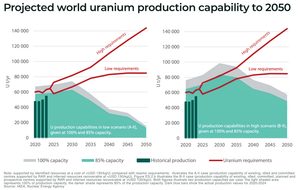
Meanwhile, global uranium demand is projected to rise, with forecasts indicating a 28% increase by 2030 and more than doubling by 2040.
For North America, the takeaway is blunt: nuclear ships do not just need reactors. They need trusted uranium, conversion, enrichment, fabrication, transport security and long-term fuel contracting.

Opportunity in the Athabasca Basin
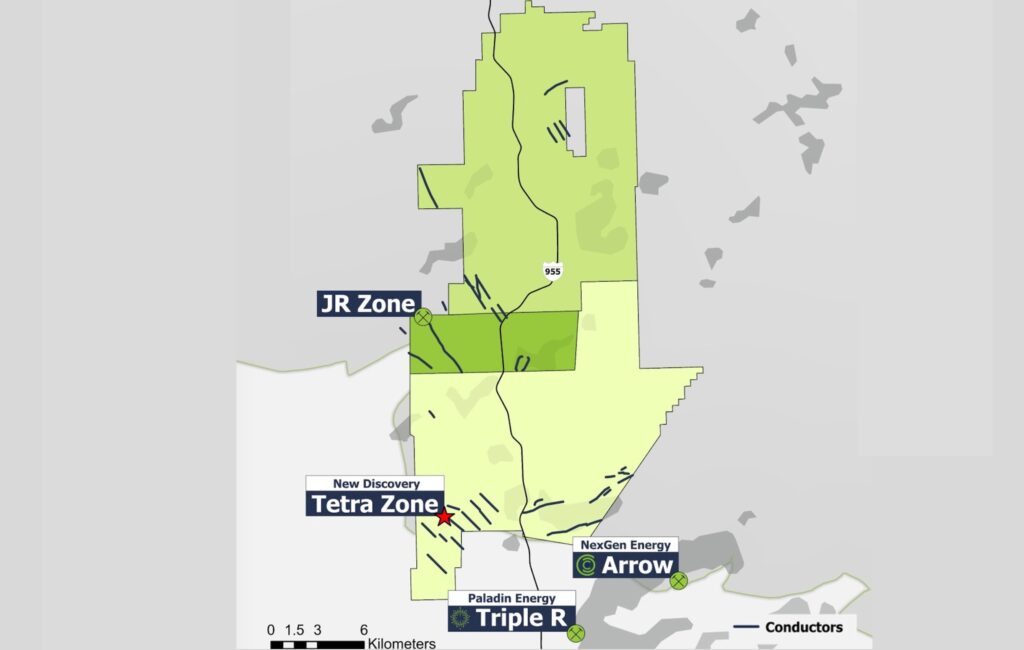
F3 Uranium (TSXV: FUU, OTCQB: FUUFF)‘s 100%-owned Patterson Lake North (PLN) Project in northern Saskatchewan totals 44,613 hectares and includes the Patterson Lake North, Minto, and Broach properties, according to the company, with a maiden Indicated resource at the JR Zone of 11.801 million lbs U₃O₈ at 4.39% (including a high-grade domain of 10.788 million lbs at 12.23%)— offering both scale and grade.
F3’s winter 2026 diamond drilling program at the Tetra Zone tested step-outs along strike and down plunge, intersecting uranium mineralization in three of six holes. Step-out hole PLN26-226 cut 0.5m of radioactivity up to 1,400 cps from 470.5 to 471.0m, 275m along strike from high-grade hole PLN25-219A, which previously returned 13.0m of 0.28% U₃O₈ including 3.0m of 1.19% U₃O₈. Additional anomalous radioactivity was intersected in holes PLN26-225 and PLN26-222. These results validate F3’s structural model and confirm that the Tetra Zone remains open along strike and down plunge.
The JR Zone Uranium deposit is located approximately 25km northwest of Paladin’s Triple R Deposit and NexGen’s Arrow Deposit in the southwest Athabasca Basin and is accessible via Provincial Highway 955.
Canaccord Genuity has initiated coverage on F3 Uranium with a Buy rating and a CAD$0.30 target. Other broker targets are materially higher: SCP at CAD$0.70, Red Cloud at CAD$0.55, and Haywood at CAD$0.55.
That spread in target prices underscores two things: first, analysts are modelling meaningful exploration upside; second, valuation remains leveraged to additional discovery success in a tightening basin.
F3 recently disclosed US$25 million in treasury to advance drilling through 2026.
The higher-grade cores mirror the structure of Athabasca’s biggest deposits. Geologically, Tetra is hosted in basement rocks, similar to NexGen’s Arrow, indicating the potential for sizeable pods of mineralization controlled by fault structures.
Defense is creating a nuclear demand stack
The shipping push is part of a wider military nuclear pivot.
The US military is adopting commercial microreactors, including the Army’s Janus Program, the Air Force’s Eielson Air Force Base pilot, and Navy solicitations for SMRs and microreactors to power installations.
The Army says Janus will use commercial microreactors for secure, resilient energy at defense installations and will support the full uranium fuel cycle and broader nuclear supply chain.
That is the bridge to uranium.
Once nuclear moves from grid electricity into bases, ships, AI infrastructure and maritime logistics, fuel security becomes defense policy.
Conclusion
The upside case is not that nuclear-powered container ships suddenly absorb millions of pounds of uranium, it’s simply too early.
The upside case is that Washington is redefining nuclear fuel as strategic infrastructure. If the US wants nuclear surface combatants, commercial nuclear ships, military microreactors and resilient bases, it needs an allied fuel system that can survive sanctions, shipping disruptions and geopolitical pressure.
The downside risk is execution. Nuclear ships face high capital costs, slow licensing, and insurance uncertainty.
The next milestone is MARAD’s August 5, 2026 comment deadline. The market should watch who responds: reactor developers, shipyards, insurers, ports, uranium suppliers, fuel-service companies and defense contractors.
The strategic point is simple. If the US is serious about maritime dominance, uranium is no longer just a reactor fuel. It is a logistics fuel, a naval fuel and a North American security asset.
Q&A
Why are nuclear powered ships a national-security issue?
Nuclear propulsion reduces dependence on vulnerable fuel logistics and can support longer-endurance warships, which is why the Navy is now backing nuclear-powered surface combatants in its shipbuilding plans.
Is the US developing nuclear powered commercial ships?
Yes. MARAD issued a May 2026 RFI to study scalable, commercially viable SMRs for the marine transportation system, including port access, insurance, liability and workforce requirements.
Why does Canada matter for nuclear powered ships?
Canada uranium supply is the largest share of US uranium deliveries in 2024, as well as geopolitical ally, making it central to any secure North American nuclear fuel chain.
Will nuclear powered ships immediately increase uranium demand?
No. Early demand would likely be modest. The bigger impact is strategic: nuclear shipping could expand the political and industrial case for secure uranium, conversion, enrichment and fuel fabrication in North America.