

Utilities have left about 65% of their projected uranium requirements through 2045 uncovered, while the long-term contracts needed to finance new supply remain below replacement rate.
Utilities worldwide entered 2026 with about 3.1 billion lb U3O8 of requirements still uncovered through 2045 — roughly 65% of projected needs, according to UxC estimates presented by Cameco.
It is a deepening contract gap hiding in plain sight.
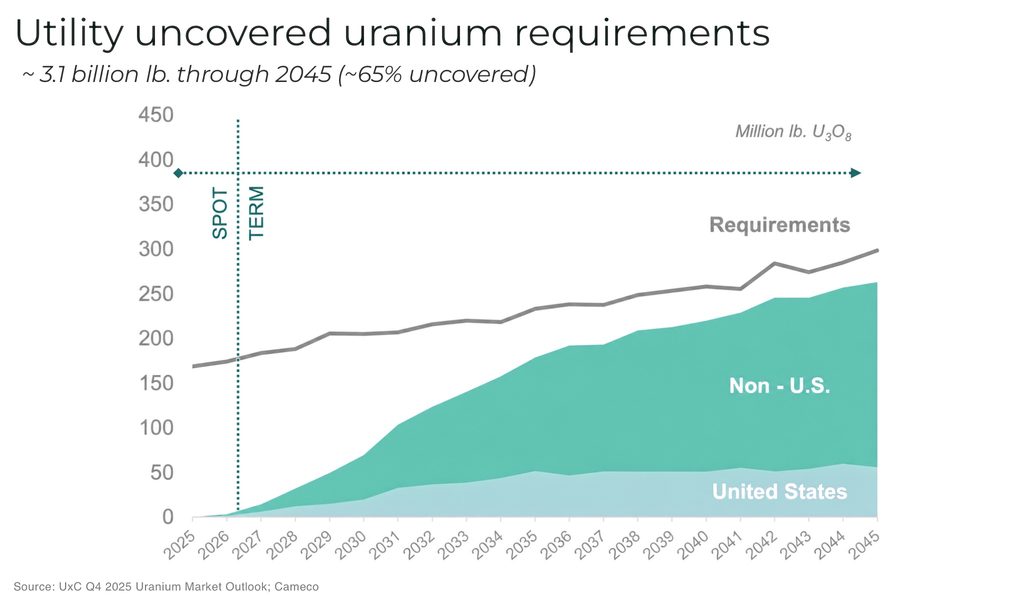
“Uncovered” does not mean reactors are about to run out of fuel, but rather the uranium fuel has not yet been secured — and the mines and fuel-cycle capacity needed to deliver it cannot be financed and built retroactively.
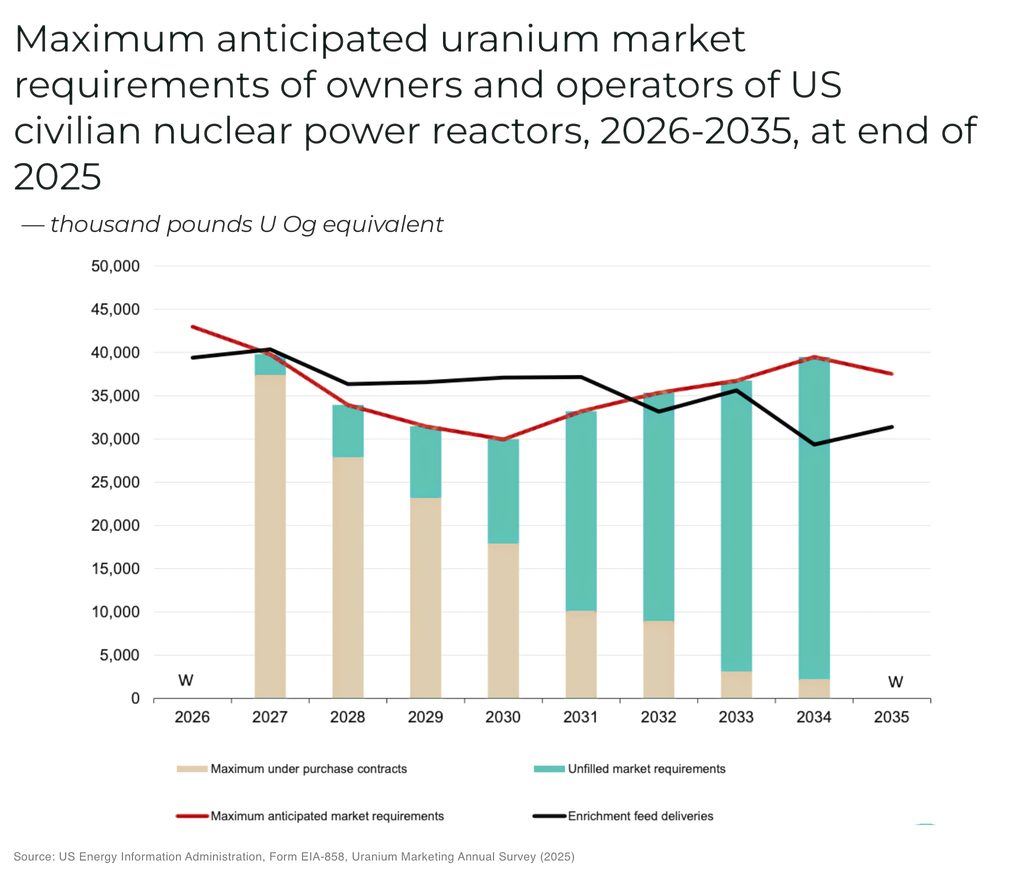
By the end of 2025, US nuclear utilities had 52% of their maximum anticipated requirements through 2035 — 186.3 million lb — still unsecured.
While spot uranium attracts the headlines, only 13% of uranium delivered to US reactor operators in 2025 was purchased under spot contracts. The remaining 87% came through long-term contracts.
And the imbalance extends beyond the US, with Cameco warning utilities worldwide contracted 589 million lb U3O8 equivalent over the five years through 2025, but reactors consumed approximately 815 million lb. That leaves a 226 million lb contracting replacement gap, 28% of uranium consumed and an average of about 45 million lb a year — with cumulative uncovered requirements of about 3.1 billion pounds to the end of 2045.
Commercial uranium inventories can help cover near-term fuel needs, masking the exposure, but inventories cannot create the new mine production, conversion and enrichment capacity needed to close it.
“With the lack of investment over the past decade, there is growing uncertainty about where uranium will come from to satisfy growing demand, and utilities are becoming increasingly concerned about the availability of material to meet their long-term needs” — Cameco, Management’s discussion and analysis, February 13 2026
Why the deficit looks smaller than reality
There are an estimated 5.93 million tonnes of recoverable uranium globally, at costs of up to US$130/kgU, rising to 7.94 million tonnes at up to US$260/kgU.
But uranium in the ground is not the same as fuel ready for a reactor. It must be permitted, financed and mined, then converted, enriched, fabricated, transported and contracted — and this is the part often missed — years before delivery to utilities.
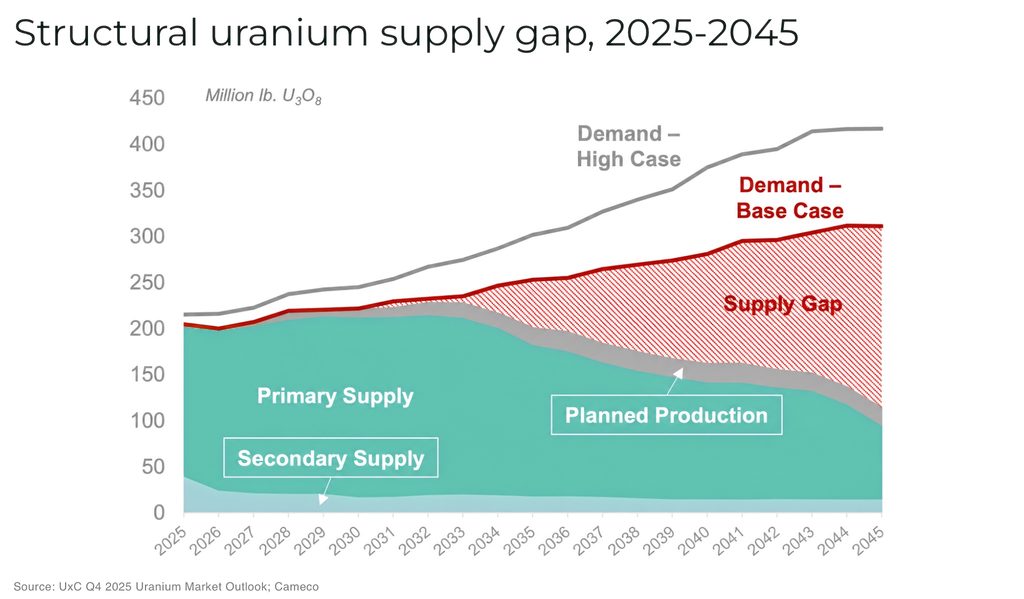
The World Nuclear Association (WNA) projects global reactor uranium requirements will rise from 68,920 tU in 2025 to just over 150,000 tU by 2040 (in its Reference Scenario). To put that projection in context: global mine output totalled 60,213 tU in 2024, equivalent to about 87% of near-term reactor requirements in 2024.
Meeting 150,000 tU of demand in 2040 would require a further 149% increase in just 16 years, nearly three times the historical growth rate across the global uranium mining industry.
The supply side is, of course, not expected to remain flat. The OECD Nuclear Energy Agency and IAEA’s Uranium 2024 Red Book estimates 2040 production capability at 43,985 tU from existing, idled and committed centres, rising to 93,635 tU with planned and prospective projects.
This means:
- the Red Book identifies just 43,985 tU of capability in 2040, which would cover only 38%-51% of its projected reactor requirements, leaving a shortfall of between 49%-62%. Even after planned and prospective production centres are included, the broader supply pipeline covers only the low-demand case and remains 19% short of the high case
- against WNA’s newer 2040 demand forecast of more than 150,000 tU, the Red Book’s broader supply pipeline would cover only about 62%, leaving a 38% gap — more than 56,000 tU, or 147 million lb U3O8
Such a shortfall in primary mine supply by 2040 would be no temporary squeeze, but a severe structural imbalance with decades of deficit accumulation.
Inventories are masking the pressure, but utility contracting is warning of mounting stress beneath the surface, reflected in a persistent spread between spot and long-term pricing.
Now that exposure is showing up in the market where utilities secure future supply with long-term uranium price. By July 2026, the long-term price was US$95.50/lb versus US$86.38 spot, a US$9.12 spread.
That spread matters.
Spot prices can soften when financial buyers pause or if uranium inventories move, but long-term prices rise when utilities decide future supply is worth paying for.
Demand is accelerating faster than supply
Global electricity demand is forecast to grow 3.6% annually from 2026 to 2030, with US demand increasingly driven by data centres.
To help meet that demand, the US government is seeking to quadruple nuclear capacity from approximately 100 GW in 2024 to 400 GW by 2050, as well as targeting 5 GW of uprates to existing plants and ten new large reactors under construction by 2030.
(And the shift is not confined to the US with the World Nuclear Association now listing 79 reactors under construction and another 124 planned worldwide, and global nuclear capacity rising from 398 GWe in 2025 to 746 GWe by 2040.)
That policy push comes as global nuclear generation set a record in 2025 and is expected to continue rising through 2030.
That puts real pressure on a uranium mining industry where new uranium mines can take 10 to 20 years to move from discovery to production.
(We examine that reactor buildout and the race to make fuel available our recent analysis America wants new reactors. But can it fuel them in time? )
For context, global mine production grew about 50% over the 20 years from 40,263 tU in 2004 to 60,213 tU in 2024, or roughly 2% annually, but:
- reaching the Red Book’s broad capability case by 2040 would require growth of about 2.8% a year
- matching WNA’s 150,000-plus tU demand with mines alone would require about 5.9% annually
Secondary supply will contribute, but the comparison shows the scale and speed of execution still required — if — all the necessary mines are built with no further disruption to enrichment and logistics.
The deficit is a schedule, not one missing shipment
The 186.3 million lb is cumulative across the 2026–2035 delivery window.
EIA data show US unfilled requirements:
- rising from less than 1 million lb in 2026
- to 12 million lb in 2030, 23.1 million lb in 2031 and 33.6 million lb in 2033
- and by 2035, the cumulative total reaches 186.3 million lb
Contract coverage moves, however, in the opposite direction.
Maximum quantities under existing contracts fall from 42 million lb for delivery in 2026 to 17.9 million lb in 2030 and just 3.2 million lb in 2033.
Some decline is normal and utilities certainly do not contract every future requirement a decade in advance, so uncovered requirements are not necessarily proof that suppliers will fail to deliver.
The challenge is timing.
US utility uncovered requirements begin rising sharply around 2030 — only four years away — but many of the mines and fuel-cycle facilities needed to supply this uranium take far longer to permit, finance and build.
Utilities can delay signing contracts, but every year of delay leaves producers less time to create new capacity.
Inventory buys time, not supply
US reactor operators held 118 million lb of commercial uranium inventory at the end of 2025, compared with 40.9 million lb contained in fuel assemblies loaded during the year.
That is a substantial buffer, but it is not simply three years of reactor-ready fuel. Uranium inventories sit in different locations and stages of the fuel cycle. Some material is working inventory needed to keep conversion, enrichment and fabrication schedules moving, while some is committed to particular reactors or future reloads.
Inventory can help the spot market to remain calm despite future supply deteriorating, because a utility with adequate stock does not need to chase urgent pounds. Instead it can wait for better terms and use inventory to bridge deliveries.
But that only pushes procurement into a tighter timeframe (and every pound of uranium drawn from inventory today can become a pound that eventually needs to be replaced).
The Contract Book is what gets mines built
Long-term contracts do more than secure uranium for utilities: they help determine which mines are financed, restarted or expanded.
A developer cannot normally finance and build a mine around a brief spot-price spike, but instead need confidence that customers will take uranium supply over several years at prices capable of supporting construction and operating costs. This comes from binding offtake agreements, credible buyers and durable contract terms.
This “relationship” creates a feedback loop:
- utilities delay contracting because inventories give them time
- producers delay committing new output because they do not yet have the contracts needed to justify investment
- the longer both sides wait, the less time remains for new capacity to come online
That is what a utility supply deficit means before any reactor runs short: buyers gradually lose leverage over the price, origin and timing of future pounds.
Such a significant supply deficit is, of course, not inevitable, but it will not close itself, so closing the contract gap ultimately requires a pipeline of new projects — and exploration resources are only the beginning of that pipeline.
F3 Uranium: building the pipeline for future supply
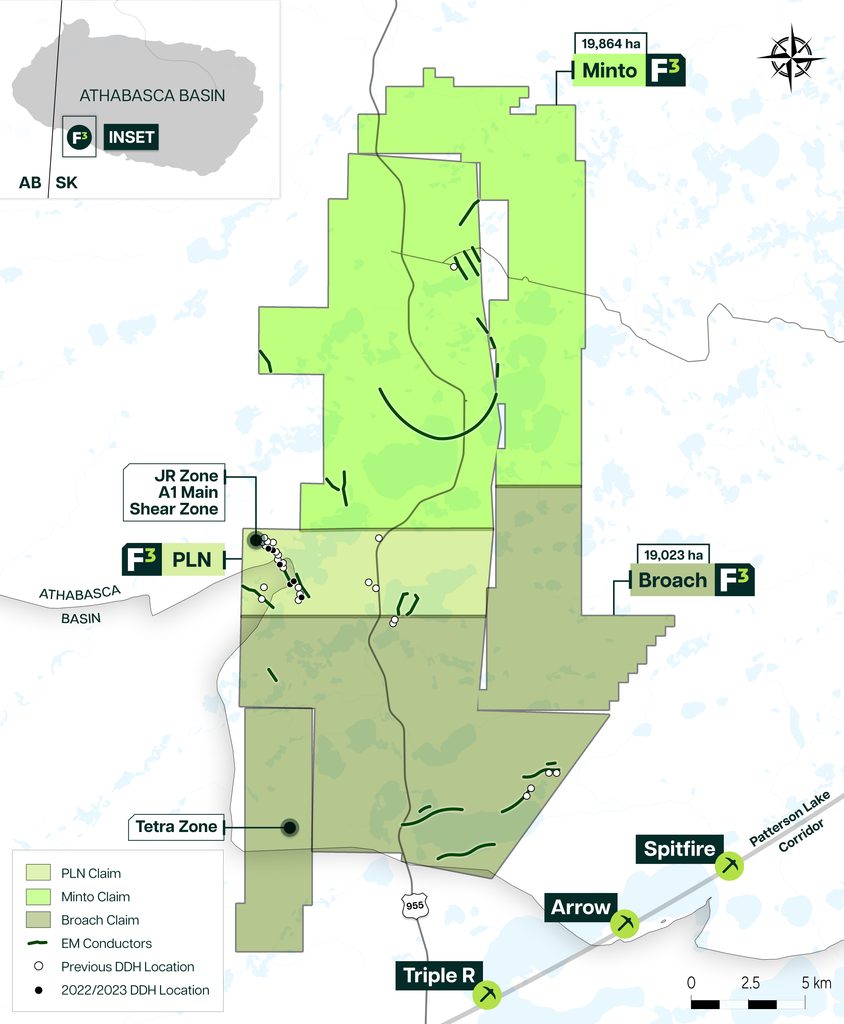
F3 Uranium Corp (TSXV: FUU, OTCQB: FUUFF) owns 100% of the Patterson Lake North project in Saskatchewan’s western Athabasca Basin, comprising the Patterson Lake North, Broach and Minto properties.
The project’s most advanced asset is the JR Zone contains a Mineral Resource Estimate (MRE) of Indicated resource of 11.801 million lb U3O8 grading 4.41%, including a high-grade domain of 10.8 million lb grading 12.23%.
| JR Zone domain | Classification | Tonnes | Grade | Contained U3O8 |
| High-grade domain | Indicated | 39,997 | 12.23% U3O8 | 10.788 million lb |
| Low-grade domain | Indicated | 81,262 | 0.57% U3O8 | 1.031 million lb |
| Total JR Zone | Indicated | 121,259 | 4.41% U3O8 | 11.801 million lb |
Mineral Resources are reported at a cut-off grade of 0.255% U3O8. Figures are reported by F3; totals may not add precisely because of rounding.
The company is also testing the wider potential of the project with its newer Tetra discovery approx 13 km south of JR, as well as the company’s 2026 exploration programme advancing targets across the Patterson Lake North, Broach and Minto properties.
Drilling at Tetra has returned several mineralised intervals, including 3.0 metres grading 1.19% U3O8 and a separate 13.0-metre interval grading 0.28%. Subsequent step-out drilling intersected further mineralisation, supporting the geological case for a wider system while leaving its eventual size and grade currently unresolved.
F3 reported C$25.4 million in cash and redeemable term deposits at December 31, 2025, before completing a further C$5.55 million flow-through financing in April 2026.
Canaccord Genuity has initiated coverage on F3 Uranium with a Buy rating and a CAD$0.30 target. Other broker targets are materially higher: SCP at CAD$0.70, Red Cloud at CAD$0.55, and Haywood at CAD$0.40.
With a 100%-owned, independently estimated Indicated resource, an unusually high-grade core and a road-accessible land package containing several further targets, F3’s story is shifting from high-grade resource to district-scale system.
Conclusion: the real shortage is time
The uranium deficit is not an empty warehouse in 2026. It is a shrinking volume of contracted future supply set against requirements that reactors cannot postpone once a refuelling schedule begins.
Inventories can cushion the transition, secondary supplies (eg recycling) can narrow the physical gap, and higher prices can bring forward new primary uranium production.
All three depend on time, which is running out.