- India has banned exports of lithium-ion battery black mass with immediate effect, until further orders, covering unsorted battery waste and scrap that contains lithium, cobalt, nickel and manganese under HS code 85491400
- the ban comes a week after New Delhi approved a US$300 million (₹2,814 crore) capex scheme for lithium and nickel processing plants
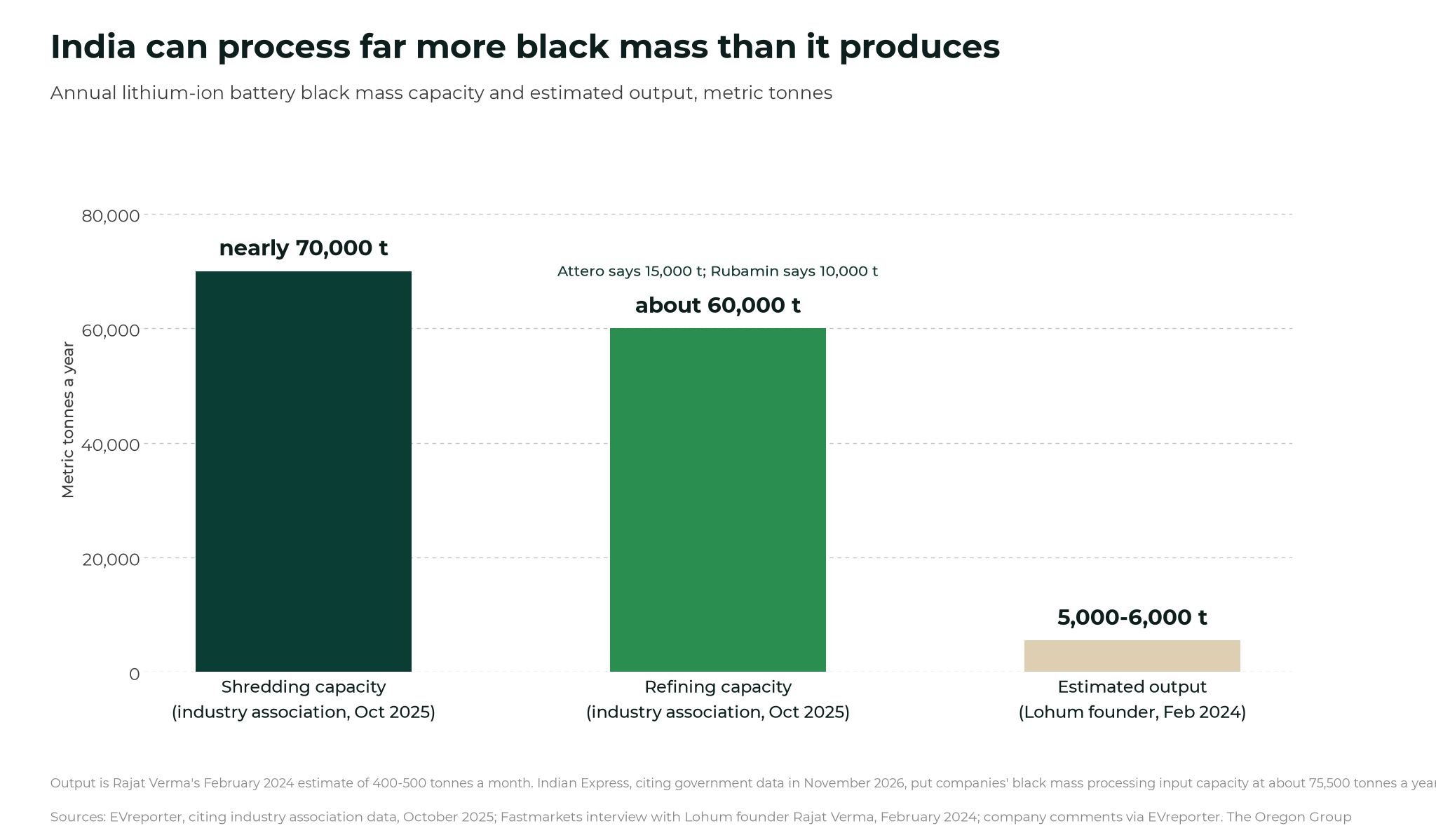
- India’s shredders can make nearly 70,000 tonnes of black mass a year, against about 60,000 tonnes of domestic refining capacity, according to industry association data cited by EVreporter, while estimated output in early 2024 was only about 5,000 to 6,000 tonnes a year
India has banned exports of lithium-ion battery black mass, the shredded battery powder that contains lithium, cobalt, nickel and manganese. The aim is to force recyclers to refine those critical minerals at home rather than ship them to refiners in China and South Korea.
The Directorate General of Foreign Trade changed the export status of black mass from “free” to “prohibited” in Notification No. 49/2026-27 on November 10. The order covers unsorted battery waste and scrap that contains no lead, cadmium or mercury, under HS code 85491400.
It is not a blanket ban on battery exports, applying only to that waste category, so refined metals and salts are not covered by the order — but the timing is deliberate.
On November 4, the Union Cabinet approved a 30% capital subsidy for four processing plants: two lithium plants of at least 30,000 tonnes a year each and two nickel plants of at least 50,000 tonnes each. Support is capped at US$53 million (₹500 crore) per lithium plant and US$96 million (₹900 crore) per nickel plant.
The policy is meant to reduce India’s reliance on supply chains dominated by China, with the government saings the ban will assure feedstock availability for domestic recycling and refining units and improve their capacity utilisation.
India’s refiners are short of feed
India’s battery shredders can produce nearly 70,000 tonnes of black mass a year, and its refiners can process about 60,000 tonnes, according to industry association data cited by EVreporter in October 2025. Indian Express, citing government data, has since put companies’ input capacity for processing lithium-ion battery black mass at about 75,500 tonnes a year.
However, most plants run well below capacity because they cannot get enough spent batteries. Attero says it can refine up to 15,000 tonnes a year and Rubamin 10,000 tonnes. So, actual output is far lower. In February 2024, Lohum’s founder estimated India’s black mass production at 400 to 500 tonnes a month, or roughly 5,000 to 6,000 tonnes a year. That is less than a tenth of domestic refining capacity, so the ban is less about the tonnes India keeps than about deciding who gets to process them.
Black mass is becoming a controlled commodity
India is not acting alone.
- China, the world’s largest battery refiner, has allowed free imports of black mass that meets its standards since 1 August 2025
- the European Commission has gone the other way, classifing black mass as hazardous waste, which bans its export to countries outside the Organisation for Economic Co-operation and Development (OECD), such as China. Those rules apply from 9 December 2026
- the United States has also moved to keep battery black mass and tungsten scrap at home
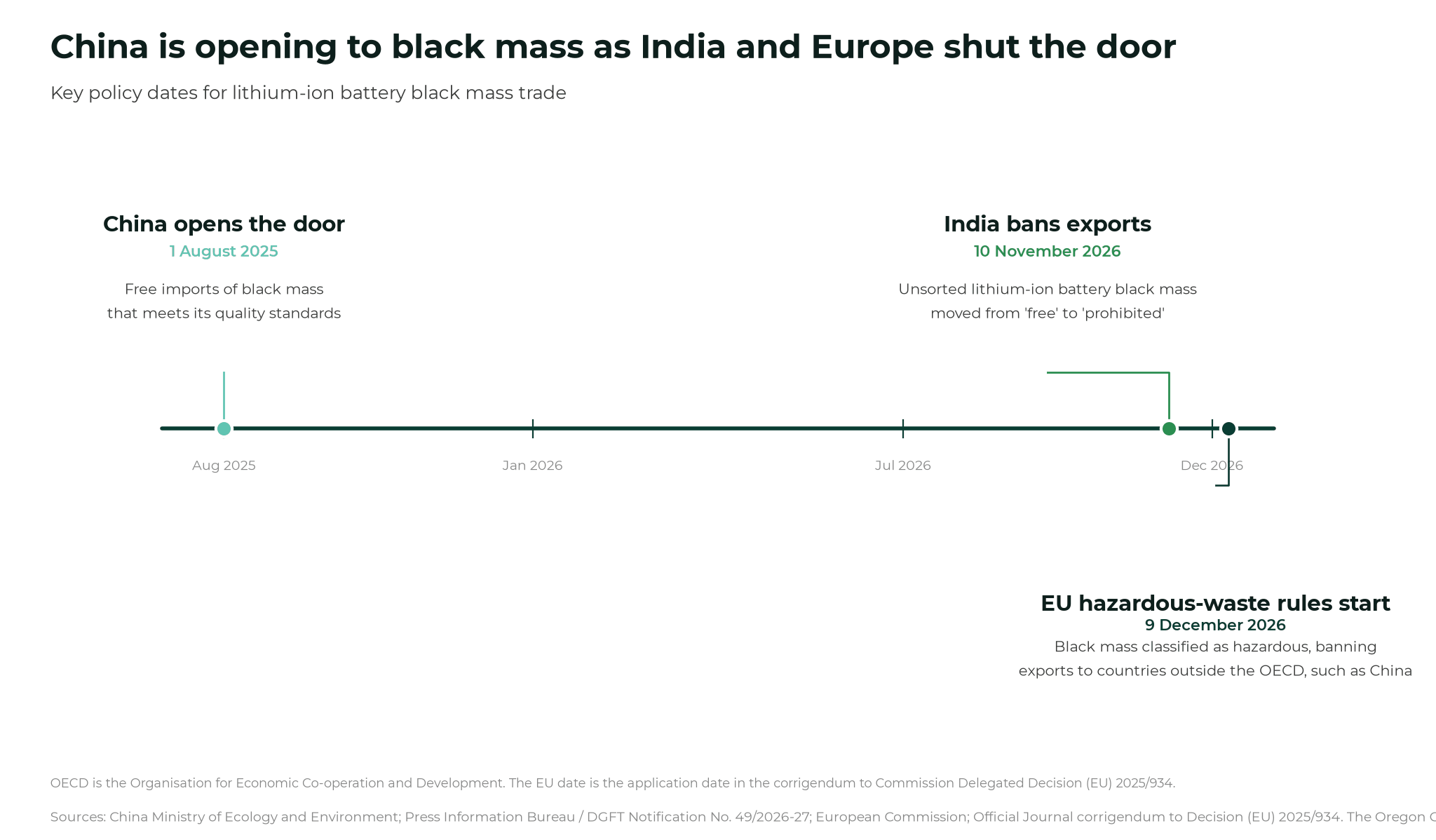
This all matters because it highlights how countries that lack mines are starting to treat scrap batteries like ore. China is trying to pull in recycled feed, while Europe, the US and now India are locking it inside their borders. For refiners outside China, that means more competition for a feedstock that used to move freely to whoever paid the most.
Conclusion
The losers are India’s shredders, who make up an estimated +80% of the country’s lithium-ion recycling industry, but are paid better prices by overseas refiners, with some claim Indian refineries paying about 2% less. Industry voices have warned that the shift could hand pricing power to a few domestic refiners.
There is also a gap further down the chain. India has practically no production of cathode active material, according to battery expert Dr SRS Prabaharan, so the cobalt and nickel salts its refiners recover may still have to be sold abroad. Enforcement has been a problem too: in 2025 customs officials were alerted to shredders exporting black mass under the wrong trade codes.
Unless India builds cathode plants that can use the lithium, nickel and cobalt its refiners recover, the ban may just move the export point one step down the value chain, from black mass to metal salts.