- on October 22, Benchmark Mineral Intelligence projected the world will need the equivalent of 134 new lithium mines by 2050, with electric vehicles driving 76% of demand
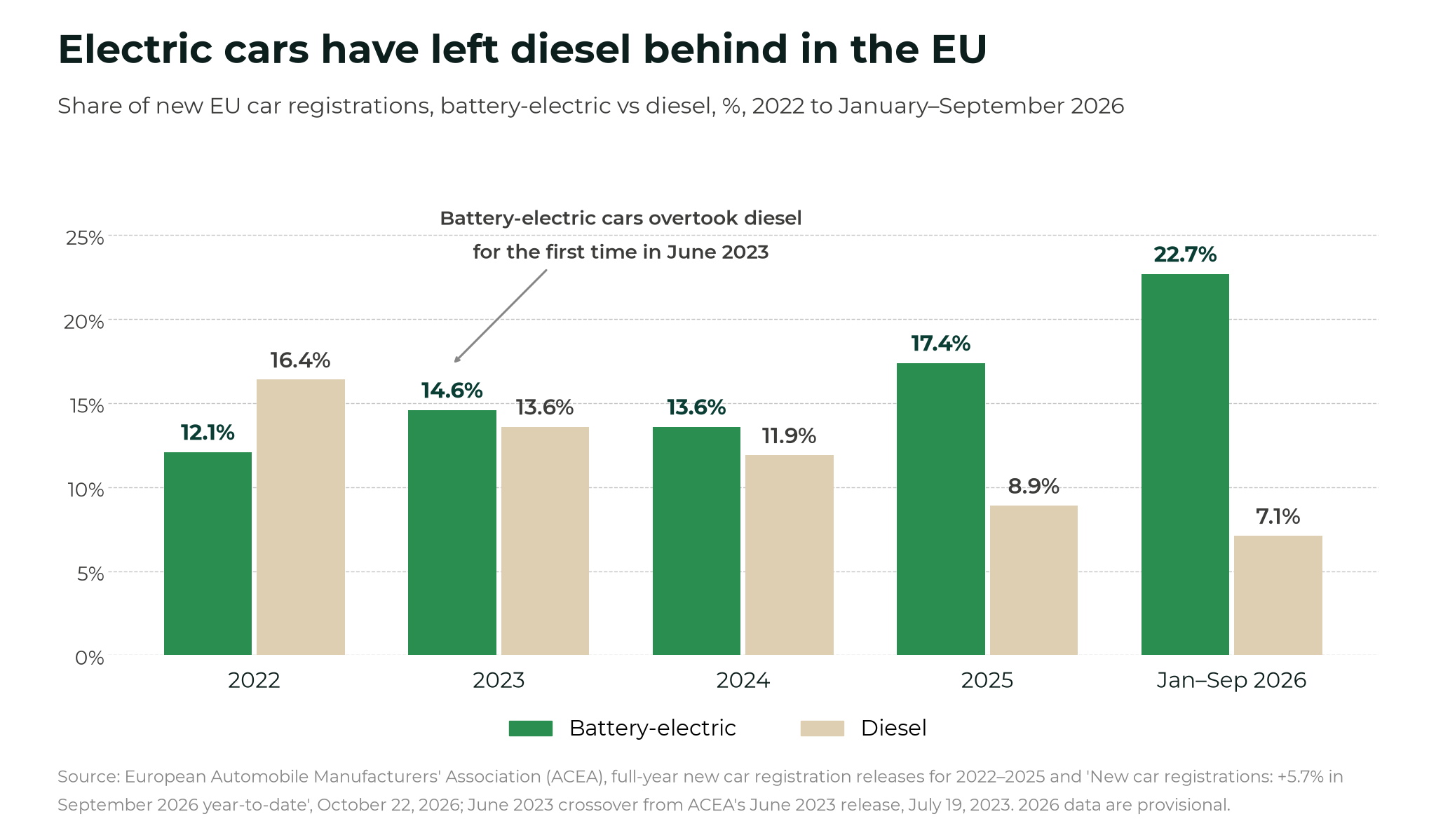
- battery-electric cars took 22.7% of new EU car registrations in January–September 2026, against 7.1% for diesel, according to the European Automobile Manufacturers’ Association
- the IEA calls lithium the fastest-growing critical mineral, with mined output needing to rise around 2.5 times by 2040 in its Stated Policies Scenario
The world will need at least 134 new lithium mines by 2050 — maybe more than 180 mines — to keep up with demand, according to Benchmark Mineral Intelligence, as electric vehicles take a growing share of the world’s lithium.
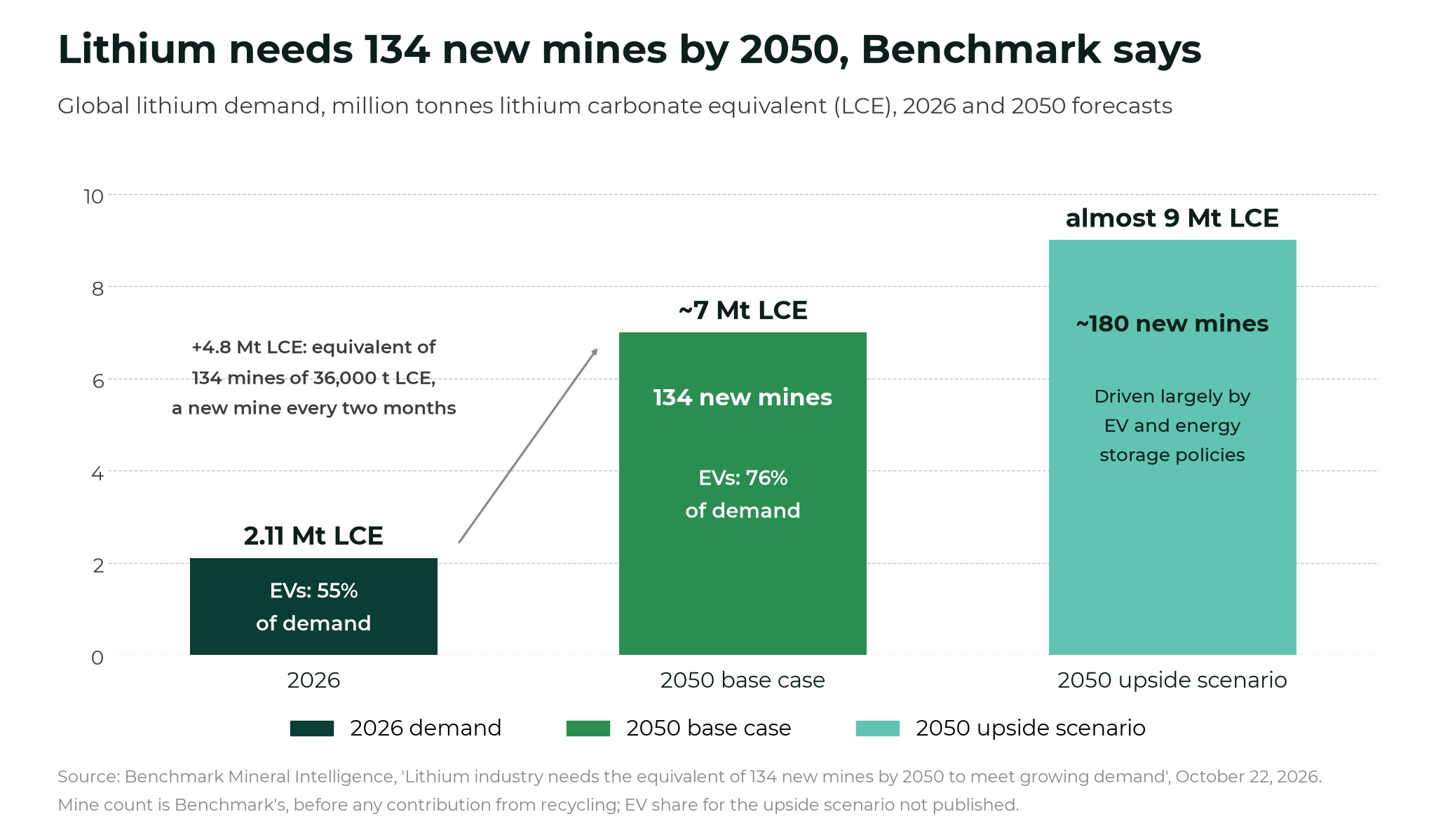
Benchmark forecasts global lithium demand will reach around 7 million tonnes of lithium carbonate equivalent (LCE) in 2050, up from 2.11 million tonnes in 2026 — more than triple.
At an average mine size of 36,000 tonnes LCE, it says that growth equals 134 new mines, “effectively a new mine every two months for the next 24 years”, with 44 of those mines needed between 2040 and 2050 alone.
What the 134-mine forecast is built on
Electric batteries are forecast to account for 92% of lithium demand in 2026, up from around 70% in 2020. In particular, electric vehicles account for 55% of demand today, and that is expected to rise to 76% by 2050.
Cameron Perks, Benchmark’s Product Director for Lithium said:
“Meeting 2050 demand requires the equivalent of 134 new lithium mines, more than US$100 billion of investment before any contribution from recycling, rising to more than 180 mines in our upside scenario.”
The upside scenario takes demand to almost 9 million tonnes LCE, driven largely by EV and energy storage policies worldwide and could require more than US$150 billion of investment, against more than US$100 billion for the 134 mines in the base case.
That upside scenario takes demand to almost 9 million tonnes LCE, driven largely by EV and energy storage policies worldwide,” and would need “well over US$150 billion,” Perks said.
Cameron Perks warns “even the base-case investment could prove conservative, depending on where the mines are built.”
Electric cars are already overtaking diesel
Europe shows how fast the electric vehicle share can move.
EV sales across the EU hit a record 1.64 million in January to August 2026, up 45% year on year, with electric cars taking 22% of the market. Notably, battery-electric cars outsold petrol cars over a full quarter for the first time in the second quarter of 2026.
In August, battery-electric registrations across the EU, EFTA and the UK reached 243,207, against 202,931 for petrol and diesel combined — the first time electric cars had outsold the two together.
Where the new supply has to come from
Benchmark expects the map of lithium mining to widen, for example:
- Australia’s share of mined supply falls from 29% in 2026 to 20% by 2050
- China’s share stays relatively stable at around 25%
- North America rises from 1.7% to 13%
- Europe rises from less than 1% to 5.5%
Does the IEA agree?
The IEA’s Global Critical Minerals Outlook 2026 calls lithium “the fastest-growing critical mineral.”
Lithium demand was 275,000 tonnes of lithium in 2025, with the IEA’s Stated Policies Scenario takes that to 932,000 tonnes in 2040 and 1.12 million tonnes in 2050, while its Current Policies Scenario reaches 828,000 tonnes in 2050.
Even after recycling, the IEA says mined output needs to increase by around 2.5 times by 2040 in its Stated Policies Scenario.
The call for more mines is not new, as we wrote in Inside the accelerating global race for lithium in January 2024:
“By the IEA’s estimate, the sector needs up to 50 new mines in less than a decade – a big ask considering the supply side dynamics.”
The investment test
Benchmark’s own warning is about investment, not geology:
“The biggest challenge is sustaining that investment through price cycles, while competing for capital with AI, defence and the wider energy transition,” Perks said.
That challenge is already visible as we highlighted in Over $750 billion needed for energy mineral supply to meet demand:
“Spending by battery-material companies dropped more than 20%, while lithium producers cut investment by around 40%.”
Conclusion
Benchmark’s base case calls for a new lithium mine every two months for 24 years, with EVs the main driver.
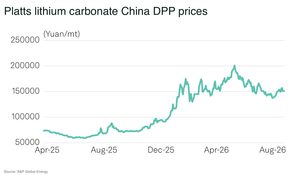
Europe’s registrations show that EV share can climb quickly, but today’s prices show how hard it is to fund new supply through a downturn.
The world needs a new lithium mine every two months, and today’s prices will not make that easy.