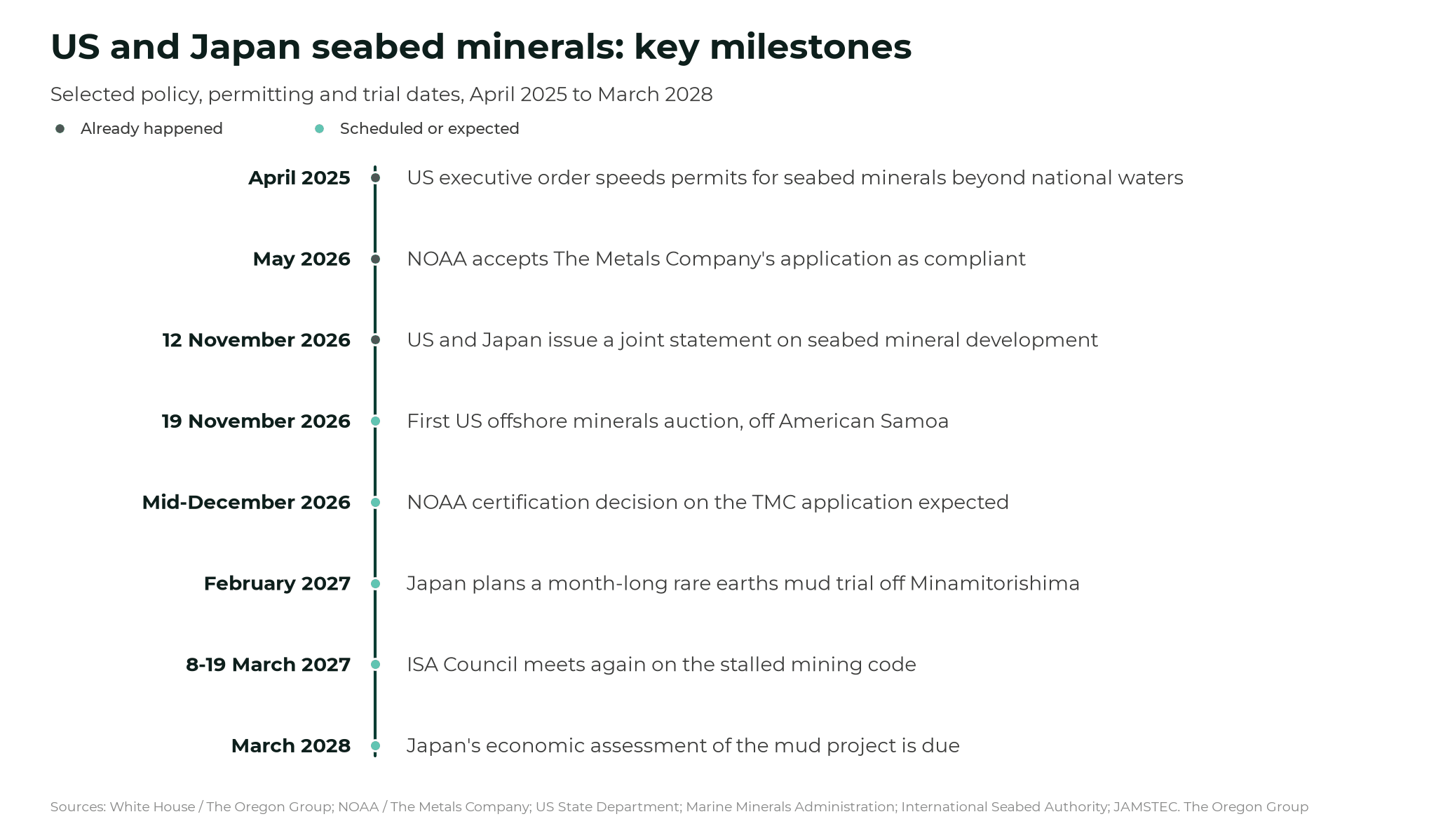
- the US and Japan issued a joint statement on November 12 on developing seabed minerals, including rare earth mud near Minamitorishima and polymetallic nodules, which hold nickel, cobalt, copper and manganese
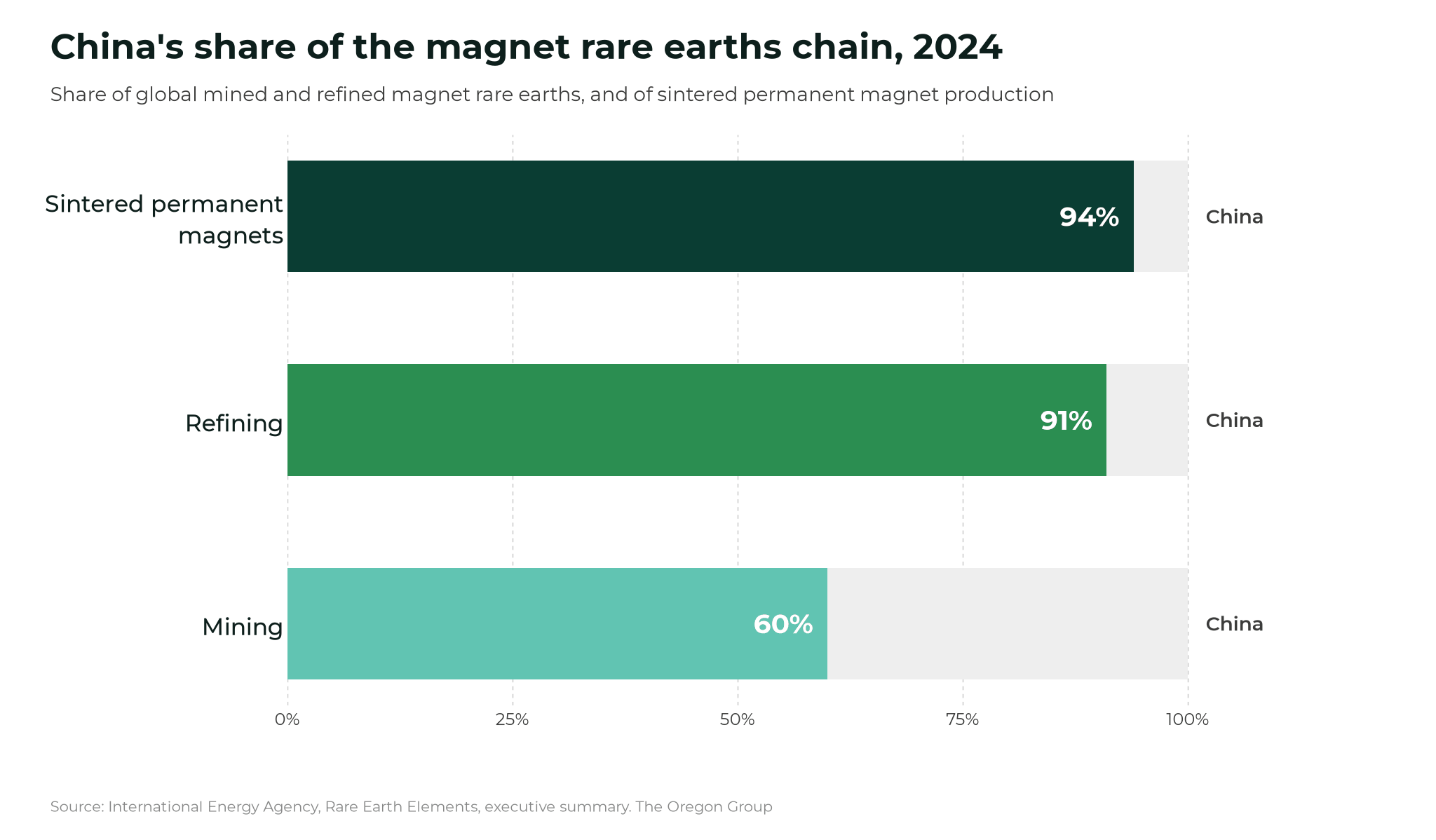
- China accounted for 91% of global refined magnet rare earths output in 2024, the metals used in magnets for electric vehicles, wind turbines and defence
- the first US offshore minerals auction, covering two tracts of 16.3 million and 15.2 million acres off American Samoa, is set for November 19 and already faces a lawsuit seeking to block the sale
The US and Japan have agreed to work together on seabed mining of rare earths and polymetallic nodules, even as United Nations rules for the international ocean floor remain unfinished.
The joint statement, issued on November 12 after two days of talks in Toyama, Japan, covers Japan’s rare earth mud project near Minamitorishima and its polymetallic nodules project, setting out plans for industry partnerships, processing among “trusted partners” and clearer national rules to attract private investment — but it gives no funding amounts, tonnages or deadlines.
A national route around unfinished UN rules
The two governments also want “complementarity between domestic and international regulatory regimes”.
In practice, the US and Japan are building a national-law path while the International Seabed Authority (ISA), the UN body that regulates mining beyond national waters, has still not adopted a mining code; for example, after talks in July, the ISA Council set no adoption date, and will meet again from March 8 to 19, 2027.
In particular, an April 2025 executive order told US agencies to speed up permits for seabed minerals beyond national waters and to work with allies in their own exclusive economic zones.
The first hard test of the US approach comes on November 19, when the Marine Minerals Administration auctions two tracts of 16.3 million and 15.2 million acres off American Samoa. A winning bid would only allow preliminary work such as mapping, not mining — but a council of matai from the Manu‘a Islands and community groups have already filed a lawsuit to block the sale, arguing the government lacks the authority to lease the area.
In international waters, The Metals Company is seeking a US permit under the Deep Seabed Hard Mineral Resources Act. In May, the National Oceanic and Atmospheric Administration (NOAA) accepted the company’s consolidated application as compliant, covering about 65,000 square kilometres in the Clarion-Clipperton Zone that TMC estimates hold 619 million tonnes of wet nodules, with 200 million tonnes of exploration upside.
NOAA now expects to decide only on certification by mid-December, after reviewing more than 1,600 public comments. Certification would be a finding that the company has the financial and technical capacity and a compliant plan, it would not be a licence or a permit.
Two ISA contractors owned by the company have already taken the Authority to the Seabed Disputes Chamber over a compliance inquiry. The US is not a party to the UN Law of the Sea treaty that created the ISA, but Japan is, but its Minamitorishima mud sits inside Japan’s exclusive economic zone, so the ISA does not govern that project.
Japan’s mud trial and a possible processing link
As we wrote last month, Japan was months from running out of yttrium after China cut oxide exports to the country by 97.7% in January-May — pushing Japan to look for alternative secure supply.
One way, is that Japan has already shown it can lift rare earth mud that contains the same metal: the drilling vessel Chikyu recovered about 50 metric tonnes of rare earth mud from 5,569 metres in a trial early this year — medium and heavy rare earths, including yttrium, gadolinium and dysprosium, made up about 54% of the rare earth content.
A month-long trial, targeted at 350 tonnes of mud a day, is planned from February 2027, with an economic assessment due by March 2028. As we wrote in July, in China’s rare earth restrictions push Japan to mine the Pacific seabed:
“The deep-sea mining project plans to extract mineral resources from the ocean floor, but, for now, remains an experimental operation, not a commercial mine.”
The Metals Company has said it may lean on its five-year partnership with Pacific Metals Company and that company’s plant in Hachinohe, Japan, if its Texas plant is not ready in time, though plant modifications are still being worked through.
Separately, Impossible Metals said on November 9 that its autonomous robot selectively recovered about 450 grams of nodules from more than 4,000 metres on a scientific dive in the Clarion-Clipperton Zone.
That matters because China accounted for 91% of global refined magnet rare earths output in 2024, including metals, including neodymium, praseodymium, dysprosium and terbium, go into magnets for electric vehicles, wind turbines and defence — but has in the last few years started to leverage export restrictions.
The risks to watch
The American Samoa auction could be delayed or blocked in court, and NOAA certification would still leave a full environmental review before any commercial permit. Japan’s next mud trial is not until February 2027, and plant modifications for processing in Hachinohe are still being worked through.
But, as we highlighted in our article two years ago, the signals are clear: Deep-sea mining is coming, whether the environmental lobby like it or not.