- the US Department of Energy has added helium to its Critical Material List on October 23, 2026, calling it “non-substitutable” for semiconductor manufacturing, quantum computing and natural-gas leak testing
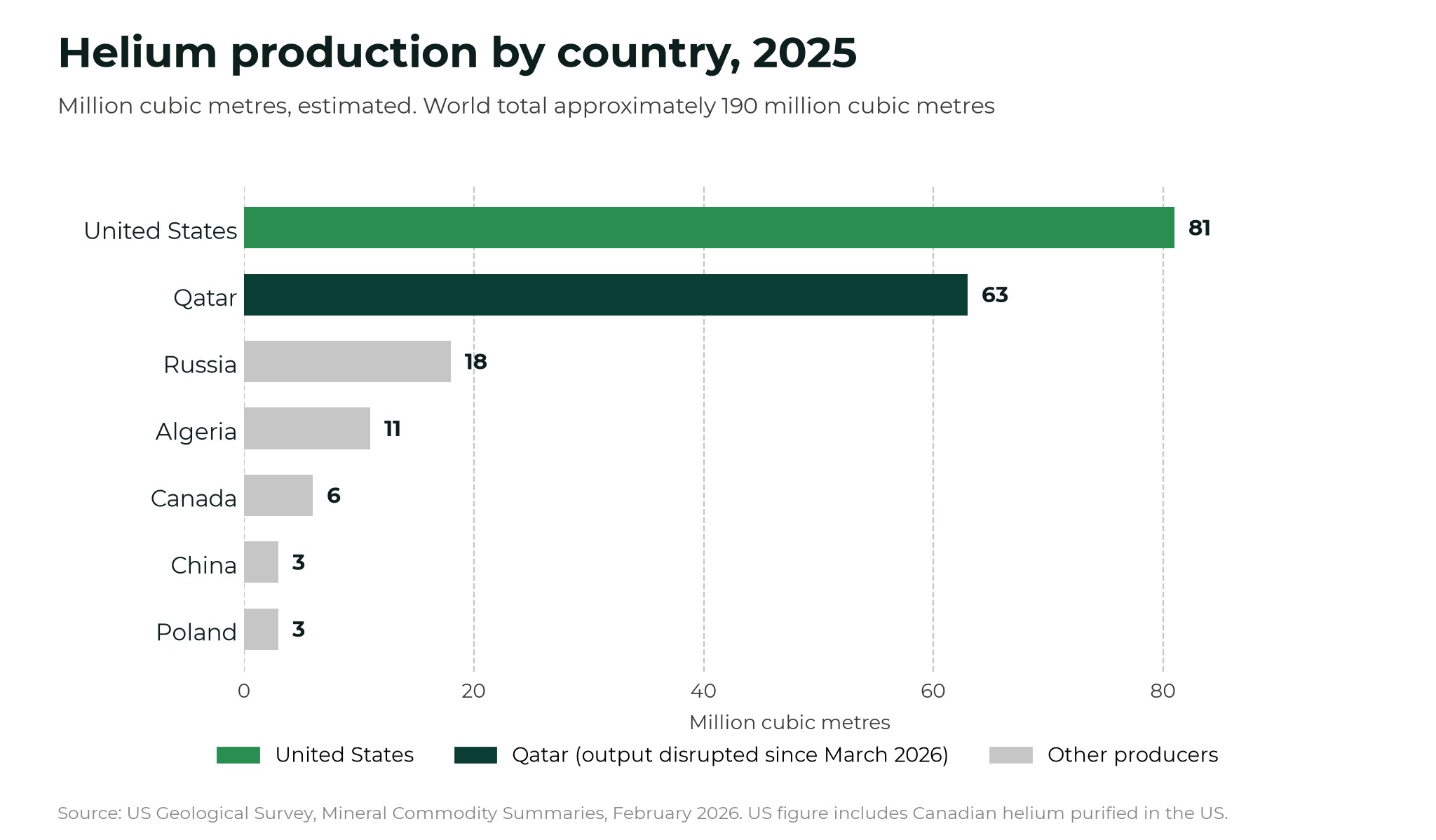
- the US produced an estimated 81 million cubic metres of helium in 2025, the world’s largest output, against 63 million cubic metres from Qatar
The US Department of Energy has added helium to its Critical Material List, calling the gas “non-substitutable” for semiconductor manufacturing, quantum computing and leak testing natural-gas infrastructure.
The announcement comes after Iranian strikes on Qatar’s Ras Laffan complex in March removed roughly 30% to 35% of the world’s helium supply.
The Federal Register notice makes helium a “critical material” under the Energy Act of 2020, with the Department of Energy framing the need as global, not just American. Its assessment, the notice says, “concludes that helium is needed globally for semiconductor manufacturing and other key energy applications.”
The link to AI is explicit. The notice says building US “SI” (Super Intelligence, or Artificial Intelligence) infrastructure will require expansion of semiconductor production.
Audrey Robertson, the Assistant Secretary of Energy, put the risk bluntly in an interview with AP:
“Helium is one of those components that could be a single point of failure, where we cannot let that happen.”
Why is helium important?
Most popularly known for filling party balloons, helium is essential across significant growth industries, particularly as it’s use as a super coolant, including:
- medical, eg to cool the superconducting magnets in MRI scanners (there is no substitute for helium in cryogenic uses requiring temperatures below minus 429°F, which is why it remains essential in MRI and other superconducting applications)
- military equipment, eg air-to-air missile guidance systems
- high-tech manufacturing, eg fibre optic cables
- space rockets, eg liquid fuel rockets to separate hot gases and ultra-cold liquid fuel during lift-off; for example, NASA is one of the biggest consumers of helium in the world, buying 1.4 million liters of liquid helium and 87.7 million standard cubic feet of gaseous helium in 2022
- semiconductors and scientific research, eg as a “superfluid” in quantum computing

See our analysis: Helium crisis puts US in control of semiconductor supply chain
Washington sold its cushion
The timing is awkward as the US Geological Survey put helium on its 2018 critical minerals list, but later lists omitted it because domestic supply was considered secure. Then, in June 2024, the Bureau of Land Management completed the sale of the Federal Helium System to industrial gas company Messer, for bids totalling US$423.35 million. The USGS now lists the US government helium stockpile as “None”.
Meanwhile, the global market has tightened from several directions, for example:
- Iranian attacks on March 2, 18 and 19 damaged two LNG trains feeding Qatar’s helium plants, and QatarEnergy said repairs could take three to four years
- Russia, the third-largest producer, made helium exports outside the Eurasian Economic Union subject to government approval until the end of 2027 from April 14
- long-term helium contracts have risen 40% to 60%, on top of tripled spot prices
That leaves the US as the world’s swing supplier, producing 43% of global supply in 2025 and exporting 38 million cubic metres.
Chipmakers in Korea, Taiwan and Singapore immediately started looking towards the US when Qatar went down, former Air Liquide executive Rich Brooke told CBS’s 60 Minutes on October 18.
As we reported in Helium crisis puts US in control of semiconductor supply chain:
“While policymakers in Washington worry about the security of critical mineral supply chains (such as copper or nickel or rare earths), the US helium industry faces a different dynamic: its primary competitor has effectively been removed from the market — and prices are rising.”
A label, not a cheque
However, the designation does not, on its own, add supply. It does not provide new funding or speed up permitting, although it should support more federal financing available to producers.
The Department of Energy itself says “limited refining capacity and lengthy permitting timelines continue to constrain US production.”
QatarEnergy has suggested it could restore full production in several weeks if the Strait of Hormuz reopened — but developers face their own doubts; for example, at gasworld’s Helium Super Summit in Houston this week, 56% of delegates surveyed predicted only a minority of new projects would reach commercial operation.
Washington has now added helium to its critical list. The harder test is whether new (US) plants can be permitted and built in time to secure supply.