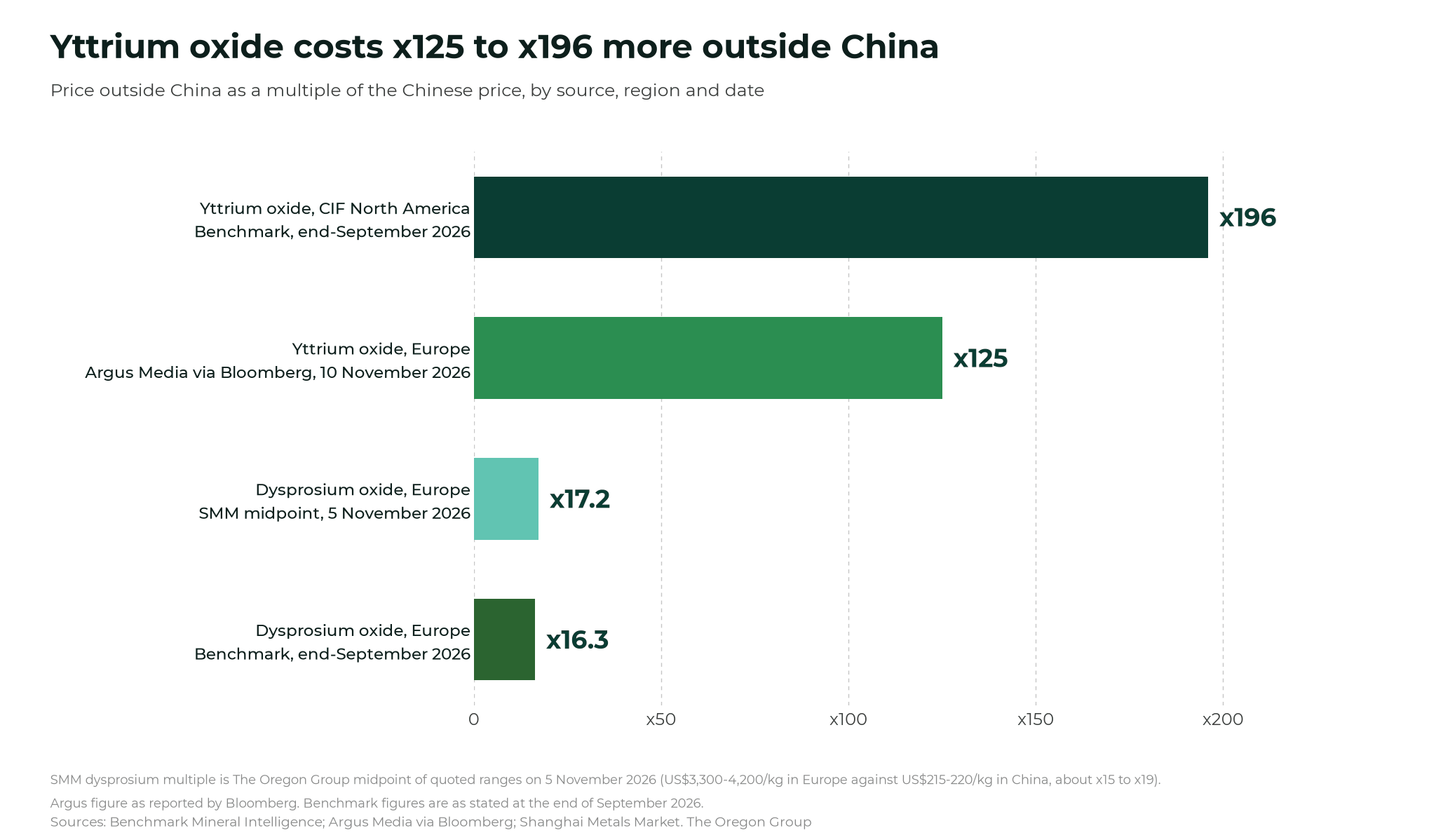
- yttrium oxide costs about US$1.15 million a tonne in Europe against US$9,144 in China, roughly x125 more, according to Argus Media prices reported by Bloomberg, while Benchmark put North American yttrium oxide at about x196 the Chinese price at the end of September
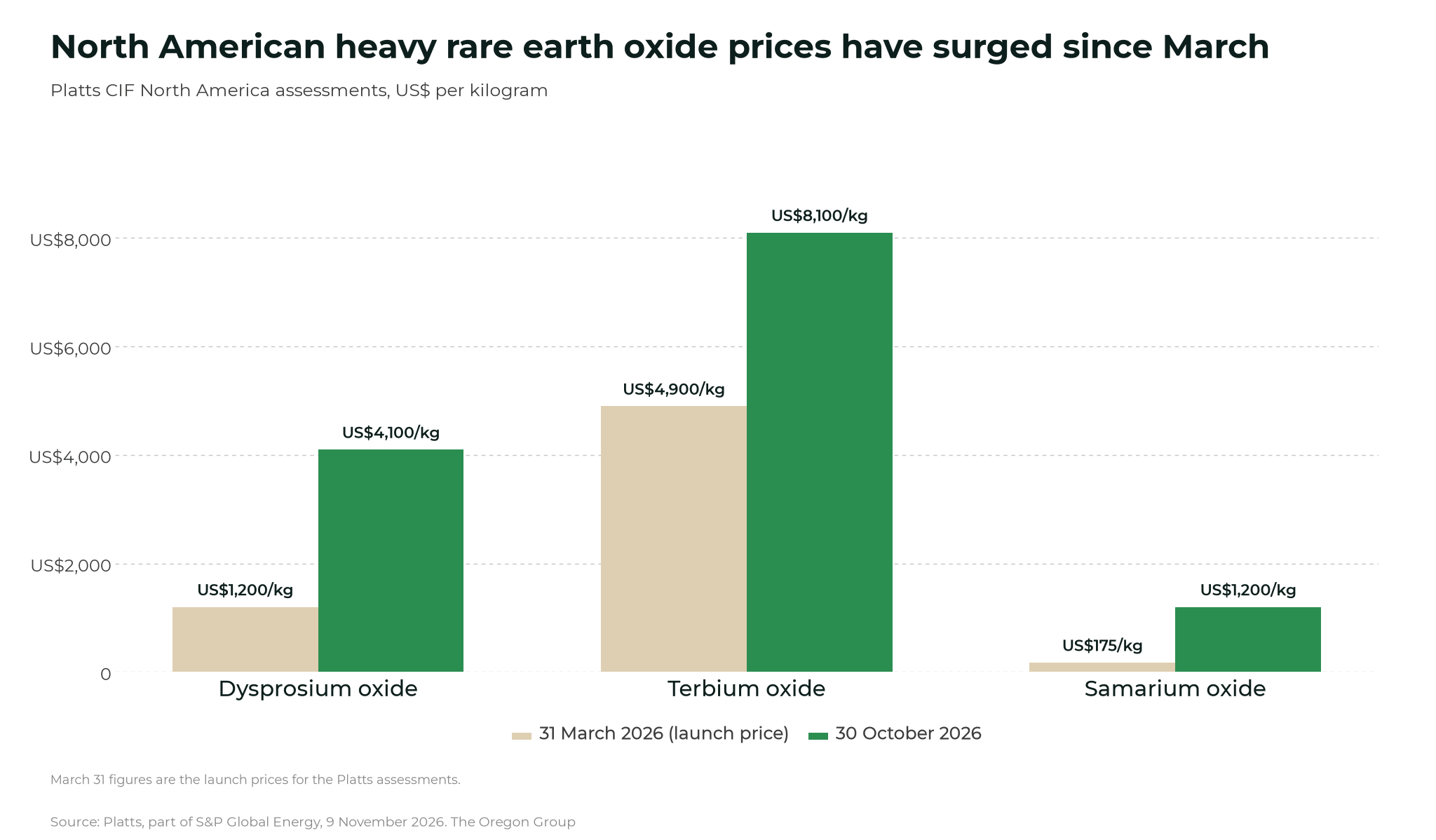
- Shanghai Metals Market quoted European dysprosium oxide at US$3,300-4,200/kg on November 5, against US$215-220/kg in China, about x15 to x19, and Platts assessed dysprosium oxide in North America at US$4,100/kg on October 30, with terbium oxide at US$8,100/kg
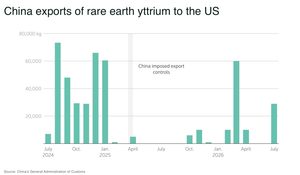
- China exported 934 tonnes of yttrium oxide in January-September 2026, 26% less than a year earlier, with only 18 tonnes going to Japan, down 98%, according to customs data reported by Kyodo and Mysteel, and China’s pause on a wider set of export controls leaves its April 2025 curbs on seven heavy rare earths, including yttrium, dysprosium and terbium, in force
Yttrium oxide now costs at least x125 more in Europe than in China, as Beijing’s export restrictions on heavy rare earths split the market in two.
A metric tonne of the oxide costs about US$1.15 million in Europe, compared with US$9,144 in China, according to Argus Media prices reported by Bloomberg. Supplies inside China remain substantial and, before the curbs, prices around the world were only slightly higher than in China.
The gap comes after China extended its pause on a wider set of rare earth export controls until January 10, 2027 — but that extension does not touch the metals behind the price gap. Controls introduced in April 2025 on samarium, gadolinium, terbium, dysprosium, lutetium, scandium and yttrium remain in effect, and exporters still need a licence.
How wide is the gap?
The price difference may be even higher, with Benchmark putting North American yttrium oxide at about x196 the Chinese price at the end of September 2026.
Dysprosium, which keeps magnets working at high temperatures, shows a similar split: on November 5, Shanghai Metals Market quoted European dysprosium oxide at US$3,300-4,200/kg, against US$215-220/kg in China, about x15 to x19. Benchmark had already put European dysprosium oxide at around x16.3 the Chinese price at the end of September, up from x6.8 at the end of June.
The chart below shows those multiples, by source and date:
In North America, the story is the same, with Platts, part of S&P Global Energy, assessing dysprosium oxide in North America at US$4,100/kg on October 30, up from US$1,200/kg when the assessment was launched on March 31. Terbium oxide rose from US$4,900/kg to US$8,100/kg over the same period, and samarium oxide from US$175/kg to US$1,200/kg.
The chart below shows those Platts assessments on March 31 and October 30:
The prices reflect a real shortage of material, not just speculation.
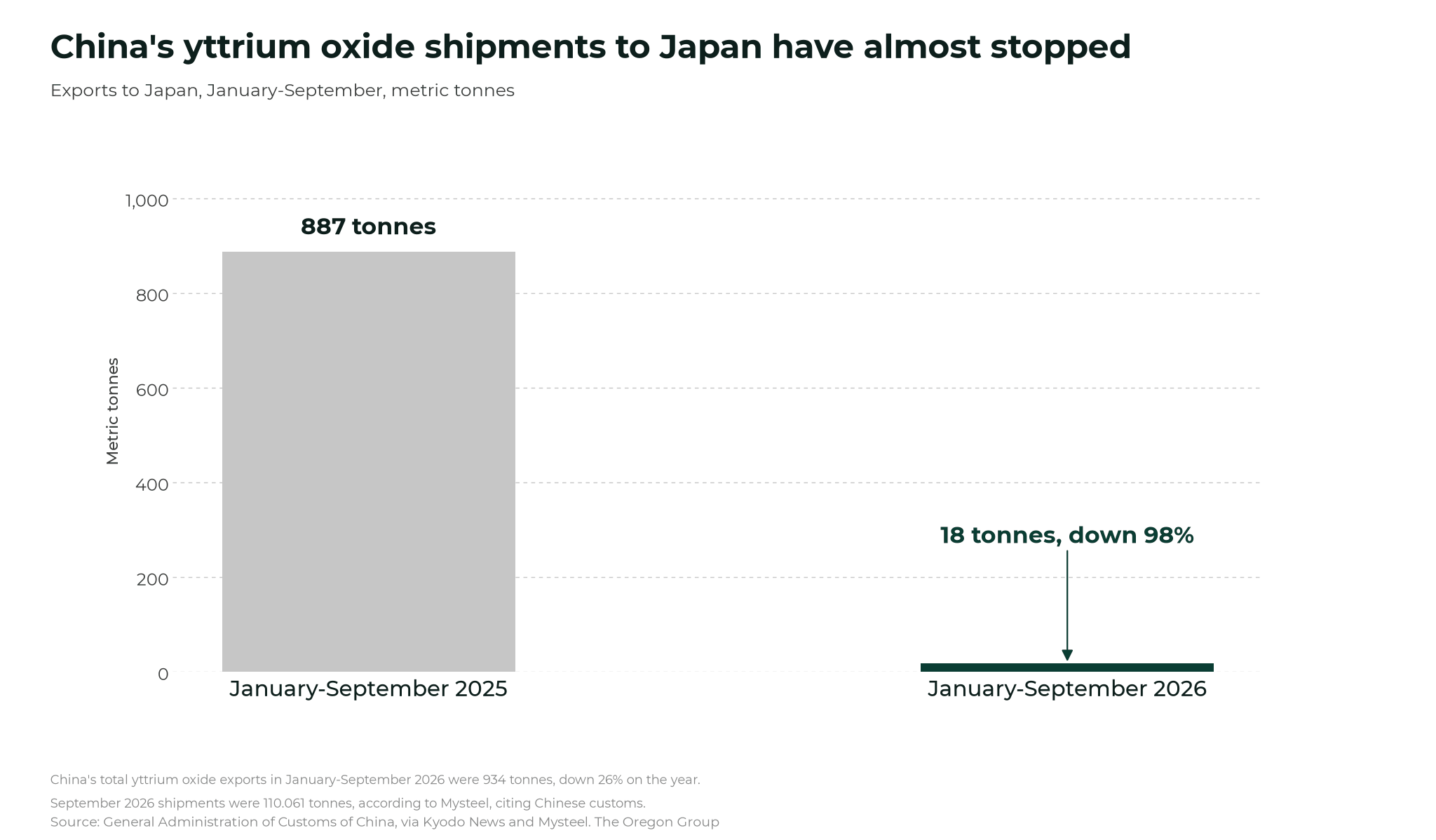
China exported 934 tonnes of yttrium oxide in January-September 2026, 26% less than a year earlier, according to customs data reported by Kyodo. Only 18 tonnes went to Japan, down 98% from 887 tonnes in the same period of 2025. Mysteel, citing the General Administration of Customs, recorded 110.061 tonnes in September alone.
The chart below shows China’s yttrium oxide exports to Japan in the first nine months of 2025 and 2026:
Why yttrium matters
Yttrium is used in semiconductors and coats the blades of gas and jet-engine turbines, so the squeeze reaches across defence, aerospace and the power supply for artificial intelligence data centres.
Most mined yttrium still comes from China, despite efforts by the US to support a secure, ex-China supply. For example, Lynas Rare Earths is expanding heavy rare earth production at its Malaysian plant, but yttrium is sequenced after gadolinium and is not yet in production.
Project Blue research director David Merriman warned that little relief is coming soon:
“Within the next year or two, really there is very limited ex-China supply which is going to be available”
The Pentagon’s ban on Chinese rare earths in defence supply chains starts on January 1, and the US has already warned Beijing that it has delivered only two-thirds of its commitments. Japan has already seen the squeeze, as we reported.
The price signal cuts both ways
The squeeze is in heavy rare earths, not the whole market.
Outside China, prices for praseodymium-neodymium oxide, the main light rare earth used in magnets, fell below the US$110/kg floor set in MP Materials’ and Lynas’s agreements with the US Department of Defense during the third quarter, as producers outside China redirected volumes into an oversupplied market.
High heavy rare earth prices may also attract new supply. Benchmark’s forecasters say the premium outside China on dysprosium and terbium is “the economic signal required to bring new heavy rare earth capacity online”.