
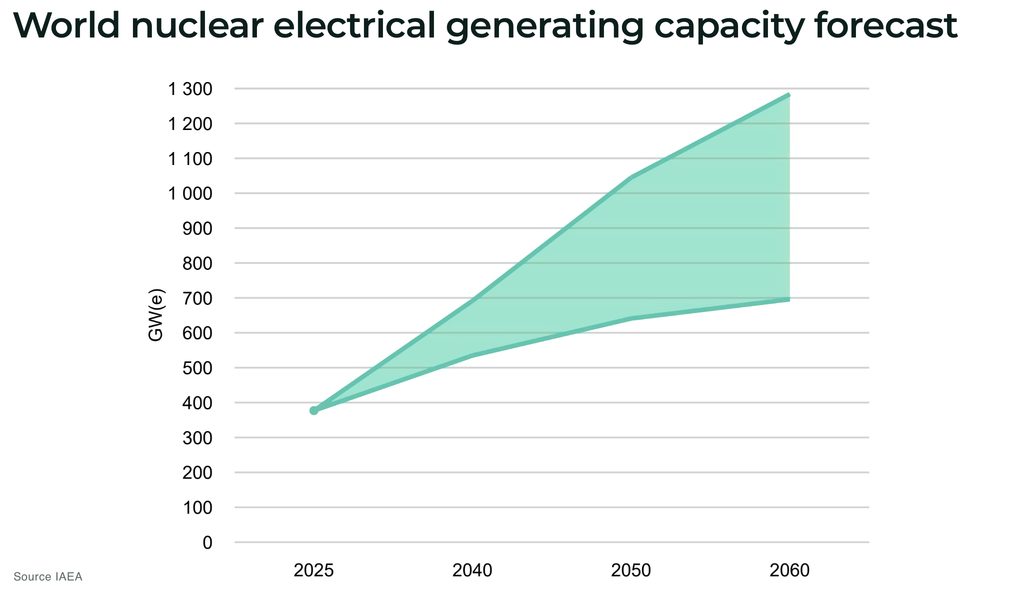
- the IAEA projects 641–1,045 GW of nuclear capacity by 2050, raising both its low and high estimates
- the “Red Book” identifies more than 8.1 million tonnes of recoverable uranium resources, sufficient for its projected demand through 2050
- at 85% utilisation, even the expanded mine pipeline falls below high-case reactor requirements around 2031, leaving a role for secondary supplies and further investment
Annual uranium mine supply could fall approx 46,000 tonnes below reactor requirements by 2040 under a high-demand scenario, equivalent to 41% of projected needs, The Oregon Group calculations from the new OECD-NEA and IAEA Red Book show.
The calculation includes planned and prospective mines operating at 85% of nominal capacity. It puts annual mine output at approximately 65,000 tonnes against reactor requirements of 110,700 tonnes. Under the report’s lower-demand scenario, the same production pipeline leaves an annual gap of approximately 18,000 tonnes.
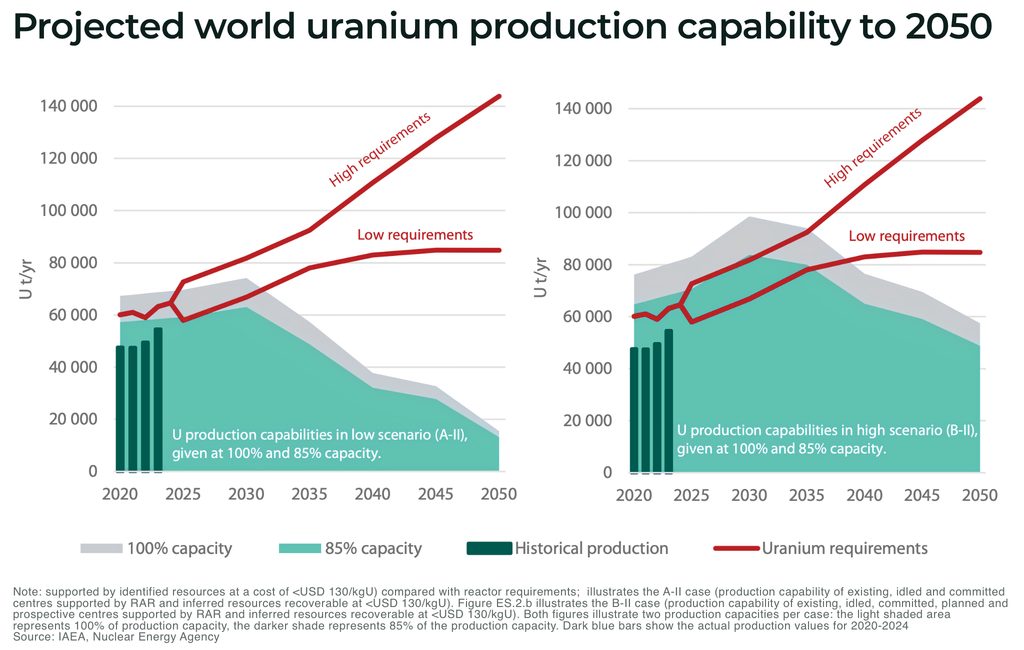
The figures exclude inventories and other secondary supplies. They measure the difference between the assessed mine pipeline and reactor requirements, rather than forecasting an unavoidable fuel shortage.
But the investment challenge extends across both demand scenarios: additional uranium will need to come from secondary sources, better-performing operations or projects beyond the assessed pipeline. That comes as the IAEA raises its nuclear capacity outlook, increasing the scale of the industry’s potential fuel requirements.
Nuclear forecasts rise by up to 14%
The IAEA now projects 641–1,045 GW of nuclear capacity by 2050, up from 561–992 GW in last year’s assessment. The conservative estimate rises approximately 14%, while the upper estimate increases 5%.
Its annual outlook also extends to 2060 for the first time. By then, nuclear capacity could reach 696–1,284 GW, compared with 377 GW operating at the end of 2025. The high case would more than triple the operating fleet’s capacity.
Small modular reactors account for 23–28% of new capacity added through 2060, depending on the scenario. Lifetime extensions are another major variable: 46% of operating nuclear capacity is already at least 40 years old.
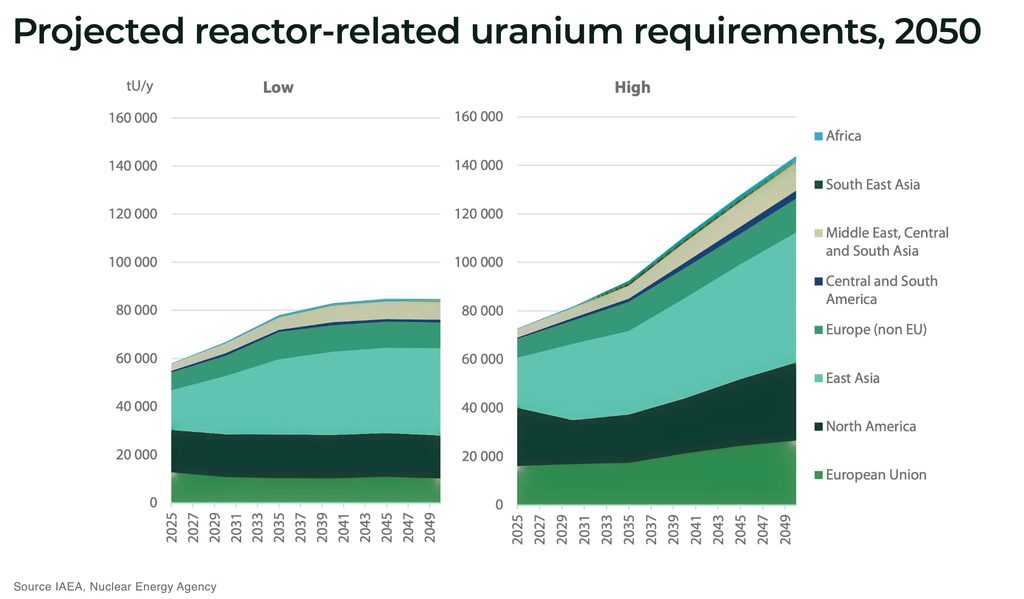
The Red Book separately projects annual uranium requirements rising from roughly 64,500 tonnes in 2024 to 84,800–143,900 tonnes by 2050. East Asia, driven by China’s reactor expansion, becomes the largest consuming region.
Those uranium estimates correspond to 565–916 GW of nuclear capacity in 2050, below the IAEA annual outlook’s range. The two reports therefore point towards expansion using different scenarios; their capacity and fuel-demand estimates should not be treated as a single forecast.
The mine pipeline needs more than restarts
Uranium production is already recovering. Global mine output reached 61,924 tonnes in 2024, covering approximately 96% of reactor requirements, compared with about 85% in 2022.
Combined production in 2023–2024 was approximately 20% higher than in the preceding two years. Restarts and expansions supplied much of the increase, including renewed Canadian output and the return of Langer Heinrich in Namibia and Honeymoon in Australia.
The longer-term problem is replacing depleted production while meeting additional demand. The Red Book’s expanded pipeline already includes mines that are planned or prospective but not firmly committed. Even so, its projected nominal capacity declines from 94,075 tonnes annually in 2035 to 76,485 tonnes in 2040.
The 85% operating assumption reduces those figures further. It reflects the report’s observation that actual mine output typically falls below stated capacity. At full nominal capacity, the calculated 2040 gap would still be approximately 6,500–34,300 tonnes across the two demand cases, before secondary supplies.
Restart opportunities offer some relief, but cannot be assumed to deliver their full listed output. The Red Book identifies approximately 11,750 tonnes of annual idled capacity beyond operations already restarting or firmly committed to restart. It cautions that only part may return, potentially at reduced rates, because prolonged shutdowns complicate rehabilitation and increase costs.
Resources are sufficient; developing them takes time
The Red Book identifies more than 8.1 million tonnes of uranium recoverable below US$260 per kilogram, sufficient to meet its demand projections through 2050.
That resource total is broader than the mine-capability projections, which principally cover identified resources recoverable below US$130/kgU. The calculated gaps therefore do not imply geological scarcity or rule out additional, higher-cost production.
The constraint is converting deposits into dependable supply. The NEA puts the typical interval between discovery and production at 15–20 years, making financing, permitting and development decisions increasingly important to the next decade’s output.
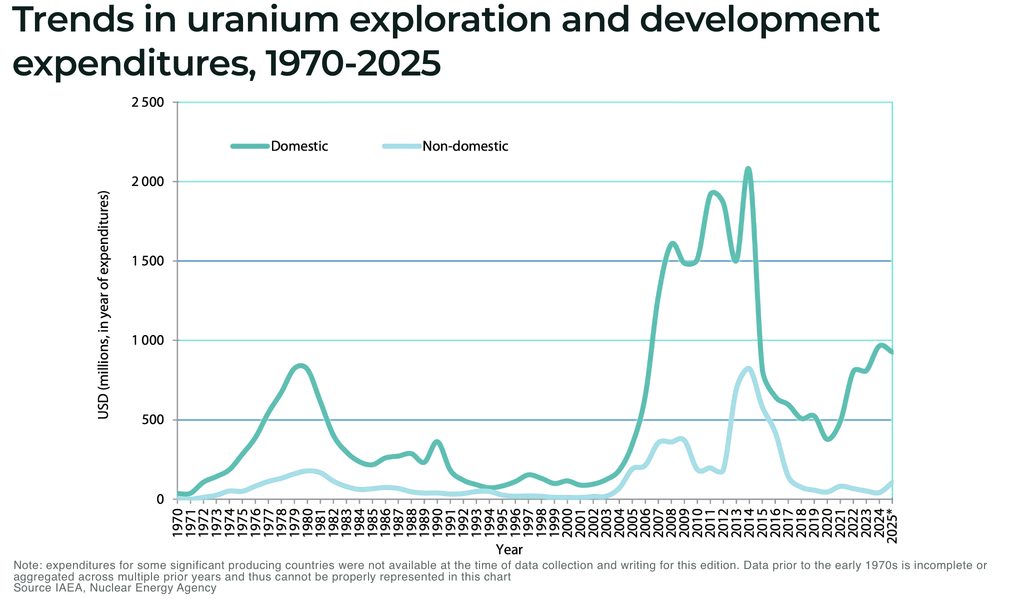
Exploration and development expenditure exceeded US$1.78 billion in 2023–2024, up approximately 46% from the preceding two-year period. However, drilling specifically directed towards project development remained relatively stagnant.
Geopolitical exposure adds another complication. Kazakhstan, Canada, Namibia, Australia and Uzbekistan accounted for nearly 90% of production in 2023–2024. Technical setbacks, permitting delays or disruptions in a major producing country can therefore affect a concentrated supply base.
These findings reinforce the delivery challenges explored in The Oregon Group’s coverage of Canada’s uranium exports and efforts to rebuild US uranium production.
Contracts will determine what gets built
Secondary supplies remain an important buffer, but their future availability is uncertain. The Red Book cites an estimate of 5,000–6,000 tonnes annually by 2040, while acknowledging limited visibility into stockpiles. That figure should not be treated as a guaranteed volume available to every buyer.
Higher prices could encourage additional production, while slower reactor deployment would reduce requirements. The report’s comparisons do not fully model those market responses, so the calculated shortfall is an investment signal rather than a fixed outcome.
For investors, the decisive milestones are long-term supply contracts, final investment decisions, construction and demonstrated production. The NEA identifies sustained prices supported by long-term contracts as critical to bringing new mines into operation.
The opportunity lies in projects that can turn sufficient resources into reliable deliveries before an expanding reactor fleet needs them.
Q&A
Is there enough uranium for nuclear expansion?
The Red Book finds sufficient identified resources for its demand scenarios through 2050, provided investment brings them into production.
How much could nuclear capacity grow?
The IAEA projects 696–1,284 GW by 2060, compared with 377 GW operating at the end of 2025.
Does the Red Book predict a uranium shortage in 2031?
Its expanded mine scenario falls below high-case reactor requirements around 2031 at 85% utilisation. That comparison excludes secondary supplies and does not establish an unavoidable fuel shortage.